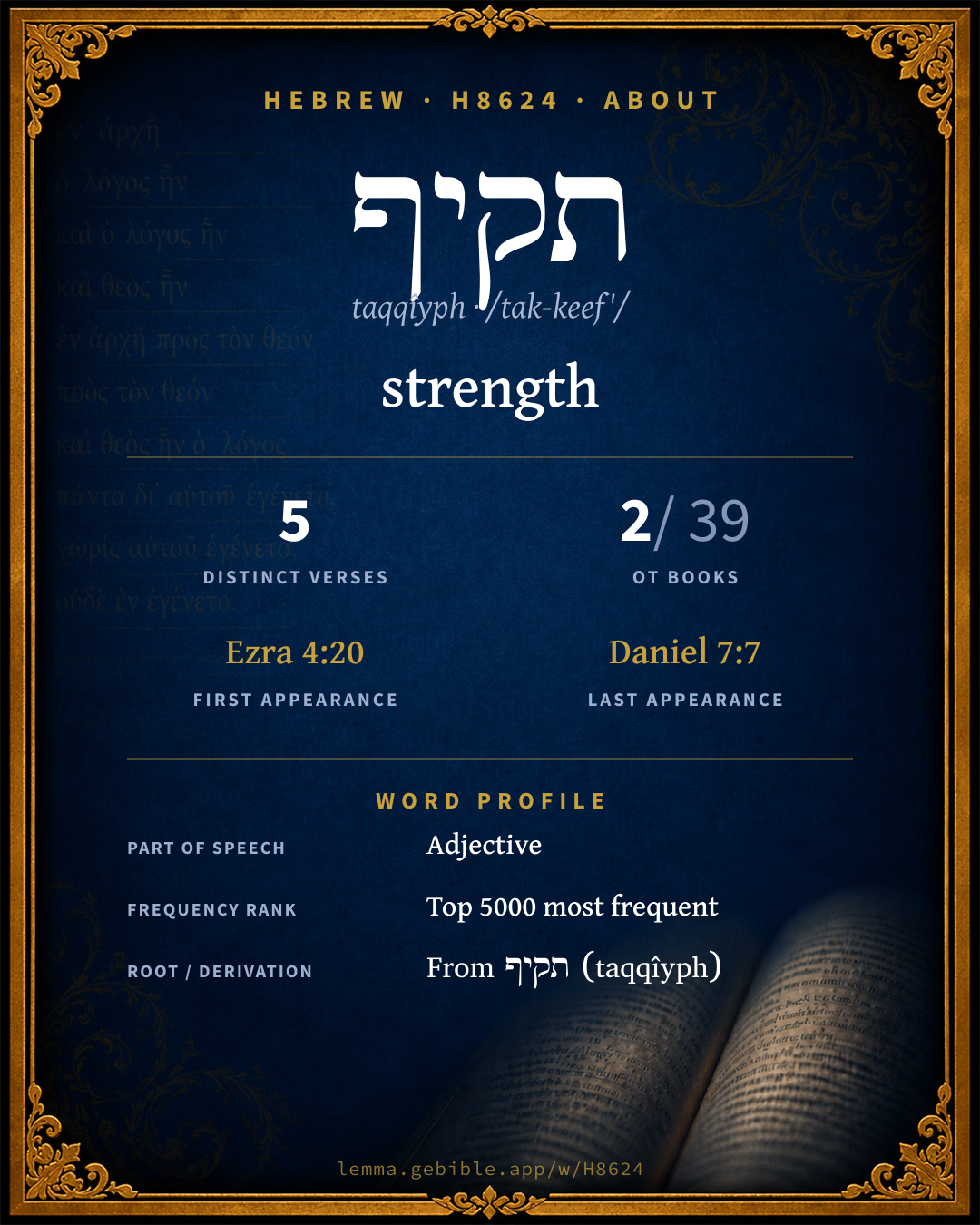
תַּקִּיף
strength
Full lexicon entry — Brown-Driver-Briggs (BDB)
From Brown-Driver-Briggs (BDB)
Where this word appears
Grammar key — what these labels mean
Part of speech
- Adjective
- A word that describes or qualifies a noun.
State
- Absolute
- The independent form of a noun, not bound to a following word.
Gender
- Feminine
- Grammatically feminine.
- Masculine
- Grammatically masculine.
Number
- Singular
- One.
- Plural
- More than one (in Hebrew, generally three or more).
Grammatical forms
- Adjective, Adjective, Feminine, Singular, Absolute 3 times (60%)
- Adjective, Adjective, Masculine, Plural, Absolute 2 times (40%)
Parsed forms decoded from the imported morphology (morphhb / Westminster Leningrad Codex — WLC text public domain, morphhb tagging CC BY 4.0), counted across 5 parsed occurrences — not distinct verses.
Every verse where H8624 appears — 5 distinct verses across 2 books. Click any verse to open its interlinear word-by-word view. Verse text shown in the World English Bible for context — . Each verse’s Hebrew form is shown with its reference; the English is not keyword-highlighted, since the data carries no word-level English alignment. Use “Compare translations” on any verse to read it across multiple English versions. This concordance covers the Hebrew Bible; Septuagint (Greek Old Testament) occurrences are not indexed here.
Ezra 1 verse
Daniel 4 verses
- Daniel 2:40 תַקִּיפָ֖ה adj Adjective fs The fourth kingdom shall be strong as iron, because iron breaks in pieces and subdues all things; and as iron that crushes all these, shall it break in pieces and crush.
- Daniel 2:42 תַקִּיפָ֔ה adj Adjective fs As the toes of the feet were part of iron, and part of clay, so the kingdom shall be partly strong, and partly broken.
- Daniel 4:3 תַקִּיפִ֑ין adj Adjective mp How great are his signs! and how mighty are his wonders! his kingdom is an everlasting kingdom, and his dominion is from generation to generation.
- Daniel 7:7 וְ/תַקִּיפָ֜א conj + Adjective Adjective fs After this I saw in the night-visions, and, behold, a fourth animal, awesome and powerful, and strong exceedingly; and it had great iron teeth; it devoured and broke in pieces, and stamped the residue with its feet: and it was diverse from all the animals that were before it; and it had ten horns.
About this entry
At a glance — auto-summarized from this page’s data, not written by a person. Every figure links to its source below. This summary describes the numbers; it doesn’t interpret them.
“strength” is the headline sense of the Hebrew adjective תקיף (taqqîyph). With only 5 verses it sits in the long tail of Hebrew Bible vocabulary. More than three-quarters of its appearances fall in Daniel. Scripture first uses it in Ezra 4:20. See the sense tree, 5-verse concordance, and the renderings breakdown below.
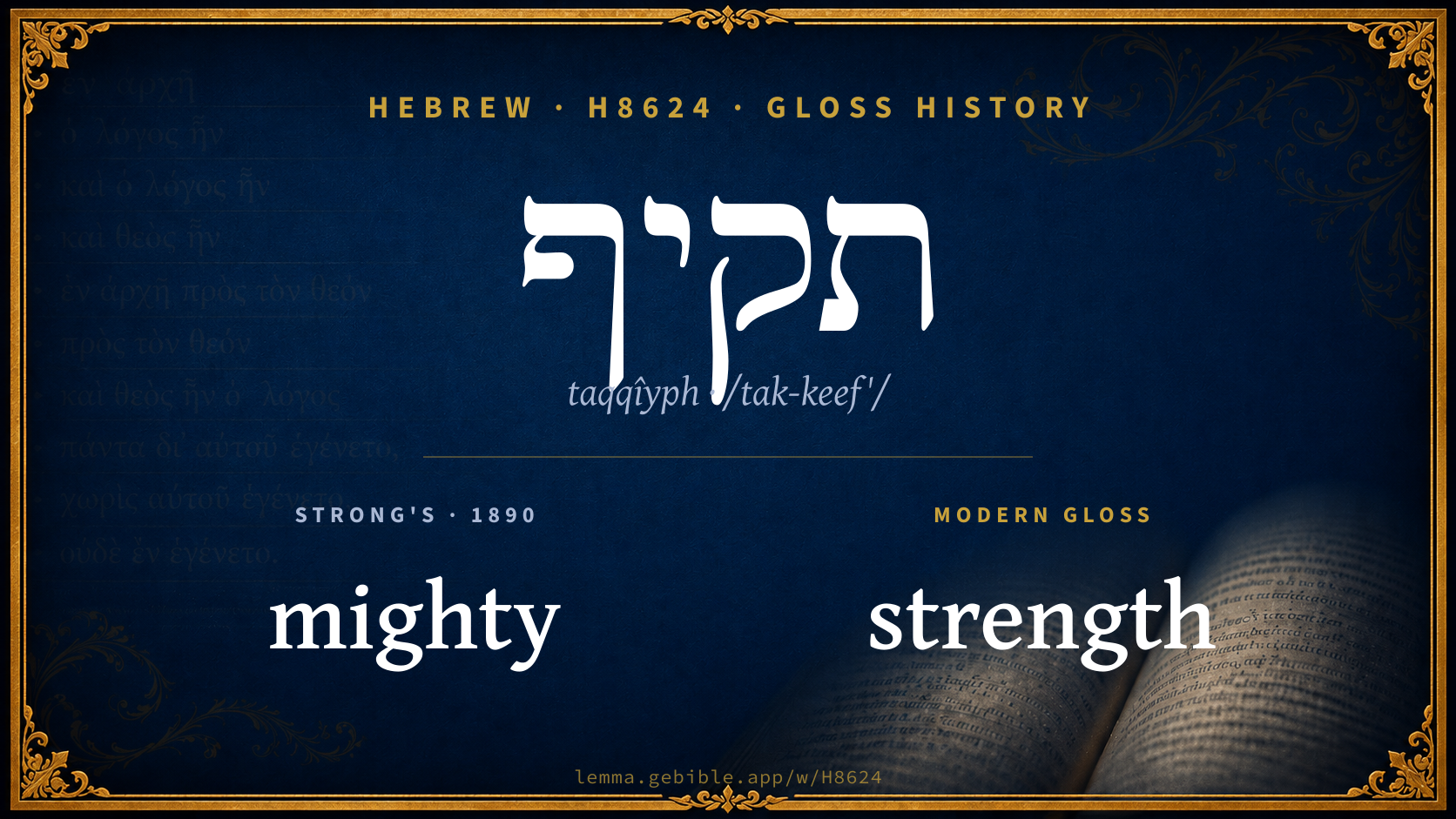
Gloss history
Strong's 1890 vs modern scholarship
About this word
Strong's H8624 catalogs a Hebrew word from the Hebrew Old Testament.
These counts are not copied from any lexicon or concordance. They are computed here, from the morphology-tagged Hebrew Old Testament. What Lemma adds →
- 5
- distinct verses
- The word appears in 5 distinct verses.
- 2 / 39
- OT books
- The word appears in 2 of 39 Old Testament books.
- #3,337
- by frequency
- Top 5000 most frequent Hebrew words (rank 3,337 of 8,640 Hebrew words by occurrence).
View all 5 occurrences in the concordance →
By traditional corpus
Conventional, traditional groupings — biblical authorship is debated, so this is a traditional corpus grouping, not an authorship claim. Each share is this word’s portion of its verses in that division of the Hebrew canon. Each figure is a share of the word’s 5 distinct verses.
- Writings (Ketuvim) 5 verses · 100%
How translations render this word
Counts come from each version’s own published word-to-Strong’s tagging or interlinear alignment — an approximate guide to how each version renders this word, not a word-level alignment the data otherwise carries. Because each total is that version’s own tagged count, the per-version totals vary from one another and need not match the appearance or distinct-verse counts above. These counts may also differ from a printed concordance because Lemma counts each distinctly tagged rendering and does not collapse phrase taggings into a single head-word total. This is a fixed set of word-tagged versions (KJV, ASV, BSB, ULT) and does not change with the reading translation you choose elsewhere. Each version’s license is shown beside its name below (and on Sources).
- King James Version: Strong 3×, Mighty 2×
- American Standard Version: Mighty 2×, Strong 2×
- Berean Standard Bible: Strong 3×, Mighty 2×
- unfoldingWord Literal Text: Strong 3×, Mighty 2×
King James Version Public Domain
Renders H8624 across 5 tagged occurrences — most commonly:
American Standard Version Public Domain
Renders H8624 across 5 tagged occurrences — most commonly:
Plus 1 rendering that appears only once — usually multi-word phrases or single function words the recovered tagging swept in, not distinct renderings.
Berean Standard Bible Public Domain
Renders H8624 across 5 tagged occurrences — most commonly:
unfoldingWord Literal Text CC BY-SA 4.0
Renders H8624 across 6 tagged occurrences — most commonly:
Plus 1 rendering that appears only once — usually multi-word phrases or single function words the recovered tagging swept in, not distinct renderings.
Senses in BDB
The 1 sense BDB distinguishes for this word, in lexicon order (not ranked by frequency or importance). The full entry — with sub-senses — is in the Lexicon Entry tab.
- might, strong, mighty
Word origin
[ תַּקִּיף ] adj. strong, mighty
— Brown-Driver-Briggs (Oxford 1906, public domain), digitized via Sefaria, supplemented by the OpenScriptures HebrewLexicon (CC BY 4.0). See Sources.
Derived from תקיף (taqqîyph) (H8623) — mighty.
Jastrow Dictionary
A second Hebrew/Aramaic lexicon for comparison, covering Aramaic and post-biblical (Talmudic, Targumic, Midrashic) usage that the biblical-Hebrew BDB does not. Matched by lemma rather than by Strong’s number, so a lemma may carry more than one Jastrow headword (shown separately below), and the entries cover usage well beyond the Bible.
תְּקֵיף
- , v. תְּקֵף
תַּקִּיף
- strong, powerful. Sifré Deut. 307 הצור הת׳ ‘the rock’ (Deut. XXXII, 4) means, the mighty; Yalk. ib. 942.—Fem. תַּקִּיפָה. Keth. 26ᵇ; a. e. e.g. Deuteronomy 32:4
תַּקִּיף ²
- , strong, mighty; protector; hard, stern, severe. Targ. Deut. I, 28 (h. text רם). Ib. XXXII, 15 (h. text צור). Targ. Ps. XXVIII, 1. Ib. XXXVII, 35 (h. text עריץ). Targ. Is. XIX, 4 (h. text עז). Targ. O. Deut. XXVIII, 50 ת׳ אפין (h. text עז פנים); a. fr.—B. Mets. 64ᵃ ואי איניש ת׳ הוא וכ׳ and if it is a hard-hearted man that is not likely to give presents; a. e.—Pl. תַּקִּיפִין, תַּקִּיפַיָּא, הַּקִּיפֵי. Targ. Ex. I, 9 (Y. ed. Vien. תַּקְפִין). Targ. Is. XIII, 11. Ib. X, 33 (h. text גבהים). Targ. Ez. III, 6 (h. text עמקי; ib. 5 עמקי, עמיקי). Ib. 7; a. fr.—Snh. 11ᵃ sq. מאי בין תקיפי Ms. F. (ed. תַּקִּיפָאֵי), v. עִנְוְתָנָא; Meg. 28ᵇ; Taan. 23ᵇ; a. e.—Fem. תַּקִּיפָא, תַּקִּיפְתָּא. Targ. Ex. XIII, 9. Targ. Is. XXIII, 7 (ed. Wil. תַּקִּיפְ׳; h. text עליזה). Ib. XLVII, 7. Targ. Cant. VIII, 6; a. e.—Keth. 62ᵃ; a. e.
תְּקַף
- 1. to seize, hold firmly. Targ. Job XXVII, 6 תְּקָפִית Ms. (ed. תַּקִּיפִית). Ib. VIII, 15 יִתְקֵיף ed. Lag. (ed. Wil. תתקיף, corr. acc.; Ms. יִתּוֹקַף Ittof.).
- 2. to be strong, become powerful. Targ. Ex. I, 7 (Y. ed. Vien. אַתְקִיפוּ Af.). Ib. XIX, 19 (Y. ed. Wil. תַּקִּיף, read: תָּקֵיף). Targ. Gen. XLI, 57. Targ. O. Deut. XXXI, 6, sq. Targ. Jud. VII, 11 יִתְקְפָן ed. Lag. (ed. Wil. יתקוף, corr. acc.); a. fr.
- 3. to be heavy, rest heavily upon, be hard. Targ. O. Gen. XLVII, 20 (Y. תַּקִּיף). Targ. I Sam. V, 7 (ed. Wil. תַּקִּרפַת).—Gitt. 77ᵇ ת׳ ליה עלמא the world was heavy for him, i.e. he felt very ill (v. קַלִּיל II). Kidd. 22ᵇ חזייה דתָקיף ליה עלמא טובא (or דתְקֵיף) he saw that he was very sick; a. fr.—Ned. 91ᵃ, v. infra.
- 4. (with רוגזא, or sub. רוגזא) to be vehement, hot, excited. Targ. Gen. XXX, 2. Targ. Ex. XXII, 23. Targ. Ps. XVIII, 8 ת׳ ליה; Targ. II Sam. XXII, 8 ת׳ רוגזיה. Targ. Jon. IV, 4; 9 תְּקוֹף ed. Lag. (ed. Wil. תְּקֵיף, a. תקוף). Targ. Gen. IV, 6 (Y. ed. Vien. תַּקִּיף); a. fr.—Yeb. 63ᵇ מִתְקֵיף תְּקִיפָא she is irascible, v. עֲבַר Ithpe.—Ned. 91ᵃ זמנין דתקיף לה מן גברא sometimes she has a strong feeling against her husband; [oth. interpret.: she has a strong passion for another man].—4) to get hot, ferment, get sour. B. Mets. 64ᵃ אי תַקְפָה ברשותך if it should get sour, it shall be considered in thy possession (it shall be thy loss). Ib. 83ᵃ זבני … ותְקִיפוּ להו I bought three hundred barrels of wine for thee, and they turned sour; ארבע … כי תְקִיפֵי וכ׳ (v. Rabb. D. S. a. l. note 4) if four hundred barrels turn sour, this must have been rumored about; Yalk. Ex. 346 כי תַקְפֵי; Ber. 5ᵇ (En Yaʿăḳob אִיתְּקוּף Ithpe); a. e.
- (cmp. חזק)
- 1. to strengthen; to repair; to harden (the heart of). Targ. Ps. CXLVII, 13. Targ. II Kings XII, 7; 9. Ib. 6 יְתַקְּפיּן (not יִתְקְ׳). Targ. Deut. I, 38. Targ. O. Ex. IV, 21 ed. Berl. (ed. Vien. Af.). Targ. Ps. LXXXIX, 41 (h. text פריצ׳!); a. fr.
- 2. to seize, force. Ḥag. 15ᵃ תַּקְּפֵיה עייליה וכ׳ he seized him and brought him to the school-house.
- 3. (v. תַּקִּיף) to be strong &c., v. supra.
- 1. to grow strong. Targ. Y. Ex. I, 7 (v. supra); a. e.
- 2. to strengthen, make strong, heavy; to harden. Targ. Ps. CV, 24. Targ. I Kings XII, 10; 14. Targ. Jer. V, 3; a. fr.—Part. pass. מַתְקַף. Targ. Is. XXX, 13.
- 3. to seize, take hold of, to cause to seize. Targ. Gen. XXI, 18. Targ. Ex. IV, 4. Ib. IX, 2; a. fr.
- 4. (scholastic term) [to seize, stop,] to raise an objection. Ḥull. 43ᵃ מַתְקִיף לה וכ׳ R. A. objected to it; a. v. fr.
- , Ittof. אִתּוֹקַף
- 1. to strengthen one’s self, be strong; to make an effort. Targ. Y. Deut. XXXI, 6, sq. Targ. II Chr. I, 1. Ib. XVIII, 34. Targ. Ps. CVI, 23 (some ed. Af. incorr.); a. fr.
- 2. to be hardened. Targ. Ex. VII, 13; a. e.
- 3. to get sour, v. supra.—[Targ. Y. Num. XXXVI, 7 תיתקף, read: תיסתקף, v. סְקַף I.]
A Dictionary of the Targumim, the Talmud Babli and Yerushalmi, and the Midrashic Literature (Marcus Jastrow; London, Luzac, 1903) — Public Domain. Digitized via Sefaria. Digitized via Sefaria. Full attribution on Sources.
Forms in the corpus
The 5 distinct written forms H8624 takes in the Hebrew Bible, most frequent first — each parse links to that state’s occurrences in the concordance. Hebrew forms include their vowel points and cantillation, so a single lemma takes many written forms.
| Form | Parsing | Example | Uses |
|---|---|---|---|
| וְ/תַקִּיפָ֜א | Adjective, Adjective, Feminine, Singular, Absolute | Daniel 7:7 | 1 |
| תַקִּיפִ֑ין | Adjective, Adjective, Masculine, Plural, Absolute | Daniel 4:3 | 1 |
| תַקִּיפָ֔ה | Adjective, Adjective, Feminine, Singular, Absolute | Daniel 2:42 | 1 |
| תַקִּיפָ֖ה | Adjective, Adjective, Feminine, Singular, Absolute | Daniel 2:40 | 1 |
| תַּקִּיפִ֗ין | Adjective, Adjective, Masculine, Plural, Absolute | Ezra 4:20 | 1 |
Septuagint verse parallels
This word appears in 5 verses that also exist in the Greek Old Testament (Septuagint), out of the 5 Hebrew verses it occurs in. You can read those verses in Greek by switching the Old Testament edition to the Septuagint.
Read these verses in the Septuagint
This is a verse-level parallel only — the same verses exist in both the Hebrew and Greek Old Testaments. No word-level Hebrew↔Greek correspondence is claimed: the data carries no such alignment, so no Greek word is shown as this Hebrew word’s translation. Coverage is not total — the Septuagint omits the deuterocanon and renumbers the Psalms, so some Hebrew verses have no direct Greek parallel.