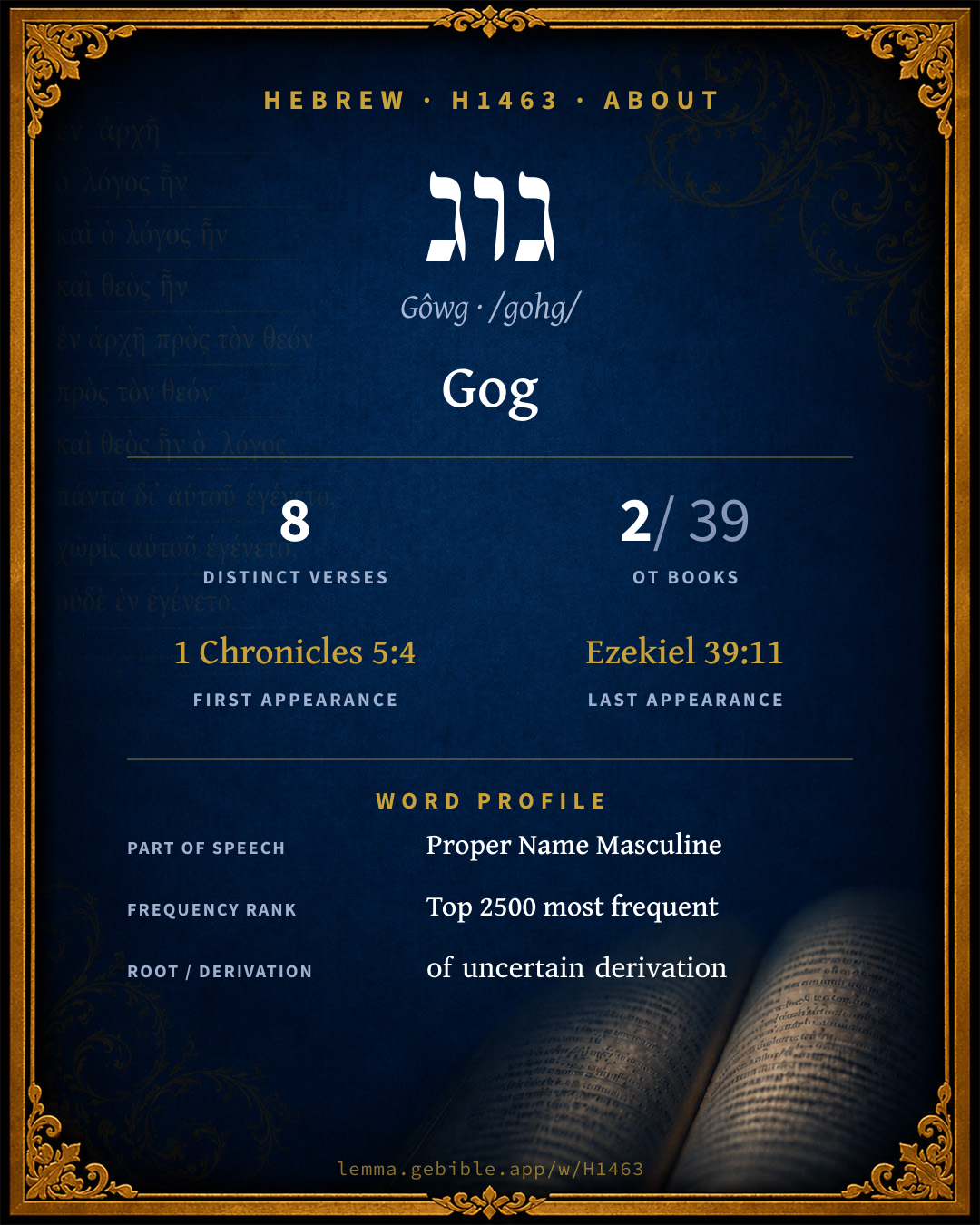
גּוֹג
Gog
BDB lists 3 entries for ‘Gog’ fuller range ↓
Full lexicon entry — Brown-Driver-Briggs (BDB)
From Brown-Driver-Briggs (BDB)
Where this word appears
Grammar key — what these labels mean
Part of speech
- Noun
- A naming word — a person, place, thing, or idea.
Noun type
- Proper
- A name of a specific person, place, or people (e.g. Abraham, Zion, Israel).
Every verse where H1463 appears — 8 distinct verses across 2 books. Click any verse to open its interlinear word-by-word view. Verse text shown in the World English Bible for context — . Each verse’s Hebrew form is shown with its reference; the English is not keyword-highlighted, since the data carries no word-level English alignment. Use “Compare translations” on any verse to read it across multiple English versions. This concordance covers the Hebrew Bible; Septuagint (Greek Old Testament) occurrences are not indexed here.
1 Chronicles 1 verse
Ezekiel 7 verses
- Ezekiel 38:2 גּוֹג֙ n Proper Son of man, set your face toward Gog, of the land of Magog, the prince of Rosh, Meshech, and Tubal, and prophesy against him,
- Ezekiel 38:3 גּ֔וֹג n Proper and say, Thus says the Lord Yahweh: Behold, I am against you, Gog, prince of Rosh, Meshech, and Tubal:
- Ezekiel 38:14 לְ/ג֔וֹג prep + n Proper Therefore, son of man, prophesy, and tell Gog, Thus says the Lord Yahweh: In that day when my people Israel dwells securely, shall you not know it?
- Ezekiel 38:16 גּֽוֹג n Proper and you shall come up against my people Israel, as a cloud to cover the land: it shall happen in the latter days, that I will bring you against my land, that the nations may know me, when I shall be sanctified in you, Gog, before their eyes.
- Ezekiel 38:18 גוֹג֙ n Proper It shall happen in that day, when Gog shall come against the land of Israel, says the Lord Yahweh, that my wrath shall come up into my nostrils.
- Ezekiel 39:1 גּ֔וֹג גּ֔וֹג n Proper n Proper You, son of man, prophesy against Gog, and say, Thus says the Lord Yahweh: Behold, I am against you, Gog, prince of Rosh, Meshech, and Tubal:
- Ezekiel 39:11 לְ/גוֹג֩ גּוֹג֙ prep + n Proper n Proper It shall happen in that day, that I will give to Gog a place for burial in Israel, the valley of those who pass through on the east of the sea; and it shall stop those who pass through: and there shall they bury Gog and all his multitude; and they shall call it The valley of Hamon Gog.
About this entry
At a glance — auto-summarized from this page’s data, not written by a person. Every figure links to its source below. This summary describes the numbers; it doesn’t interpret them.
גוג — transliterated Gôwg — is a Hebrew name carrying the sense “Gog.” More than three-quarters of its appearances fall in Ezekiel. It appears 8 verses across 2 books of the Hebrew Bible, among its uncommon vocabulary. Its earliest occurrence is 1 Chronicles 5:4. Each statement above links to its evidence; the full detail follows below.
Gloss history
Strong's 1890 vs modern scholarship
About this word
Strong's H1463 catalogs a Hebrew word from the Hebrew Old Testament.
These counts are not copied from any lexicon or concordance. They are computed here, from the morphology-tagged Hebrew Old Testament. What Lemma adds →
- 8
- distinct verses
- The word appears in 8 distinct verses.
- 2 / 39
- OT books
- The word appears in 2 of 39 Old Testament books.
- #2,342
- by frequency
- Top 2500 most frequent Hebrew words (rank 2,342 of 8,640 Hebrew words by occurrence).
View all 8 occurrences in the concordance →
Most concentrated in
- Ezekiel 7 verses 88%
- 1 Chronicles 1 verse 13%
By section of the Old Testament
By traditional corpus
Conventional, traditional groupings — biblical authorship is debated, so this is a traditional corpus grouping, not an authorship claim. Each share is this word’s portion of its verses in that division of the Hebrew canon. Each figure is a share of the word’s 8 distinct verses.
- Prophets (Nevi'im) 7 verses · 88%
- Writings (Ketuvim) 1 verse · 13%
How translations render this word
Counts come from each version’s own published word-to-Strong’s tagging or interlinear alignment — an approximate guide to how each version renders this word, not a word-level alignment the data otherwise carries. Because each total is that version’s own tagged count, the per-version totals vary from one another and need not match the appearance or distinct-verse counts above. These counts may also differ from a printed concordance because Lemma counts each distinctly tagged rendering and does not collapse phrase taggings into a single head-word total. This is a fixed set of word-tagged versions (KJV, ASV, BSB, ULT) and does not change with the reading translation you choose elsewhere. Each version’s license is shown beside its name below (and on Sources).
- King James Version: Gog 5×, Against gog 2×, Behold i am against thee o gog 2×
- American Standard Version: Gog 5×, Behold 2×
- Berean Standard Bible: Gog 10×
- unfoldingWord Literal Text: Gog 9×
King James Version Public Domain
Renders H1463 across 10 tagged occurrences — most commonly:
Plus 1 rendering that appears only once — usually multi-word phrases or single function words the recovered tagging swept in, not distinct renderings.
American Standard Version Public Domain
Renders H1463 across 10 tagged occurrences — most commonly:
Plus 3 renderings that appear only once — usually multi-word phrases or single function words the recovered tagging swept in, not distinct renderings.
Berean Standard Bible Public Domain
Renders H1463 across 10 tagged occurrences — most commonly:
unfoldingWord Literal Text CC BY-SA 4.0
Renders H1463 across 10 tagged occurrences — most commonly:
Plus 1 rendering that appears only once — usually multi-word phrases or single function words the recovered tagging swept in, not distinct renderings.
Senses in the full BDB
What do BDB’s symbols mean?
BDB uses these scholarly abbreviations:
| Symbol | Meaning |
|---|---|
| 𝔊 | the Septuagint (the ancient Greek translation, LXX) |
| 𝔙 | the Vulgate (the Latin translation) |
| 𝔖 | the Syriac version (the Peshitta) |
| 𝔗 | the Targum (the Aramaic translation) |
| ψ | the Psalms |
| √ | root (the underlying root or stem) |
| ‖ | parallel passage (a synonymous or contrasted parallel) |
| † | the dagger: every passage where the word occurs is cited |
The 2 senses and sub-senses the full Brown-Driver-Briggs lexicon distinguishes for this word, in lexicon order (not ranked by frequency), with BDB’s own verbatim wording and sub-sense lettering. Shown in Hebrew script with BDB’s own scholarly abbreviations. The condensed entry is in the Lexicon Entry tab. See also the Forms in the corpus table below.
- 1. 1 Ch 5:4 a Reubenite. e.g. 1 Chronicles 5:4
- 2. Gog of the land of Magog, prince of Rosh, Meshek, and Tubal, גּוֹג אֶרֶץ מָגוֹג נְשִׂיא רֹאשׁ מֶשֶׁךְ וְתֻבָ֑ל Ez 38:2, 3 (om. א׳ מָגוֹג) 39:1 (om. id.) cf. 38:14, 16 (del. 𝔊 𝔖 Co) v 18; 39:1, 11(×3) (גֵּיא הֲמוֹן ג׳) v 15 (id.); cf. Assyrian Gâgu, chief of a mountain tribe N. of Assyria DlPa 247 COT on Ez 38:2. e.g. Ezekiel 38:2
Senses from the full Brown-Driver-Briggs lexicon (Brown, Driver, Briggs; Oxford 1906 — public domain), digitized via Sefaria, supplemented by the OpenScriptures HebrewLexicon (CC BY 4.0). Full attribution on Sources.
Word origin
n.pr.m. (√ unknown)—
— Brown-Driver-Briggs (Oxford 1906, public domain), digitized via Sefaria, supplemented by the OpenScriptures HebrewLexicon (CC BY 4.0). See Sources.
Origin: of uncertain derivation
Forms in the corpus
The 7 distinct written forms H1463 takes in the Hebrew Bible, most frequent first — each parse links to that state’s occurrences in the concordance. Hebrew forms include their vowel points and cantillation, so a single lemma takes many written forms.
| Form | Parsing | Example | Uses |
|---|---|---|---|
| גּ֔וֹג | Noun, Proper | Ezekiel 38:3 | 3 |
| גּוֹג֙ | Noun, Proper | Ezekiel 38:2 | 2 |
| גּ֥וֹג | Noun, Proper | 1 Chronicles 5:4 | 1 |
| גּֽוֹג | Noun, Proper | Ezekiel 38:16 | 1 |
| גוֹג֙ | Noun, Proper | Ezekiel 38:18 | 1 |
| לְ/ג֔וֹג | Noun, Proper | Ezekiel 38:14 | 1 |
| לְ/גוֹג֩ | Noun, Proper | Ezekiel 39:11 | 1 |
Same root — word family
Other BDB entries built from the same root as H1463, grouped by Strong’s listed origin. These share a root / origin per the lexicon — not necessarily a shared meaning. Each links to that word’s own entry.
Proper names from this root
People and places named from this root — a name, not an additional meaning of the word.
Compare all same-root words → 2 of the same-root words are proper names (people or places). They share a root, not necessarily a meaning.
Bible dictionary
Public-domain dictionary articles matched to this entry by name (Gog). A biblical name can be shared by more than one person or place, so an article may treat several.
Easton's Bible Dictionary · M. G. Easton, 1897
(1.) A Reubenite (1 Chr. 5:4), the father of Shimei.
(2.) The name of the leader of the hostile party described in Ezek. 38, 39, as coming from the "north country" and assailing the people of Israel to their own destruction. This prophecy has been regarded as fulfilled in the conflicts of the Maccabees with Antiochus, the invasion and overthrow of the Chaldeans, and the temporary successes and destined overthrow of the Turks. But "all these interpretations are unsatisfactory and inadequate. The vision respecting Gog and Magog in the Apocalypse (Rev. 20:8) is in substance a reannouncement of this prophecy of Ezekiel. But while Ezekiel contemplates the great conflict in a more general light as what was certainly to be connected with the times of the Messiah, and should come then to its last decisive issues, John, on the other hand, writing from the commencement of the Messiah's times, describes there the last struggles and victories of the cause of Christ. In both cases alike the vision describes the final workings of the world's evil and its results in connection with the kingdom of God, only the starting-point is placed further in advance in the one case than in the other."
It has been supposed to be the name of a district in the wild north-east steppes of Central Asia, north of the Hindu-Kush, now a part of Turkestan, a region about 2,000 miles north-east of Nineveh.
Smith's Bible Dictionary · William Smith, 1863
(mountain).
+ A Reubenite, (1 Chronicles 5:4) son of Shemaiah.
Hitchcock's Bible Names Dictionary · Roswell D. Hitchcock, 1869
roof; covering
Classic public-domain reference works; full attribution on Sources.
Septuagint verse parallels
This word appears in 8 verses that also exist in the Greek Old Testament (Septuagint), out of the 8 Hebrew verses it occurs in. You can read those verses in Greek by switching the Old Testament edition to the Septuagint.
Read these verses in the Septuagint
This is a verse-level parallel only — the same verses exist in both the Hebrew and Greek Old Testaments. No word-level Hebrew↔Greek correspondence is claimed: the data carries no such alignment, so no Greek word is shown as this Hebrew word’s translation. Coverage is not total — the Septuagint omits the deuterocanon and renumbers the Psalms, so some Hebrew verses have no direct Greek parallel.