
Ezekiel 28:20

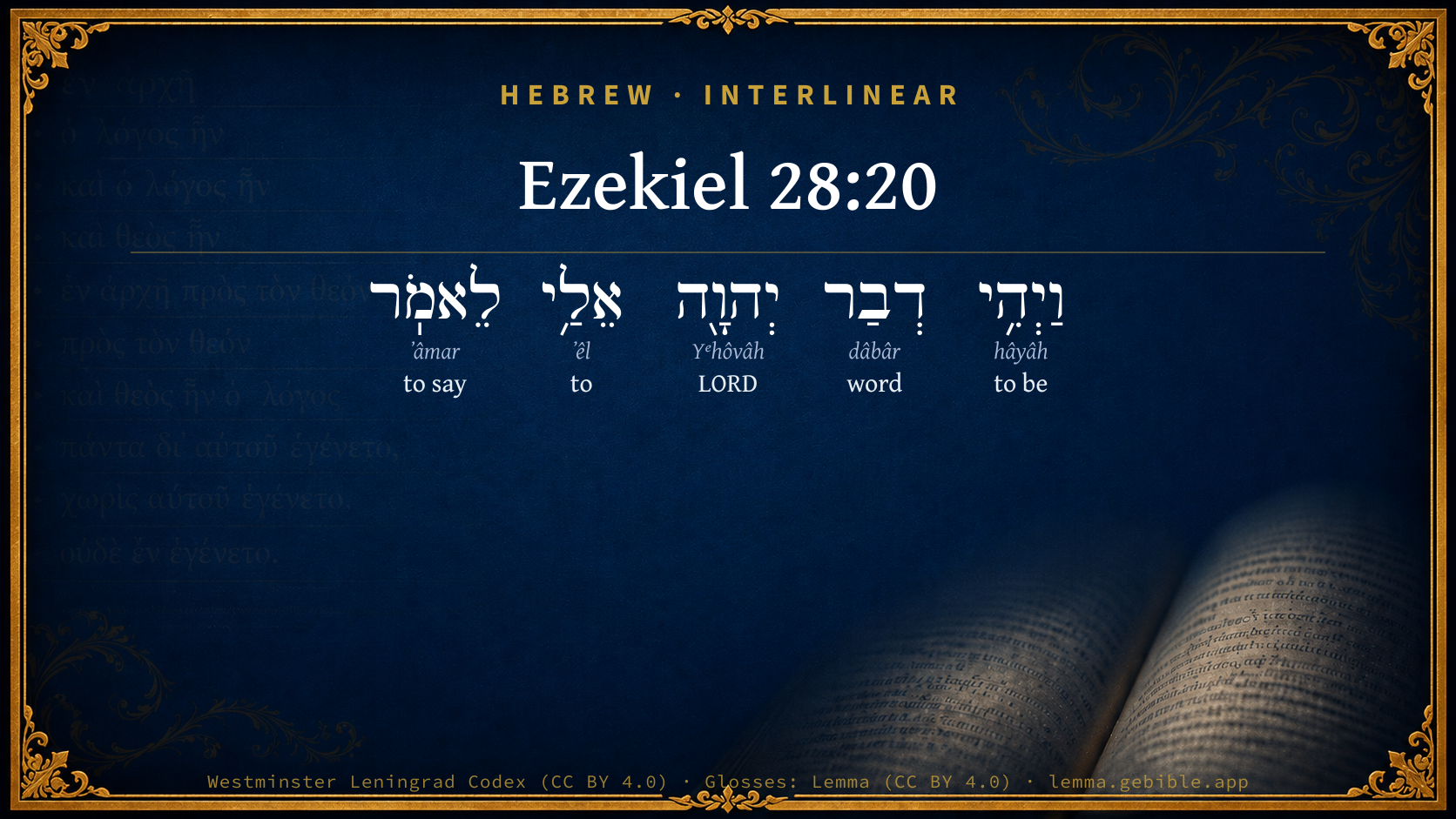
Hebrew (Westminster Leningrad Codex) Ezekiel 28:20 appears in the Hebrew Old Testament. The text above is from the Westminster Leningrad Codex. Each word links to its Strong’s number, a concise gloss, and parsing drawn from the Open Scriptures Hebrew Bible morphology. Click any word for its full Brown-Driver-Briggs (BDB) entry.
Download image
Cite this verse

Ezekiel 28:20 (World English Bible). Public Domain. Lemma interlinear Bible study tool, https://lemma.gebible.app/v/ezekiel/28/20.

Show BibTeX & RIS
BibTeX
RIS
English Translation
The word of Yahweh came to me, saying,
World English Bible · Public Domain
Download a study sheet

One document with this verse’s original text, its word-by-word gloss line, the meaning frame, cross-references with their text, attributed commentary, and full source and license credits — printable, and it pastes into notes with its structure intact.

This verse Autodidact and up

Study sheet (.html) Plain text (.txt)

A passage Seminary Student

Up to 50 verses in one chapter. A passage sheet keeps up to 6 commentary sources and 12 cross-references per verse, in the order this page ranks them, and says so on the sheet whenever that leaves anything out. Ask for a single verse and you get the Autodidact verse sheet above.

Everything on this page stays free to read, with no account — the sheet is a download of what is already on screen, not access to it.

Want to remove ads? Support Godless Engineer
Compare translations 3

The same verse in 3 English versions, stacked beneath the original-language interlinear above. Click any original word for its lexicon entry.

Each is an independent rendering of the whole verse — the interlinear is not word-aligned to these translations.

Highlighted words mark where these versions differ — a whole-verse word diff, not a word-by-word alignment.

  • World English Bible Public Domain
    The word of Yahweh came to me, saying,
  • King James Version Public Domain
    Again the word of the LORD came unto me, saying,
  • unfoldingWord Literal Text CC BY-SA 4.0
    Then the word of Yahweh came to me, saying,

unfoldingWord Literal Text — © unfoldingWord, licensed CC BY-SA 4.0. Word-aligned USFM3 via Door43 (git.door43.org/unfoldingWord/en_ult).

Versions to compare (up to 4)

3 of 4 selected

Show all 18 translations

Every available English version of this verse, each an independent rendering of the whole verse.

  • World English Bible Public Domain
    The word of Yahweh came to me, saying,
  • Berean Standard Bible Public Domain
    Then the word of the LORD came to me, saying,
  • Majority Standard Bible Public Domain
    Then the word of the LORD came to me, saying,
  • King James Version Public Domain
    Again the word of the LORD came unto me, saying,
  • American Standard Version (1901) Public Domain
    And the word of Jehovah came unto me, saying,
  • Revised Version (1885) Public Domain
    And the word of the LORD came unto me, saying,
  • Geneva Bible (1599) Public Domain
    Againe, the worde of the Lord came vnto me, saying,
  • Douay-Rheims (1899) Public Domain
    And the word of the Lord came to me, saying:
  • Young's Literal Translation Public Domain
    And there is a word of Jehovah unto me, saying,
  • Literal Standard Version CC BY-SA 4.0
    And there is a word of YHWH to me, saying,
  • Unlocked Literal Bible CC BY-SA 4.0
    Then the word of Yahweh came to me, saying,
  • unfoldingWord Literal Text CC BY-SA 4.0
    Then the word of Yahweh came to me, saying,
  • Darby Bible Public Domain
    And the word of Jehovah came unto me, saying,
  • World Messianic Bible Public Domain
    The LORD’s word came to me, saying,
  • Webster's Bible Public Domain
    Again the word of the LORD came to me, saying,
  • Free Bible Version CC BY-SA 4.0
    A message from the Lord came to me, saying,
  • Bible in Basic English Public Domain
    And the word of the Lord came to me, saying,
  • JPS Tanakh (1917) Public Domain
    And the word of the LORD came unto me, saying:

Literal Standard Version (2020), Covenant Press — licensed CC BY-SA 4.0. Text via the HelloAO Bible API (eBible.org). Unlocked Literal Bible (unfoldingWord) — licensed CC BY-SA 4.0. Text via the HelloAO Bible API (eBible.org). unfoldingWord Literal Text — © unfoldingWord, licensed CC BY-SA 4.0. Word-aligned USFM3 via Door43 (git.door43.org/unfoldingWord/en_ult). Free Bible Version, Dr. Jonathan Gallagher — licensed CC BY-SA 4.0. Text via the HelloAO Bible API (eBible.org).

Word by word

More ways to search: Search by grammar → Find every occurrence → Compare this word →

Practice this passage: Drill this verse → Learn its vocabulary →

About this verse

These counts appear in no published source. They are computed here, from the morphology-tagged text and Lemma’s own curated glosses. What Lemma adds →

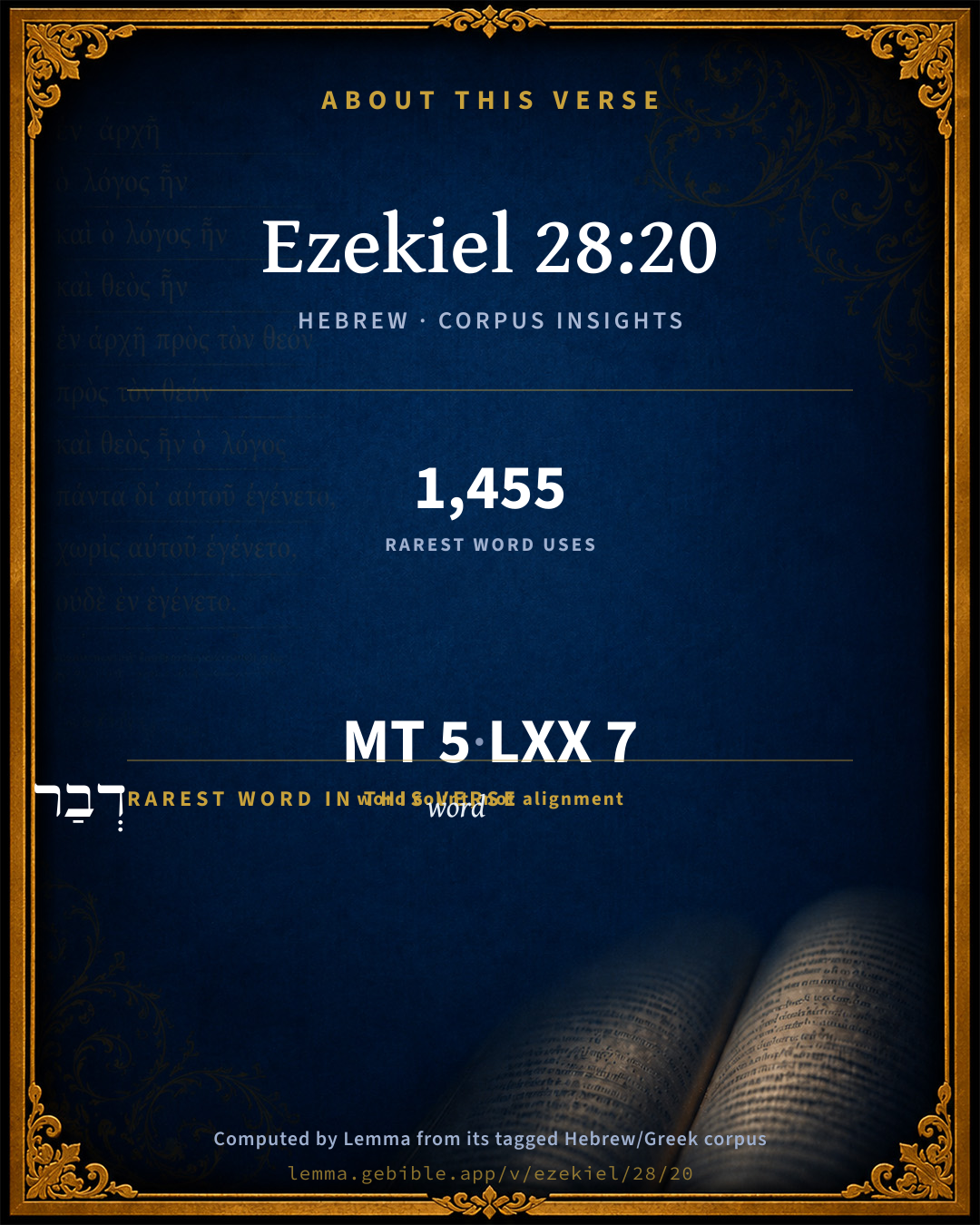
5
words
5
distinct lemmas
Prophets
section

Grammatical profile

  • 2 verbs
  • 2 nouns
  • 1 preposition

Verb forms

  • וַיְהִ֥י Qal · Sequential Imperfect
  • לֵאמֹֽר Qal · Infinitive Construct

Hebrew & Septuagint length

In English translation the verse runs 8 words from the Hebrew and 10 from the Septuagint (LXX English) — closely comparable.

A rough comparison of the two English renderings, which tokenize alike — not a word-level alignment.

Word counts can differ between the Hebrew and the Greek without any difference in meaning — e.g. the Hebrew direct-object marker אֵת has no separate Greek word, and Greek often adds the article ὁ.

In the original languages it is 5 Hebrew tokens and 7 Greek tokens — but the two are counted differently (Hebrew bundles its prefixes and suffixes into one token; the Greek is in lemma form), so that isn’t a like-for-like length.

Hebrew and Greek witnesses Masoretic Hebrew ↔ Greek Septuagint

The same verse in the two great witnesses to the Old Testament, shown verse-for-verse.

These are two independent witnesses, not word-aligned to each other, and the Septuagint is shown in lemma (dictionary) form.

Hebrew Ezekiel 28:20 Masoretic · Westminster Leningrad Codex

וַיְהִ֥י דְבַר יְהוָ֖ה אֵלַ֥י לֵאמֹֽר

The word of Yahweh came to me, saying,

World English Bible · Public Domain

Greek LXX Ezekiel 28:20 Septuagint · lemma form

καί γίγνομαι λόγος κύριος πρός ἐγώ λέγω

And the word of the Lord came to me, saying,

LXX2012 (modern English Septuagint) · Public Domain

Hebrew: Westminster Leningrad Codex (CC BY 4.0). Greek: Septuagint (public domain); English from LXX2012 (modern English Septuagint) (Public Domain). How the Septuagint differs from the Hebrew →

Targum (Aramaic paraphrase)

1

The Targum is the ancient Jewish Aramaic paraphrase of the Hebrew Scriptures — an interpretive translation, not the Hebrew text itself. Onkelos (literal) and Pseudo-Jonathan (expansive) render the Torah, and Jonathan the Prophets. Coverage is partial: where no permissively-licensed English translation exists for a verse, only the Aramaic is shown. This is verse-level text, not a word-by-word alignment to the Hebrew.

  1. Targum Jonathan Prophets (Joshua–Malachi)
    וַהֲוָה פִתְגָם נְבוּאָה מִן קֳדָם יְיָ עִמִי לְמֵימָר:

    (no public-domain English translation for this verse)

    Targum Jonathan — Aramaic: “Mikraot Gedolot” (public domain). English: “Sefaria Community Translation” (CC0 1.0 (public-domain dedication)); “London "Chaldee Paraphrase," 1871” (public domain). Text via Sefaria.

Commentary

Notes on Ezekiel 28:20 from classic Christian and Jewish commentators (each source and its license shown beneath its notes). The classic Christian expositions comment on the surrounding passage and are grouped to its opening verse, so a note may address several verses; the Jewish commentaries on the Tanakh (Rashi and others) are per-verse, so they appear only where the commentator wrote on this verse.

Lemma curates 59 commentaries, every one of them public domain or Creative Commons licensed, each selected and text-cleaned for this edition rather than reprinted as found. About our sources →

The Cambridge Bible for Schools and Colleges

gen. ed. J. J. S. Perowne

20–26. Prophecy against Sidon

See on ch. Eze_25:1. The passage has three parts:

(1) Eze_28:20-23. The Lord shall send great judgments on Zidon, by which means he shall get his greatness and holiness recognised, and they shall know that he is God. (2) Eze_28:24. Thus shall all that vex Israel round about come to an end and cease. (3) Eze_28:25-26. Israel when restored shall thus dwell securely, all that were hostile to her having been removed; and she shall know Jehovah her God to be God alone. These words suggest the explanation both of the judgments upon the nations and of the position which they occupy in the prophet’s Book. See introd to ch. 25.

The Cambridge Bible for Schools and Colleges (gen. ed. J. J. S. Perowne; Cambridge University Press, 1878–1918) — public domain. Text from a community e-Sword module.

Trapp's Complete Commentary

John Trapp

Eze 28:20 Again the word of the LORD came unto me, saying,

Ver. 20. Again the word of the Lord.] See Eze 18:1.

John Trapp, A Commentary or Exposition upon All the Books of the Old and New Testament (1647–1656) — public domain. Text from a community e-Sword module.

Dummelow's Commentary on the Holy Bible

J. R. Dummelow

God's Judgment on Sidon

Sidon, the partner of Tyre in opposing Nebuchadrezzar, will be its partner in destruction (Eze_28:20-23). The overthrow of the heathen nations will vindicate the supreme power of the God of Israel, will prepare the way for His people's restoration to their own land, and will ensure their security and peace in the future (Eze_28:24-26). These last vv. have an important bearing on the significance of all Ezekiel's prophecies against the nations.

J. R. Dummelow, A Commentary on the Holy Bible (Macmillan, 1909) — public domain. Text from a community e-Sword module.

Keil & Delitzsch

C. F. Keil & F. Delitzsch

Prophecy Against Sidon and Promise for Israel

The threatening word against Sidon is very brief, and couched in general terms, because as a matter of fact the prophecy against Tyre involved the announcement of the fall of Sidon, which was dependent upon it; and, as we have already observed, Sidon received a special word of God simply for the purpose of making up the number of the heathen nations mentioned to the significant number seven. The word of God against Sidon brings to a close the cycle of predictions of judgment directed against those heathen nations which had given expression to malicious pleasure at the overthrow of the kingdom of Judah. There is therefore appended a promise for Israel (Eze 28:25, Eze 28:26), which is really closely connected with the threatening words directed against the heathen nations, and for which the way is prepared by Eze 28:24. The correspondence of נקדּשׁתּי בהּ (I shall be sanctified in her) in Eze 28:22 to נקדּשׁתּי בם (I shall be sanctified in them) in Eze 28:25, serves to place the future fate of Israel in antithesis not merely to the future fate of Sidon, but, as Eze 28:24 and Eze 28:26 clearly show, to that of all the heathen nations against which the previous threats have been directed.

Eze 28:20-24

And the word of Jehovah came to me, saying, Eze 28:21. Son of man, direct thy face towards Sidon, and prophesy against it, Eze 28:22. And say, Thus saith the Lord Jehovah, Behold, I will be against thee, O Sidon, and will glorify myself in the midst of thee; and they shall know that I am Jehovah, when I execute judgments upon it, and sanctify myself upon it. Eze 28:23. I will send pestilence into it, and blood into its streets; slain will fall in the midst of it by the sword, which cometh upon it from every side; and they shall learn that I am Jehovah. Eze 28:24. And there shall be no more to the house of Israel a malignant thorn and smarting sting from all round about them, who despise them; but they shall learn that I am the Lord Jehovah. - Jehovah will glorify Himself as the Lord upon Sidon, as He did before upon Pharaoh (compare Exo 14:4, Exo 14:16-17, to which the word נכבּדתּי in Eze 28:22, an unusual expression for Ezekiel, evidently points). The glorification is effected by judgments, through which He proves Himself to be holy upon the enemies of His people. He executes the judgments through pestilence and blood (vid., Eze 5:17; Eze 38:22), i.e., through disease and bloodshed occasioned by war, so that men fall, slain by the sword (cf. Eze 6:7). Instead of נפל we have the intensive form נפלל, which is regarded by Ewald and Hitzig as a copyist's error, because it is only met with here. Through these judgments the Lord will liberate His people Israel from all round about, who increase its suffering by their contempt. These thoughts sum up in Eze 28:24 the design of God's judgments upon all the neighbouring nations which are threatened in Ezekiel 25-28, and thus prepare the way for the concluding promise in Eze 28:25 and Eze 28:26. The figure of the sting and thorn points back to Num 33:55, where it is said that the Canaanites whom Israel failed to exterminate would become thorns in its eyes and stings in its sides. As Israel did not keep itself free from the Canaanitish nature of the heathen nations, God caused it to fell these stings of heathenism. Having been deeply hurt by them, it was now lying utterly prostrate with its wounds. The sins of Canaan, to which Israel had given itself up, had occasioned the destruction of Jerusalem (Ezekiel 16). But Israel is not to succumb to its wounds. On the contrary, by destroying the heathen powers, the Lord will heal His people of the wounds which its heathen neighbours have inflicted upon it. סלּון, synonymous with סלּון in Eze 2:6, a word only found in Ezekiel. ממאיר, on the contrary, is taken from Lev 13:51 and Lev 14:44, where it is applied to malignant leprosy (see the comm. on the former passage). - For השּׁאטים אותם, see Eze 16:57 and Eze 25:6.

Eze 28:25-26

Thus saith the Lord Jehovah, When I shall gather the house of Israel out of the peoples among whom they have been scattered, I shall sanctify myself upon them before the eyes of the heathen nations, and they will dwell in their land which I have given to my servant Jacob. Eze 28:26. They will dwell there securely, and build houses and plant vineyards, and will dwell securely when I execute judgments upon all who despise them of those round about them; and they shall learn that I Jehovah am their God. - Whilst the heathen nations succumb to the judgments of God, Israel passes on to a time of blessed peace. The Lord will gather His people from their dispersion among the heathen, bring them into the land which He gave to the patriarch Jacob, His servant, and give them in that land rest, security, and true prosperity. (For the fact itself, compare Eze 11:17; Eze 20:41; Eze 36:22.)

Keil & Delitzsch — Biblical Commentary on the Old Testament (1861–1891) — public domain (CC PDM 1.0). Text via the HelloAO Bible API. (Old Testament only.)

Fairbairn on Ezekiel, Jonah & the Pastoral Epistles

Patrick Fairbairn

CHAPTER 28:20-26.

THE JUDGMENT OF SIDON, AND THE ULTIMATE PEACE OF ISRAEL.

WE have already remarked, in the introduction to this series of prophecies, that Sidon was not so properly an independent state, as rather an integral portion of the great maritime power of which Tyre was the centre. Hence in the description given by the prophet in Ezekiel 27 of the resources of Tyre, Sidon is mentioned as contributing of her mariners to man the Tyrian vessels. Though thus, however, politically merged in Tyre, Sidon had possessed a religious connection with the covenant-people, which does not appear to have extended to Tyre, and which furnished an historical reason for the separate mention of Sidon, in addition to the circumstance of its being necessary to complete the number seven. Whether it arose from Sidon being the elder city, or from her citizens having more frequent intercourse with the Israelites, or, finally, from the character of the religion prevalent in Sidon being of a more seductive and infectious character, the fact is certain, that a corrupting influence flowed in upon Israel from Sidon such as is never mentioned in connection with Tyre. So early as the time of the Judges, the gods of Sidon are named among the false deities that had acquired an ascendency over the children of Israel (Jdg 10:6). In the days of Solomon, the worship of Ashtoreth, the goddess of the Sidonians, was again openly practised (1Ki 11:33). And that this influence never became wholly extinct, and continued even to the times of the prophet, is evident from the scene described in Ezekiel 8, of women sitting in the attitude of mourners, and weeping for Tarnmuz. This was undoubtedly an importation from the territory of Sidon, where the Tammuz or Adonis-worship had its origin. And that the circumstance now referred to was not without its weight in determining the prophet to give a separate place to Sidon, may be certainly inferred, not only from the strongly historical bias of the prophet’s mind, but also from the express mention at the close, of the freedom that was to be acquired for Israel, by the overthrow of such neighbours as the Sidonians, from the corrupting influences that had vexed and troubled them in times past.

The prophecy itself against Sidon is of the most general description:

Eze 28:20. And the word of the Lord came to me, saying,

Eze 28:21. Son of man, set thy face toward Sidon, and prophecy against it; and say,

Eze 28:22. Thus saith the Lord Jehovah, Behold I am against thee, Sidon, and shall be glorified in the midst of thee: and they shall know that I am Jehovah, when I shall have executed judgments in her, and shall he sanctified in her.

Eze 28:23. And I will send against her pestilence, and blood shall be in her streets, and the slain shall be judged in her midst by the sword against her from every side; and they shall know that I am Jehovah.

It was the less necessary to enter here into particulars, as from the nature of Sidon’s relation to Tyre it would naturally be understood that the fortunes of the larger city must be shared in by the less. If Tyre was to fall before the adverse influences that were to assail her, and become a scene of desolation, much more should Sidon, which had far inferior resources to meet the danger. It passed through many a siege, and consequently suffered many successive blows; and though it has never altogether ceased to be an inhabited place, it has possessed for ages nothing of the relative greatness and importance which belonged to it in the time of Ezekiel. God has indeed been sanctified in her by means of the humiliating reverses she has been made to undergo.

And now the prophet turns from these scenes of desolation to the prospect of better days to come for the covenant-people, to whom the downfall of these neighbouring heathen powers betokened good, as it indicated the purpose of God to rid them of what had hitherto vexed and troubled their condition.

Eze 28:24. And there shall not be any more to the house of Israel a vexing brier (The only verbal peculiarity in the passage, is in the epithet here applied to brier, מָמְאִיר. Gesenius derives it from מָאַר taken as synonymous with מָרַר, to be bitter; hence the word here, anything causing bitterness, vexing. מַמְאֶרֶת is applied to the leprosy, when found to be fixed and settled (Lev 13:51-52), where our translators have rendered it fretting. The ancient versions, Vulgate, Syriac, express the sense of bitterness in the passage before us; the noun evidently requires something of that sort.) and a grieving thorn of all that are round about them, that despise them; and they shall know that I am the Lord Jehovah.

Eze 28:25. Thus saith the Lord Jehovah, Because I will gather the house of Israel from the peoples whither they are scattered, and I shall be sanctified in them in the eyes of the nations, and they shall sit down upon the land which I gave to my servant Jacob;

Eze 28:26. And they shall dwell upon it securely, and build houses, and plant vineyards, and dwell securely, since I execute judgments upon all that hate them round about them; and they shall know that I am Jehovah their God.

This concluding part of the prophecy evidently has respect to what was said by Moses, in Num 33:55, regarding such of the original inhabitants of Canaan as the Israelites in their unfaithfulness might fail to drive out: “They shall be pricks in your eyes, and thorns in your sides, and shall vex you in the land wherein you dwell.” Such in sad experience they found to be the case, and in regard to the Sidonians not less than others. The territory of Sidon lay within the bounds of the tribe of Asher; and it is expressly recorded that this tribe could not dispossess the inhabitants of Sidon (Jdg 1:31). A peaceful relation in process of time sprung up between the Sidonians and their Israelitish neighbours; but this only opened the way, as we have seen, to a more pernicious and destructive influence than the open assaults of war. In leading them to depart from the pure worship of Jehovah, by the introduction of the foul rites of Ashtoreth and Adonis, the Sidonians proved in the worst sense thorns in the side of the covenant-people. But the result of those judgments which God was now going to execute should be to put an end to these vexatious and perverting influences. What the people themselves had failed to do, on account of their unfaithfulness to the covenant, the faithful Jehovah would accomplish by the execution of his judgments; he would extirpate these annoying briers and thorns, and allow the people to enjoy in undisturbed freedom and repose the heritage he had given in covenant to their father Jacob.

The latter part of the prediction, which foretells a future period of peace and security to Israel, is a promise of coming good thrown into the form of the past—a prophecy cast in the mould of history. That the good would be realized to the full extent promised, we must certainly hold; but not, therefore, that it would be realized to the full in the precise form here adopted. For if our past investigations into the meaning of this prophet have taught us anything, it is that we must know how to distinguish between the form and the reality. Even the immediately preceding vision respecting the king of Tyre is remarkable for nothing so much as the tendency displayed in it to use the historical as the merely ideal form of the thoughts and feelings sought to be conveyed by the prophet. In the earlier part of it a completely ideal representation is given us, though under the form of history, of the pre-eminent greatness and glory of the king of Tyre; while in the latter part the form is changed, and is neither so boldly figurative nor is it thrown into the historical type. How far, therefore, in this concluding prophecy regarding Israel the historical form should be regarded, cannot be pronounced on with absolute certainty from the words themselves, but must be gathered from the course of Divine providence. The positive element in the promise—that which must be found in history, otherwise the word fails—is, that God’s future dealings with his covenant-people should be such as to rid them from the annoyance and the danger to which in past times they had been exposed from the worldly greatness and the idolatrous spirit of their immediate neighbours; so that they should enjoy the peculiar blessing of the covenant in comparative peace and security. And doubtless the Lord might fulfil this promise, while all the ancient relations were allowed to stand Israel restored to their proper territory, and the surrounding nations either entirely driven from their possessions, or so completely changed in their feelings toward Israel, and so reduced in outward circumstances, as to be no longer snares to Israel’s peace and prosperity. To a very considerable extent this was the case. Such of the people as afterwards returned from their dispersions, and settled in the land of Canaan, had comparatively few struggles with their old neighbours, either as political or religious adversaries. Those neighbours had themselves become too broken and enfeebled by the reverses they experienced to exert religiously the deleterious influence, or politically to inflict the evils which in their former flourishing condition they were quite able to produce. And though for a period there were trials and contests which Israel was obliged to maintain with them, yet these proved only occasional interruptions to the general peace; and for generations before the coming of our Lord it might justly be said, that Israel had no longer a thorn or a brier to plague them in their immediate neighbours. In a religious point of view—which is the one here chiefly meant—the Jews were even enabled to make reprisals upon the heathen; and it was not so much the worship of Jehovah that had to be afraid of the corrupting influence of heathenism, as rather the religions of heathenism that were endangered by the knowledge and worship of Jehovah. For instead of melting away, as of old, under the pernicious agency of surrounding idolatries and corruptions, Judaism could number its converts out of all lands, rescued from the crumbling superstitions of heathendom.

It thus appears that even in regard to the historical form of this prediction, it received a very striking and wonderful degree of fulfilment ages after he who uttered it had slept with his fathers. The Lord did bring back Israel to their own land, and by reason of the judgments he executed upon those who in past ages had troubled and vexed them, they were permitted to dwell in comparative peace, and even attained to a place of relative strength and moral ascendancy. But the prophecy should not be limited to that temporary and partial fulfilment. We see its full extent and compass of meaning only when, looking through the historical drapery and the shell of ancient relations, we contemplate Israel rising in Christ and the Church of the New Testament to be the head and centre of all that is great, permanent, and good in the world, before which everything that is adverse must fall. The heritage of Jacob is now no longer the narrow stripe of territory which was given to the seed of blessing as a temporary type and earnest, but the whole ransomed earth, which to its uttermost bounds is the destined possession of Christ and his Israel offspring. Till this great consummation is reached, the prophecy still waits for its full realization. And believing that it shall be realized, that it is the purpose of God to humble and destroy every adverse power, and exalt the saints with Christ to possess the kingdom, let the Church of God ply with every means at her command the blessed work of the world’s regeneration, and “bate not a jot in heart or hope” on account of the evil influences against her. Since it is the cause of truth and righteousness for which she contends, the victory cannot fail to be ultimately on her side.

Patrick Fairbairn — An Exposition of Ezekiel (1851), Jonah (1849), and The Pastoral Epistles (1874) — public domain. Text from a community e-Sword module.

Tyndale Open Study Notes

Tyndale Open Resources

28:20-24 No specific charges are made against Sidon, Tyre’s close neighbor to the north, though presumably it was guilty of similar offenses. Its rejoicing at Judah’s destruction would not last.

Tyndale Open Study Notes — © Tyndale Open Resources, licensed CC BY-SA 4.0. Text via the HelloAO Bible API.

Matthew Henry's Commentary

God's glory is his great end, both in all the good and in all the evil which proceed out of the mouth of the Most High; so we find in these verses. 1. God will be glorified in the destruction of Zidon, a city that lay near to Tyre, was more ancient, but not so considerable, had a dependence upon it and stood and fell with it. God says here, I am against thee, O Zidon! and I will be glorified in the midst of thee, Eze 28:22. And again, "Those that would not know be gentler methods shall be made to know that I am the Lord, and I alone, and that I am a just and jealous God, when I shall have executed judgments in her, destroying judgments, when I shall have done execution according to justice and according to the sentence passed, and so shall be sanctified in her." The Zidonians, it should seem, were more addicted to idolatry than the Tyrians were, who, being men of business and large conversation, were less under the power of bigotry and superstition. The Zidonians were noted for the worship of Ashtaroth; Solomon introduced it, Kg1 11:5. Jezebel was daughter to the king of Zidon, who brought the worship of Baal into Israel (Kg1 16:31); so that God had been much dishonoured by the Zidonians. Now, says he, I will be glorified, I will be sanctified. The Zidonians were borderers upon the land of Israel, where God was known, and where they might have got the knowledge of him and have learned to glorify him; but, instead of that, they seduced Israel to the worship of their idols. Note, When God is sanctified he is glorified, for his holiness is his glory; and those whom he is not sanctified and glorified by he will be sanctified and glorified upon, by executing judgments upon them, which declare him a just avenger of his own and his people's injured honour. The judgments that shall be executed upon Zidon are war and pestilence, two wasting depopulating judgments, Eze 28:23. They are God's messengers, which he sends on his errands, and they shall accomplish that for which he sends them. Pestilence and blood shall be sent into her streets; there the dead bodies of those shall lie who perished, some by the plague, occasioned perhaps through ill diet when the city was besieged, and some by the sword of the enemy, most likely the Chaldean armies, when the city was taken, and all were put to the sword. Thus the wounded shall be judged; when they are dying of their wounds they shall judge themselves, and others shall say, They justly fall. Or, as some read it, They shall be punished by the sword, that sword which has commission to destroy on every side. It is God that judges, and he will overcome. Nor is it Tyre and Zidon only on which God would execute judgments, but on all those that despised his people Israel, and triumphed in their calamities; for this was now God's controversy with the nations that were round about them, Eze 28:26. Note, When God's people are under his correcting hand for their faults he takes care, as he did concerning malefactors that were scourged, that they shall not seem vile to those that are about them, and therefore takes it ill of those who despise them and so help forward the affliction when he is but a little displeased, Zac 1:15. God regards them even in their low estate; and therefore let not men despise them. 2. God will be glorified in the restoration of his people to their former safety and prosperity. God had been dishonoured by the sins of his people, and their sufferings too had given occasion to the enemy to blaspheme (Isa 52:5); but God will now both cure them of their sins and ease them of their troubles, and so will be sanctified in them in the sight of the heathen, will recover the honour of his holiness, to the satisfaction of all the world, Eze 28:25. For, (1.) They shall return to the possession of their own land again: I will gather the house of Israel out of their dispersions, in answer to that prayer (Psa 106:27), Save us, O Lord our God! and gather us from among the heathen; and in pursuance of that promise (Deu 30:4), Thence will the Lord thy God gather thee. Being gathered, they shall be brought in a body, to dwell in the land that I have given to my servant Jacob. God had an eye to the ancient grant, in bringing them back, for that remained in force, and the discontinuance of the possession was not a defeasance of the right. He that gave it will again give it. (2.) They shall enjoy great tranquillity there. When those that have been vexatious to them are taken off they shall live in quietness; there shall be no more a pricking brier nor a grieving thorn, Eze 28:24. They shall have a happy settlement, for they shall build houses, and plant vineyards; and they shall enjoy a happy security and serenity there; they shall dwell safely, shall dwell with confidence, and there shall be none to disquiet them or make them afraid, Eze 28:26. This never had full accomplishment in the body of that people, for after their return out of captivity they were ever and anon molested by some bad neighbour or other. Nor has the gospel-church been ever quite free from pricking briers and grieving thorns; yet sometimes the church has rest, and believers always dwell safely under the divine protection and may be quiet from the fear of evil. But the full accomplishment of this promise is reserved for the heavenly Canaan, when all the saints shall be gathered together, and every thing that offends shall be removed, and all griefs and fears for ever banished.

Matthew Henry's Commentary on the Whole Bible (1708–1710) — public domain (CC PDM 1.0). Text via the HelloAO Bible API.

John Gill's Exposition

Again, the word of the Lord came unto me,.... After the prophecy of the destruction of the prince and king of Tyre, concerning a neighbouring city:

saying as follows:

John Gill's Exposition of the Whole Bible (1746–1763) — public domain (CC PDM 1.0). Text via the HelloAO Bible API.

The Pulpit Commentary

Vers. 20-23. The judgment of Zidon.

I PARTNERS IN GUILT WILL BE PARTNERS IN DOOM. Tyre and Zidon were constantly associated together by reason of their nearness to one another, and their common interests and actions. Zidon followed Tyre in its degenerate course of wickedness. Thus, like Sodom and Gomorrah, Type and Zidon were commonly named together as conjoined in an ugly pre-eminence of wickedness. (e.g. Luk_10:14) There is no security in such companionship. We gain nothing by following a multitude to do evil. (Exo_23:2) When a large province rebels, there is more hope of immunity than when a few citizens behave seditiously, because the central government may not be strong enough to cope with the more serious disturbance. But in dealing with the Almighty such considerations do not apply. God can as easily destroy two cities as one. The number of sinners does not dilute the guilt of the separate individuals; it cannot mitigate their doom.

II UNPROSPEROUS SINNERS WILL BE PUNISHED AS WELL AS PROSPEROUS ONES. Tyre was prosperous; Zidon was unprosperous. At least, the history of Zidon is that of a decline in influence compared with the growing importance of Tyre. The oldest and most prominent settlement of the Canaanites, (Gen_10:15) and the representative of the whole Canaanitish trade, (Gen_49:13) Zidon had gradually declined until it had become virtually, if not nominally, a dependence of Type. But though she reaped less earthly good from her wickedness, she did not therefore escape punishment. There is a superstitious notion that those people who suffer adversity on earth will be spared further punishment after death. But this notion is utterly without warrant, unless it can be proved that the last farthing is paid, and we can scarcely be bold enough to assert that anything of the kind has happened to the most unfortunate. Further, it is sometimes thought that failure exonerates. The evil deed is not carried out to perfection because the doer of it is hampered by external circumstances. This fact is no mitigation of his guilt. He would have consummated his wickedness had he been able to do so. Then he is guilty of the full completion of it, for the sin lies in the intention. Lastly, it is perhaps secretly thought that obscurity will hide from judgment. It was not so with Zidon. God sees all.

III GOD IS CONCERNED WITH WHAT WE REGARD AS SECONDARY IN IMPORTANCE. He even gets glory through his just treatment of such a second-rate place as Zidon. God is too great to need to confine his attention to what is only of primary importance. As this is true of judgment, so it is also true of redemption. God does not only get glory through "pestilence and blood." His highest glory is seen in the redemption of the world. This redemption is not only for the great and notable.

Second-rate characters are not beneath the attention of Christ. His salvation is for all for the obscure, the neglected, the unfortunate.

Vers. 20-26. The end of Divine judgment.

This severe condemnation of the idolatrous and vicious Zidon, coupled with the very gracious promise to Israel, with which the prophecy concludes, many instruct us

I WHY AND HOW GOD IS AGAINST US. "I am against thee, O Zidon" (Ver. 22). And we know that Jehovah was expressing his high displeasure and was warning of serious national disaster (Ver. 23) because of the iniquities of the state. The worst forms of religious superstition had long existed idolatrous rites accompanied by immoral practices; the city was utterly corrupt; its condition called for Divine rebuke and chastisement. And the prophet delivers the one while he foretells the other, in the Name of the Lord. God may be "against" us. Not that he ever wishes us evil; (Eze_33:11) on the contrary, he always desires the return and restoration of the worst. (Luk_15:7) But God is against us:

1. When our spirit and our life are wrong; when these are irreverent, immoral, unworthy, mischievous.

2. He then is seriously displeased with us, especially when his special kindness to us demands a very different return. (Joh_3:19)

3. He rebukes us in his Word he condemns us in the strong but yet the merciful language which his Son and his human spokesmen have uttered in his Name; and he chastens us, he sends us, as individual souls, that which answers to the national distresses here announced (Ver. 23). He lets sickness and suffering, or defeat and disappointment, or opposition and overthrow, or bereavement and loneliness, come to our home or our heart; we are laid low; some "sword" goes through us, and we are among the slain.

II HIS AIM JUDGMENT. Jehovah would smite Zidon, that that city, darkened in its mind by its long-continued guilt, might be enlightened; that it might understand that its licentious goddess was impotent to help in the hour of peril, and might know that God "was the Lord" (Vers. 22-24). God"s purpose in permitting or in sending trouble to the home and sorrow to the soul, is restorative. He seeks to enlighten, and, by enlightening, to restore us.

1. He wishes us to understand clearly that the earthly forces and human attachments in which we have been putting our trust and seeking our satisfaction are wholly insufficient to us; that they break down when we most need their help; that they are vain; and that we are wrong.

2. He desires to lead us back to himself to his side and to his service; to an absolute trust in his Son our Savior; and to a whole-hearted consecration to his holy service. And it is well worth while to suffer anything and everything that we may "know that he is Lord;" that we nay recognize in him the Savior in whom to hide, the Divine Friend whom we can love with all the strength of our soul, the Leader whom we can follow at every step, the Lord whom it is both our sacred duty and our lasting joy to serve in every sphere.

III His PROMISE TO HIS PEOPLE. (Vers. 24, 26.) How far this prediction has been fulfilled is matter of sacred history; perhaps it is one of those promises which are only realized by "the springing and germinant" fulfillment of which Lord Bacon speaks. Beside

(1) the historical, there is

(2) the spiritual; and there is also

(3) the heavenly fulfillment.

Of these three, the second is found in the spiritual condition of those who, by a full surrender of spirit to their Divine Lord, find a perfect rest in him. (Mat_11:28; Joh_14:27; Php_4:7; Eph_3:16-19) The last will be found when the thorns and the briers which here are felt even in "the garden of the Lord" shall have been cut away by the strong hand of the Divine Husbandman, and there shall be beauty without decay, joy without suffering or satiety, life without any fear of death or of decline.

Thorn without flowers; flowers on the thorn, Then thornless, everlasting bloom. Three crowns; the first when Faith has worn, And Hope the next, with brow still torn, Love shall the last assume. C.

Vers. 20-24. God glorified in the execution of judgment.

the word of the Lord came unto me, saying, Son of man, set thy face against Zidon," etc. Zidon was "an ancient and wealthy city of Phoenicia, on the eastern coast of the Mediterranean Sea, less than twenty English miles to the north of Tyre," and on the extreme northwestern border of the land of Israel. The Hebrew word Tsidon signifies" Fishing," and indicates the earliest employment of its inhabitants. The land in the neighborhood of Zidon was of great fertility. "Adjoining the city there are luxuriant gardens and orchards, in which there is a profusion of the finest fruit trees suited to the climate." "The gardens of Zidon," says Dean Stanley, "are conspicuous even from a distance." In early times Zidon seems to have been a more important city than its neighbor, Tyro. (cf. Jos_11:8 Jos_19:28) Homer, in his poems, makes no mention of Tyro, but several times he mentions Zidon and the Zidonians. But from the time of Solomon until the invasion of Nebuchadnezzar, Zidon appears to have been less influential than Tyro. Our text declares the judgment of God against Zidon, and that in that judgment he will be glorified; and it suggests that he is glorified .

I IN THE REASONS OF HIS JUDGMENT. These reasons maybe arranged under two heads.

1. The conduct of the Zidonians in relation to himself. They were idolaters, worshipping Baal, the sun-god, (1Ki_16:31) and Ashtoreth as their tutelary goddess. (1Ki_11:5, 1Ki_11:33; 2Ki_23:13) It was from them that these idolatries had been introduced amongst the chosen people. The influence of Zidonian women upon the religious character of Solomon was most deplorable; and the marriage of Ahab to Jezebel, a Zidonian princess, was prolific of most disastrous consequences to the kingdom of Israel, both religiously and in other ways. The Zidonians might have obtained the knowledge of the true God from their neighbors the Israelites, and have turned to him in heart and life, if they had been so disposed. But instead of that, they corrupted Israel with their idols. Thus they robbed God of his rightful honor and praise. And his glory he will not give to another, neither his praise unto graven images. (Isa_42:8)

2. The conduct of the Zidonians in relation to his people. We have already spoken of their evil influence over them religiously. In other ways they were troublesome to them. They had been as "a pricking brier" and "a grieving thorn" to Israel (ver 24). There is probably a reference in this verse to Num_33:55 and Jos_23:13. And, like others of theneighbors of the Israelites, the Zidonians seem to have rejoiced in their troubles and distresses. They are said to have done despite unto them" (Ver. 24). They had made them smart with their contempt and derision. The Lord takes notice of this, and will judge them for it. Says Hengstenberg, "While the Lord chastises his own people with an unsparing rod, he visits the neighboring heathen nations for the wrong which they have done to his people, as if it were directed against himself, and verifies in them his word, "He that toucheth you toucheth the apple of his eye"." (Zec_2:8) Thus we see that there were good reasons for this judgment. God does not punish any person or people without just cause.

His work is perfect; For all his ways are judgment; A god of faithfulness and without iniquity, Just and right is he. (Deu_32:4)

and judgment are the foundation of thy throne"; (Psa_89:14) "Righteous and true are thy ways, thou King of the ages". (Rev_15:3)

II IN THE NATURE OF HIS JUDGMENT. "I will send into her pestilence, and blood in her streets; and the wounded shall fall in the midst of her, with the sword upon her on every side" (Ver. 23). This judgment by pestilence and sword call hardly be said to have been executed in the invasion by Nebuchadnezzar, seeing that Zidon submitted to him apparently without offering any serious resistance. But this threatening of pestilence and sword may point to the sufferings of the Zidonians at a later period of their history, in consequence of their revolt against the Persians, to whom they were then subject. Zidon was at that time a wealthy and flourishing city; and the revolt would probably have been successful but for the treachery of Tennes, their king, who, in fulfillment of a compact with Artaxerxes Ochus, the Persian monarch, betrayed into his "power one hundred of the most distinguished citizens of Zidon, who were all shot to death with javelins. Five hundred other citizens, who went out to the king with ensigns of supplication, shared the same fate; and by concert between Tennes and Mentor, the Persian troops were admitted within the gates, and occupied the city walls. The Zidonians, before the arrival of Ochus, had burnt their vessels to prevent any one leaving the town; and when they saw themselves surrounded by the Persian troops, they adopted the desperate resolution of shutting themselves up with their families, and setting fire each man to his own house (B.C. 351). Forty thousand persons are said to have perished in the flames. Tennes himself did not save his own life, as Ochus, notwithstanding his promise to the contrary, put him to death. The privilege of searching the ruins" for the gold and silver they contained was sold by Artaxerxes for money. But our point is that the character of this judgment contributes to the glory of God. Whether we refer the prophecy to the conquest by Nebuchadnezzar, or to the terrible transactions connected with the revolt against the Persian power, or to both, there was nothing arbitrary on God"s part in the execution of the judgment. The Lord did not, as it were, go out of his way to inflict it. The Zidonians may be said to have brought it upon themselves. Yet all was regulated and controlled by the providence of God. The Divine punishment of sin is never an arbitrary infliction, but the natural working of a necessary law. The penalty is the natural consequence of the transgression. The suffering is the fruit of the sin.

III IN THE EFFECT OF HIS JUDGMENT. A twofold effect is exhibited by the prophet.

1. Relief and blessing to the people of the Lord. "And there shall be no more a pricking brier unto the house of Israel, nor a grieving thorn of any that be round about them, that did despite unto them" (Ver. 24). This refers not to the Zidonians alone, but to the other peoples who, being neighbors to the house of Israel, had been a trouble unto them. They "that are round about them, that did despite unto them," would cease to molest and distress them. "God s judgment on the ungodly tends to the good of his Church.

2. Acknowledgment of the supremacy of the Lord. Twice in this brief paragraph it is said of the Zidonians, And they shall know that I am the Lord." (These words, which occur so frequently in this book, we noticed in Eze_6:7, 10 7:4) The people of Zidon "must recognize or experience him in his operations, whom they obstinately refused to recognize willingly" (Hengstenberg). It is also said of the Israelites, "they shall know that I am the Lord God." In the relief afforded to them and the deliverances wrought for them they would recognize the presence and power and supremacy of Jehovah. Thus "the Lord of hosts is exalted in judgment, and God the Holy One is sanctified in righteousness". W.J. (Isa_5:16)

The Pulpit Commentary (1880–1919), ed. H.D.M. Spence-Jones & Joseph S. Exell — public domain. Text from a community e-Sword module.

Kretzmann's Popular Commentary

Paul E. Kretzmann

Prophecy Against Zidon

v. 20. Again the word of the Lord came unto me, saying,

v. 21. Son of man, set thy face against Zidon, the other large city of Phoenicia, and formerly its capital, and prophesy against it

v. 22. and say, Thus saith the Lord God, whose powerful rule extends over all the earth, Behold, I am against thee, O Zidon; and I will be glorified in the midst of thee, namely, by carrying out this sentence of judgment upon her; and they shall know that I am the Lord, the one true God, when I shall have executed judgments in her and shall be sanctified in her, her overthrow redounding to the setting forth of His holiness.

v. 23. For I will send into her pestilence and blood into her streets, two of the three great scourges of war; and the wounded shall be judged in the midst of her, the slain falling everywhere, by the sword upon her on every side; and they shall know that I am the Lord.

v. 24. And there shall be no more a pricking brier unto the house of Israel, namely, by the continual temptation and offense which the people of Zidon gave to the Jews, nor any grieving thorn of all that are round about them, all the surrounding heathen nations, Cf Jos 23:13, that despised them, for it was on account of this contempt that the heathen first ensnared Israel in sin and then became the instrument of punishing them; and they shall know that I am the Lord God.

v. 25. Thus saith the Lord God, in rounding out this section of His prophecy, When I shall have gathered the house of Israel from the people among whom they are scattered, in the Babylonian captivity, and shall be sanctified in them in the sight of the heathen, namely, by their repentant return to the true worship, then shall they dwell in their land that I have given to My servant Jacob.

v. 26. And they shall dwell safely therein, in peace and security, and shall build houses and plant vineyards, as in times of perfect peace; yea, they shall dwell with confidence, in firm trust in the God of their salvation, when I have executed judgments upon all those that despise them round about them, by taking every advantage of them; and they shall know that I am the Lord, their God. The Messianic era was prepared, in a measure, by the return of the repentant Jews to the home of their fathers, and the Lord had His congregation in their midst from that time on; but the full realization of the tenor of these words did not come until the kingdom of the Messiah was established by the preaching of the Gospel of God’s mercy by Jesus and by His apostles.

Paul E. Kretzmann, Popular Commentary of the Bible (1921–1924) — public domain. Text from a community e-Sword module.

unfoldingWord translationNotes

Door43 World Missions Community

the word of Yahweh came

This is an idiom that is used to introduce something that God told his prophets or his people. See how you translated this in Ezekiel 3:16. AT: "Yahweh spoke this message" or "Yahweh spoke these words" (See: Idiom)

Son of man

"Son of a human being" or "Son of humanity." God calls Ezekiel this to emphasize that Ezekiel is only a human being. God is eternal and powerful, but humans are not. See how you translated this in Ezekiel 2:1. AT: "Mortal person" or "Human"

set your face against Sidon

Sidon was far away, so Ezekiel could not see it, but staring in that direction would be a symbol of harming the people there. See how you translated a similar phrase in Ezekiel 6:2. AT: "Turn toward Sidon and stare" or "stare toward Sidon so that the people there will be harmed" (See: Symbolic Action)

prophesy against

"prophesy about the bad things that will happen to." See how you translated this in Ezekiel 4:7.

Behold!

"Look!" or "Listen!" or "Pay attention to what I am about to tell you!"

I will be glorified in your midst

This can be stated in active form. AT: "I will reveal my glory among you" (See: Active or Passive)

know that I am Yahweh

When Yahweh says that people will know that he is Yahweh, he is implying that they will know that he is the one true God who has supreme authority and power. See how you translated this in Ezekiel 6:7. AT: "understand that I am Yahweh, the one true God" or "realize that I, Yahweh, have supreme power and authority" (See: Assumed Knowledge and Implicit Information)

when I execute justice within you

The abstract noun "justice" can be translated using the verb "judge." AT: "when I judge you" (See: Abstract Nouns)

I will be shown to be holy in you

This can be stated in active form. AT: "I will use you to show you that I am holy" (See: Active or Passive)

translationWords

Sidon

prophet

Lord Yahweh

glory

just

holy

unfoldingWord translationNotes — © Distant Shores Media and the Door43 World Missions Community, licensed CC BY-SA 4.0. Source: git.door43.org/Door43/en_tn.

Lesson kit

Teaching starters — assembled from the data on this page, not authored interpretation. Every prompt links to the verse data it draws on. Edit before teaching.

Ezekiel, in the Prophets, opens this verse with 5 words (5 distinct Hebrew lemmas). Its most distinctive word is dâbâr (“word”). A historical commentator’s framing appears above. Read the whole chapter for the surrounding context.

Discussion questions

  1. How does “word” (dâbâr) shape what this verse is saying?
  2. The translations on this page render this verse differently — a whole-verse word diff, not a word-by-word alignment. What might account for the different wordings?
  3. «וַיְהִ֥י» is a Qal Sequential Imperfect verb. How does that grammatical form shape the action described?
  4. Compare how The Cambridge Bible for Schools and Colleges and Trapp's Complete Commentary read this verse. Where do they agree or differ?

Things to notice

Reading settings

Reading text

Shown beneath each verse's original-language words.

Old Testament
Old Testament edition

Read the OT as the Masoretic Hebrew (MT) or the Greek Septuagint (LXX).

English shown for the Greek Septuagint (in the Hebrew ↔ Greek comparison).

Comparing translations? Open the Compare panel on any verse page to stack up to four side by side.