1 Timothy 5:19

Greek (Tischendorf 8th ed.) 1 Timothy 5:19 appears in the Greek New Testament. The text above is from the Tischendorf 8th edition. Each word links to its Strong’s number and a concise gloss. Click any word for its full Thayer’s Greek Lexicon entry.
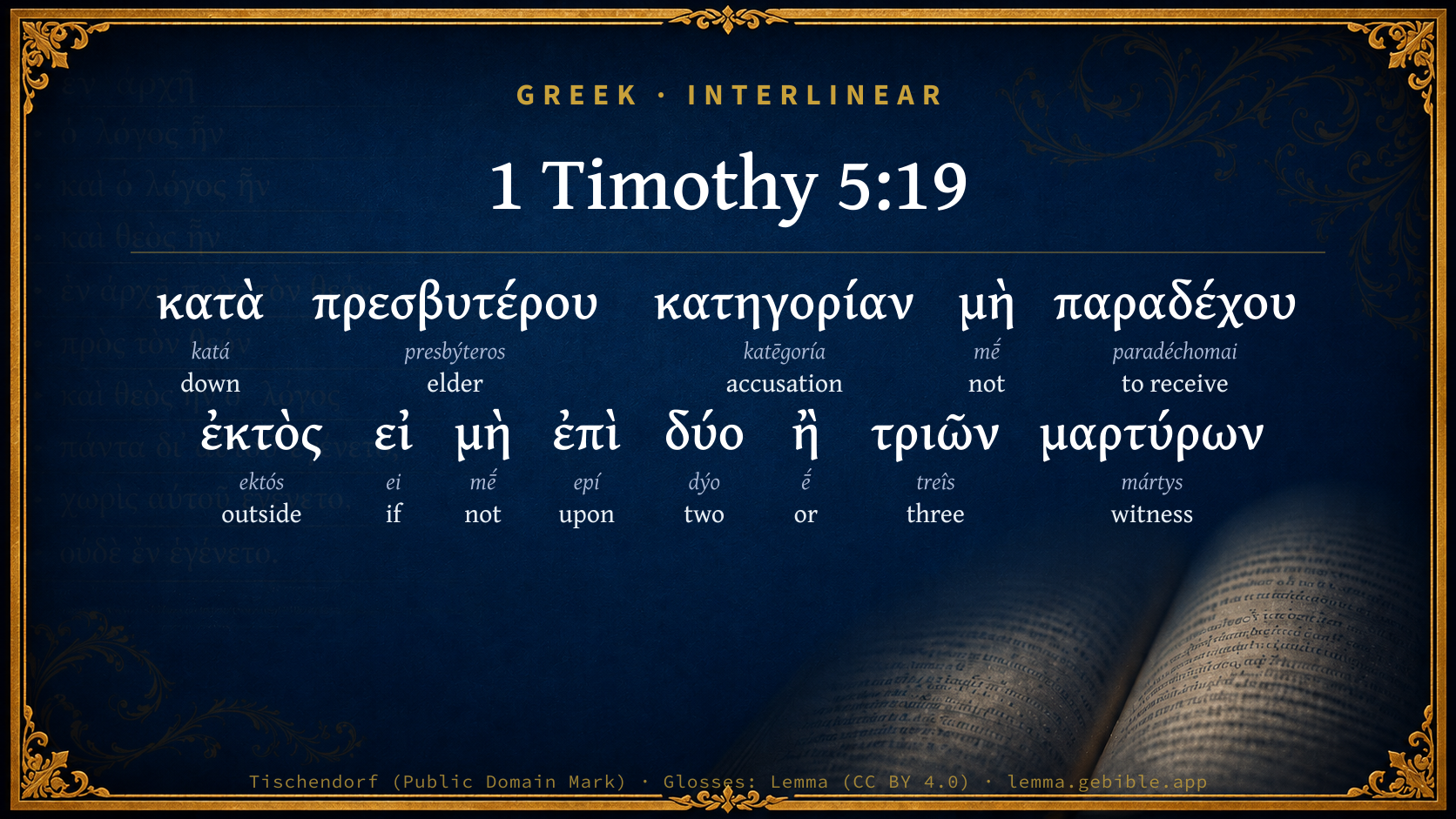
Download image
Cite this verse

1 Timothy 5:19 (World English Bible). Public Domain. Lemma interlinear Bible study tool, https://lemma.gebible.app/v/1-timothy/5/19.

Show BibTeX & RIS
BibTeX
RIS
English Translation
Don't receive an accusation against an elder, except at the word of two or three witnesses.
World English Bible · Public Domain
Download a study sheet

One document with this verse’s original text, its word-by-word gloss line, the meaning frame, cross-references with their text, attributed commentary, and full source and license credits — printable, and it pastes into notes with its structure intact.

This verse Autodidact and up

Study sheet (.html) Plain text (.txt)

A passage Seminary Student

Up to 50 verses in one chapter. A passage sheet keeps up to 6 commentary sources and 12 cross-references per verse, in the order this page ranks them, and says so on the sheet whenever that leaves anything out. Ask for a single verse and you get the Autodidact verse sheet above.

Everything on this page stays free to read, with no account — the sheet is a download of what is already on screen, not access to it.

Want to remove ads? Support Godless Engineer
Compare translations 3

The same verse in 3 English versions, stacked beneath the original-language interlinear above. Click any original word for its lexicon entry.

Each is an independent rendering of the whole verse — the interlinear is not word-aligned to these translations.

Highlighted words mark where these versions differ — a whole-verse word diff, not a word-by-word alignment.

  • World English Bible Public Domain
    Don't receive an accusation against an elder, except at the word of two or three witnesses.
  • King James Version Public Domain
    Against an elder receive not an accusation, but before two or three witnesses.
  • unfoldingWord Literal Text CC BY-SA 4.0
    Against an elder, do not receive an accusation unless on two or three witnesses.

unfoldingWord Literal Text — © unfoldingWord, licensed CC BY-SA 4.0. Word-aligned USFM3 via Door43 (git.door43.org/unfoldingWord/en_ult).

Versions to compare (up to 4)

3 of 4 selected

Show all 19 translations

Every available English version of this verse, each an independent rendering of the whole verse.

  • World English Bible Public Domain
    Don't receive an accusation against an elder, except at the word of two or three witnesses.
  • Berean Standard Bible Public Domain
    Do not entertain an accusation against an elder, except on the testimony of two or three witnesses.
  • Majority Standard Bible Public Domain
    Do not entertain an accusation against an elder, except on the testimony of two or three witnesses.
  • King James Version Public Domain
    Against an elder receive not an accusation, but before two or three witnesses.
  • American Standard Version (1901) Public Domain
    Against an elder receive not an accusation, except at `the mouth of' two or three witnesses.
  • Revised Version (1885) Public Domain
    Against an elder receive not an accusation, except at the mouth of two or three witnesses.
  • Geneva Bible (1599) Public Domain
    Against an Elder receiue none accusation, but vnder two or three witnesses.
  • Douay-Rheims (1899) Public Domain
    Against a priest receive not an accusation, but under two or three witnesses.
  • Young's Literal Translation Public Domain
    Against an elder an accusation receive not, except upon two or three witnesses.
  • Literal Standard Version CC BY-SA 4.0
    Do not receive an accusation against an elder, except on two or three witnesses.
  • Unlocked Literal Bible CC BY-SA 4.0
    Do not receive an accusation against an elder unless there are two or three witnesses.
  • unfoldingWord Literal Text CC BY-SA 4.0
    Against an elder, do not receive an accusation unless on two or three witnesses.
  • Darby Bible Public Domain
    Against an elder receive not an accusation unless where there are two or three witnesses.
  • World Messianic Bible Public Domain
    Don’t receive an accusation against an elder except at the word of two or three witnesses.
  • Webster's Bible Public Domain
    Against an elder receive not an accusation, but before two or three witnesses.
  • Free Bible Version CC BY-SA 4.0
    Don't entertain any accusation against an elder unless two or three witnesses support it.
  • Bible in Basic English Public Domain
    Do not take as true any statement made against one in authority, but only if two or three give witness to it.
  • Text-Critical English NT CC BY 4.0
    Do not accept an accusation against an elder unless it is confirmed by two or three witnesses.
  • Tyndale New Testament (1534) Public Domain
    Agaynst an elder receave none accusacion: but vnder two or thre witnesses.

Literal Standard Version (2020), Covenant Press — licensed CC BY-SA 4.0. Text via the HelloAO Bible API (eBible.org). Unlocked Literal Bible (unfoldingWord) — licensed CC BY-SA 4.0. Text via the HelloAO Bible API (eBible.org). unfoldingWord Literal Text — © unfoldingWord, licensed CC BY-SA 4.0. Word-aligned USFM3 via Door43 (git.door43.org/unfoldingWord/en_ult). Free Bible Version, Dr. Jonathan Gallagher — licensed CC BY-SA 4.0. Text via the HelloAO Bible API (eBible.org).

Word by word

More ways to search: Search by grammar → Find every occurrence → Compare this word →

Practice this passage: Drill this verse → Learn its vocabulary →

About this verse

These counts appear in no published source. They are computed here, from the morphology-tagged text and Lemma’s own curated glosses. What Lemma adds →

13
words
12
distinct lemmas
Pauline Epistles
section

Notable vocabulary

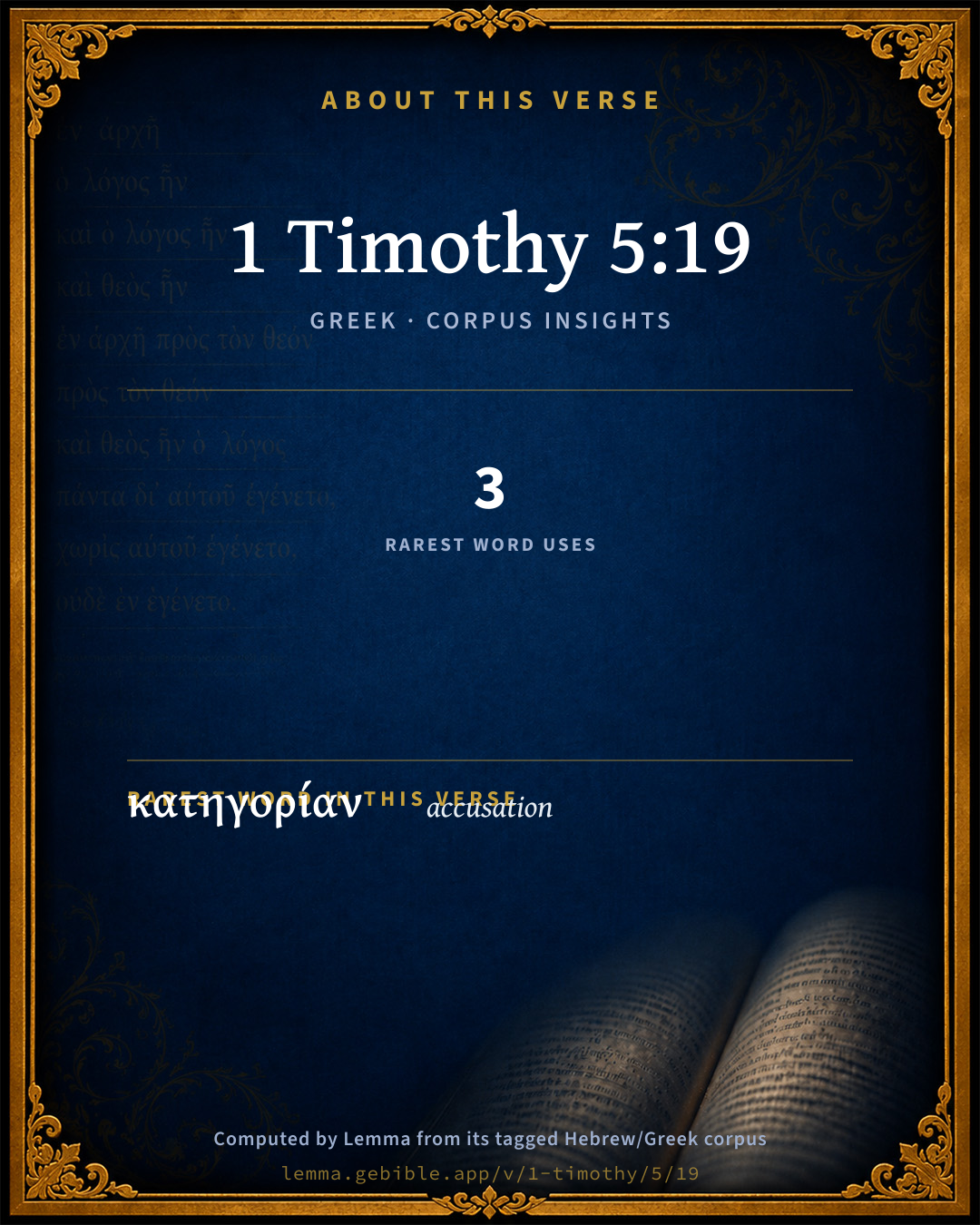
The rarest word here is κατηγορίαν accusation G2724 — appearing just 3 times in the whole Greek New Testament.

Shared distinctive vocabulary

κατηγορίαν accusation G2724 occurs in 3 verses of the Greek New Testament. Also found in:

Repetition

A word recurs within this verse:

Cross-references

12

Topical passages linked to 1 Timothy 5:19 in the Treasury of Scripture Knowledge — connected by theme and wording, ordered by reader-vote popularity; previews shown in the World English Bible.

  • Matthew 18:16 But if he doesn't listen, take one or two more with you, that at the mouth of two or three witnesses every word may be established.
  • Deuteronomy 19:15 One witness shall not rise up against a man for any iniquity, or for any sin, in any sin that he sins: at the mouth of two witnesses, or at the mouth of three witnesses, shall a matter be established.
  • 2 Corinthians 13:1 This is the third time I am coming to you. "At the mouth of two or three witnesses shall every word established."
  • Deuteronomy 17:6 At the mouth of two witnesses, or three witnesses, shall he who is to die be put to death; at the mouth of one witness he shall not be put to death.
  • Titus 1:6 if anyone is blameless, the husband of one wife, having children who believe, who are not accused of loose or unruly behavior.
  • Hebrews 10:28 A man who disregards Moses' law dies without compassion on the word of two or three witnesses.
  • Deuteronomy 19:18–19 and the judges shall make diligent inquisition: and, behold, if the witness is a false witness, and has testified falsely against his brother;
  • John 8:17 It's also written in your law that the testimony of two people is valid.
  • Acts 25:16 To whom I answered that it is not the custom of the Romans to give up any man to destruction, before the accused has met the accusers face to face, and has had opportunity to make his defense concerning the matter laid against him.
  • John 18:29 Pilate therefore went out to them, and said, "What accusation do you bring against this man?"
  • Acts 11:30 which they also did, sending it to the elders by the hands of Barnabas and Saul.
  • Acts 24:2–13 When he was called, Tertullus began to accuse him, saying, "Seeing that by you we enjoy much peace, and that excellent measures are coming to this nation,

Cross-references courtesy of OpenBible.info (CC BY 4.0).

Commentary

Notes on 1 Timothy 5:19 from classic Christian and Jewish commentators (each source and its license shown beneath its notes). The classic Christian expositions comment on the surrounding passage and are grouped to its opening verse, so a note may address several verses; the Jewish commentaries on the Tanakh (Rashi and others) are per-verse, so they appear only where the commentator wrote on this verse.

Lemma curates 59 commentaries, every one of them public domain or Creative Commons licensed, each selected and text-cleaned for this edition rather than reprinted as found. About our sources →

Joseph Benson's Commentary

1Ti 5:19-20. Against an elder — Or presbyter; do not even receive an accusation — Unless it is offered to be proved by two or three credible witnesses — By the Mosaic law a private person might be cited (though not condemned) on the testimony of one witness. But St. Paul forbids an elder to be even cited on such evidence, his reputation being of more importance than that of others. Them that sin — Namely, openly and scandalously, and are duly convicted; rebuke before all the church, that others also may fear — To commit the like offences.

Joseph Benson's Commentary on the Old and New Testaments (1811–1818) — public domain. Text from a community e-Sword module.

Tyndale Open Study Notes

Tyndale Open Resources

5:19-21 The climate created by the false teachers may have led to spurious charges against the leaders of the community. This passage follows the outline of Deut 19:15-21. • two or three witnesses: See Deut 17:6; 19:15; Matt 18:16; 2 Cor 13:1; Heb 10:28.

Tyndale Open Study Notes — © Tyndale Open Resources, licensed CC BY-SA 4.0. Text via the HelloAO Bible API.

Bengel's Gnomon

Johann Albrecht Bengel

1Ti 5:19. Πρεσβυτέρου, an elder) 1Ti 5:17.—κατηγορίαν, accusation) According to the law of Moses, a private person might be summoned, but not condemned, when there was only one witness: Paul directs that an elder should not even be summoned; for both his character as an innocent person stands higher, and he is more exposed to envy and calumny.—μὴ παραδέχου, do not receive) Timothy had therefore the power of judging in the Church, 1Ti 5:21; 1Ti 5:24.

Bengel's Gnomon of the New Testament — English translation (T&T Clark, Edinburgh, 1860) — public domain. Text from a community e-Sword module.

Meyer's Critical & Exegetical Commentary

Heinrich August Wilhelm Meyer

1Ti_5:19. The apostle now defines the proper conduct on Timothys part towards the presbyters who do not superintend the church καλῶς, but expose themselves to blame, thereby doing hurt to their official influence.

Κατὰ πρεσβυτέρου κατηγορίαν μὴ παραδέχου] Chrysostom wrongly remarks on πρεσβυτέρου: οὐχὶ τὸ ἀξίωμα, ἀλλὰ τὴν ἡλικίαν. Timothy is not to receive an accusation (κατηγορια, Luk_6:7; Joh_18:29) in order to decide regarding it, ἐκτὸς εἰ μὴ ἐπὶ δύο ἢ τριῶν μαρτύρων. On the pleonasm, ἐκτὸς εἰ μή, see Lobeck, ad Phryn. p. 459; comp. 1Co_14:5; 1Co_15:2. Paul is here referring manifestly to the Mosaic law, Deu_19:15 (LXX.: ἐπὶ στόματος δύο μαρτύρων καὶ ἐπὶ στόματος τριῶν μαρτύρων στήσεται πᾶν ῥῆμα); comp. Deu_17:6 (ἐπὶ δυσὶ μάρτυσιν ἢ ἐπὶ τρισὶ μάρτυσι). It is a question whether he does so in the sensecorresponding with the lawof ordaining that Timothy is only to receive an accusation against a presbyter when supported by the testimony of two or three witnesses (so de Wette,[189] Wiesinger, van Oosterzee, and in general most expositors); or whether here, as in Mat_18:16, there is only a somewhat general reference to the law, and it is merely said that Timothy is to receive the accusation only when brought before him in presence of two or three witnesses[190] (so Hofmann; comp., too, Winer, p. 351 [E. T. p. 469]; Buttmann, p. 289; ἐπὶ μαρτύρων occurs also in the classics in the sense of before witnesses). As he is not speaking here of a decision, but only of the reception of an accusation (in order that a decision may be made), and as the construction also is irregular, the second view may be adopted as the more probable one (different in the third edition of this commentary). Reference to the law is made in the N. T. also at Mat_18:16; 2Co_13:1, and Heb_10:28; comp., too, Joh_8:17.

[189] De Wettes question, whether Timothy was not to observe this precept of justice in the case of accusations against others, is not to the point. Timothy was not appointed judge over all matters of private dispute.

[190] The suitability of such a precept is manifest when we consider the position which Timothy had to take up towards the presbyters; comp. on this Hofmann.

Meyer — Critical and Exegetical Commentary on the New Testament — English translation by Peter Christie, edited by Frederick Crombie (T&T Clark, 1880) — public domain. Text from a community e-Sword module.

Expositor's Greek Testament

ed. W. Robertson Nicoll

1Ti 5:19 . The mention of καλῶς προεστῶτες πρεσβύτεροι , and of what was due to them, naturally suggests by contrast the consideration of unsatisfactory presbyters. Yet even these were to be protected against the possibility of arbitrary dismissal. They were to have a fair trial in accordance with the provisions of the Old Law, Deu 19:15 (see also Deu 17:6 , Num 35:30 . This requirement of two or three witnesses is used allegorically in 2Co 13:1 . Cf. Joh 8:17 , Heb 10:28 .) It has been asked, Why should this, the ordinary rule, be mentioned at all? The solution is to be found in a consideration of the private, unofficial, character of the Christian Church when this epistle was written. The Church was altogether a voluntary society, unrecognised by the state. The crimes of which its governors could take cognisance were spiritual; or if they were such as were punishable by the ordinary state law, the Church was concerned only with the spiritual and moral aspect of them, that is to say, so far as they affected Church life. There were then no spiritual courts, in the later sense of the term. No Church officer could enforce any but spiritual punishments. In these circumstances, the observance of legal regulations would not be a matter of necessity. Indeed a superintendent who was jealous for the purity of the Church might feel himself justified in acting even on suspicion, when the question arose as to the dismissal of a presbyter.

ἐκτὸς εἰ μή : This phrase arises from a blend of εἰ μή and ἐκτὸς εἰ . Examples of its use are cited from Lucian. Alford notes that similar “pleonastic expressions such as χωρὶς εἰ or εἰ μή , are found in later writers such as Plutarch, Dio Cassius, etc.”. Deissmann cites an instructive example for its use in the Cilician Paul from an inscription of Mopsuestia in Cilicia of the Imperial period ( Bible Studies , trans. p. 118). See reff.

ἐπὶ … μαρτύρων : This seems an abbreviation for ἐπὶ στόματος μαρτ . So R.V. Cf. 2Co 13:1 , Hebr. עַל־פִּי עֵד . It is a different use from ἐπὶ in the sense of before (a judge), Mar 13:9 , Act 25:9-10 . See Blass, Gram . p. 137.

The Expositor's Greek Testament, edited by W. Robertson Nicoll (1897–1910) — public domain. Text from a community e-Sword module.

Geneva Bible (1599)

Geneva Bible translators

The second rule: Let no accusation be admitted against an Elder, but under two or three witnesses.

Geneva Bible (1599) marginal notes — public domain. Text via Bolls.life.

Jamieson, Fausset & Brown

Robert Jamieson, A. R. Fausset & David Brown

Against an elder--a presbyter of the Church.

receive not--"entertain not" [ALFORD].

but before two or three witnesses--A judicial conviction was not permitted in Deu 17:6; Deu 19:15, except on the testimony of at least two or three witnesses (compare Mat 18:16; Joh 8:17; Co2 13:1; Jo1 5:6-7). But Timothy's entertaining an accusation against anyone is a different case, where the object was not judicially to punish, but to admonish: here he might ordinarily entertain it without the need of two or three witnesses; but not in the case of an elder, since the more earnest an elder was to convince gainsayers (Tit 1:9), the more exposed would he be to vexatious and false accusations. How important then was it that Timothy should not, without strong testimony, entertain a charge against presbyters, who should, in order to be efficient, be "blameless" (Ti1 3:2; Tit 1:6). Ti1 5:21, Ti1 5:24 imply that Timothy had the power of judging in the Church. Doubtless he would not condemn any save on the testimony of two or three witnesses, but in ordinary cases he would cite them, as the law of Moses also allowed, though there were only one witness. But in the case of elders, he would require two or three witnesses before even citing them; for their character for innocence stands higher, and they are exposed to envy and calumny more than others "Receive" does not, as ALFORD thinks, include both citation and conviction, but means only the former.

Jamieson, Fausset & Brown — Commentary Critical and Explanatory on the Whole Bible (1871) — public domain (CC PDM 1.0). Text via the HelloAO Bible API.

Adam Clarke's Commentary

Verse 19. Against an elder] Be very cautious of receiving evil reports against those whose business it is to preach to others, and correct their vices. Do not consider an elder as guilty of any alleged crime, unless it be proved by two or three witnesses. This the law of Moses required in respect to all. Among the Romans, a plebeian might be condemned on the deposition of one credible witness; but it required two to convict a senator. The reason of this difference is evident: those whose business it is to correct others will usually have many enemies; great caution, therefore, should be used in admitting accusations against such persons.

Adam Clarke's Commentary on the Bible (1810–1826) — public domain. Text from a community e-Sword/MySword module.

John Calvin's Commentaries

19 Against an elder receive not an accusation After having commanded that salaries should be paid to pastors, he likewise instructs Timothy not to allow them to be assailed by calumnies, or loaded with any accusation but what is supported by sufficient proof. But it may be thought strange, that he represents, as peculiar to elders, a law which is common to all. God lays down, authoritatively, this law as applicable to all cases, that they shall be decided “by the mouth of two or three witnesses.” (Deuteronomy 17:6; Matthew 18:16.) Why then does the Apostle protect elders alone by this privilege, as if it were peculiar to them, that their innocence shall be defended against false accusations?

I reply, this is a necessary remedy against the malice of men; for none are more liable to slanders and calumnies than godly teachers. Not only does it arise from the difficulty of their office, that sometimes they either sink under it, or stagger, or halt, or blunder, in consequence of which wicked men seize many occasions for finding fault with them; but there is this additional vexation, that, although they perform their duty correctly, so as not to commit any error whatever, they never escape a thousand censures. And this is the craftiness of Satan, to draw away the hearts of men from ministers, that instruction may gradually fall into contempt. Thus not only is wrong done to innocent persons, in having their reputation unjustly wounded, (which is exceedingly base in regard to those who hold so honorable a rank,) but the authority of the sacred doctrine of God is diminished.

And this is what Satan, as I have said, chiefly labors to accomplish; for not only is the saying of Plato true in this instance, that “the multitude are malicious, and envy those who are above them,” but the more earnestly any pastor strives to advance the kingdom of Christ, so much the more is he loaded with envy, and so much the fiercer are the assaults made on him. Not only so, but as soon as any charge against the ministers of the word has gone abroad, it is believed as fully as if they were already convicted. This is not merely owing to the higher degree of moral excellence which is demanded from them, but because almost all are tempted by Satan to excessive credulity, so that, without making any inquiry, they eagerly condemn their pastors, whose good name they ought rather to have defended.

On good grounds, therefore, Paul opposes so heinous iniquity, and forbids that elders shall be subjected to the slanders of wicked men till they have been convicted by sufficient proof. We need not wonder, therefore, if they whose duty it is to reprove the faults of all, to oppose the wicked desires of all, and to restrain by their severity every person whom they see going astray, have many enemies. What, then, will be the consequence; if we shall listen indiscriminately to all the slanders that are spread abroad concerning them?

John Calvin's Commentaries (1540-1563) — public domain. Text from the Calvin Translation Society English edition (1840s-50s) via the Christian Classics Ethereal Library (ccel.org). Calvin's coverage is partial (roughly two-thirds of the Bible); uncommented books and verses are honest gaps, never fabricated. The 19th-century editor's footnotes and remarks are omitted so the notes are faithfully Calvin's own voice.

Ellicott's Commentary for English Readers

(19) Against an elder receive not an accusation, but before two or three witnesses.—By the “elder” here we must understand a presbyter—the ordained minister of the Church. St. Paul has been directing his son in the faith, and successor in the government of the chief Asian Church, carefully to watch for, and to reward by dignity and honour, the services of the more zealous and distinguished presbyters. He now tells him that the other matters, besides zeal and successful service among the Church’s professed officers, will come before him when he stands at the helm of the Church. Charges—owing, possibly, to jealousy, party feeling, suspected doctrinal error—will not unfrequently be brought against a presbyter. Such an accusation is only to be received by Timothy when the evidence is perfectly clear. Every possible precaution against simply vexatious charges brought against one occupying the hard and difficult position of a presbyter, must be taken by the presiding minister. The reference is to Deu_17:6.

A Bible Commentary for English Readers, edited by Charles John Ellicott (1878–1897) — public domain. Text from a community e-Sword module.

The Cambridge Bible for Schools and Colleges

gen. ed. J. J. S. Perowne

19. Against an elder] A continuation of Timothy’s official duties towards the presbyters, as is indicated by the context. The Mosaic precept here referred to is given in its most general terms, Deu_19:15, ‘One witness shall not rise up against a man for any iniquity, or for any sin … at the mouth of two witnesses, or at the mouth of three witnesses, shall the matter be established.’ So the preposition rendered by A.V. here ‘before’ is more exactly given R.V. at the mouth of, the phrase being given thus in full, Mat_18:16. Winer’s note, § 47, 9th ed. ‘by, with, on the testimony of … witnesses’ is more exact than the phrase in his text ‘before witnesses.’ The reason for being particular here is that in our idiom ‘to hear a thing only before witnesses’ implies merely sufficient publicity and evidence of its having been heard, an entirely different thing from what the Greek conveys with the context. The preposition by itself would equally well bear either meaning e.g. (1) in 2Co_7:14, ‘our glorying which I made before Titus;’ (2) in the common phrase ‘of a truth,’ Luk_4:25, ‘of a truth,’ i.e. with, on the firm basis of truth, ‘I say unto you.’ Both meanings come from the proper notion of superposition.

but before] Lit. to give an English colloquial pleonasm, ‘except unless.’ So with more stress than ‘but,’ except it be. The phrase occurs 1Co_15:2, where R.V. alters ‘unless’ into ‘except.’ Cf. the old use of ‘but’ according to its derivation, ‘touch not a cat but without a glove,’ and Spenser

‘But this I read that but its remedy

Thou her afford, full shortly I her dead shall see.’

This direction is to be regarded as embodying the sense of what St Paul wished to convey under the form of another quotation from O.T., so that we should paraphrase, ‘except it be,’ in the spirit of the old precept, ‘at the mouth of two or three witnesses,’ and so Drs Westcott and Hort print the words. This is the simplest answer to De Wette’s question whether Timothy is not to observe this judicial rule in all cases as well as merely in the case of an elder. There is no question of the precise observance of this or any other purely ceremonial precepts any longer. The spirit however lives; ‘judge, rebuke, but never on ill-supported accusations.’

The Cambridge Bible for Schools and Colleges (gen. ed. J. J. S. Perowne; Cambridge University Press, 1878–1918) — public domain. Text from a community e-Sword module.

John Gill's Exposition

Them that sin rebuke before all,.... This the apostle adds to the above rule, to show that he was far from screening wicked ministers, or elders, guilty of flagitious crimes, and gross enormities: for these words, though they may be applied unto, and may hold good of all offenders, that are members of churches; yet they seem chiefly to regard elders, even such who sin, who continue to sin, who live in sin, in some notorious sin or another; which is evident and known, to the great scandal of religion, and dishonour of the Gospel: and so some read the words, "them that sin before all, rebuke"; not only admonish once and again, but degrade them from their office, and withdraw from them, as from other disorderly persons, and cut them off, and cast them out of the church, and that in a public manner; and so the Arabic version renders it, "before the congregation": which was done only in case of notorious offences: and which rule is observed by the Jews, and runs thus (h);

"a wise man, an elder in wisdom, and so a prince, or the father of the sanhedrim, that sins, they do not excommunicate him (with Niddui) always "publicly", unless he does as Jeroboam the son of Nebat and his companions; but when he sins other sins, they chastise him privately.''

The end is,

that others also may fear; that other elders, or other members of the church, or both, may fear to do the same evil things, lest they incur the same censure and punishment: the Syriac version reads, "other men"; and the Arabic version, "the rest of the people". The phrase seems to be taken out of Deu 13:11.

(h) Maimon. Talmud Tora, c. 7. sect. 1.

John Gill's Exposition of the Whole Bible (1746–1763) — public domain (CC PDM 1.0). Text via the HelloAO Bible API.

Trapp's Complete Commentary

John Trapp

19 Against an elder receive not an accusation, but before two or three witnesses.

Ver. 19. Receive not an accusation] If to be accused were sufficient to make a man guilty, no good minister should be innocent. Praedicare nihil aliud est quam derivare in se furorem totius mundi, saith Luther. Truth hath always a scratched face. Men hate him that reproveth in the gate. Every fool hath a bolt to shoot at a faithful preacher.

John Trapp, A Commentary or Exposition upon All the Books of the Old and New Testament (1647–1656) — public domain. Text from a community e-Sword module.

Albert Barnes' Notes on the Bible

Against an elder - The word “elder” here seems to be used in the sense in which it is in the previous verse as relating to “office,” and not in the sense of an aged man, as in 1Ti 5:1. The connection demands this interpretation.

Receive not an accusation - He was not to regard such a charge as well founded unless sustained by two or three witnesses. It is clear from this, that Paul supposed that Timothy would be called on to hear charges against others who were in the ministerial office, and to express his judgment on such cases. There is no reason, however, to suppose that he meant that he should hear them alone, or as a “bishop,” for this direction does not make the supposition improper that others would be associated with him. It is just such counsel as would now be given to a Presbyterian or congregational minister, or such as would be given to an associate justice in a court, on the supposition that a brother judge was at any time to be tried by him and his colleagues.

But before two or three witnesses - Margin, “under.” The meaning is, unless supported by the testimony of two or three persons. He was not to regard an accusation against a presbyter as proved, if there was but one witness in the case, however positive he might be in his testimony. The reasons for this direction were probably such as these:

(1) This was the requirement of the Jewish law in all cases, which had thus settled a principle which the apostle seems to have regarded as important, if not obligatory, under the Christian dispensation; see Deu 17:6; Deu 19:15; compare notes on Joh 8:17; 2Co 13:1.

(2) There would be much greater reason to apprehend that one person might be deceived in the matter on which he bore witness, or might do it from malignant motives, or might be bribed to give false testimony, than that two or three would give such testimony; and the arrangement, therefore, furnished important security for the innocent.

(3) There might be reason to apprehend that evil-minded persons might be disposed to bring charges against the ministers of the gospel or other officers of the church, and it was important, therefore, that their rights should be guarded with anxious care. The ministers of religion often give offence to wicked people by their rebukes of sin (compare Mar 6:17-20); wicked people would rejoice to see an accusation against them sustained; the cause of religion would be liable to suffer much when its ministers were condemned as guilty of gross offences, and it is right, therefore, that the evidence in the case should be as free as possible from all suspicion that it is caused by malignity, by hatred of religion, or by conspiracy, or by a desire to see religion disgraced.

(4) The character of a minister of the gospel is of value, not only to himself and family, as is the case with that of other people, but is of special value to the church, and to the cause of religion. It is the property of the church. The interests of religion depend much on it, and it should not be wantonly assailed; and every precaution should be adopted that Christianity should not be deprived of the advantage which may be derived in its favor from the piety, experience, and talents of its public defenders. At the same time, however, the wicked, though in the ministry, should not be screened from the punishment which they deserve. The apostle gave no injunction to attempt to cover up their faults, or to save them from a fair trial. He only demanded such security as the nature of the case required, that the trial should be fair. If a minister of the gospel has been proved to be guilty of crime, the honor of religion, as well as simple justice, requires that he shall be punished as he deserves. He sins against great light; he prostitutes a holy office, and makes use of the very reputation which his office gives him, that he may betray the confidence of others; and such a man should not escape. There should be no “benefit of clergy,” and neither a black coat, nor bands, nor the lawn should save a villain.

Albert Barnes' Notes on the Bible (1834–1885) — public domain. Text from a community e-Sword/MySword module.

Haydock's Catholic Bible Commentary

Against a priest. The word presbyter[9] is commonly here expounded of bishops and priests; though St. John Chrysostom understands it of men advanced in age. --- Receive not an accusation; i.e. do not sit as judge, nor hearken to such information. (Witham)

===============================

[BIBLIOGRAPHY]

Adversus presbyterum, Greek: kata presbuterou. And St. John Chrysostom, (p. 313.) Greek: ten elikian.

George Leo Haydock (1774–1849), Haydock's Catholic Family Bible and Commentary, 1859 edition — public domain. Excludes Psalms (Douay-Rheims chapter numbering differs from Protestant) and Deuterocanonical books (Catholic canon only).

Matthew Poole's English Annotations

Against an elder; whether an elder in years or in office, though the latter being the persons formerly spoken of, seen here principally intended.

Recieve not an accusation, but before two or three witnesses; that is, not to proceed to any judicial inquiry upon it, Deu 17:6. This was a law concerning all elders or younger persons, especially in capital causes, but the apostle willeth this to be more specially observed as to officers in the church, whose faithful discharge of their trusts usually more exposeth them to people’s querulous tongues.

Matthew Poole's English Annotations on the Holy Bible (1683–1685) — public domain. Text from a community e-Sword/MySword module.

Whedon's Commentary on the Bible

Daniel D. Whedon

19. Trial of elders.

Two or three witnesses—Moses (Deu_19:15) required that number of witnesses to condemn a man; St. Paul requires that number to even put an elder on trial. The character of the man demanded a double amount of presumption against him.

Daniel D. Whedon (gen. ed.), Commentary on the Old and New Testaments (1874–1909) — public domain. Text from a community e-Sword module.

The Pulpit Commentary

Except at the mouth of for but before, A.V An elder; here clearly a presbyter, as the context proves. Receive (paradecou); give ear to, entertain; as in Act_22:18, "They will not receive thy testimony." At the mouth of, etc. There is a reference to the law in Numbers Deu_19:15, and elsewhere (to which our Lord also refers, (Joh_8:17) and St. Paul applies the principle of the law to Timothy"s dealings with presbyters who might be accused of not "ruling well." He was not to encourage delatores, secret accusers and defamers, but if any one had a charge to make against a ruler, it was to be done in the presence of witnesses (ejpi with a genitive). A doubt arises whether" the witnesses" here spoken of were to be witnesses able to support the accusation, or merely witnesses in whose presence the accusation must be made. The juxtaposition of the legal terms kathgoria and ejpirwn favors the strict meaning of marturwn, witnesses able to support the kathgoria. And, therefore, the direction to Timothy is, "Suffer no man to accuse a presbyter unless he is accompanied by two or three witnesses who are ready to back up the accusation." The italic the mouth of, in the R.V, is not necessary or indeed justified. There is no ellipsis of stomatov. jEtio h triwn% marturwn, before two or three witnesses," is good classical Greek.

Directions as to accusations against elders.

an elder receive not an accusation, except it be upon two or three witnesses.

I ELDERS MAY BE EXPOSED TO SUCH ACCUSATIONS BY THEIR VERY ZEAL AND FAITHFULNESS.

1. Their duty being to convince the gainsayers and to reprove the faults of men, they would be exposed to the risk of false accusation. Good ministers would be oftener accused if their accusers could but find judges willing to receive their charges.

2. It is the interest of the Church of Christ to maintain the reputation of its ministers unchallenged. It involves a sort of scandal for them to be accused at all, even though they should afterwards be cleared.

II THE COURSE RECOMMENDED IN CASES OF THIS SORT.

1. It diminishes the chances of such charges being made, that the testimony of a single malicious witness will not suffice to have an accusation even formally considered.

2. It would be a serious discouragement to a good minister for such charges to be entertained upon partial or defective evidence.

3. The deference due to the position of a man chosen by the Church as its pastor demanded a wise caution in the reception of charges against him.

4. Yet it was the duty of Timothy to make an investigation supported by adequate evidence. There is nothing in the minister"s position to exempt him from a just inquiry and its due consequences . T.C.

The Pulpit Commentary (1880–1919), ed. H.D.M. Spence-Jones & Joseph S. Exell — public domain. Text from a community e-Sword module.

John Wesley's Explanatory Notes

Against an elder - Or presbyter. Do not even receive an accusation, unless by two or three witnesses - By the Mosaic law, a private person might be cited (though not condemned) on the testimony of one witness; but St. Paul forbids an elder to be even cited on such evidence, his reputation being of more importance than that of others.

John Wesley, Explanatory Notes Upon the Whole Bible (1754–1765) — public domain. Text via the GEBible commentary corpus.

Burkitt's Expository Notes on the New Testament

William Burkitt

Here our apostle directs Timothy how to proceed in church censures against open offenders: which plainly shows, that there was a right of judging and censuring offenders in Timothy, by virtue of his office.

First then he begins to acquaint him with his duty in censuring an elder, and advises him never to admit an accusation against such, without the attestation of two or three witnesses: because,

1. It is the interest of the church of Christ, that the reputation of its ministers be supported.

2. Because prejudiced persons will be ready to accuse without reason.

Conscientious ministers shall never want accusers, if false accusers can but find judges that are willing to believe them: therefore against an elder receive not an accusation, but before two or three witnesses:

Next he advises him, when there is a just and sufficient cause for censuring an elder, to do it publicly. Then that sin, that is, such elders as sin, and are convicted of it, and so become scandalous by it, rebuke before all the church, before all the clergy as in a synod, putting them to public shame, that others may fear to sin, seeing thee to punish so publicly and impartially.

Lastly, he concludes his advice with a very solemn charge to Timothy, before God and Christ and the glorious angels, to observe these rules of justice in ecclesiastical judicature, without preferring one man before another, doing nothing by a partial respect of persons.

Learn hence, That so heinous is the sin of unjust and unrighteous judging, especially in ecclesiastical persons, and of such fatal mischief to the church, that all imaginable care and caution ought to be taken to prevent both the sin and the danger of it. I charge thee before God, and the Lord Jesus Christ, that thou observe these things.

William Burkitt's Expository Notes on the New Testament (1700–1703) — public domain. Text from a community e-Sword module.

The People's New Testament

B. W. Johnson

19. Against an elder receive not. Accusations against bishops might be brought before Timothy. They were not to be considered unless supported by two or three witnesses. The same rule is found in Deut. 19:15.

B. W. Johnson's The People's New Testament with Notes (1889–1891) — public domain. Electronic text from the Christian Classics Ethereal Library (CCEL) ThML edition.

unfoldingWord translationNotes

Door43 World Missions Community

Do not receive an accusation

Paul speaks of accusations as if they were objects that could be physically accepted by people. AT: "Do not accept as true any accusation that someone speaks" (See: Metaphor)

two or three

"at least two" or "two or more"

sinners

This refers to anyone doing anything that disobeys or displeases God, even things that other people do not know about.

before all

"where everyone can see"

so that the rest may be afraid

"so that others will be afraid to sin"

translationWords

accuse

elder

testimony

sin

fear

unfoldingWord translationNotes — © Distant Shores Media and the Door43 World Missions Community, licensed CC BY-SA 4.0. Source: git.door43.org/Door43/en_tn.

Cambridge Greek Testament for Schools and Colleges

19. Some Latin MSS. known to Jerome seem to have omitted the words ἐκτὸς … μαρτύρων; and it is possible that we have a trace of this in Cyprian Test. iii. 76; but the variant is only a curiosity of criticism.

19. κατὰ πρεσβυτέρου κατηγορίαν κ.τ.λ. Against a presbyter receive not an accusation except &c. κατηγορία and παραδέχομαι are not found in St Paul’s writings outside the Pastorals, but they are common words, although the former does not happen to occur in the LXX. We have κατήγορος, κατηγορεῖν frequently in the Greek Bible (e.g. Rom 2:15).

ἐκτὸς εἰ μή. We have this pleonastic form of negation at 1Co 14:5; 1Co 15:2; it is fairly common in late writers such as Plutarch[532].

[532] See Deissmann, Bibelstudien, p. 115, who points out that ἐκτὸς εἱ μή is found in an inscription of Mopsuestia in Cilicia.

ἐπὶ δύο ἤ τριῶν μαρτύρων. Words taken in substance from Deu 19:15; cp. Deu 17:6. The general principle is appealed to by St Paul in 2Co 13:1, by our Lord in Joh 8:17, and also in Heb 10:28. The force of ἐπὶ is hardly doubtful. The analogy of 2Co 13:1 confirms the translation of the R.V. at the mouth of, which is the meaning of the precept in its original place in Deu 19:15 ἐπὶ στόματος δύο μαρτύρων κ.τ.λ. And we adopt this rendering, although στόματος is omitted in the verse before us, and although ἐπὶ with the gen. (as in 1Co 6:1) gives a good sense, in the presence of, coram. The precept is here interesting, as marking the beginnings of presbyteral discipline. Timothy is directed, in order to avoid any slightest injustice, to follow the precedents of the old law in his supervision of the Church at Ephesus. Two witnesses at least must give evidence if charges against a presbyter are to be entertained.

Cambridge Greek Testament for Schools and Colleges (Cambridge University Press, 1896; 21 vols, various authors incl. Carr, Maclear, Plummer, Farrar, Lumby, Moule, M. R. James, Simcox) — public domain. Text from a community e-Sword module.

Alford’s Greek Testament

Henry Alford

19.] See the summary above. Against a presbyter (Chrys., Thl., are certainly wrong in supposing that age, not office is again here indicated: the whole passage is of presbyters by office—cf. ver. 22 below) entertain not an accusation, except (reff. pleonastic expressions such as ἐκτὸς εἰ μή, χωρὶς εἰ or εἰ μή, are found in later writers, such as Plutarch, Dio Cassius, &c.: we have πλὴν εἰ μή in Demosth. 141. 21, 719. 1: Aristot. de Anim. i. 5. 9, al. See Lobeck on Phrynichus, p. 459) before (lit. in presence of; and perhaps we ought to press the meaning: but from the occurrence of ἐπὶ στόματος δύο μαρτ. κ.τ.λ. in ref. Deut., it is more likely figurative, ‘in the presence of,’ signifying merely ‘vorhandenseyn,’ their presence in the case) two or three witnesses (De W. asks,—but were not these required in every case, not only in that of a presbyter? Three answers are given: one by Chrys. (τὸ δὲ ἐπὶ ἄλλων, φησί, μάλιστα δὲ κατὰ πρεσβυτέρου), Thdrt. (συμβαίνει γὰρ ἐκκλησίας αὐτὸν προστασίαν πεπιστευμένον καὶ λυπῆσαι τῶν ἁμαρτανόντων τινάς, εἶτα ἐντεῦθεν ἐκείνους δεομένως διατεθέντας συκοφαντίαν ὑφῆναι. δεῖ τοίνυν ἀπαντῆσαι τῶν μαρτύρων τὸν ἀριθμόν), and so Calvin at more length: the other by Huther, that Timotheus was not constituted judge in private men’s matters, only over the officers of the church in faults with which they might be charged as regarded the execution of their duty: a third by Bengel,—‘privatus poterat, lege Mosis, citari uno teste, non condemnari: presbyterum ne citari quidem Paulus jubet, &c.’ But this is manifestly a distinction without point—the κατηγορίαν παραδέχεσθαι being used not of mere citation, but of entertaining the charge as a valid one: in other words, as including citation and conviction as well. So nearly Grotius, but bringing out a different distinction, which is manifestly here not in question—‘poterat ad unius testis dictum vir plebeius capi aut contra eum inquisitio incipi: non ita autem contra Senatorem, cui æquiparatur Presbyter.’ The first reason seems the more probable: that he is only recalling the attention of Timotheus to a known and prescribed precaution, which was in this case especially to be always observed. Somewhat otherwise Ellicott: see his note).

Henry Alford, The Greek Testament (1849–1861) — public domain. Text from a community e-Sword module.

International Critical Commentary

19. ἐπὶ δύο . . . μαρτύρων] The words were omitted in some MSS known to Jerome, but in no extant MS, and are necessary to the context. Perhaps “Do not let an accusation be brought before you in private, unless two or three witnesses are present with you to hear it” (Holtzmann, Wohlenberg, cf. Apost. Canon 74, ἐπίσκοπον κατηγορηθέντα ἐπί τινι παρὰ ἀξιοπίστων ἀνθρώπων καλεῖσθαι αὐτὸν ἀνάγκαιον), where the trial follows: but more probably it refers to the actual trial, a short phrase equivalent to ἐπὶ στόματος δύο κ.τ.λ., “unless two or three support the charge with their evidence”—the rule of Jewish law (Deu 19:15) taken up by our Lord (Mat 18:16), by St. Paul (2Co 13:1), and later applied to a charge against an ἐπίσκοπος, Apost. Canon 75, which limits the witnesses to orthodox Christians, εἰς μαρτυρίαν τὴν κατʼ ἐπισκόπου αἰρετικ̣ὸν μὴ προσδέχεσθαι, ἀλλὰ μηδὲ πιστῶν ἕνα μόνον.

International Critical Commentary — older volumes (1896–1929), various authors — public domain. Text from a community e-Sword module.

Vincent's Word Studies in the New Testament

Marvin R. Vincent

Receive not an accusation [κατηγοριαν μη παραδεχου] . Neither word in Paul. For accusation see on. Joh 5:45. It means a formal accusation before a tribunal. The compound verb para emphasises the giver or transmitter of the thing received : to receive from another. But [εκτος ει μη] . Except. A pleonastic formula, except in case. The formula in 1Co 14:5; 1Co 14:9.

Before [επι] . Or on the authority of. On condition that two witnesses testify. The O. T. law on this point in Deu 19:15. Comp. Mt 18:16; Joh 8:17; 9 1Co 13:1.

Marvin R. Vincent, Word Studies in the New Testament (1887–1900) — public domain. Text from a community e-Sword/MySword module.

Lesson kit

Teaching starters — assembled from the data on this page, not authored interpretation. Every prompt links to the verse data it draws on. Edit before teaching.

1 Timothy, in the Pauline Epistles, opens this verse with 13 words (12 distinct Greek lemmas). Its most distinctive word is katēgoría (“accusation”). A historical commentator’s framing appears above. Read the whole chapter for the surrounding context.

Discussion questions

  1. The word katēgoría carries the sense “accusation.” How does it shape the verse?
  2. John 18:29 shares the word «accusation» with this verse. How do the two illuminate each other?
  3. “not” occurs 2× in this one verse. What is the effect of the repetition?
  4. These translations render this verse differently. What is at stake in choosing one wording over another?
  5. Reading how Joseph Benson's Commentary and Tyndale Open Study Notes read this verse, where do the two commentators agree and where do they part?

Things to notice

Reading settings

Reading text

Shown beneath each verse's original-language words.

Old Testament
Old Testament edition

Read the OT as the Masoretic Hebrew (MT) or the Greek Septuagint (LXX).

English shown for the Greek Septuagint (in the Hebrew ↔ Greek comparison).

Comparing translations? Open the Compare panel on any verse page to stack up to four side by side.