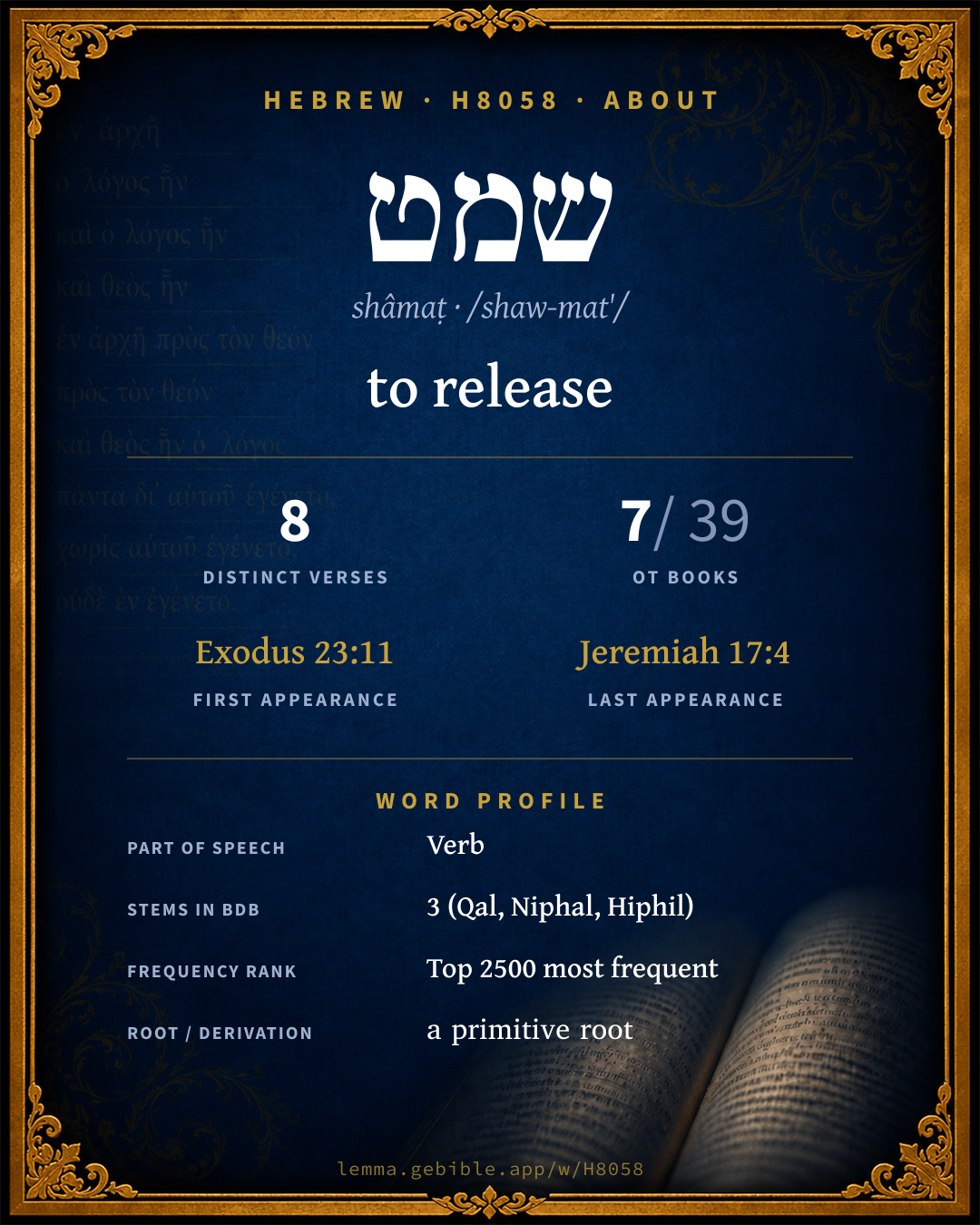
שָׁמַט
to release
‘to release’ is one of 3 main senses fuller range ↓
Full lexicon entry — Brown-Driver-Briggs (BDB)
From Brown-Driver-Briggs (BDB)
Where this word appears
See every Qal verb in the Hebrew Bible →
Grammar key — what these labels mean
Part of speech
- Verb
- An action or state-of-being word.
Stem
- Qal
- The basic, simple active stem — the plain form of the verb (“he wrote”). Here: ‘let drop’
- Niphal
- Usually the simple passive or reflexive of the Qal (“he was written”).
- Hiphil
- The causative active stem (“he caused / brought about”).
Form
- Perfect
- A completed action or state — Hebrew marks aspect (completeness) more than strict tense (“he wrote”).
- Sequential Perfect
- A perfect with prefixed waw continuing a preceding imperfect or command (waw-consecutive perfect).
- Sequential Imperfect
- An imperfect with prefixed waw — the standard past-narrative form (waw-consecutive imperfect).
- Jussive
- A third- or second-person volitional form expressing wish or command (“let him write”).
- Infinitive Absolute
- An unbound verbal noun, often intensifying or standing in for a finite verb.
- Imperfect
- An incomplete, ongoing, or future action (“he will / would write”).
- Imperative
- A direct command (“write!”).
Person
- 3rd Person
- The one spoken about (“he / she / it / they”).
- 2nd Person
- The one addressed (“you”).
Gender
- Common
- Either gender — not distinguished for this form.
- Masculine
- Grammatically masculine.
- Feminine
- Grammatically feminine.
Number
- Plural
- More than one (in Hebrew, generally three or more).
- Singular
- One.
Grammatical forms
- Verb, Qal, Perfect, 3rd Person, Common, Plural 2 times (20%)
- Verb, Qal, Imperative, 2nd Person, Masculine, Plural 2 times (20%)
- Verb, Qal, Sequential Perfect, 2nd Person, Masculine, Singular 1 time (10%)
- Verb, Qal, Sequential Imperfect, 3rd Person, Masculine, Plural 1 time (10%)
- Verb, Niphal, Perfect, 3rd Person, Common, Plural 1 time (10%)
- Verb, Hiphil, Jussive, 3rd Person, Feminine, Singular 1 time (10%)
- Verb, Qal, Infinitive Absolute 1 time (10%)
- Verb, Qal, Imperfect, 2nd Person, Masculine, Singular 1 time (10%)
Parsed forms decoded from the imported morphology (morphhb / Westminster Leningrad Codex — WLC text public domain, morphhb tagging CC BY 4.0), counted across 10 parsed occurrences — not distinct verses.
Every verse where H8058 appears — 8 distinct verses across 7 books. Click any verse to open its interlinear word-by-word view. Verse text shown in the World English Bible for context — . Each verse’s Hebrew form is shown with its reference; the English is not keyword-highlighted, since the data carries no word-level English alignment. Use “Compare translations” on any verse to read it across multiple English versions. This concordance covers the Hebrew Bible; Septuagint (Greek Old Testament) occurrences are not indexed here.
Exodus 1 verse
Deuteronomy 2 verses
- Deuteronomy 15:2 שָׁמ֗וֹט Qal inf.abs This is the manner of the release: every creditor shall release that which he has lent to his neighbor; he shall not exact it of his neighbor and his brother; because Yahweh's release has been proclaimed.
- Deuteronomy 15:3 תַּשְׁמֵ֥ט Hiphil juss 3fs Of a foreigner you may exact it: but whatever of your is with your brother your hand shall release.
2 Samuel 1 verse
2 Kings 1 verse
1 Chronicles 1 verse
Psalms 1 verse
Jeremiah 1 verse
About this entry
At a glance — auto-summarized from this page’s data, not written by a person. Every figure links to its source below. This summary describes the numbers; it doesn’t interpret them.
At its core, שמט (shâmaṭ) means “to release.” First canonically at Exodus 23:11, it enters the text early. With 8 verses in 7 books, it is an uncommon word in the Hebrew Bible. Its uses concentrate in Deuteronomy (25% of all occurrences). Read the stem: it spans 3 stems, including Qal and Niphal. Dig into 8-verse concordance and the renderings breakdown below.
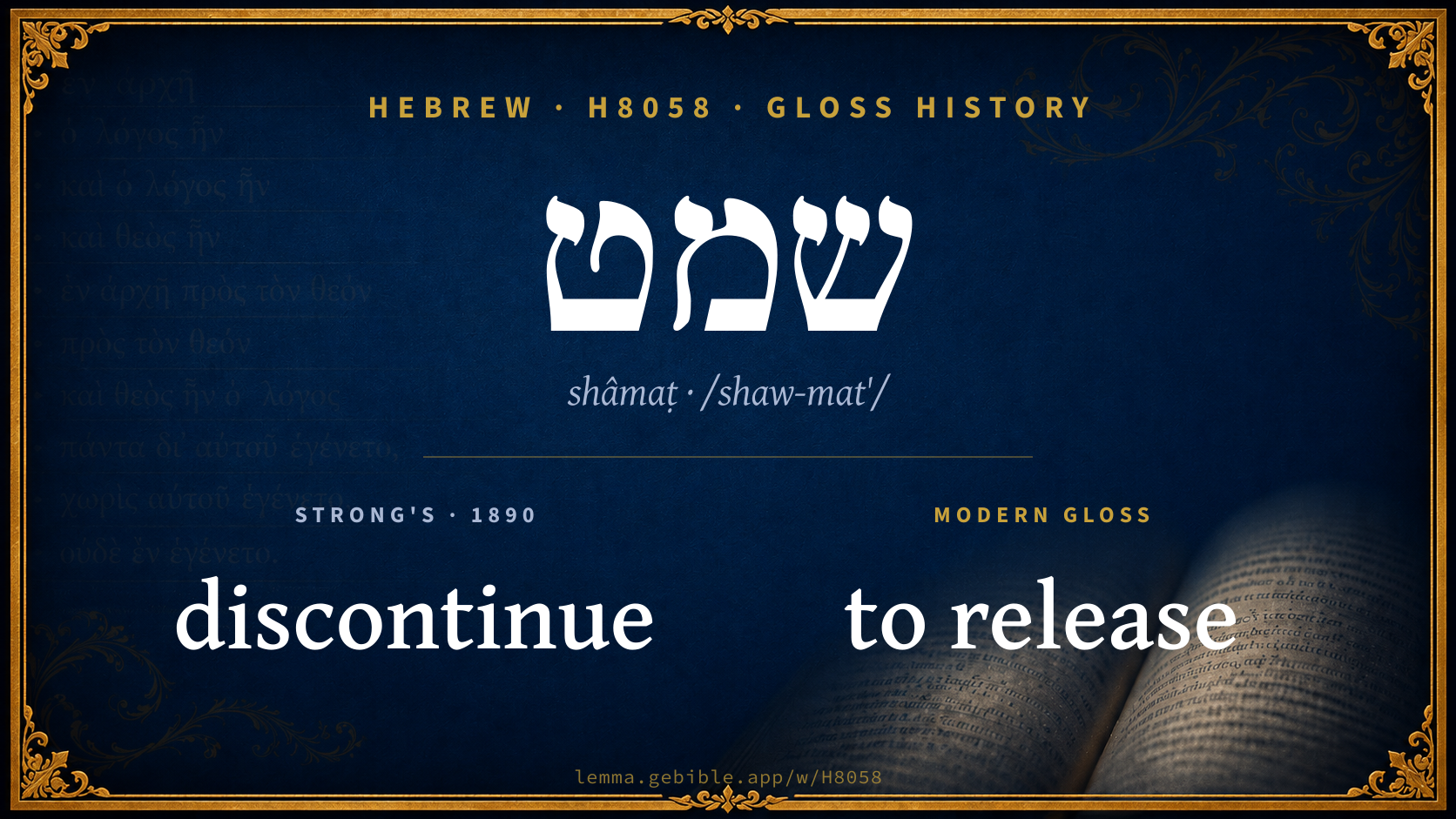
Gloss history
Strong's 1890 vs modern scholarship
About this word
Strong's H8058 catalogs a Hebrew word from the Hebrew Old Testament.
These counts are not copied from any lexicon or concordance. They are computed here, from the morphology-tagged Hebrew Old Testament. What Lemma adds →
- 8
- distinct verses
- The word appears in 8 distinct verses.
- 7 / 39
- OT books
- The word appears in 7 of 39 Old Testament books.
- #2,342
- by frequency
- Top 2500 most frequent Hebrew words (rank 2,342 of 8,640 Hebrew words by occurrence).
View all 8 occurrences in the concordance →
Most concentrated in
- Deuteronomy 2 verses 25%
- Exodus 1 verse 13%
- 2 Samuel 1 verse 13%
By section of the Old Testament
By traditional corpus
Conventional, traditional groupings — biblical authorship is debated, so this is a traditional corpus grouping, not an authorship claim. Each share is this word’s portion of its verses in that division of the Hebrew canon. Each figure is a share of the word’s 8 distinct verses.
- Torah (Pentateuch) 3 verses · 38%
- Prophets (Nevi'im) 3 verses · 38%
- Writings (Ketuvim) 2 verses · 25%
How translations render this word
Counts come from each version’s own published word-to-Strong’s tagging or interlinear alignment — an approximate guide to how each version renders this word, not a word-level alignment the data otherwise carries. Because each total is that version’s own tagged count, the per-version totals vary from one another and need not match the appearance or distinct-verse counts above. These counts may also differ from a printed concordance because Lemma counts each distinctly tagged rendering and does not collapse phrase taggings into a single head-word total. This is a fixed set of word-tagged versions (KJV, ASV, BSB, ULT) and does not change with the reading translation you choose elsewhere. Each version’s license is shown beside its name below (and on Sources).
- King James Version: Shall release 2×
- American Standard Version: Shall release 2×
- Berean Standard Bible: Had stumbled 2×
- unfoldingWord Literal Text: Shall release 2×, Stumbled 2×
King James Version Public Domain
Renders H8058 across 9 tagged occurrences — most commonly:
Plus 7 renderings that appear only once — usually multi-word phrases or single function words the recovered tagging swept in, not distinct renderings.
American Standard Version Public Domain
Renders H8058 across 9 tagged occurrences — most commonly:
Plus 7 renderings that appear only once — usually multi-word phrases or single function words the recovered tagging swept in, not distinct renderings.
Berean Standard Bible Public Domain
Renders H8058 across 9 tagged occurrences — most commonly:
Plus 7 renderings that appear only once — usually multi-word phrases or single function words the recovered tagging swept in, not distinct renderings.
unfoldingWord Literal Text CC BY-SA 4.0
Renders H8058 across 9 tagged occurrences — most commonly:
Plus 5 renderings that appear only once — usually multi-word phrases or single function words the recovered tagging swept in, not distinct renderings.
Senses in the full BDB
Hebrew verbs can shift meaning by stem (binyan): Qal is the basic action, Niphal is often passive or reflexive, Piel often intensifies or makes it factitive, and Hiphil is typically causative. The senses below are grouped under the stem BDB assigns to each.
What do BDB’s symbols mean?
BDB uses these scholarly abbreviations:
| Symbol | Meaning |
|---|---|
| 𝔊 | the Septuagint (the ancient Greek translation, LXX) |
| 𝔙 | the Vulgate (the Latin translation) |
| 𝔖 | the Syriac version (the Peshitta) |
| 𝔗 | the Targum (the Aramaic translation) |
| ψ | the Psalms |
| √ | root (the underlying root or stem) |
| ‖ | parallel passage (a synonymous or contrasted parallel) |
| † | the dagger: every passage where the word occurs is cited |
The 3 senses and sub-senses the full Brown-Driver-Briggs lexicon distinguishes for this word, in lexicon order (not ranked by frequency), with BDB’s own verbatim wording and sub-sense lettering. Shown in Hebrew script with BDB’s own scholarly abbreviations. The condensed entry is in the Lexicon Entry tab. See also the Forms in the corpus table below.
Qal
- let drop, fall
Niphal
- . their judges have been thrown down
Hiphil
- . thou shalt cause thy hand to let drop, etc.
Senses from the full Brown-Driver-Briggs lexicon (Brown, Driver, Briggs; Oxford 1906 — public domain), digitized via Sefaria, supplemented by the OpenScriptures HebrewLexicon (CC BY 4.0). Full attribution on Sources.
Word origin
[ שָׁמַט ] vb. let drop
— Brown-Driver-Briggs (Oxford 1906, public domain), digitized via Sefaria, supplemented by the OpenScriptures HebrewLexicon (CC BY 4.0). See Sources.
Origin: a primitive root
Jastrow Dictionary
A second Hebrew/Aramaic lexicon for comparison, covering Aramaic and post-biblical (Talmudic, Targumic, Midrashic) usage that the biblical-Hebrew BDB does not. Matched by lemma rather than by Strong’s number, so a lemma may carry more than one Jastrow headword (shown separately below), and the entries cover usage well beyond the Bible.
שָׁמַט
- to slip; (act. verb) to loosen, detach; to carry off, steal. Num. R. s. 420 (ref. to II Sam. VI, 6) למה שָׁמְטוּ why did they slip (turn off)? M. Kat. 24ᵃ שמטו חזירים וכ׳ swine dragged his body off. Y. Ber. III, 5ᵈ bot., a. e. שׁוֹמֵט וכ׳, v. קְלִבִּנְטִירִין. Ib. מטה … שׁוֹמְטָן ודיו in the case of a bed the poles of which are movable, one (in mourning) detaches them, and that is sufficient; Y. Ned. VII, end, 40ᶜ שומטו (corr. acc.). B. Mets. 104ᵃ שׁוֹמְטוֹ מעל גבי בניו he may take it (the pledge) from the back of his (the debtor’s) sons. Ex. R. s. 43 והם שׁוֹמְטִים וכ׳, v. טֶטְרָאמוּלִי. Y. Keth. V, 30ᵇ היתה שׁוֹמֶטֶת עצמה וכ׳ she slipped away from under him; Sot. 9ᵇ נִשְׁמְטָה (Nif.). Gen. R. s. 14 שׁוֹמְטָהּ, v. צָרַר I. Pesik. R. s. 20 נִשְׁמוֹט אותה let us abandon her (that she may not find her way home); מיד שְׁמָטוּהָ (not שמוטה) and so they abandoned her. Lev. R. s. 34 יִשְׁמוֹט, v. חָלַץ. Gen. R. s. 20 שומט גידין וכ׳ it (the serpent) draws out fibres (v. גִּיד) and eats them. Midr. Till. to Ps. CXIV (ref. to Deut. IV, 34 גוי מקרב גוי) כאדם ששומט את העובר וכ׳ as a man draws an embryo out of its mother’s womb. Ib. למדנו צער לנִשְׁמָט לשומט מנין we learn here that there was pain for the body drawn out (Israel), whence do we learn that it was painful for him that drew out (for the Lord who redeemed them)?; a. fr.—Part. pass. שָׁמוּט; f. שְׁמוּטָה. Ḥull. 54ᵃ ש׳ ושחוטה וכ׳ if the trachea was found detached, yet cut through, the animal is kasher; שא"א לש׳ וכ׳ for it is impossible that a loose trachea should be cut through (therefore the detachment must have taken place after the ritual cutting). Ib. 57ᵃ, a. e. שְׁמוּטַת ורך an animal with a dislocated thigh-bone; שמוטת וד with a dislocated foreleg; a. e.—V. שָׁמוּט. e.g. 2 Samuel 6:6
- to be detached, slip away. Midr. Till. l. c., v. supra. Sot. l. c., v. supra. Num. R. s. 18 הר חורב שעליו נִשִׁמְטָה החרב וכ׳ it is named mount Horeb, because on it the sword (of judgment) was unsheathed (for crimes); (Yalk. ib. 684 נמשכה; Yalk. Ps. 796 נמתחה). Macc. II, 1, v. קַתְּ. Sifra Emor, ch. II, Par. 3 (expl. שרוע, Lev. XXI, 18) שנשמטה יריכו (Rabad שנשתרבבה) whose hip is dislocated. Cant. R. to V, 16 (ממנו) נשמטה נפשו his soul slipped away (from him), he fainted; a. fr.—[Tosef. ‘Uktsin I, 2 (Tbul Yom III) נשמטין, read with ed. Zuck. נִכְסָסִין.] e.g. Leviticus 21:18
- 1. to loosen, pluck, esp. to thin a thicket of reeds. Tosef. Shebi. I, 7; Y. ib. II, 33ᵈ top מְשַׁמְּטִין בקנים you may thin reeds (in the Sabbatical year); מקום … ולְשַׁמֵּט וכ׳ where it is customary to clear vines and to thin reeds before &c.; a. e.
- 2. to drag forth. Pesik. R. s. 17 ומְשַׁמְּטִים הבכורות מבין וכ׳ and the dogs dragged the dead bodies of the first-born out of the burial caves; Yalk. Ex. 186; a. e.
- 3. (v. שְׁמִטָּה) to cause release from debt; to cause cessation of field labor; (neut. verb) to come under the law of limitation of the Sabbatical year; (of the ground) to rest. Shebi. X, 1 שביעית מְשַׁמֶּטֶת את המלוה וכ׳ the Sabbatical year causes cancellation of (cash) debts, whether verbal or written; הקפת … אינה משמטת, v. הַקָּפָה; שכר שכיר אינו מְשַׁמֵּט a hired man’s wages do not come under the law of sh’miṭṭah; ib. 2 המוסר … אינן משמטין (not אינו) if one hands his notes over to the court, they are not subject to the law of limitation; ib. האונס … וכל מעשה ב"ד אינן משמטין fines for outrage …, and all obligations arising from legal procedures do not come under the law &c.; ib. 3, v. פְּרוֹזְבּוֹל; [Y. ed. מַשְׁמִיט, מַשְׁמִיטִין &c. Hif. interch. with Pi.]. Sifra B’ḥuck., Par. 2, ch. VII אני אמרתי … ומשמטים לי אחת וכ׳ I have told you that you may sow six years, and let the ground rest for me one year, that you may know &c.; עמדו וגלו והיא תְשַׁמֵּט מאליה כל שמיטים וכ׳ go ye and be carried into exile, and it (the land) will rest of itself (making up for) all the Sabbatical years &c.; Yalk. Lev. 675 והיא תַשְׁמִיט מאיליה עד שתרצה לפני כל שמיטין וכ׳. Ab. d’R. N. ch. XXXVIII הואיל ואין אתם משמיטין אותה היא תְשַׁמֵּט אתכם (ed. Schechter ואי אתם משמטים את הארץ) because you do not let the earth rest, she will abandon you; ומספר ירחים שאי אתם משמיטין אותה היא תשמט מאליה (ed. Schechter שאין אתם משמטים) and according to the number of months that you fail to let her rest, she will rest of herself. Gitt. 36ᵃ בזמן שאתה משמט … משמט כספים when thou art bound to let the ground rest, thou art bound to cancel debts; a. fr.—Snh. 97ᵃ כשם שהשביעית משמטת … כך העולם משמט וכ׳ as the Sabbatical year causes cessation of field work once every seven years, so shall the world rest (be waste) one millennium in every seven millenniums.
- 4. to remit a debt. Gitt. 37ᵇ המחזיר חוב … יאמר לו משמט אני וכ׳ if a person pays a debt in the Sabbatical year, he (the creditor) must say, ‘I remit’ (and have no claim): but if he (the debtor) says, ‘nevertheless’, he may accept; Sabb. 148ᵇ; Sifré Deut. 112; a. e.
- 5. to abandon, send away. Ab. d’R. N. l. c., v. supra.
- same, v. supra.
- to slide, fall off. Midr. Till. to Ps. XVIII, 11 מִשְׁתַּמְּטוֹת, v. טֶלֶף.
שְׁמַט
- 1. to loosen, detach, break loose, take away. Targ. Y. Lev. XIV, 40 (h. text חלץ). Ib. 43. Targ. II Esth. III, 8.—Ned. 48ᵇ דהיה שָׁמֵיט וכ׳ who was in the habit of stealing flax balls. B. Bath. 28ᵇ מִשְׁמַט הוא דקא שמיט ואכיל he plucks and eats (as the fruits grow, but does not harvest); a. e.—Part. pass. שָׁמִיט; f. שְׁמִיטָא. Gen. R. s. 68 דין עיניה ש׳ (some ed. שְׁמִיטָה; oth. שְׁמוּטָה Hebraism) one of them had an eye taken out (in a quarrel); Lev. R. s. 8; Tanḥ. Ki Thissa 5 שמיטי (corr. acc.).
- 2. (neut. verb) to slip off, glide. Targ. Y. I Deut. XIX, 5 יִשְׁמוֹט (Y. II יִשְׁמֵיט; ed. Vien. יַשְׁמִיט, corr. acc.).—
- 3. to be released, rest, lie fallow. Targ. O. Lev. XXVI, 35 שְׁמַטַת ed. Berl. (oth. ed. שְׁמֵיטַת; ed. Vien. שְׁמָטָא, read: שְׁמָטַת). Targ. II Chr. XXXVI, 21.
- 4. to let rest, leave fallow, v. infra.
- 1. to release, remit a debt. Targ. Deut. XV, 2.
- 2. to rest, lie fallow. Targ. O. Lev. XXVI, 34, sq.; a. e.
- 3. to abandon, let lie fallow. Targ. O. Ex. XXIII, 11 (Y. ed. Vien. תִּשְׁ׳, Pe.); a. e.—[Targ. Y. II, Deut. XIX, 5, v. supra.]
- 1. to cause remission of debt. Gitt. 36ᵃ מדאורייתא מְשַׁמְּטָא … דלא משמטא by Biblical law the Sabbatical year brings remission, and how could Hillel ordain that it should not bring remission? Ib.ᵇ ותקינו … דתְשַׁמֵּט וכ׳ and the Rabbis had ordained that it should bring remission as a remembrance of the (Biblical) Sabbatical year; a. e.
- 2. to let go, drop, discard. Tanḥ. Vayishl. 8 [read:] שַׁמְּטֵיה discard it (the vow), v. שִׁטְפָא.
- 3. to tear off. B. Kam. 117ᵃ שמטיה וכ׳, v. קוֹעָא.
- 1. to slip off, be dislocated; to break loose. Targ. Y. Num. XXV, 8. Targ. Y. Lev. XXI, 18 דמִשְׁתְּמִיט יריכיה (h. text שרוע), v. preced.—Yoma 87ᵃ bot., v. קוֹעָא; a. e.
- 2. to relieve one’s self; to escape, get rid. Targ. II Chr. XXI, 8. Targ. Ps. CXLI, 6.—B. Mets. 3ᵇ אִשְׁתַּמּוּטֵי הוא דקא מישתמיט וכ׳ he tries to get rid of him (for the moment), thinking, when I have the money, I shall pay him. Ib. 17ᵃ; a. e.—B. Bath. 48ᵇ דלא הוה ליה לאישתמוטי Ms. M. (v. Rabb. D. S. a. l. note) when he had no way of getting loose (by some subterfuge). Ḥull. 120ᵃ אִשְׁתְּמִיטְתֵּיה הא וכ׳ that which was said in the West escaped his attention. B. Kam. 12ᵃ אִישְׁתַּמְּטִין עולא Ulla has escaped us (was afraid to oppose me); a. e.
A Dictionary of the Targumim, the Talmud Babli and Yerushalmi, and the Midrashic Literature (Marcus Jastrow; London, Luzac, 1903) — Public Domain. Digitized via Sefaria. Digitized via Sefaria. Full attribution on Sources.
Forms in the corpus
The 10 distinct written forms H8058 takes in the Hebrew Bible, most frequent first — each parse links to that stem’s occurrences in the concordance. Hebrew forms include their vowel points and cantillation, so a single lemma takes many written forms.
| Form | Parsing | Example | Uses |
|---|---|---|---|
| וְ/שָׁמַטְתָּ֗ה | Verb, Qal, Sequential Perfect, 2nd Person, Masculine, Singular | Jeremiah 17:4 | 1 |
| וַֽ/יִּשְׁמְט֑וּ/הָ | Verb, Qal, Sequential Imperfect, 3rd Person, Masculine, Plural | 2 Kings 9:33 | 1 |
| נִשְׁמְט֣וּ | Verb, Niphal, Perfect, 3rd Person, Common, Plural | Psalms 141:6 | 1 |
| שִׁמְט֖וּ/הָ | Verb, Qal, Imperative, 2nd Person, Masculine, Plural | 2 Kings 9:33 | 1 |
| שָֽׁמְט֖וּ | Verb, Qal, Perfect, 3rd Person, Common, Plural | 1 Chronicles 13:9 | 1 |
| שָׁמ֗וֹט | Verb, Qal, Infinitive Absolute | Deuteronomy 15:2 | 1 |
| שָׁמְט֖וּ | Verb, Qal, Perfect, 3rd Person, Common, Plural | 2 Samuel 6:6 | 1 |
| שמט/הו | Verb, Qal, Imperative, 2nd Person, Masculine, Plural | 2 Kings 9:33 | 1 |
| תִּשְׁמְטֶ֣/נָּה | Verb, Qal, Imperfect, 2nd Person, Masculine, Singular | Exodus 23:11 | 1 |
| תַּשְׁמֵ֥ט | Verb, Hiphil, Jussive, 3rd Person, Feminine, Singular | Deuteronomy 15:3 | 1 |
Same root — word family
Other BDB entries built from the same root as H8058, grouped by Strong’s listed origin. These share a root / origin per the lexicon — not necessarily a shared meaning. Each links to that word’s own entry.
Derived from this word
Compare all same-root words → They share a root, not necessarily a meaning.
Septuagint verse parallels
This word appears in 7 verses that also exist in the Greek Old Testament (Septuagint), out of the 8 Hebrew verses it occurs in. You can read those verses in Greek by switching the Old Testament edition to the Septuagint.
Read these verses in the Septuagint
This is a verse-level parallel only — the same verses exist in both the Hebrew and Greek Old Testaments. No word-level Hebrew↔Greek correspondence is claimed: the data carries no such alignment, so no Greek word is shown as this Hebrew word’s translation. Coverage is not total — the Septuagint omits the deuterocanon and renumbers the Psalms, so some Hebrew verses have no direct Greek parallel.