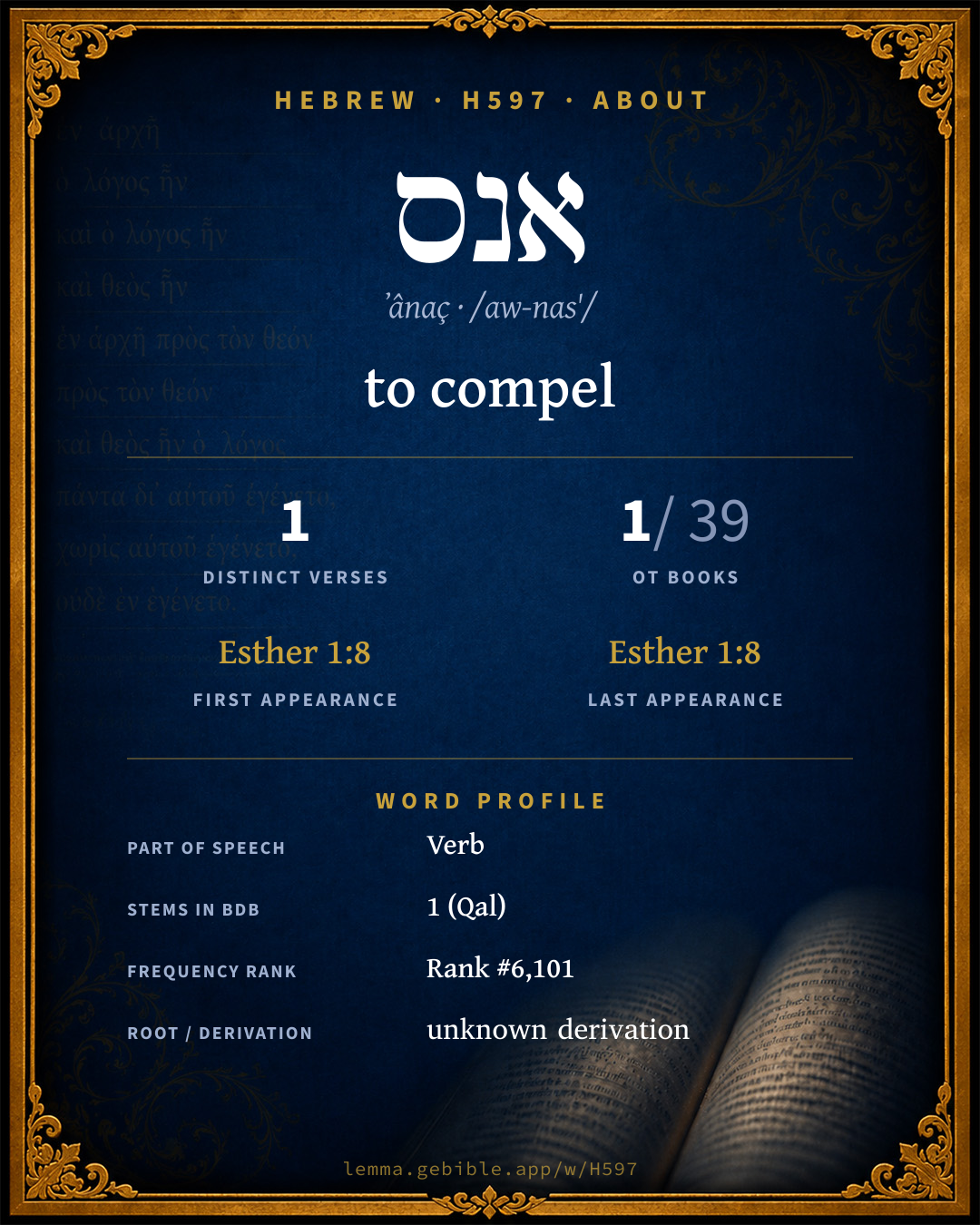
אָנַס
to compel
Full lexicon entry — Brown-Driver-Briggs (BDB)
From Brown-Driver-Briggs (BDB)
Where this word appears
Grammar key — what these labels mean
Part of speech
- Verb
- An action or state-of-being word.
Stem
- Qal
- The basic, simple active stem — the plain form of the verb (“he wrote”).
Form
- Participle Active
- A verbal adjective expressing ongoing or characteristic action (“writing / one who writes”).
State
- Absolute
- The independent form of a noun, not bound to a following word.
Gender
- Masculine
- Grammatically masculine.
Number
- Singular
- One.
Every verse where H597 appears — 1 distinct verse across 1 book. Click any verse to open its interlinear word-by-word view. Verse text shown in the World English Bible for context — . Each verse’s Hebrew form is shown with its reference; the English is not keyword-highlighted, since the data carries no word-level English alignment. Use “Compare translations” on any verse to read it across multiple English versions. This concordance covers the Hebrew Bible; Septuagint (Greek Old Testament) occurrences are not indexed here.
Esther 1 verse
About this entry
At a glance — auto-summarized from this page’s data, not written by a person. Every figure links to its source below. This summary describes the numbers; it doesn’t interpret them.
“to compel” is the headline sense of the Hebrew verb אנס (ʼânaç). The Hebrew Bible uses it only 1 verse. It clusters heavily in Esther, which alone accounts for 100% of its uses. Its lone occurrence is Esther 1:8. From the same root come אנס. The sections below give every sense, occurrence, and version rendering.
Gloss history
Strong's 1890 vs modern scholarship

About this word
Strong's H597 catalogs a Hebrew word from the Hebrew Old Testament.
These counts are not copied from any lexicon or concordance. They are computed here, from the morphology-tagged Hebrew Old Testament. What Lemma adds →
- 1
- distinct verses
- The word appears in 1 distinct verse.
- 1 / 39
- OT books
- The word appears in 1 of 39 Old Testament books.
- #6,101
- by frequency
- Rank #6,101 (rank 6,101 of 8,640 Hebrew words by occurrence).
View all 1 occurrence in the concordance →
Most concentrated in
- Esther 1 verse 100%
By section of the Old Testament
By traditional corpus
Conventional, traditional groupings — biblical authorship is debated, so this is a traditional corpus grouping, not an authorship claim. Each share is this word’s portion of its verses in that division of the Hebrew canon. Each figure is a share of the word’s 1 distinct verse.
- Writings (Ketuvim) 1 verse · 100%
How translations render this word
Counts come from each version’s own published word-to-Strong’s tagging or interlinear alignment — an approximate guide to how each version renders this word, not a word-level alignment the data otherwise carries. Because each total is that version’s own tagged count, the per-version totals vary from one another and need not match the appearance or distinct-verse counts above. These counts may also differ from a printed concordance because Lemma counts each distinctly tagged rendering and does not collapse phrase taggings into a single head-word total. This is a fixed set of word-tagged versions (KJV, ASV, BSB, ULT) and does not change with the reading translation you choose elsewhere. Each version’s license is shown beside its name below (and on Sources).
- King James Version: None did compel 1×
- American Standard Version: None could compel 1×
- Berean Standard Bible: Limit was placed 1×
- unfoldingWord Literal Text: Compulsion 1×
King James Version Public Domain
Renders H597 across 1 tagged occurrence — most commonly:
American Standard Version Public Domain
Renders H597 across 1 tagged occurrence — most commonly:
Berean Standard Bible Public Domain
Renders H597 across 1 tagged occurrence — most commonly:
unfoldingWord Literal Text CC BY-SA 4.0
Renders H597 across 1 tagged occurrence — most commonly:
Senses in the full BDB
What do BDB’s symbols mean?
BDB uses these scholarly abbreviations:
| Symbol | Meaning |
|---|---|
| 𝔊 | the Septuagint (the ancient Greek translation, LXX) |
| 𝔙 | the Vulgate (the Latin translation) |
| 𝔖 | the Syriac version (the Peshitta) |
| 𝔗 | the Targum (the Aramaic translation) |
| ψ | the Psalms |
| √ | root (the underlying root or stem) |
| ‖ | parallel passage (a synonymous or contrasted parallel) |
| † | the dagger: every passage where the word occurs is cited |
The 1 sense the full Brown-Driver-Briggs lexicon distinguishes for this word, in lexicon order (not ranked by frequency), with BDB’s own verbatim wording and sub-sense lettering. Shown in Hebrew script with BDB’s own scholarly abbreviations. The condensed entry is in the Lexicon Entry tab.
Qal
- Pt. אֵין אֹנֵס viz., to drink Est 1:8 (‖ כִּרְצוֹן אִישׁ וָאִישׁ). e.g. Esther 1:8
Senses from the full Brown-Driver-Briggs lexicon (Brown, Driver, Briggs; Oxford 1906 — public domain), digitized via Sefaria, supplemented by the OpenScriptures HebrewLexicon (CC BY 4.0). Full attribution on Sources.
Word origin
vb. compel, constrain (late, often Mish. id., Aramaic אֲנַס, ܐܶܢܰܣ )—
— Brown-Driver-Briggs (Oxford 1906, public domain), digitized via Sefaria, supplemented by the OpenScriptures HebrewLexicon (CC BY 4.0). See Sources.
Origin: unknown derivation
Jastrow Dictionary
A second Hebrew/Aramaic lexicon for comparison, covering Aramaic and post-biblical (Talmudic, Targumic, Midrashic) usage that the biblical-Hebrew BDB does not. Matched by lemma rather than by Strong’s number, so a lemma may carry more than one Jastrow headword (shown separately below), and the entries cover usage well beyond the Bible.
אָנַס
- to bend, force; to do violence; to outrage &c. Ḥull. 45ᵃ א׳ בסימנים if one in cutting presses the windpipe and gullet out of their natural position. Ib. אָנְסָה עצמה if the animal strained its neck so as to dislocate the organs. Gitt. 44ᵇ; Ḥull. 131ᵃ הרי שאָנְסוּ וכ׳ if royal officers took forcible possession of (seized,) his barn. Keth. III, 4 האוֹנֵס he who violates a woman. Part. pass. f. אֲנוּסָה an outraged woman. Y. Yeb. VI, 7ᶜ; a. fr.—Masc. אָנוּס the victim of an accident, unavoidably prevented. Ned. 27ᵃ א׳ רחמנא וכ׳ the Merciful (the Law) acquits from responsibility him who is the victim of an unavoidable accident; a. fr.
- to violate. Num. R. s. 14 לאַנְּסָהּ to violate her.
- to be forced, overcome, to meet with an accident. Ber. 13ᵇ נ׳ בשינה overcome by sleep. Ḥull. 31ᵃ נֶאֶנְסָה וטבלה if she dipped in the water by an accident Ib. 45ᵃ ובלבד שלא תֵּאָנֵס provided the animal is not forced so that its organs be dislocated. Keth. I, 10 נאנסה she was outraged; a. v. fr.
אֲנַס
- , fut. יֵינַס ch. same;
- 1. to take by force, snatch, rob. Targ. II Sam. XXIII, 21; a. fr.
- 2. to oppress, rob (h. עשק). Targ. I Sam. XII, 3; 4; a. fr.—Arakh. 16ᵃ ואזלין ואנסין ליה and they (violent men) go and rob him (or force him to feed them, v. Rashi a. l.). Lev. R. s. 34 (אַנְסִינוֹן) אַנְסִינָן אקימנן וכ׳ he forced them, made them managers of public charities.
- 3. (cmp. ענש) to distrain, fine. Targ. Amos. IV, 2; a. fr.; v. אָנוֹסָא.
- 4. to urge, press; restrain. B. Bath. 57ᵇ one must למַינַס נפשיה restrain himself (turn his eyes away forcibly). Ḥull. 133ᵃ א׳ ליה עידניה time pressed him.—Part. pass. אָנִיס 1) wronged &c. Targ. Hos. V, 11; a. e.—2) unavoidably prevented, forced, v. preced. Naz. 23ᵃ מינס א׳ he had no will of his own (being drunk). Ned. 27ᵇ; a. fr.
- to oppress. Targ. Jer. VII, 6 (h. text ינה).
- , contr. אִיתְּנִיס.
- 1. to be robbed; to be fined, (of official extortion); &c. Targ. Is. XXI, 2. Lev. R. s. 34 דאנון מארסוון (read דאתון מִתְאַנְּסוּן or דאינון מאנסכון; Yalk. Lev. 665 דאתון מזדמיין, v. זמי) that you will lose through extortion &c.
- 2. to meet with an accident, be unavoidably prevented. Ned. 27ᵃ איתניס ולא אתא he met with an accident and did not come in time. Ib. והא מֵינַס איתניס was he not unavoidably prevented (since he died during the appointed time)? Keth. 16ᵇ אִתְּנוּסֵי הוא דאתניסו they were prevented from forming the bridal procession [prob. alluding to government interference; Rashi: through excessive drinking]. [איתניס to grow ill, v. אִיתְנִיס a. נְסַס.]
אַנָּס
- (preced. ws.) one who acts violently, a violent man. B. Bath. 45ᵃ סתם נכרי א׳ הוא as a rule the gentile is violent (lawless). Y. Kidd. I, 60ᶜ top.—Pl. אַנָּסִין אַנָּסִים. Ḥull. 94ᵇ מפני הא׳ on account of the lawless (among the gentiles).—Esp. (law) Annas, one who is in possession of property bought from one who obtained it by force or consfiscation, owner of reclaimable property. Kil. VII, 6 (5) הא׳ שזרע וכ׳ if an Annas put seeds into a vineyard (creating Kilayim), and it is reclaimed. Ib. from what time and onward נקרא א׳ is one called an Annas (who may consider himself in undisturbed possession)? Answ. משישקע (v. Y. ib. 31ᵃ) from the time the name of the original owner is sunk (when the property is no longer named after him).—Pl. as above. Y. Succ. IV, beg. 54ᵇ, v. הֶפְקֵר.
A Dictionary of the Targumim, the Talmud Babli and Yerushalmi, and the Midrashic Literature (Marcus Jastrow; London, Luzac, 1903) — Public Domain. Digitized via Sefaria. Digitized via Sefaria. Full attribution on Sources.
Same root — word family
Other BDB entries built from the same root as H597, grouped by Strong’s listed origin. These share a root / origin per the lexicon — not necessarily a shared meaning. Each links to that word’s own entry.
Derived from this word
Compare all same-root words → They share a root, not necessarily a meaning.
Septuagint verse parallels
This word appears in 1 verse that also exists in the Greek Old Testament (Septuagint), out of the 1 Hebrew verse it occurs in. You can read those verses in Greek by switching the Old Testament edition to the Septuagint.
Read these verses in the Septuagint
This is a verse-level parallel only — the same verses exist in both the Hebrew and Greek Old Testaments. No word-level Hebrew↔Greek correspondence is claimed: the data carries no such alignment, so no Greek word is shown as this Hebrew word’s translation. Coverage is not total — the Septuagint omits the deuterocanon and renumbers the Psalms, so some Hebrew verses have no direct Greek parallel.