Galatians 4:2

Greek (Tischendorf 8th ed.) Galatians 4:2 appears in the Greek New Testament. The text above is from the Tischendorf 8th edition. Each word links to its Strong’s number and a concise gloss. Click any word for its full Thayer’s Greek Lexicon entry.
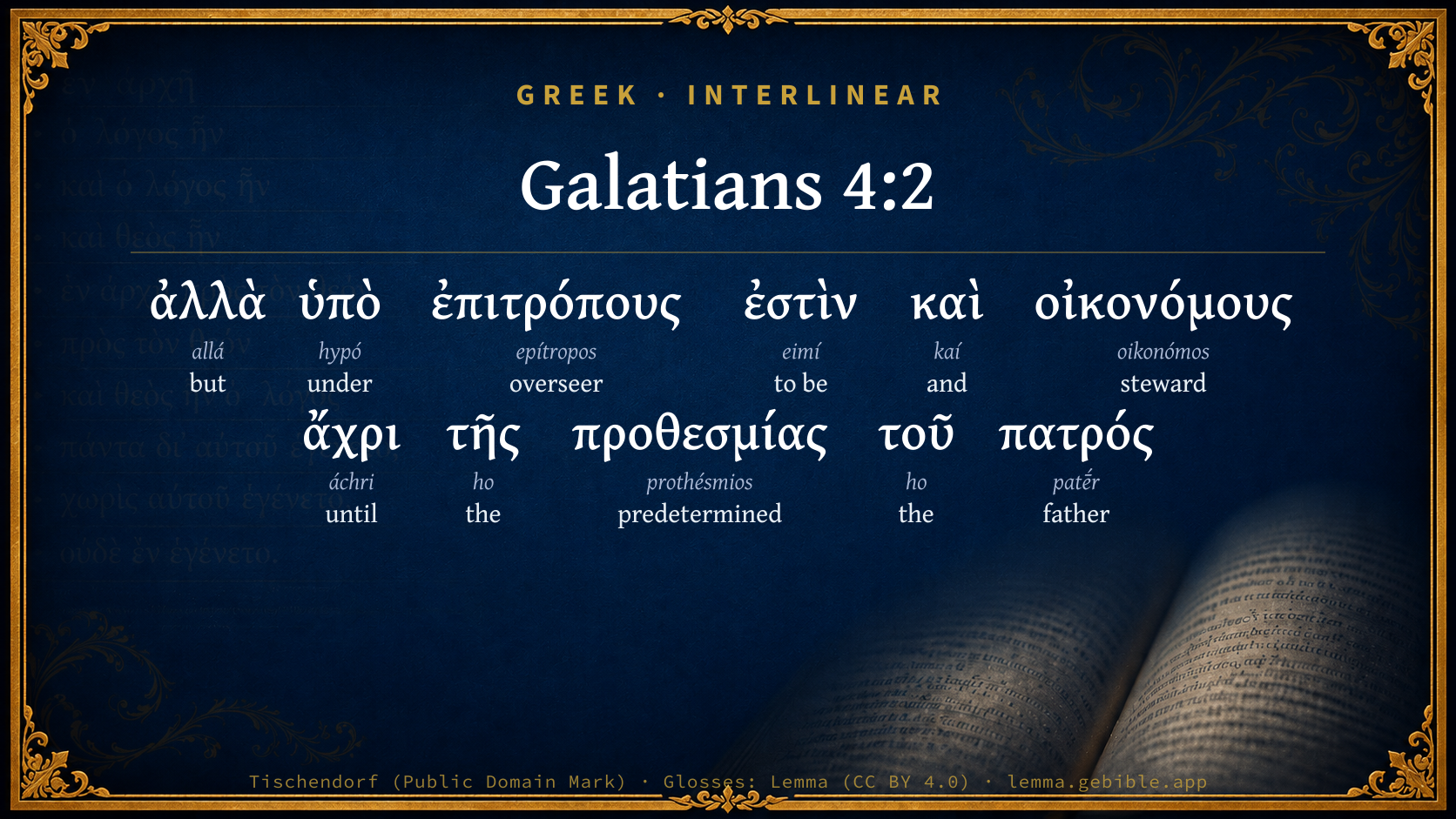
Download image
Cite this verse

Galatians 4:2 (World English Bible). Public Domain. Lemma interlinear Bible study tool, https://lemma.gebible.app/v/galatians/4/2.

Show BibTeX & RIS
BibTeX
RIS
English Translation
but is under guardians and stewards until the day appointed by the father.
World English Bible · Public Domain
Highlights
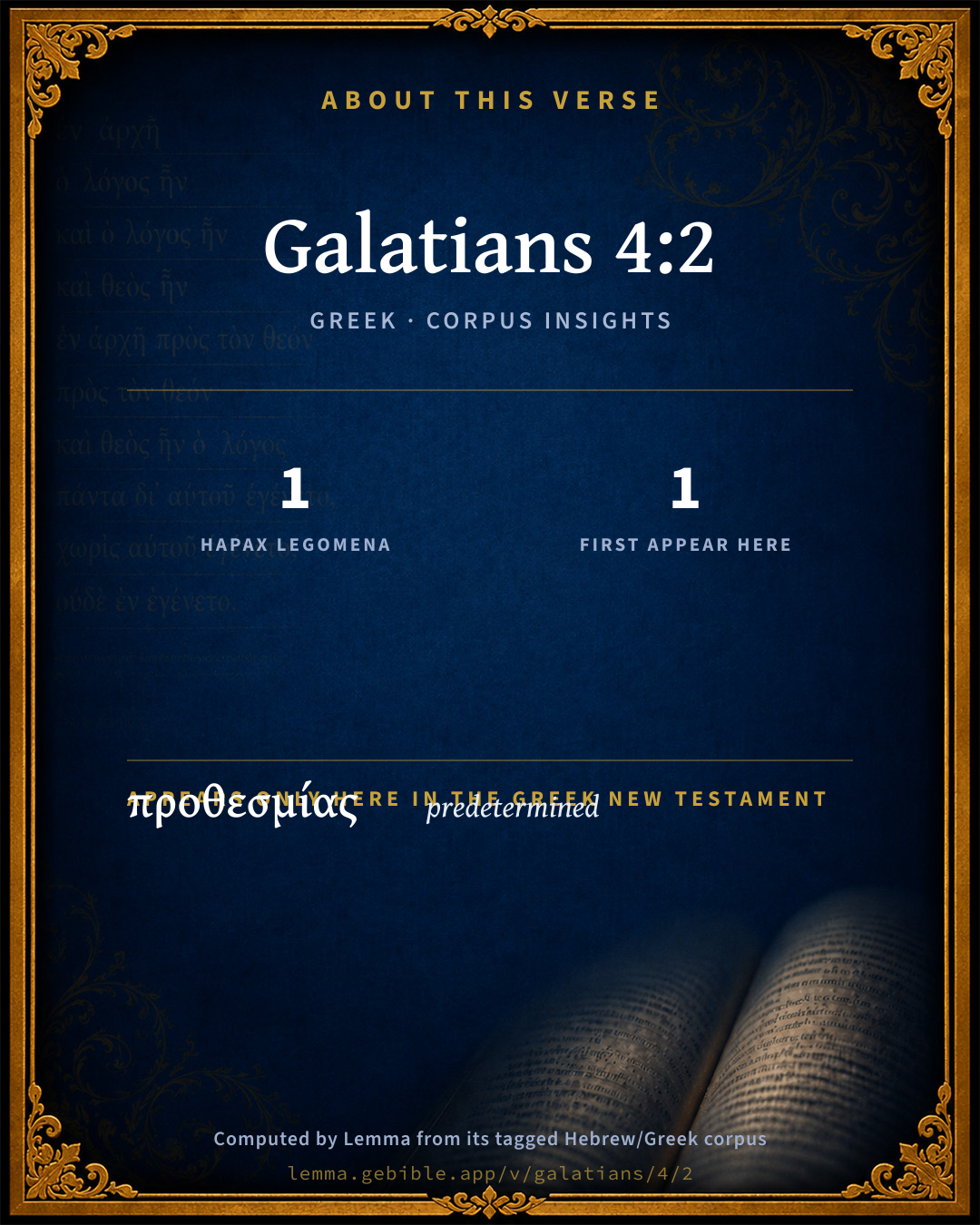
  • 1 hapax legomenon — only here in the Greek New Testament
  • 1 first appearance in the Greek New Testament
Full analysis ↓
Download a study sheet

One document with this verse’s original text, its word-by-word gloss line, the meaning frame, cross-references with their text, attributed commentary, and full source and license credits — printable, and it pastes into notes with its structure intact.

This verse Autodidact and up

Study sheet (.html) Plain text (.txt)

A passage Seminary Student

Up to 50 verses in one chapter. A passage sheet keeps up to 6 commentary sources and 12 cross-references per verse, in the order this page ranks them, and says so on the sheet whenever that leaves anything out. Ask for a single verse and you get the Autodidact verse sheet above.

Everything on this page stays free to read, with no account — the sheet is a download of what is already on screen, not access to it.

Want to remove ads? Support Godless Engineer
Compare translations 3

The same verse in 3 English versions, stacked beneath the original-language interlinear above. Click any original word for its lexicon entry.

Each is an independent rendering of the whole verse — the interlinear is not word-aligned to these translations.

Highlighted words mark where these versions differ — a whole-verse word diff, not a word-by-word alignment.

  • World English Bible Public Domain
    but is under guardians and stewards until the day appointed by the father.
  • King James Version Public Domain
    But is under tutors and governors until the time appointed of the father.
  • unfoldingWord Literal Text CC BY-SA 4.0
    But he is under guardians and stewards until the date appointed by his father.

unfoldingWord Literal Text — © unfoldingWord, licensed CC BY-SA 4.0. Word-aligned USFM3 via Door43 (git.door43.org/unfoldingWord/en_ult).

Versions to compare (up to 4)

3 of 4 selected

Show all 19 translations

Every available English version of this verse, each an independent rendering of the whole verse.

  • World English Bible Public Domain
    but is under guardians and stewards until the day appointed by the father.
  • Berean Standard Bible Public Domain
    He is subject to guardians and trustees until the date set by his father.
  • Majority Standard Bible Public Domain
    He is subject to guardians and trustees until the date set by his father.
  • King James Version Public Domain
    But is under tutors and governors until the time appointed of the father.
  • American Standard Version (1901) Public Domain
    but is under guardians and stewards until the day appointed of the father.
  • Revised Version (1885) Public Domain
    but is under guardians and stewards until the term appointed of the father.
  • Geneva Bible (1599) Public Domain
    But is vnder tutours and gouernours, vntil the time appointed of the Father.
  • Douay-Rheims (1899) Public Domain
    But is under tutors and governors until the time appointed by the father:
  • Young's Literal Translation Public Domain
    but is under tutors and stewards till the time appointed of the father,
  • Literal Standard Version CC BY-SA 4.0
    but is under tutors and stewards until the time appointed of the father,
  • Unlocked Literal Bible CC BY-SA 4.0
    But he is under guardians and trustees until the date set by his father.
  • unfoldingWord Literal Text CC BY-SA 4.0
    But he is under guardians and stewards until the date appointed by his father.
  • Darby Bible Public Domain
    but he is under guardians and stewards until the period fixed by the father.
  • World Messianic Bible Public Domain
    but is under guardians and stewards until the day appointed by the father.
  • Webster's Bible Public Domain
    But is under tutors and governors until the time appointed by the father.
  • Free Bible Version CC BY-SA 4.0
    An heir is subject to guardians and managers until the time set by the father.
  • Bible in Basic English Public Domain
    But is under keepers and managers till the time fixed by the father.
  • Text-Critical English NT CC BY 4.0
    But he is under guardians and stewards until the time appointed by his father.
  • Tyndale New Testament (1534) Public Domain
    but is vnder tuters and governers vntill the tyme appoynted of the father.

Literal Standard Version (2020), Covenant Press — licensed CC BY-SA 4.0. Text via the HelloAO Bible API (eBible.org). Unlocked Literal Bible (unfoldingWord) — licensed CC BY-SA 4.0. Text via the HelloAO Bible API (eBible.org). unfoldingWord Literal Text — © unfoldingWord, licensed CC BY-SA 4.0. Word-aligned USFM3 via Door43 (git.door43.org/unfoldingWord/en_ult). Free Bible Version, Dr. Jonathan Gallagher — licensed CC BY-SA 4.0. Text via the HelloAO Bible API (eBible.org).

Word by word

More ways to search: Search by grammar → Find every occurrence → Compare this word →

Practice this passage: Drill this verse → Learn its vocabulary →

About this verse

These counts appear in no published source. They are computed here, from the morphology-tagged text and Lemma’s own curated glosses. What Lemma adds →

11
words
10
distinct lemmas
Pauline Epistles
section

Notable vocabulary

1 hapax legomenon — a word that appears only here in the entire Greek New Testament:

  • προθεσμίας predetermined G4287

First appearance in Scripture

This word makes its first canonical appearance in the Greek New Testament here:

  • προθεσμίας predetermined G4287

Shared distinctive vocabulary

ἐπιτρόπους overseer G2012 occurs in 3 verses of the Greek New Testament. Also found in:

Repetition

A word recurs within this verse:

Commentary

Notes on Galatians 4:2 from classic Christian and Jewish commentators (each source and its license shown beneath its notes). The classic Christian expositions comment on the surrounding passage and are grouped to its opening verse, so a note may address several verses; the Jewish commentaries on the Tanakh (Rashi and others) are per-verse, so they appear only where the commentator wrote on this verse.

Lemma curates 59 commentaries, every one of them public domain or Creative Commons licensed, each selected and text-cleaned for this edition rather than reprinted as found. About our sources →

Bengel's Gnomon

Johann Albrecht Bengel

Gal 4:2. Ἐπιτρόπους) tutors of an heir.—οἰκονόμους) curators of goods. [Engl. Ver. not so well, governors].

Bengel's Gnomon of the New Testament — English translation (T&T Clark, Edinburgh, 1860) — public domain. Text from a community e-Sword module.

Meyer's Critical & Exegetical Commentary

Heinrich August Wilhelm Meyer

Gal_4:2. Ἐπίτροπος means here not guardian (ὀρφανῶν ἐπίτροπος, Plat. Legg. p. 766 C; Dem. 988. 2; Xen. Mem. i. 2. 40; 2Ma_11:1; 2Ma_13:2; 2Ma_14:2; comp. also the rabbinical אפוטרופוס in Schoettgen, Hor. p. 743 f.), as it is explained by all who look upon the father as dead (see, however, on Gal_4:1), but overseer, governor, and that without any more special definition (Herod. i. 108; Pind. Ol. i. 171; Dem. 819. 17; Xen. Oec. 21. 9; and very frequently in classical authors); it is neither therefore to be taken (as in Mat_20:8; Luk_8:3) as synonymous with οἰκονόμος (which would give a double designation without ground for it), nor as equivalent to παιδαγωγός (which would be an arbitrary limitation). The term denotes any one, to whose governorship the boy is assigned by the father in the arrangement which has been made of the family affairs; and from this category are then specially singled out the οἰκονόμοι, the superior slaves appointed as managers of the household and property (Luk_16:1), on whom the νήπιος was dependent in respect to money and other outward wants.

ἄχρι τῆς προθεσμίας τοῦ πατρός] Until the appointed time of the father, until the term, which the father has fixed upon for releasing his son from this state of dependence. ἡ προθεσμία, tempus praestitutum, does not occur elsewhere in the N.T., but is frequent in classical authors. See Wetstein; also Jacobs, Ach. Tat. p. 440.

Meyer — Critical and Exegetical Commentary on the New Testament — English translation by Peter Christie, edited by Frederick Crombie (T&T Clark, 1880) — public domain. Text from a community e-Sword module.

Geneva Bible (1599)

Geneva Bible translators

This is added, because he that is always under a tutor or governor, may hardly be counted a freeman.

Geneva Bible (1599) marginal notes — public domain. Text via Bolls.life.

Jamieson, Fausset & Brown

Robert Jamieson, A. R. Fausset & David Brown

tutors and governors--rather, "guardians (of the person) and stewards (of the property)." Answering to "the law was our schoolmaster" or "tutor" (Gal 3:24).

until the time appointed of the father--in His eternal purposes (Eph 1:9-11). The Greek is a legal term, expressing a time defined by law, or testamentary disposition.

Jamieson, Fausset & Brown — Commentary Critical and Explanatory on the Whole Bible (1871) — public domain (CC PDM 1.0). Text via the HelloAO Bible API.

Adam Clarke's Commentary

Verse 2. But is under tutors] επιτροπους. Guardians and governors; οικονομους. those who have the charge of the family. These words are nearly similar; but we may consider the first as executor, the last as the person who superintends the concerns of the family and estate till the heir become of age; such as we call trustee.

Until the time appointed of the father.] The time mentioned in the father's will or testament.

Adam Clarke's Commentary on the Bible (1810–1826) — public domain. Text from a community e-Sword/MySword module.

Ellicott's Commentary for English Readers

(2) Under tutors and governors.—The distinction between these two terms is that between guardians of the person and stewards of the property. It would be better to translate, guardians and stewards.

Until the time appointed of the father.—From this it would appear that the length of the minority was determined by the father. This, however, was not the case either in Greek or Roman law; and the suggestion that the father may have had larger powers in Galatia than elsewhere, though supported by some remote indications, seems to be one of those subtleties in which learning sometimes overreaches itself; it being unlikely that the short sojourn of the Apostle in Galatia would have been enough to make him acquainted with the technicalities of the Galatian code. It is more probable that the application of the analogy has here come in to modify the statement of the analogy itself. The minority of the human race is fixed by the heavenly Father, though the earthly father, in disposing of his children, has to conform to another law than his own will.

A Bible Commentary for English Readers, edited by Charles John Ellicott (1878–1897) — public domain. Text from a community e-Sword module.

The Cambridge Bible for Schools and Colleges

gen. ed. J. J. S. Perowne

2. tutors and governors] guardians and stewards, the one having the charge of his person, the other the management of his estate.

the time appointed of the father] the time fixed before by his father for the coming of age. It is not necessary, as has been stated already, to refer this to any special law or custom. It is clearly what might have often happened; and it is mentioned because of its typical import. The ‘fulness of the time’ is the antitype to ‘the time appointed’, and ‘the father’ of the minor has his counterpart in Him to whom we cry, ‘Abba, Father’.

The Cambridge Bible for Schools and Colleges (gen. ed. J. J. S. Perowne; Cambridge University Press, 1878–1918) — public domain. Text from a community e-Sword module.

John Gill's Exposition

But is under tutors and governors,.... The word rendered "tutors", is adopted by the Jewish Targumists and Rabbins into their language; and by the former is used (x) for any ruler and governor, civil or domestic; and by the latter, for such as are guardians of infants, fatherless children, and such as are under age, as it is here used; and who were either appointed by the will of the deceased, or by the sanhedrim, of whom they say (y), , "we do not appoint a tutor or guardian for a bearded person"; that is, an adult person, one that is grown up to man's estate; but , "we appoint a guardian for an infant"; and they had not used to appoint women or servants, or such as were minors themselves, or any of the common people; but men of substance, integrity, and wisdom (z); a fatherless child had two tutors (a); the power that guardians so appointed had, is at large described by Maimonides (b). Governors were such as acted under the tutors or guardians, and were employed by them for the improvement of their estates and minds, as stewards, schoolmasters, &c. until the time appointed of the father; by his last will and testament, which might be sooner or later, as he pleased; but if he died intestate, the time of minority, and so the duration of tutors and guardians, were according to the laws of the nation; which with the Romans was until a man was twenty five years of age; and with the Jews, for a male, was until he was thirteen years of age and one day; and for a female, until she was twelve years of age and one day, if the signs of ripeness of age appeared; but if they did not, the time was protracted until they were twenty, and even sometimes till they were thirty five years of age, before the matter was determined (c).

(x) Targum Jon. ben Uzziel in Gen. xxxix. 4. & xli 34, 35. & xliii 15. Targum in Esther i. 8. & 2. 3. (y) T. Bab. Bava Metzia, fol. 39. 1, 2. (z) Maimon. Hilch. Necabot, c. 10. sect. 6. (a) Bartenora in Misn. Pesachim, c. 8. sect. 1. (b) Hilch. Nechalot, c. 11. (c) Ib. Hilch. Ishot, c. 2. sect. 1, 2.

John Gill's Exposition of the Whole Bible (1746–1763) — public domain (CC PDM 1.0). Text via the HelloAO Bible API.

Trapp's Complete Commentary

John Trapp

2 But is under tutors and governors until the time appointed of the father.

Ver. 2. But is under tutors] Those under the law were but alphabetaries (rudimentaries) in comparison of those under the gospel. {a} The sea about the altar was brazen, 1Ki 7:23, and what eyes could pierce through it? Now our sea about the throne is glassy, Rev 4:6, like to crystal, clearly conveying the light and sight of God to our eyes.

{a} ο μηδε τον Αισωπον πεπατηκως. Aristophanes.

John Trapp, A Commentary or Exposition upon All the Books of the Old and New Testament (1647–1656) — public domain. Text from a community e-Sword module.

Albert Barnes' Notes on the Bible

But is under - Is subject to their control and direction.

Tutors - The word tutor with us properly means instructor. But this is not quite the sense of the original. The word (επίτροπος epitropos); properly means a steward, manager, agent; Mat 20:8; Luk 8:3. As used here, it refers to one - usually a slave or a freedman - to whose care the boys of a family were committed, who trained them up, accompanied them to school, or sometimes instructed them at home; compare the note at Gal 3:24. Such a one would have the control of them.

And governors - This word (οἰκόνομος oikonomos) means a house-manager, an overseer, a steward. It properly refers to one who had authority over the slaves or servants of a family, to assign them their tasks and portions. They generally, also, had the management of the affairs of the household, and of the accounts. They were commonly slaves, who were entrusted with this office as a reward for fidelity; though sometimes free persons were employed; Luk 16:1, Luk 16:3,Luk 16:8. These persons had also charge of the sons of a family, probably in respect to their pecuniary matters, and thus differed from those called tutors. It is not necessary, however, to mark the difference in the words with great accuracy. The general meaning of the apostle is, that the heir was under government and restraint.Until the time appointed of the father - The time fixed for his entering on the inheritance. The time when he chose to give him his portion of the property. The law with us fixes the age at twenty-one when a son shall be at liberty to manage for himself. Other countries have affixed other times. But still, the time when the son shall inherit the father’s property must be fixed by the father himself if he is living, or may be fixed by his will if he is deceased. The son cannot claim the property when he comes of age.

Albert Barnes' Notes on the Bible (1834–1885) — public domain. Text from a community e-Sword/MySword module.

Matthew Poole's English Annotations

The heir, (mentioned in the former verse), though he be an heir of a great estate, yet is not presently possessed of it; but he is by his father kept under tutors and governors, until the time which he hath appointed when he will be pleased to release him from his pupillage, and settle some part of his inheritance upon him.

Matthew Poole's English Annotations on the Holy Bible (1683–1685) — public domain. Text from a community e-Sword/MySword module.

Whedon's Commentary on the Bible

Daniel D. Whedon

2. But—The items of his servile external conditions.

Under tutors—The guardians of his person.

And governors—The trustees of his property. He is thus a prisoner in his own domains, a servant in his own lordship.

Time appointed—His close of twenty-five years’ minority—the time appointed by law.

Of the father—This does not mean that the father appoints the time; but it is the time by which the father is limited, and grants him the rights of majority.

Daniel D. Whedon (gen. ed.), Commentary on the Old and New Testaments (1874–1909) — public domain. Text from a community e-Sword module.

The Pulpit Commentary

But is under tutors and governors (ajlla uJpopouv ejsti kaimouv) but is under guardians and stewards. jEpitropov is, in Greek, the proper designation of a minor"s guardian; as, for example, is shown by Demosthenes"s speeches against Aphobus, who had been his ejpitropov. These speeches also show that the ejpitropov was entrusted with the handling of the property of his ward. Yet, as oijkonomov more especially denotes one entrusted with the management of property, it should seem that St. Paul uses the former term with more especial reference to the guardian"s control over the person of his ward. The ward has to do what the ejpitropov, guardian, thinks proper, with no power of ordering his actions according to his own will; while, on the other hand, the youth is not able to appropriate or apply any of his property further than as the "steward" thinks right; between the two he is bound hand and foot to other people"s control. The plural number of the two nouns indicates the rough and general way in which the apostle means to sketch the case; speaking in a general way, one may describe a minor as subject to "guardians and stewards." Until the time appointed of the father (acri thv proqesmiav tou patrov). The noun proqesmia, properly an adjective, wra or hJmera being understood, m used very commonly to denote, either a determined period during which a thing is to be done or forborne, which is its most ordinary sense (see Reiske"s "Lexicon to Demosthenes"); or the further limit of such a period, whence Symmachus uses it to render the Hebrew word for "end" in Job_28:3; or, lastly, aspecified time at which a certain thing was to take place, as, for example, Josephus, "Ant.," 7:4, 7, "When the (proqesmia) day appointed for the payment came." This last seems to be the meaning of the word here, though it admits of being taken in the second sense, as describing the limit of the child"s period of nonage. The somewhat loosely constructed genitive, tou patrov, "of the father," may be compared either with the didaktoi tou Qeou, "taught of God", (Joh_6:45) or, in a somewhat different application, "the chastening and admonition of the Lord". (Eph_6:4) In reference to the whole case as stated by the apostle, it has been asked Is the father to be conceived of as dead, or as only gone out of the country, or how? It is sufficient to reply that "the point of the comparison to use Bishop Lightfoot"s words not in the circum stances of the father, but of the son;" and, further, that to supplement the description which the apostle gives by additional particulars not relevant for the purpose of the comparison would only tend to cloud our view of its actual import. In fact, any image taken from earthly things to illustrate things spiritual will inevitably, if completely filled out, be found to be in some respects halting. Another inquiry has engaged the attention of commentators, as to how far the particular circumstance, that the period of nonage is made dependent upon the father"s appoint meat, can be shown to agree with actual usage as it then obtained. It would seem that no positive proof has hitherto been alleged that such a hypothesis was in strict conformity with either Greek or Roman or Hebrew law. And hence some have had recourse to the precarious and far-fetched supposition that St. Paul founds his thesis on Galatian usage, arguing that such would have been in accordance with that purely arbitrary control which, according to Caesar ("Bell. Gall.," 6:19), a paterfamilias exercised over wife and children among the kindred tribes in Gaul. The scruple, how ever, now referred to arises from supposing that we know more about the facts than we really do know. So far as has been shown, we cannot tell what was really the precise rule of procedure which, in the case described by the apostle, prevailed either in Judaea, or in Tarsus, or in Galatia; nor again from what region of actual experience St. Paul drew his illustration. We, therefore, have no possible right to say that the case which he supposes was not fairly supposable. On the contrary, when we reflect how open the apostle"s mind was for taking note of facts about him, and how wide and varied his survey, we may safely rest assured that his supposed case was in reality framed in perfect accordance to the civil usage, to which the Galatians would understand him to refer. At the same time, it must be conceded that, amongst different modes of arranging a minor"s case which actual usage permitted or may be imagined to have permitted, the apostle selected just that particular mode which would best suit his present immediate purpose.

The Pulpit Commentary (1880–1919), ed. H.D.M. Spence-Jones & Joseph S. Exell — public domain. Text from a community e-Sword module.

John Wesley's Explanatory Notes

But is under tutors - As to his person. And stewards - As to his substance.

John Wesley, Explanatory Notes Upon the Whole Bible (1754–1765) — public domain. Text via the GEBible commentary corpus.

Luther on Galatians

Martin Luther

VERSE 2. But is under tutors and governors until the time appointed of the father.

The Apostle had apparently finished his discourse on justification when this illustration of the youthful heir occurred to him. He throws it in for good measure. He knows that plain people are sooner impressed by an apt illustration than by learned discussion.

"I want to give you another illustration from everyday life," he writes to the Galatians. "As long as an heir is under age he is treated very much like a servant. He is not permitted to order his own affairs. He is kept under constant surveillance. Such discipline is good for him, otherwise he would waste his inheritance in no time. This discipline, however, is not to last forever. It is to last only until ’the time appointed of the father.’"

Martin Luther — Commentary on the Epistle to the Galatians (1535), English translation by Theodore Graebner (Zondervan, 1939) — public domain (U.S. copyright not renewed). Text from a community e-Sword module.

McGarvey & Pendleton's Commentaries

J. W. McGarvey

but is under guardians and stewards until the day appointed of the father.

J. W. McGarvey (with Philip Y. Pendleton), Commentaries on the New Testament (The Fourfold Gospel, 1914; Acts; and the epistles) — public domain. Text from a community e-Sword/MySword module.

Cambridge Greek Testament for Schools and Colleges

2. ἀλλʼ ὑπὸ ἐπιτρόπους ἐστὶ, Mat 20:8; Luk 8:3[114]. See Appendix, note C. ἐπ. = any person to whom authority is committed, whether a Procurator, e.g. Cumanus in Joseph. Ant. xx. 6. 2 (§ 132), or only a bailiff over labourers, Mat 20:8. In Luk 8:3 Chuza may have been Herod’s “agent “or “factor” generally, or may have had special charge of the royal children. So Lysias was the ἐπίτροπος of Antiochus Epiphanes, 2Ma 11:1; 2Ma 13:2; 2Ma 14:2. In our verse it is to be translated “guardians” (R.V.) or “tutors” (in the old sense of the word with no reference to teaching) according as the father is thought of as dead or as alive.

[114] Is affixed to a word it means that all the passages are mentioned where that word occurs in the New Testament.

The plural both here and in οἰκονὸμους is purposely vague. It marks the father’s freedom to appoint as many as he would, either contemporaneously or successively. The singular would have meant that the heir had but one ἐπίτροπος and one οἰκονόμος.

καὶ οἰκονόμους. Luk 12:42; Luk 16:1; Luk 16:3; Luk 16:8; Rom 16:23; 1Co 4:1-2; Tit 1:7; 1Pe 4:10[115]. In all these passages the οἰκονόμος administers property, whether material or spiritual. So here the οἰκονόμοι are those who administer the property of the heir. But whether the father is regarded as dead or only absent is not clear. Bengel concisely differentiates the two words: ἐπιτρόπους tutores heredis, οἰκονόμους curatores bonorum.

[115] Is affixed to a word it means that all the passages are mentioned where that word occurs in the New Testament.

ἄχρι τῆς προθεσμίας[116] τοῦ πατρός. Symmachus thrice translates qêtz “end” or “limit” by προθεσμία, Job 28:3; Dan 9:26 bis (cf. his use of ἐμπροθεσμός in Eze 21:25 (30) and with Aq. and Theod. in Eze 35:5).

[116] Is affixed it means that all the passages are mentioned where the word occurs in the Greek Bible.

If the father is regarded as alive there is no difficulty; if as dead there is. For ordinarily under Roman law a minor came of age at twenty-five, being under a tutor till 14 and a curator till 25 (Ramsay, Gal., p. 392). But it seems that in certain cases the father was allowed some discretion in this. See Dawson Walker, The Gift of Tongues etc., pp. 118, 119, 168. Compare our own law, according to which a minor generally comes into his property at twenty-one, but not always, if the father makes special provision to the contrary. See further Appendix, note C.

Cambridge Greek Testament for Schools and Colleges (Cambridge University Press, 1896; 21 vols, various authors incl. Carr, Maclear, Plummer, Farrar, Lumby, Moule, M. R. James, Simcox) — public domain. Text from a community e-Sword module.

Alford’s Greek Testament

Henry Alford

2.] ἐπιτρόπους, overseers of the person; guardians: οἰκονόμους, overseers of the property, stewards. See Ellicott’s and Bagge’s notes.

προθεσμία, the time (previously) appointed. The word (an adjective used substantively: scil. ἡμέρα or ὥρα. See for the classical meaning, ‘the time allowed to elapse before bringing an action,’ Smith’s Dict. of Antt. sub voce) is a common one: Wetst. gives many examples. The following clearly explain it: ὁρίσαι προθεσμίαν, ἐν ᾗ τὸ ἱερὸν συντελεσθήσεται, Polyæn. p. 597:—εἰ δὲ ὁ τῆς ζωῆς τῶν ἀνθρώπων χρόνος εἰκοσαετὴς ἦν … τὴν δὲ τῶν κ. ἐτῶν προθεσμίαν ἐκπληρώσαντα, Plut. ad Apollon. p. 113 e. It is no objection to the view that the father is dead, that the time was fixed by law (Hebrew as well as Greek and Roman): nor on the other hand any proof of it, that προθεσμία will hardly apply to a living man’s arrangement: see on the whole, above.

Henry Alford, The Greek Testament (1849–1861) — public domain. Text from a community e-Sword module.

International Critical Commentary

2. To speak of allegorically, the object being not the words uttered or the thing actually mentioned, but that to which there is underlying reference. Philo, Leg. alleg. II 10 (4); Plut. Es. carn. Orat. 1. 7:4. In the passive, Philo, Cherub. 25 (8): τὰ μὲν δὴ χερουβὶμ καθʼ ἕνα τρόπον οὕτως ἀλληγορεῖται. Clem. Paed. I 47 (chap. vi): οὕτως πολλαχῶς ἀλληγορεῖται ὁ λόγος. Paed. I 46 (chap. vi). With a double object, to call (a thing something) allegorically: Clem. Paed. I 43 (chap. vi). σάρκα ἡμῖν τὸ πνεῦμα τὸ ἅγιον ἀλληγορεῖ. In the passive, Clem. Paed. II 62 (chap. viii.): οἱ … ἀπόστολοι … πόδες ἀλληγοροῦνται κυρίου. Paed. I 47 (chap. vi) bis.

International Critical Commentary — older volumes (1896–1929), various authors — public domain. Text from a community e-Sword module.

Vincent's Word Studies in the New Testament

Marvin R. Vincent

Tutors [επιτροπους] . Better, guardians. See on Luk 8:3. Only here in Paul. A general term, covering all to whom supervision of the child is intrusted, and should not be limited to paidagwgov (chapter Gal 3:24). See 2 Macc. 11 1; 13 2; 14 2.

Govenors [οικονομους] Better stewards. Lat. dispensatores. More special than guardians, signifying those who had charge of the heir's property. See on Luk 16:1. In later Greek it was used in two special senses :

1. The slave whose duty it was to distribute the rations to the other slaves : so Luk 12:42.

2. The land - steward : so Luk 16:1. Comp. Rom 16:23, oJ oijkonomov thv polewv, commonly rendered city - treasurer : A. V. chamberlain. 66 In Lucian, Alex. 39, the Roman procurators, or fiscal administrators, are called Kaisarov oijkonomoi; comp. Esra 4 49; Est 8:9. The dispensator in the Roman household had charge of the accounts and made the payments (see Cicero, ad Att 11 1; Juv. Sat 1 91). He was commonly a slave. Christian teachers are called "stewards of the mysteries of God" and "of the grace of God" (1Co 4:1; 1Pe 4:10), as those who have received the counsels of God and impart them to men. A bishop or overseer is also called "a steward of God" (Tit 1:7).

The time appointed [προθεσμιας] . N. T. o. o LXX In Athenian law the term limited for bringing actions and prosecutions. Proqesmiav nomov a statute of limitations. It was also applied to the time allowed a defendant for paying damages, after the expiration of which, if he had not paid, he was called uJperhmerov, or ejkproqesmov, or uJperproqesmov one who had gone over his day of payment. Whether Paul 's figure assumes that the father is dead or living is a point which does not affect his argument. It is not easy to decide. As Alford justly remarks : "the antitype breaks through the type and disturbs it, as is the case wherever the idea of inheritance is spiritualised." Proqesmia an appointed time for the termination of the minority, would seem to imply that the father is conceived as living; since, if he were dead, that matter would be regulated by statute. 67

Marvin R. Vincent, Word Studies in the New Testament (1887–1900) — public domain. Text from a community e-Sword/MySword module.

Lesson kit

Teaching starters — assembled from the data on this page, not authored interpretation. Every prompt links to the verse data it draws on. Edit before teaching.

Galatians, in the Pauline Epistles, opens this verse with 11 words (10 distinct Greek lemmas). Its most distinctive word is prothésmios (“predetermined”). A historical commentator’s framing appears above. Read the whole chapter for the surrounding context.

Discussion questions

  1. The word prothésmios carries the sense “predetermined.” How does it shape the verse?
  2. This verse holds 1 word here found nowhere else in the Greek New Testament. What might the rare word draw attention to?
  3. The word “predetermined” first appears here in Scripture. What is being introduced at this debut?
  4. Matthew 20:8 shares the word «overseer» with this verse. How do the two illuminate each other?
  5. “the” occurs 2× in this one verse. What is the effect of the repetition?
  6. These translations render this verse differently. What is at stake in choosing one wording over another?
  7. Reading how Bengel's Gnomon and Meyer's Critical & Exegetical Commentary read this verse, where do the two commentators agree and where do they part?

Things to notice

  • 1 word in this verse appears nowhere else in the Greek New Testament.
  • 1 word makes its first canonical appearance in Scripture here.
  • These translations choose different wording for 7 words in this verse.
  • “the” occurs 2× in this single verse.
  • 10 distinct Greek lemmas span 11 words in this verse.

Reading settings

Reading text

Shown beneath each verse's original-language words.

Old Testament
Old Testament edition

Read the OT as the Masoretic Hebrew (MT) or the Greek Septuagint (LXX).

English shown for the Greek Septuagint (in the Hebrew ↔ Greek comparison).

Comparing translations? Open the Compare panel on any verse page to stack up to four side by side.