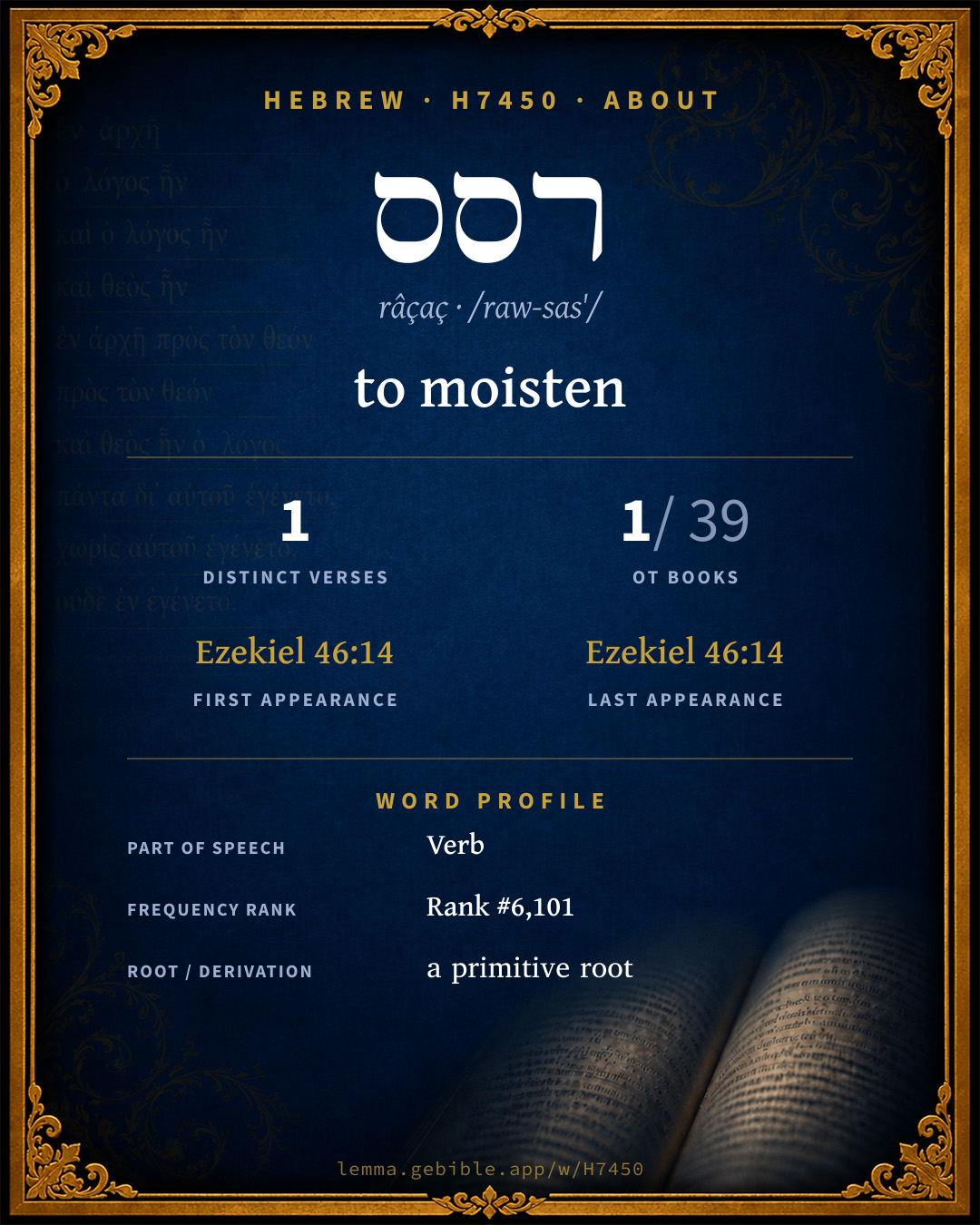
רָסַס
to moisten
Full lexicon entry — Brown-Driver-Briggs (BDB)
From Brown-Driver-Briggs (BDB)
Where this word appears
Grammar key — what these labels mean
Stem
- Qal
- The basic, simple active stem — the plain form of the verb (“he wrote”).
Form
- Infinitive Construct
- A bound verbal noun, frequently with prepositions (“to write / in writing”).
Every verse where H7450 appears — 1 distinct verse across 1 book. Click any verse to open its interlinear word-by-word view. Verse text shown in the World English Bible for context — . Each verse’s Hebrew form is shown with its reference; the English is not keyword-highlighted, since the data carries no word-level English alignment. Use “Compare translations” on any verse to read it across multiple English versions. This concordance covers the Hebrew Bible; Septuagint (Greek Old Testament) occurrences are not indexed here.
Ezekiel 1 verse
About this entry
At a glance — auto-summarized from this page’s data, not written by a person. Every figure links to its source below. This summary describes the numbers; it doesn’t interpret them.
The Hebrew verb רסס centers on the idea of “to moisten.” With only 1 verse it sits in the long tail of Hebrew Bible vocabulary. The word gravitates to Ezekiel (100%). Found nowhere else but Ezekiel 46:14. It shares a root with רסיס and רסה. For the data behind this summary, explore the sense tree and the renderings breakdown below.
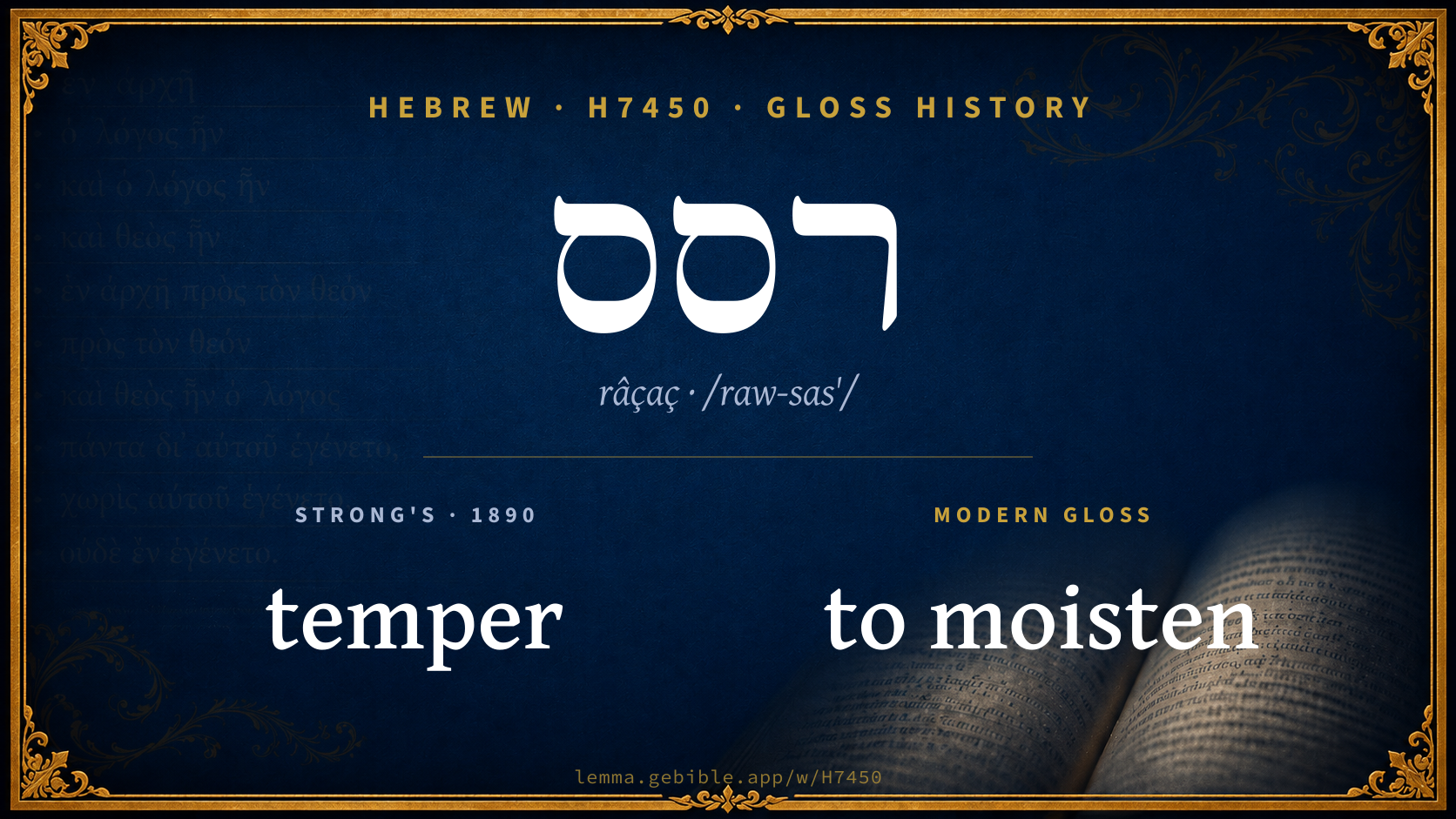
Gloss history
Strong's 1890 vs modern scholarship
About this word
Strong's H7450 catalogs a Hebrew word from the Hebrew Old Testament.
These counts are not copied from any lexicon or concordance. They are computed here, from the morphology-tagged Hebrew Old Testament. What Lemma adds →
- 1
- distinct verses
- The word appears in 1 distinct verse.
- 1 / 39
- OT books
- The word appears in 1 of 39 Old Testament books.
- #6,101
- by frequency
- Rank #6,101 (rank 6,101 of 8,640 Hebrew words by occurrence).
View all 1 occurrence in the concordance →
Most concentrated in
- Ezekiel 1 verse 100%
By section of the Old Testament
By traditional corpus
Conventional, traditional groupings — biblical authorship is debated, so this is a traditional corpus grouping, not an authorship claim. Each share is this word’s portion of its verses in that division of the Hebrew canon. Each figure is a share of the word’s 1 distinct verse.
- Prophets (Nevi'im) 1 verse · 100%
How translations render this word
Counts come from each version’s own published word-to-Strong’s tagging or interlinear alignment — an approximate guide to how each version renders this word, not a word-level alignment the data otherwise carries. Because each total is that version’s own tagged count, the per-version totals vary from one another and need not match the appearance or distinct-verse counts above. These counts may also differ from a printed concordance because Lemma counts each distinctly tagged rendering and does not collapse phrase taggings into a single head-word total. This is a fixed set of word-tagged versions (KJV, ASV, BSB, ULT) and does not change with the reading translation you choose elsewhere. Each version’s license is shown beside its name below (and on Sources).
- King James Version: Temper with 1×
- Berean Standard Bible: Moisten 1×
- unfoldingWord Literal Text: Moisten 1×
King James Version Public Domain
Renders H7450 across 1 tagged occurrence — most commonly:
Berean Standard Bible Public Domain
Renders H7450 across 1 tagged occurrence — most commonly:
unfoldingWord Literal Text CC BY-SA 4.0
Renders H7450 across 1 tagged occurrence — most commonly:
Senses in BDB
The 1 sense BDB distinguishes for this word, in lexicon order (not ranked by frequency or importance). The full entry — with sub-senses — is in the Lexicon Entry tab.
- (Qal) to moisten
Word origin
[ רָסַס ] vb. moisten;— Qal Ez 46:14.
— Brown-Driver-Briggs (Oxford 1906, public domain), digitized via Sefaria, supplemented by the OpenScriptures HebrewLexicon (CC BY 4.0). See Sources.
Origin: a primitive root
Jastrow Dictionary
A second Hebrew/Aramaic lexicon for comparison, covering Aramaic and post-biblical (Talmudic, Targumic, Midrashic) usage that the biblical-Hebrew BDB does not. Matched by lemma rather than by Strong’s number, so a lemma may carry more than one Jastrow headword (shown separately below), and the entries cover usage well beyond the Bible.
רָסַס
- (cmp. רָצַץ), Pi. רִיסֵּס to crush, break into small pieces. Y. Naz. VI, 54ᵈ bot. רִסְּסָן ואכלן (or רְסָסָן) if he chopped them (the aṇts) and ate them (v. רָסַק). Ukts. II, 5, sq. עד שׁיְרַסֵּס until he has cracked or broken the shell (and taken out the contents); Tosef. ib. II, 15 אע"פ שרי׳ … לפרק although he has cracked the shell, the connection is not considered broken until he begins to pick; וביצה טרומיטא אע"פ שרי׳ וכ׳ (not טרמיסא) and in the case of a boiled-down egg (v. טרומיטא) the connection remains, although he has crushed it, until he begins to peel it; a. e.—Part. pass. מְרוּסָּס. Sabb. VIII, 5 אם היה עב או מר׳ if the reed is thick or cracked.
- to be crushed, cracked. Ḥull. 77ᵃ מִתְרוֹסֵס מהו if the flesh covering the wound is lacerated, how is it? Sot. 11ᵃ (play on ר̇עמ̇ס̇ס̇, Ex. I, 11) ראשון ראשון מ̇תר̇וס̇ס̇ (Ar. s. v. פיתום: מתמסמס) one building after the other was crushed (fell in); Ex. R. s. 1. e.g. Exodus 1:11
רְסַס
- 1. to crush, crack.—Part. pass. רְסִיס. Targ. O. Lev. XXII, 24 (h. text כתית).—Targ. Y. Deut. XXVIII, 33 רְסִיסִין Bxt. (ed. דְּרִיסִין; h. text רציץ).
- 2. (cmp. עָרַף) to distil, drop, moisten. Targ. Prov. VII, 17 רַסֵּית. Ib. III, 20 וענני רַסּוּ טלא (or רְסוּ fr. רסי) Ar. (Ms. ושחקי רַסָּן; ed. corrupt שמיא צעי (ד)מטליא; for צעי, read ענני as a Var. of שמיא, and for דמטליא read: רסו טליא). Targ. Y. I Deut. XXXIII, 28 רַסְיַין (fr. רסי; ed. Vien. דסיין, corr. acc.).
- to cause to drip, (of a sore) to run. Part. pass. מְרַסַּס; f. מְרַסְּסָא. Targ. Is. I, 6.
- to be crushed. Targ. Y. Lev. XXII, 24 דְּמִרְסִיס (ed. Vien. דִּמְרְסִיס, corr. acc.), v. supra.
A Dictionary of the Targumim, the Talmud Babli and Yerushalmi, and the Midrashic Literature (Marcus Jastrow; London, Luzac, 1903) — Public Domain. Digitized via Sefaria. Digitized via Sefaria. Full attribution on Sources.
Same root — word family
Other BDB entries built from the same root as H7450, grouped by Strong’s listed origin. These share a root / origin per the lexicon — not necessarily a shared meaning. Each links to that word’s own entry.
Derived from this word
Proper names from this root
People and places named from this root — a name, not an additional meaning of the word.
Compare all same-root words → 1 of the same-root words is a proper name (a person or place). They share a root, not necessarily a meaning.
Septuagint verse parallels
This word appears in 1 verse that also exists in the Greek Old Testament (Septuagint), out of the 1 Hebrew verse it occurs in. You can read those verses in Greek by switching the Old Testament edition to the Septuagint.
Read these verses in the Septuagint
This is a verse-level parallel only — the same verses exist in both the Hebrew and Greek Old Testaments. No word-level Hebrew↔Greek correspondence is claimed: the data carries no such alignment, so no Greek word is shown as this Hebrew word’s translation. Coverage is not total — the Septuagint omits the deuterocanon and renumbers the Psalms, so some Hebrew verses have no direct Greek parallel.