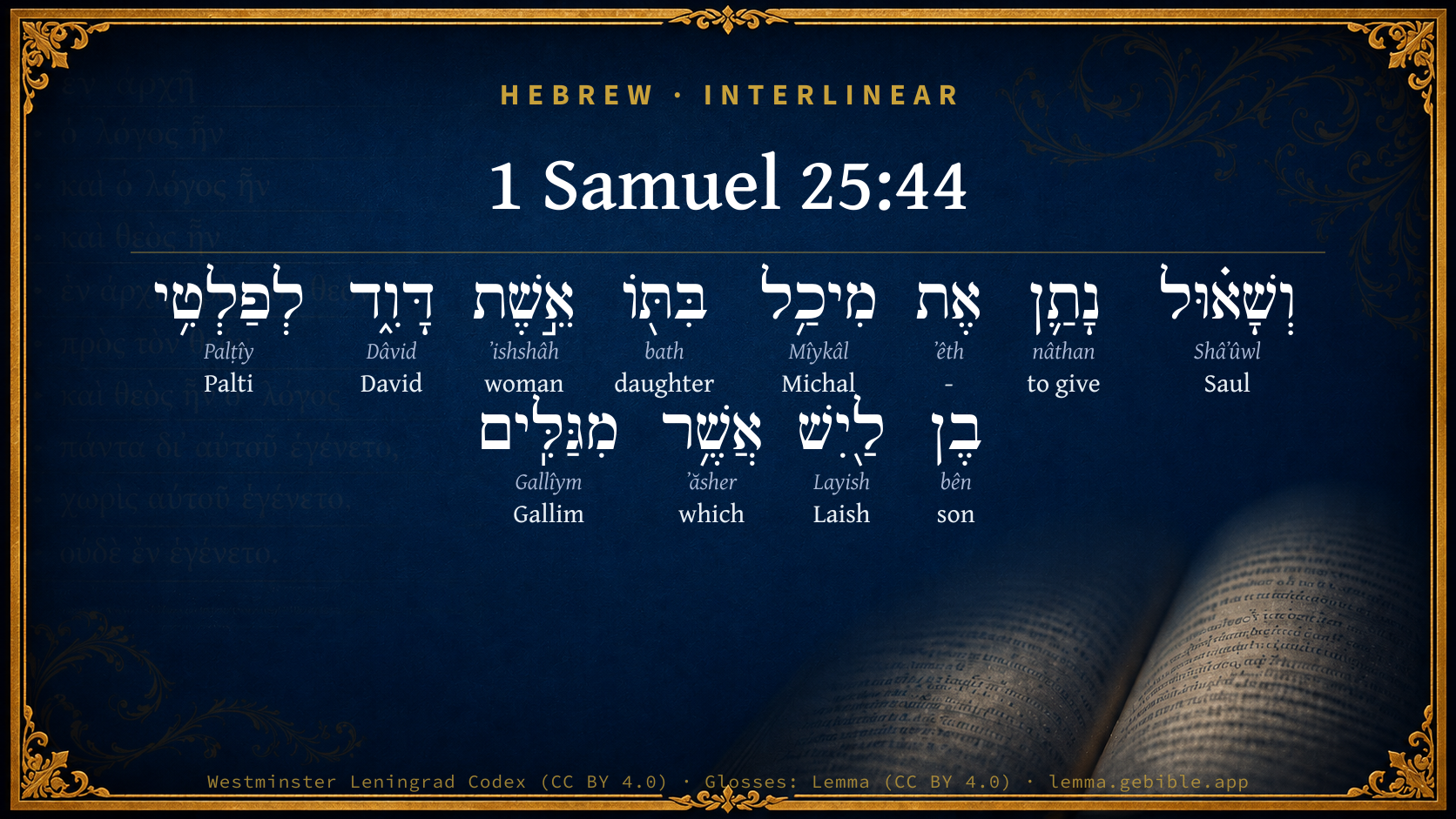
1 Samuel 25:44

Hebrew (Westminster Leningrad Codex) 1 Samuel 25:44 appears in the Hebrew Old Testament. The text above is from the Westminster Leningrad Codex. Each word links to its Strong’s number, a concise gloss, and parsing drawn from the Open Scriptures Hebrew Bible morphology. Click any word for its full Brown-Driver-Briggs (BDB) entry.
Download image
Cite this verse

1 Samuel 25:44 (World English Bible). Public Domain. Lemma interlinear Bible study tool, https://lemma.gebible.app/v/1-samuel/25/44.

Show BibTeX & RIS
BibTeX
RIS
English Translation
Now Saul had given Michal his daughter, David's wife, to Palti the son of Laish, who was of Gallim.
World English Bible · Public Domain
Highlights
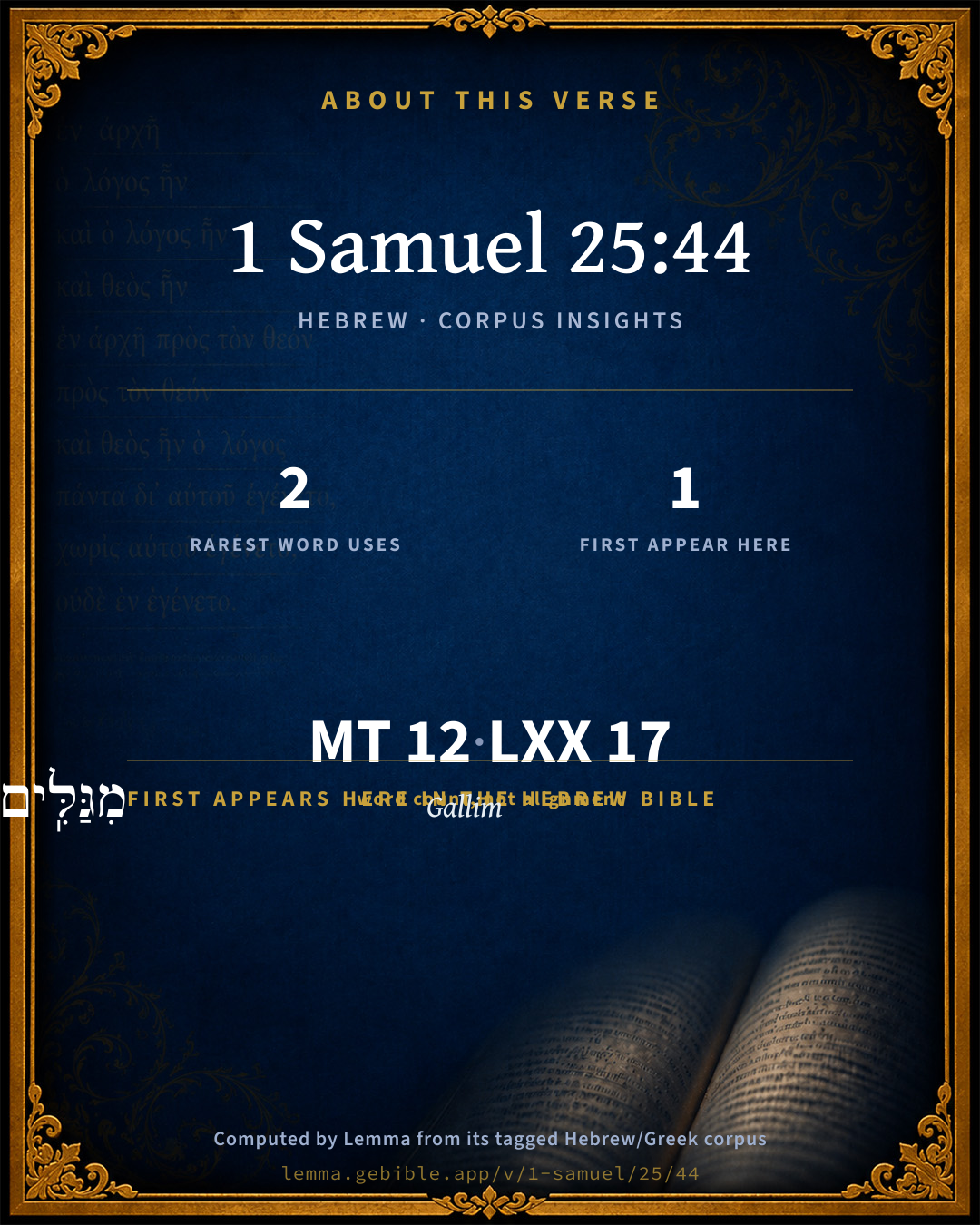
  • 1 first appearance in the Hebrew Bible
Full analysis ↓
Download a study sheet

One document with this verse’s original text, its word-by-word gloss line, the meaning frame, cross-references with their text, attributed commentary, and full source and license credits — printable, and it pastes into notes with its structure intact.

This verse Autodidact and up

Study sheet (.html) Plain text (.txt)

A passage Seminary Student

Up to 50 verses in one chapter. A passage sheet keeps up to 6 commentary sources and 12 cross-references per verse, in the order this page ranks them, and says so on the sheet whenever that leaves anything out. Ask for a single verse and you get the Autodidact verse sheet above.

Everything on this page stays free to read, with no account — the sheet is a download of what is already on screen, not access to it.

Want to remove ads? Support Godless Engineer
Compare translations 3

The same verse in 3 English versions, stacked beneath the original-language interlinear above. Click any original word for its lexicon entry.

Each is an independent rendering of the whole verse — the interlinear is not word-aligned to these translations.

Highlighted words mark where these versions differ — a whole-verse word diff, not a word-by-word alignment.

  • World English Bible Public Domain
    Now Saul had given Michal his daughter, David's wife, to Palti the son of Laish, who was of Gallim.
  • King James Version Public Domain
    But Saul had given Michal his daughter, David's wife, to Phalti the son of Laish, which was of Gallim.
  • unfoldingWord Literal Text CC BY-SA 4.0
    But Saul had given his daughter Michal, the wife of David, to Palti the son of Laish, who was Gallim.

unfoldingWord Literal Text — © unfoldingWord, licensed CC BY-SA 4.0. Word-aligned USFM3 via Door43 (git.door43.org/unfoldingWord/en_ult).

Versions to compare (up to 4)

3 of 4 selected

Show all 18 translations

Every available English version of this verse, each an independent rendering of the whole verse.

  • World English Bible Public Domain
    Now Saul had given Michal his daughter, David's wife, to Palti the son of Laish, who was of Gallim.
  • Berean Standard Bible Public Domain
    But Saul had given his daughter Michal, David’s wife, to Palti son of Laish, who was from Gallim.
  • Majority Standard Bible Public Domain
    But Saul had given his daughter Michal, David’s wife, to Palti son of Laish, who was from Gallim.
  • King James Version Public Domain
    But Saul had given Michal his daughter, David's wife, to Phalti the son of Laish, which was of Gallim.
  • American Standard Version (1901) Public Domain
    Now Saul had given Michal his daughter, David's wife, to Palti the son of Laish, who was of Gallim.
  • Revised Version (1885) Public Domain
    Now Saul had given Michal his daughter, David’s wife, to Palti the Son of Laish, which was of Gallim.
  • Geneva Bible (1599) Public Domain
    Now Saul had giuen Michal his daughter Dauids wife to Phalti the sonne of Laish, which was of Gallim.
  • Douay-Rheims (1899) Public Domain
    But Saul gave Michol his daughter, David's wife, to Phalti, the son of Lais, who was of Gallium.
  • Young's Literal Translation Public Domain
    and Saul gave Michal his daughter, wife to David, to Phalti son of Laish, who `is' of Gallim.
  • Literal Standard Version CC BY-SA 4.0
    and Saul gave his daughter Michal, David’s wife, to Phalti son of Laish, who [is] of Gallim.
  • Unlocked Literal Bible CC BY-SA 4.0
    Also, Saul had given Michal his daughter, David's wife, to Paltiel son of Laish, who was of Gallim.
  • unfoldingWord Literal Text CC BY-SA 4.0
    But Saul had given his daughter Michal, the wife of David, to Palti the son of Laish, who was Gallim.
  • Darby Bible Public Domain
    But Saul had given Michal his daughter, David's wife, to Phalti the son of Laish, who was of Gallim.
  • World Messianic Bible Public Domain
    Now Saul had given Michal his daughter, David’s wife, to Palti the son of Laish, who was of Gallim.
  • Webster's Bible Public Domain
    But Saul had given Michal his daughter, David's wife, to Phalti the son of Laish, who was of Gallim.
  • Free Bible Version CC BY-SA 4.0
    However, Saul had given his daughter Michal, David's wife, to Paltiel, son of Laish. He was from Gallim.
  • Bible in Basic English Public Domain
    Now Saul had given his daughter Michal, David's wife, to Palti the son of Laish of Gallim.
  • JPS Tanakh (1917) Public Domain
    Now Saul had given Michal his daughter, David's wife, to Palti the son of Laish, who was of Gallim.

Literal Standard Version (2020), Covenant Press — licensed CC BY-SA 4.0. Text via the HelloAO Bible API (eBible.org). Unlocked Literal Bible (unfoldingWord) — licensed CC BY-SA 4.0. Text via the HelloAO Bible API (eBible.org). unfoldingWord Literal Text — © unfoldingWord, licensed CC BY-SA 4.0. Word-aligned USFM3 via Door43 (git.door43.org/unfoldingWord/en_ult). Free Bible Version, Dr. Jonathan Gallagher — licensed CC BY-SA 4.0. Text via the HelloAO Bible API (eBible.org).

Word by word

More ways to search: Search by grammar → Find every occurrence → Compare this word →

Practice this passage: Drill this verse → Learn its vocabulary →

About this verse

These counts appear in no published source. They are computed here, from the morphology-tagged text and Lemma’s own curated glosses. What Lemma adds →

12
words
12
distinct lemmas
Historical
section

Notable vocabulary

The rarest word here is לְפַלְטִ֥י Palti H6406 — appearing just 2 times in the whole Hebrew Bible.

First appearance in Scripture

This word makes its first canonical appearance in the Hebrew Bible here:

  • מִגַּלִּֽים Gallim H1554

Shared distinctive vocabulary

לְפַלְטִ֥י Palti H6406 occurs in 2 verses of the Hebrew Bible. Also found in:

Grammatical profile

  • 1 verb
  • 9 nouns
  • 2 particles

Verb forms

  • נָתַ֛ן Qal · Perfect

Hebrew & Septuagint length

In English translation the verse runs 19 words from the Hebrew and 18 from the Septuagint (LXX English) — closely comparable.

A rough comparison of the two English renderings, which tokenize alike — not a word-level alignment.

Word counts can differ between the Hebrew and the Greek without any difference in meaning — e.g. the Hebrew direct-object marker אֵת has no separate Greek word, and Greek often adds the article ὁ.

In the original languages it is 12 Hebrew tokens and 17 Greek tokens — but the two are counted differently (Hebrew bundles its prefixes and suffixes into one token; the Greek is in lemma form), so that isn’t a like-for-like length.

Cross-references

4

Topical passages linked to 1 Samuel 25:44 in the Treasury of Scripture Knowledge — connected by theme and wording, ordered by reader-vote popularity; previews shown in the World English Bible.

  • 1 Samuel 18:27 and David arose and went, he and his men, and killed of the Philistines two hundred men; and David brought their foreskins, and they gave them in full number to the king, that he might be the king's son-in-law. Saul gave him Michal his daughter as wife.
  • 2 Samuel 3:14 David sent messengers to Ish-bosheth, Saul's son, saying, Deliver me my wife Michal, whom I pledged to be married to me for one hundred foreskins of the Philistines.
  • 1 Samuel 18:20 Michal, Saul's daughter, loved David: and they told Saul, and the thing pleased him.
  • Isaiah 10:30 Cry aloud with your voice, daughter of Gallim! listen, Laishah! You poor Anathoth!

Cross-references courtesy of OpenBible.info (CC BY 4.0).

Hebrew and Greek witnesses Masoretic Hebrew ↔ Greek Septuagint

The same verse in the two great witnesses to the Old Testament, shown verse-for-verse.

These are two independent witnesses, not word-aligned to each other, and the Septuagint is shown in lemma (dictionary) form.

Hebrew 1 Samuel 25:44 Masoretic · Westminster Leningrad Codex

וְשָׁא֗וּל נָתַ֛ן אֶת מִיכַ֥ל בִּתּ֖וֹ אֵ֣שֶׁת דָּוִ֑ד לְפַלְטִ֥י בֶן לַ֖יִשׁ אֲשֶׁ֥ר מִגַּלִּֽים

Now Saul had given Michal his daughter, David's wife, to Palti the son of Laish, who was of Gallim.

World English Bible · Public Domain

Greek LXX 1 Samuel 25:44 Septuagint · lemma form

καί σαούλ δίδωμι μελχολ ὁ θυγάτηρ αὐτός ὁ γυνή δαυίδ ὁ φαλτι υἱός λαις ὁ ἐκ ρομμα

And Saul gave Melchol his daughter, David's wife, to Phalti the son of Amis who was of Romma.

LXX2012 (modern English Septuagint) · Public Domain

Hebrew: Westminster Leningrad Codex (CC BY 4.0). Greek: Septuagint (public domain); English from LXX2012 (modern English Septuagint) (Public Domain). How the Septuagint differs from the Hebrew →

Targum (Aramaic paraphrase)

1

The Targum is the ancient Jewish Aramaic paraphrase of the Hebrew Scriptures — an interpretive translation, not the Hebrew text itself. Onkelos (literal) and Pseudo-Jonathan (expansive) render the Torah, and Jonathan the Prophets. Coverage is partial: where no permissively-licensed English translation exists for a verse, only the Aramaic is shown. This is verse-level text, not a word-by-word alignment to the Hebrew.

  1. Targum Jonathan Prophets (Joshua–Malachi)
    וְשָׁאוּל יְהַב יַת מִיכַל בְּרַתֵּיה אִתַּת דָוִד לְפַלְטִי בַּר לַיִשׁ דְמִגַלִים:

    (no public-domain English translation for this verse)

    Targum Jonathan — Aramaic: “Mikraot Gedolot” (public domain). English: “Sefaria Community Translation” (CC0 1.0 (public-domain dedication)); “London "Chaldee Paraphrase," 1871” (public domain). Text via Sefaria.

Commentary

Notes on 1 Samuel 25:44 from classic Christian and Jewish commentators (each source and its license shown beneath its notes). The classic Christian expositions comment on the surrounding passage and are grouped to its opening verse, so a note may address several verses; the Jewish commentaries on the Tanakh (Rashi and others) are per-verse, so they appear only where the commentator wrote on this verse.

Lemma curates 59 commentaries, every one of them public domain or Creative Commons licensed, each selected and text-cleaned for this edition rather than reprinted as found. About our sources →

Ellicott's Commentary for English Readers

(44) Michal his daughter.—The marriage of the Princess Michal to Phalti (Michal, we read, “loved David,” 1Sa_18:20) had taken place probably some time before. This high-handed act showed on the part of Saul a fixed determination to break utterly and for ever with David. Phalti was presumably a chieftain whom Saul was desirous of attracting to his fortunes. But the story of Miehal does not end here. After King Saul’s death, Abner, the uncle (or perhaps the cousin) of the late king, the well-known captain of his host, made overtures to David. David, however, only consented to a friendship with Abner if his young kins woman, the Princess Miehal, Saul’s daughter, was taken away from Phalti, and restored to him as his wife. Abner, we read, complied with the condition, and Miehal was taken from Phaltiel—as he is called in the account of this transaction, contained in 2Sa_3:13; 2Sa_3:16—and restored to David. An interesting and curious tradition respecting this man Phalti, or Phaltiel, is contained in the Talmud. In 1Sa_25:44 the second husband of David’s wife is called Phalti, and in 2Sa_3:15 he is called Phaltiel. Rabbi Jochanan said his name received that extension (el=God) to indicate that God had saved him from transgression. (The name Phalti being derived from the root palat—to cause to escape, Michal and Phalti never having lived together as man and wife.)—Treatise Sanhedrin, fol. 19, Colossians 2.

Once more the daughter of Saul appears in the sacred history. (See 2Sa_6:20-23.) It was the greatest day in David’s life—the Ark of the Covenant was being brought up with solemn pomp from its place of long exile in Kirjath-jearim to the new sacred capital of the loved king. One sad incident alone, we are told, marred the glories of the day. Michal, his wife, as Stanley thinks, in the proud, almost conservative, spirit of the older dynasty, not without a thought of her father’s fallen house, looked on contemptuously as King David danced before the Ark with the priests, his royal robes thrown aside; and later in the day seems to have poured out before the king her scornful feelings.

“Preceding the blest vessel, onward came,

With light dance leaping, girt in humble guise,

Israel’s sweet harper; in that hap he seemed

Less and yet more kingly. Opposite,

At a great palace, from the lattice forth

Looked Miehal, like a lady full of scorn

And sorrow.”—DANTE: Purgatory, 10

The sacred story goes on to say that Michal, as a childless wife in the royal palace of David, had time to mourn her fatal exhibition of pride. (See 2Sa_6:12-23.)

A Bible Commentary for English Readers, edited by Charles John Ellicott (1878–1897) — public domain. Text from a community e-Sword module.

Trapp's Complete Commentary

John Trapp

1Sa 25:44 But Saul had given Michal his daughter, David’s wife, to Phalti the son of Laish, which [was] of Gallim.

Ver. 44. But Saul had given Michel his daughter.] This he had done as out of pure spite to David, so out of policy, say some, that he might not have by his wife any pretence or title to the crown.

David’s wife.] Whom he had so dearly deserved, and by whom he was now so causelessly deserted; for why should she give consent to be married to another?

To Phalti.] Who is justly faulted for taking another man’s wife.

Which was of Gallim.] A town of Benjamin, near Gibeah. {Isa 10:29}

John Trapp, A Commentary or Exposition upon All the Books of the Old and New Testament (1647–1656) — public domain. Text from a community e-Sword module.

Tyndale Open Study Notes

Tyndale Open Resources

25:44 Saul’s motive for giving away Michal to another man was probably political, an attempt to remove any claim David might have on the throne by dissolving David’s marriage with a member of the royal family.

Tyndale Open Study Notes — © Tyndale Open Resources, licensed CC BY-SA 4.0. Text via the HelloAO Bible API.

Geneva Bible (1599)

Geneva Bible translators

Which was a place bordering on the country of the Moabites.

Geneva Bible (1599) marginal notes — public domain. Text via Bolls.life.

Jamieson, Fausset & Brown

Robert Jamieson, A. R. Fausset & David Brown

Michal--By the unchallengeable will of her father, she who was David's wife was given to another. But she returned and sustained the character of his wife when he ascended the throne.

Next: 1 Samuel Chapter 26

Jamieson, Fausset & Brown — Commentary Critical and Explanatory on the Whole Bible (1871) — public domain (CC PDM 1.0). Text via the HelloAO Bible API.

Adam Clarke's Commentary

Verse 44. Phalti] Called also Phaltiel, 2Sa 3:16.

Of Gallim.] Probably a city or town in the tribe of Benjamin; see Isa 10:30. It is likely therefore that Saul chose this man because he was of his own tribe.

IN this chapter we have the account of the death of Samuel, who from his infancy had been devoted to God and the service of his people. He was born at a time in which religion was at a very low ebb in Israel, as there were but very few prophets, and no open vision - scarcely any revelation from God. Those who might be called prophets had no regular ministry of God's word; they were extraordinary messengers sent for a particular purpose, and not continued in the work any longer than the time necessary to deliver their extraordinary message.

Samuel is supposed to have been the first who established academies or schools for prophets, at least we do not hear of them before his time; and it is granted that they continued till the Babylonish captivity. This was a wise institution, and no doubt contributed much to the maintenance of pure religion, and the prevention of idolatry among that people.

Samuel reformed many abuses in the Jewish state, and raised it to a pitch of political consequence to which it had been long a stranger. He was very zealous for the honour of God, and supported the rights of pure religion, of the king, and of the people, against all encroachments. He was chief magistrate in Israel before the appointment of a king, and afterwards he acted as prime minister to Saul, though without being chosen or formally appointed to that station. Indeed, he seems on the whole to have been the civil and ecclesiastical governor, Saul being little more than general of the Israelitish forces.

In his office of minister in the state, he gave the brightest example of zeal, diligence, inflexible integrity, and uncorruptedness. He reproved both the people and the king for their transgressions, with a boldness which nothing but his sense of the Divine authority could inspire, and yet he tempered it with a sweetness which showed the interest he felt in their welfare, and the deep and distressing concern he felt for their back-slidings and infidelities.

He was incorrupt; he received no man's bribe; he had no pension from the state; he enriched none of his relatives from the public purse; left no private debts to be discharged by his country. He was among the Hebrews what Aristides is said to have been among the Greeks, so poor at his death, though a minister of state, that he did not leave property enough to bury him. Justice was by him duly and impartially administered, and oppression and wrong had no existence.

If there ever was a heaven-born minister, it was Samuel; in whose public and private conduct there was no blemish, and whose parallel cannot be found in the ancient or modern history of any country in the universe.

Let ministers of state who have sought for nothing but their own glory, and have increased the public burdens by their improvident expenditure; who have endeavoured, by their wordy representations, to dazzle and elude the people, and impose false grandeur in the place of true greatness and solid prosperity; who have oppressed the many, and enriched the worthless few; fall down at the feet of THIS heaven-born man, and learn, from this immaculate judge of Israel, what a faithful servant to his king, and an incorruptible minister of state, means, and in retiring from their high station, or in going to appear before the judgment-seat of God, see whether, in the presence of their king, and in the face of the thousands of their people, they can boldly say, "Behold, here am I! Witness against me before the Lord and before his anointed. Whose ox have I taken? Whose ass have I seized? Whom have I defrauded? Whom have I oppressed, by the imposition of heavy taxes for the support of needless expenses, and the payment of venal men? Or of whose hand have I taken any bribe to blind my eyes? Scrutinize my conduct, examine the state of my family, compare their present circumstances with what they were previously to my administration, and see if you can find aught in my hands." See 1Sa 12:1, c.

O, how seldom in the annals of the world, from the assembled heads of the great body politic, can the departing prime minister hear, "Thou hast not defrauded us, thou hast not oppressed us neither hast thou taken aught of any man's hand! " This voice call be heard from Gilgal; but of what other minister can this be spoken but of Samuel the seer, who was the gift of God's mercy to the people of Israel; whose memory was too precious to be intrusted to public monuments, but stands, and alas; almost unique in the BOOK OF GOD? Of Daniel, and his administration, I shall have occasion to speak elsewhere.

A prime minister, deeply devoted to God and faithful to his king and to his country, is so rare a character in the world, that when he does occur, he should be held up to public admiration. But I have no parallel for Samuel. See the notes on 1Sa 12:1-25 and on 1Sa 24:6.

Adam Clarke's Commentary on the Bible (1810–1826) — public domain. Text from a community e-Sword/MySword module.

The Cambridge Bible for Schools and Colleges

gen. ed. J. J. S. Perowne

44. Saul had given Michal] Probably he did it when David fled, to mark the completeness of the breach between them. David afterwards compelled Phalti (or Phaltiel) to restore him Michal (2Sa_3:15).

Gallim] Only referred to again in Isa_10:30, from which passage it appears that it was between Gibeah and Jerusalem. The name of Phalti’s father Laish was probably derived from the place Laish mentioned in the same verse.

The Cambridge Bible for Schools and Colleges (gen. ed. J. J. S. Perowne; Cambridge University Press, 1878–1918) — public domain. Text from a community e-Sword module.

John Gill's Exposition

But Saul had given Michal his daughter, David's wife, to Phalti the son of Laish,.... Or "for Saul", &c. (i); which is a reason for his marrying again, but no reason for marrying more wives than one. Michal was his first wife, and they lived lovingly together, until David was obliged to flee from Saul, and then he gave her to another; partly to vex David, and partly if he could to break the relation between him and David, that he might not be thought to be his son in law, and he to persecute one in such a relation to him; and that this might not give David any show of claim, or be the means of his rising to the throne. This Phalti, to whom he gave her, is called Phaltiel, Sa2 3:15,

which was of Gallim; which very probably was a city in the tribe of Benjamin, since it is mentioned with several cities of that tribe, and as near Gibeah of Saul, Isa 10:29.

(i) "Saul enim", Tigurine version; "nam Saul", Junius & Tremcillius, Piscator; so Pool and Patrick.

Next: 1 Samuel Chapter 26

John Gill's Exposition of the Whole Bible (1746–1763) — public domain (CC PDM 1.0). Text via the HelloAO Bible API.

Albert Barnes' Notes on the Bible

Saul’s giving Michal to Phalti was intended to mark the final rupture of his own relations with David (compare Jdg 14:20; 2Sa 3:7; 2Sa 16:21). Phalti or Phaltiel Was compelled by Abner to restore Michal to David 2Sa 3:15.

Gallin - A city of Benjamin, and in the neighborhood of another town called Laish.

Albert Barnes' Notes on the Bible (1834–1885) — public domain. Text from a community e-Sword/MySword module.

Haydock's Catholic Bible Commentary

Phalti, or Phaltiel, 2 Kings iii. 15. Saul violated all laws by so doing, and David took her back when he came to the throne, which he could not have done if he had given her a bill of divorce, Deuteronomy xxiv. 4. (Calmet) --- Michol was not blameless in living thus with another man. (Menochius) --- The Rabbins say that a sword hindered Phalti from approaching her. (Horn in Sulp.) --- Gallim, a city of Benjamin, Isaias x. 30. (Calmet)

George Leo Haydock (1774–1849), Haydock's Catholic Family Bible and Commentary, 1859 edition — public domain. Excludes Psalms (Douay-Rheims chapter numbering differs from Protestant) and Deuterocanonical books (Catholic canon only).

Matthew Poole's English Annotations

But, or for, as the Hebrew vau is ofttimes used. For this seems to be added as a reason why David took other wives, because Saul had given his former wife to another man, that he might as far as he could extinguish all relation and kindred to him, whom he hated; and withal, cut off his hopes and pretence to the crown upon that account.

Matthew Poole's English Annotations on the Holy Bible (1683–1685) — public domain. Text from a community e-Sword/MySword module.

Whedon's Commentary on the Bible

Daniel D. Whedon

44. Saul had given Michal… David’s wife, to Phalti — Hoping thereby to cut off one of David’s pretensions to the throne, and to attach a new family to his cause. Compare the restoration of Michal to David, 2Sa_3:14-16, where the son of Laish is called Phaltiel.

Gallim — This place is mentioned Isa_10:30, in connection with several towns in the tribe of Benjamin, and was probably somewhere between Gibeah and Michmash; but its site is now unknown.

Daniel D. Whedon (gen. ed.), Commentary on the Old and New Testaments (1874–1909) — public domain. Text from a community e-Sword module.

Lesson kit

Teaching starters — assembled from the data on this page, not authored interpretation. Every prompt links to the verse data it draws on. Edit before teaching.

1 Samuel, in the Historical, opens this verse with 12 words (12 distinct Hebrew lemmas). Its most distinctive word is Palṭîy (“Palti”). A historical commentator’s framing appears above. Read the whole chapter for the surrounding context.

Discussion questions

  1. What does “Palti” (Palṭîy) contribute to the verse as a whole?
  2. This is the first place “Gallim” appears in Scripture (first appears here). What does its debut here establish?
  3. How does Numbers 13:9, which shares the word «Palti», read alongside this verse?
  4. These translations render this verse differently. What is at stake in choosing one wording over another?
  5. «נָתַ֛ן» is a Qal Perfect verb. How does that grammatical form shape the action described?
  6. Compare how Ellicott's Commentary for English Readers and Trapp's Complete Commentary read this verse. Where do they agree or differ?

Things to notice

Reading settings

Reading text

Shown beneath each verse's original-language words.

Old Testament
Old Testament edition

Read the OT as the Masoretic Hebrew (MT) or the Greek Septuagint (LXX).

English shown for the Greek Septuagint (in the Hebrew ↔ Greek comparison).

Comparing translations? Open the Compare panel on any verse page to stack up to four side by side.