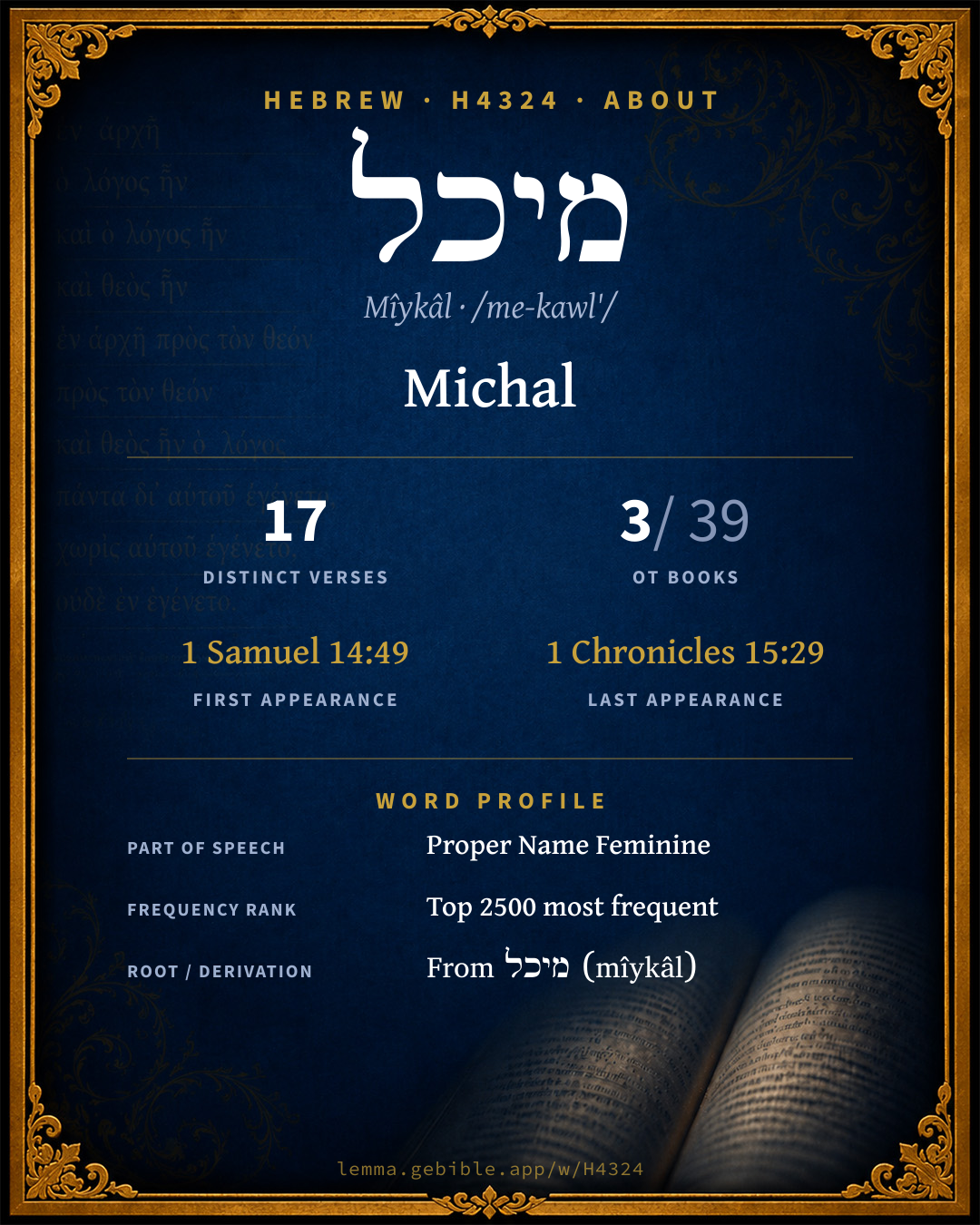
מִיכַל
Michal
BDB lists 2 entries for ‘Michal’ fuller range ↓
Full lexicon entry — Brown-Driver-Briggs (BDB)
From Brown-Driver-Briggs (BDB)
Where this word appears
Grammar key — what these labels mean
Part of speech
- Noun
- A naming word — a person, place, thing, or idea.
Noun type
- Proper
- A name of a specific person, place, or people (e.g. Abraham, Zion, Israel).
Every verse where H4324 appears — 17 distinct verses across 3 books. Click any verse to open its interlinear word-by-word view. Verse text shown in the World English Bible for context — . Each verse’s Hebrew form is shown with its reference; the English is not keyword-highlighted, since the data carries no word-level English alignment. Use “Compare translations” on any verse to read it across multiple English versions. This concordance covers the Hebrew Bible; Septuagint (Greek Old Testament) occurrences are not indexed here.
1 Samuel 9 verses
- 1 Samuel 14:49 מִיכַֽל n Proper Now the sons of Saul were Jonathan, and Ishvi, and Malchishua; and the names of his two daughters were these: the name of the firstborn Merab, and the name of the younger Michal:
- 1 Samuel 18:20 מִיכַ֥ל n Proper Michal, Saul's daughter, loved David: and they told Saul, and the thing pleased him.
- 1 Samuel 18:27 מִיכַ֥ל n Proper and David arose and went, he and his men, and killed of the Philistines two hundred men; and David brought their foreskins, and they gave them in full number to the king, that he might be the king's son-in-law. Saul gave him Michal his daughter as wife.
- 1 Samuel 18:28 וּ/מִיכַ֥ל conj + n Proper Saul saw and knew that Yahweh was with David; and Michal, Saul's daughter, loved him.
- 1 Samuel 19:11 מִיכַ֤ל n Proper Saul sent messengers to David's house, to watch him, and to kill him in the morning: and Michal, David's wife, told him, saying, If you don't save your life tonight, tomorrow you will be slain.
- 1 Samuel 19:12 מִיכַ֛ל n Proper So Michal let David down through the window: and he went, and fled, and escaped.
- 1 Samuel 19:13 מִיכַ֜ל n Proper Michal took the teraphim, and laid it in the bed, and put a pillow of goats' [hair] at the head of it, and covered it with the clothes.
- 1 Samuel 19:17 מִיכַ֗ל מִיכַל֙ n Proper n Proper Saul said to Michal, Why have you deceived me thus, and let my enemy go, so that he is escaped? Michal answered Saul, He said to me, Let me go; why should I kill you?
- 1 Samuel 25:44 מִיכַ֥ל n Proper Now Saul had given Michal his daughter, David's wife, to Palti the son of Laish, who was of Gallim.
2 Samuel 7 verses
- 2 Samuel 3:13 מִיכַ֣ל n Proper He said, Well; I will make a league with you; but one thing I require of you: that is, you shall not see my face, except you first bring Michal, Saul's daughter, when you come to see my face.
- 2 Samuel 3:14 מִיכַ֔ל n Proper David sent messengers to Ish-bosheth, Saul's son, saying, Deliver me my wife Michal, whom I pledged to be married to me for one hundred foreskins of the Philistines.
- 2 Samuel 6:16 וּ/מִיכַ֨ל conj + n Proper It was so, as the ark of Yahweh came into the city of David, that Michal the daughter of Saul looked out at the window, and saw king David leaping and dancing before Yahweh; and she despised him in her heart.
- 2 Samuel 6:20 מִיכַ֤ל n Proper Then David returned to bless his household. Michal the daughter of Saul came out to meet David, and said, How glorious was the king of Israel today, who uncovered himself today in the eyes of the handmaids of his servants, as one of the vain fellows shamelessly uncovers himself!
- 2 Samuel 6:21 מִיכַל֒ n Proper David said to Michal, [It was] before Yahweh, who chose me above your father, and above all his house, to appoint me prince over the people of Yahweh, over Israel: therefore will I play before Yahweh.
- 2 Samuel 6:23 וּ/לְ/מִיכַל֙ conj + prep + n Proper Michal the daughter of Saul had no child to the day of her death.
- 2 Samuel 21:8 מִיכַ֣ל n Proper But the king took the two sons of Rizpah the daughter of Aiah, whom she bore to Saul, Armoni and Mephibosheth; and the five sons of Michal the daughter of Saul, whom she bore to Adriel the son of Barzillai the Meholathite:
1 Chronicles 1 verse
About this entry
At a glance — auto-summarized from this page’s data, not written by a person. Every figure links to its source below. This summary describes the numbers; it doesn’t interpret them.
“Michal” is the headline sense of the Hebrew name מיכל (Mîykâl). More than half of its appearances fall in 1 Samuel. The Hebrew Bible uses it across 17 verses — uncommon. First canonically at 1 Samuel 14:49, it enters the text early. The sections below give every occurrence and version rendering.
Gloss history
Strong's 1890 vs modern scholarship
About this word
Strong's H4324 catalogs a Hebrew word from the Hebrew Old Testament.
These counts are not copied from any lexicon or concordance. They are computed here, from the morphology-tagged Hebrew Old Testament. What Lemma adds →
- 17
- distinct verses
- The word appears in 17 distinct verses.
- 3 / 39
- OT books
- The word appears in 3 of 39 Old Testament books.
- #1,612
- by frequency
- Top 2500 most frequent Hebrew words (rank 1,612 of 8,640 Hebrew words by occurrence).
View all 17 occurrences in the concordance →
Most concentrated in
- 1 Samuel 9 verses 53%
- 2 Samuel 7 verses 41%
- 1 Chronicles 1 verse 6%
By section of the Old Testament
By traditional corpus
Conventional, traditional groupings — biblical authorship is debated, so this is a traditional corpus grouping, not an authorship claim. Each share is this word’s portion of its verses in that division of the Hebrew canon. Each figure is a share of the word’s 17 distinct verses.
- Prophets (Nevi'im) 16 verses · 94%
- Writings (Ketuvim) 1 verse · 6%
How translations render this word
Counts come from each version’s own published word-to-Strong’s tagging or interlinear alignment — an approximate guide to how each version renders this word, not a word-level alignment the data otherwise carries. Because each total is that version’s own tagged count, the per-version totals vary from one another and need not match the appearance or distinct-verse counts above. These counts may also differ from a printed concordance because Lemma counts each distinctly tagged rendering and does not collapse phrase taggings into a single head-word total. This is a fixed set of word-tagged versions (KJV, ASV, BSB, ULT) and does not change with the reading translation you choose elsewhere. Each version’s license is shown beside its name below (and on Sources).
- King James Version: Michal 17×
- American Standard Version: Michal 18×
- Berean Standard Bible: Michal 17×
- unfoldingWord Literal Text: Michal 18×
King James Version Public Domain
Renders H4324 across 18 tagged occurrences — most commonly:
Plus 1 rendering that appears only once — usually multi-word phrases or single function words the recovered tagging swept in, not distinct renderings.
American Standard Version Public Domain
Renders H4324 across 18 tagged occurrences — most commonly:
Berean Standard Bible Public Domain
Renders H4324 across 18 tagged occurrences — most commonly:
Plus 1 rendering that appears only once — usually multi-word phrases or single function words the recovered tagging swept in, not distinct renderings.
unfoldingWord Literal Text CC BY-SA 4.0
Renders H4324 across 19 tagged occurrences — most commonly:
Plus 1 rendering that appears only once — usually multi-word phrases or single function words the recovered tagging swept in, not distinct renderings.
Senses in BDB
The 2 senses BDB distinguishes for this word, in lexicon order (not ranked by frequency or importance). The full entry — with sub-senses — is in the Lexicon Entry tab.
- Michal = "who is like God"
- daughter of king Saul…
Word origin
n.pr.f. (according to Ol§ 277 f.; contr. from מִיכָאֵל):—younger daughter of Saul, wife of David (𝔊 Μελχολ), 1 S 14:49; 18:20, 27, 28; 19:11, 12, 13, 17(×2); 25:44 2 S 3:13, 14; 6:16 = 1 Ch 15:29, 2 S 6:20, 21, 23; also 21:8 (𝔊 Μιχολ), but error for מֵרַב (𝔊L Μεροβ).
— Brown-Driver-Briggs (Oxford 1906, public domain), digitized via Sefaria, supplemented by the OpenScriptures HebrewLexicon (CC BY 4.0). See Sources.
Derived from מיכל (mîykâl) (H4323) — brook.
Jastrow Dictionary
A second Hebrew/Aramaic lexicon for comparison, covering Aramaic and post-biblical (Talmudic, Targumic, Midrashic) usage that the biblical-Hebrew BDB does not. Matched by lemma rather than by Strong’s number, so a lemma may carry more than one Jastrow headword (shown separately below), and the entries cover usage well beyond the Bible.
מִיכַל
- (b. h.) Miçhal, daughter of Saul and wife of David. Tosef. Sot. XI, 15; Snh. 19ᵇ. Ib. 21ᵃ. Midr. Sam. ch. XXV; a. e.—Erub. 96ᵃ מ׳ בת כושי daughter of Saul (?), v. comment.
מֵיכַל
- (אֲכַל I)
- 1. food. Targ. Lev. XI, 34. Targ. Jud. XIV, 14; a. e.—Pes. 114ᵃ מֵיכְלָךְ, v. פְּחַת. Succ. 29ᵃ; 48ᵃ מאני מ׳ eating vessels, dishes, opp. to drinking vessels.
- 2. (infin. of אֲכַל) eating. Gen. R. s. 19 במֵיכְלֵיה when eating thereof; a. fr.
A Dictionary of the Targumim, the Talmud Babli and Yerushalmi, and the Midrashic Literature (Marcus Jastrow; London, Luzac, 1903) — Public Domain. Digitized via Sefaria. Digitized via Sefaria. Full attribution on Sources.
Forms in the corpus
The 13 distinct written forms H4324 takes in the Hebrew Bible, most frequent first — each parse links to that state’s occurrences in the concordance. Hebrew forms include their vowel points and cantillation, so a single lemma takes many written forms.
| Form | Parsing | Example | Uses |
|---|---|---|---|
| מִיכַ֥ל | Noun, Proper | 1 Samuel 18:20 | 3 |
| וּ/מִיכַ֨ל | Noun, Proper | 1 Chronicles 15:29 | 2 |
| מִיכַ֣ל | Noun, Proper | 2 Samuel 3:13 | 2 |
| מִיכַ֤ל | Noun, Proper | 1 Samuel 19:11 | 2 |
| וּ/לְ/מִיכַל֙ | Noun, Proper | 2 Samuel 6:23 | 1 |
| וּ/מִיכַ֥ל | Noun, Proper | 1 Samuel 18:28 | 1 |
| מִיכַ֔ל | Noun, Proper | 2 Samuel 3:14 | 1 |
| מִיכַ֗ל | Noun, Proper | 1 Samuel 19:17 | 1 |
| מִיכַ֛ל | Noun, Proper | 1 Samuel 19:12 | 1 |
| מִיכַ֜ל | Noun, Proper | 1 Samuel 19:13 | 1 |
| מִיכַֽל | Noun, Proper | 1 Samuel 14:49 | 1 |
| מִיכַל֒ | Noun, Proper | 2 Samuel 6:21 | 1 |
| מִיכַל֙ | Noun, Proper | 1 Samuel 19:17 | 1 |
Bible dictionary
Public-domain dictionary articles matched to this entry by name (Michal). A biblical name can be shared by more than one person or place, so an article may treat several.
Easton's Bible Dictionary · M. G. Easton, 1897
Rivulet, or who as God?, the younger of Saul's two daughters by his wife Ahinoam (1 Sam. 14:49, 50). "Attracted by the graces of his person and the gallantry of his conduct, she fell in love with David and became his wife" (18:20-28). She showed her affection for him by promoting his escape to Naioth when Saul sought his life (1 Sam. 19:12-17. Comp. Ps. 59. See TERAPHIM). After this she did not see David for many years. Meanwhile she was given in marriage to another man, Phalti or Phaltiel of Gallim (1 Sam. 25:44), but David afterwards formally reclaimed her as his lawful wife (2 Sam. 3:13-16). The relation between her and David soon after this was altered. They became alienated from each other. This happened on that memorable day when the ark was brought up in great triumph from its temporary resting-place to the Holy City. In David's conduct on that occasion she saw nothing but a needless humiliation of the royal dignity (1 Chr. 15:29). She remained childless, and thus the races of David and Saul were not mixed. In 2 Sam. 21:8 her name again occurs, but the name Merab should probably be here substituted for Michal (comp. 1 Sam. 18:19).
Smith's Bible Dictionary · William Smith, 1863
(who is like God?), the younger of Saul's two daughters, (1 Samuel 14:49) who married David. The price fixed on Michal's hand was no less than the slaughter of a hundred Philistines. David by a brilliant feat doubled the tale of victims, and Michal became his wife. Shortly afterward she saved David from the assassins whom her father had sent to take his life. (1 Samuel 19:11-17) When the rupture between Saul and David had become open and incurable, she was married to another man, Phalti or Phaltiel of Gallim. (1 Samuel 25:44) After the death of her father and brothers at Gilboa, David compelled her new husband to surrender Michal to him. (2 Samuel 3:13-16) How Michal comported herself in the altered circumstances of David's household we are not told; but it is plain from the subsequent occurrences that something had happened to alter the relations of herself and David, for on the day of David's greatest triumph, when he brought the ark of Jehovah to Jerusalem, we are told that "she despised him in her heart." All intercourse between her and David ceased from that date. (2 Samuel 6:20-23) Her name appears, (2 Samuel 21:8) as the mother of five of the grandchildren of Saul.
Hitchcock's Bible Names Dictionary · Roswell D. Hitchcock, 1869
who is perfect?
Classic public-domain reference works; full attribution on Sources.
Septuagint verse parallels
This word appears in 14 verses that also exist in the Greek Old Testament (Septuagint), out of the 17 Hebrew verses it occurs in. You can read those verses in Greek by switching the Old Testament edition to the Septuagint.
Read these verses in the Septuagint
This is a verse-level parallel only — the same verses exist in both the Hebrew and Greek Old Testaments. No word-level Hebrew↔Greek correspondence is claimed: the data carries no such alignment, so no Greek word is shown as this Hebrew word’s translation. Coverage is not total — the Septuagint omits the deuterocanon and renumbers the Psalms, so some Hebrew verses have no direct Greek parallel.