
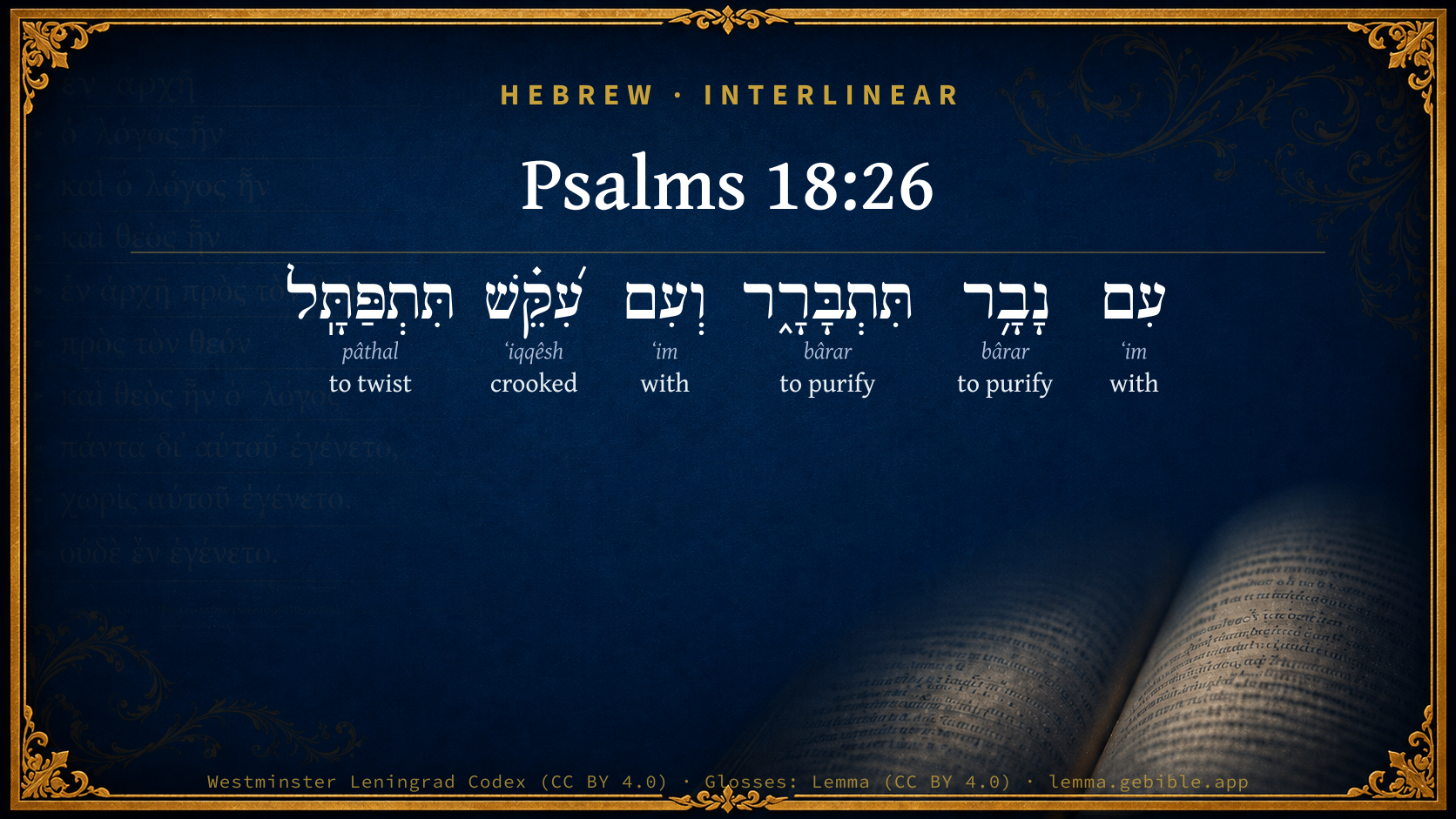
Psalms 18:26

Hebrew (Westminster Leningrad Codex) Psalms 18:26 appears in the Hebrew Old Testament. The text above is from the Westminster Leningrad Codex. Each word links to its Strong’s number, a concise gloss, and parsing drawn from the Open Scriptures Hebrew Bible morphology. Click any word for its full Brown-Driver-Briggs (BDB) entry.
Download image
Cite this verse

Psalms 18:26 (World English Bible). Public Domain. Lemma interlinear Bible study tool, https://lemma.gebible.app/v/psalms/18/26.

Show BibTeX & RIS
BibTeX
RIS
English Translation
With the pure, you will show yourself pure. With the crooked you will show yourself shrewd.
World English Bible · Public Domain
Download a study sheet

One document with this verse’s original text, its word-by-word gloss line, the meaning frame, cross-references with their text, attributed commentary, and full source and license credits — printable, and it pastes into notes with its structure intact.

This verse Autodidact and up

Study sheet (.html) Plain text (.txt)

A passage Seminary Student

Up to 50 verses in one chapter. A passage sheet keeps up to 6 commentary sources and 12 cross-references per verse, in the order this page ranks them, and says so on the sheet whenever that leaves anything out. Ask for a single verse and you get the Autodidact verse sheet above.

Everything on this page stays free to read, with no account — the sheet is a download of what is already on screen, not access to it.

Want to remove ads? Support Godless Engineer
Compare translations 3

The same verse in 3 English versions, stacked beneath the original-language interlinear above. Click any original word for its lexicon entry.

Each is an independent rendering of the whole verse — the interlinear is not word-aligned to these translations.

Highlighted words mark where these versions differ — a whole-verse word diff, not a word-by-word alignment.

  • World English Bible Public Domain
    With the pure, you will show yourself pure. With the crooked you will show yourself shrewd.
  • King James Version Public Domain
    With the pure thou wilt shew thyself pure; and with the froward thou wilt shew thyself froward.
  • unfoldingWord Literal Text CC BY-SA 4.0
    With the purified, you show yourself pure, but with the crooked, you show yourself cunning.

unfoldingWord Literal Text — © unfoldingWord, licensed CC BY-SA 4.0. Word-aligned USFM3 via Door43 (git.door43.org/unfoldingWord/en_ult).

Versions to compare (up to 4)

3 of 4 selected

Show all 18 translations

Every available English version of this verse, each an independent rendering of the whole verse.

  • World English Bible Public Domain
    With the pure, you will show yourself pure. With the crooked you will show yourself shrewd.
  • Berean Standard Bible Public Domain
    to the pure You show Yourself pure, but to the crooked You show Yourself shrewd.
  • Majority Standard Bible Public Domain
    to the pure You show Yourself pure, but to the crooked You show Yourself shrewd.
  • King James Version Public Domain
    With the pure thou wilt shew thyself pure; and with the froward thou wilt shew thyself froward.
  • American Standard Version (1901) Public Domain
    With the pure thou wilt show thyself pure; And with the perverse thou wilt show thyself froward.
  • Revised Version (1885) Public Domain
    With the pure thou wilt shew thyself pure; and with the perverse thou wilt shew thyself froward.
  • Geneva Bible (1599) Public Domain
    With the pure thou wilt shewe thy selfe pure, and with the froward thou wilt shewe thy selfe froward.
  • Douay-Rheims (1899) Public Domain
    With the holy, thou wilt be holy; and with the innocent man thou wilt be innocent.
  • Young's Literal Translation Public Domain
    With the pure Thou showest Thyself pure, And with the perverse showest Thyself a wrestler,
  • Literal Standard Version CC BY-SA 4.0
    With the pure You show Yourself pure, || And with the perverse You show Yourself a wrestler,
  • Unlocked Literal Bible CC BY-SA 4.0
    To anyone who is pure, you show yourself pure; but you are clever toward anyone who is twisted.
  • unfoldingWord Literal Text CC BY-SA 4.0
    With the purified, you show yourself pure, but with the crooked, you show yourself cunning.
  • Darby Bible Public Domain
    With the pure thou dost shew thyself pure; and with the perverse thou dost shew thyself contrary.
  • World Messianic Bible Public Domain
    With the pure, you will show yourself pure. With the crooked you will show yourself shrewd.
  • Webster's Bible Public Domain
    \\18:25\\With the merciful thou wilt show thyself merciful; with an upright man thou wilt show thyself upright;
  • Free Bible Version CC BY-SA 4.0
    You show yourself pure to those who are pure, but you show yourself smart to those who are crafty.
  • Bible in Basic English Public Domain
    He who is holy will see that you are holy; but to the man whose way is not straight you will be a hard judge.
  • JPS Tanakh (1917) Public Domain
    (18-27) With the pure Thou dost show Thyself pure; and with the crooked Thou dost show Thyself subtle.

Literal Standard Version (2020), Covenant Press — licensed CC BY-SA 4.0. Text via the HelloAO Bible API (eBible.org). Unlocked Literal Bible (unfoldingWord) — licensed CC BY-SA 4.0. Text via the HelloAO Bible API (eBible.org). unfoldingWord Literal Text — © unfoldingWord, licensed CC BY-SA 4.0. Word-aligned USFM3 via Door43 (git.door43.org/unfoldingWord/en_ult). Free Bible Version, Dr. Jonathan Gallagher — licensed CC BY-SA 4.0. Text via the HelloAO Bible API (eBible.org).

Word by word

More ways to search: Search by grammar → Find every occurrence → Compare this word →

Practice this passage: Drill this verse → Learn its vocabulary →

About this verse

These counts appear in no published source. They are computed here, from the morphology-tagged text and Lemma’s own curated glosses. What Lemma adds →

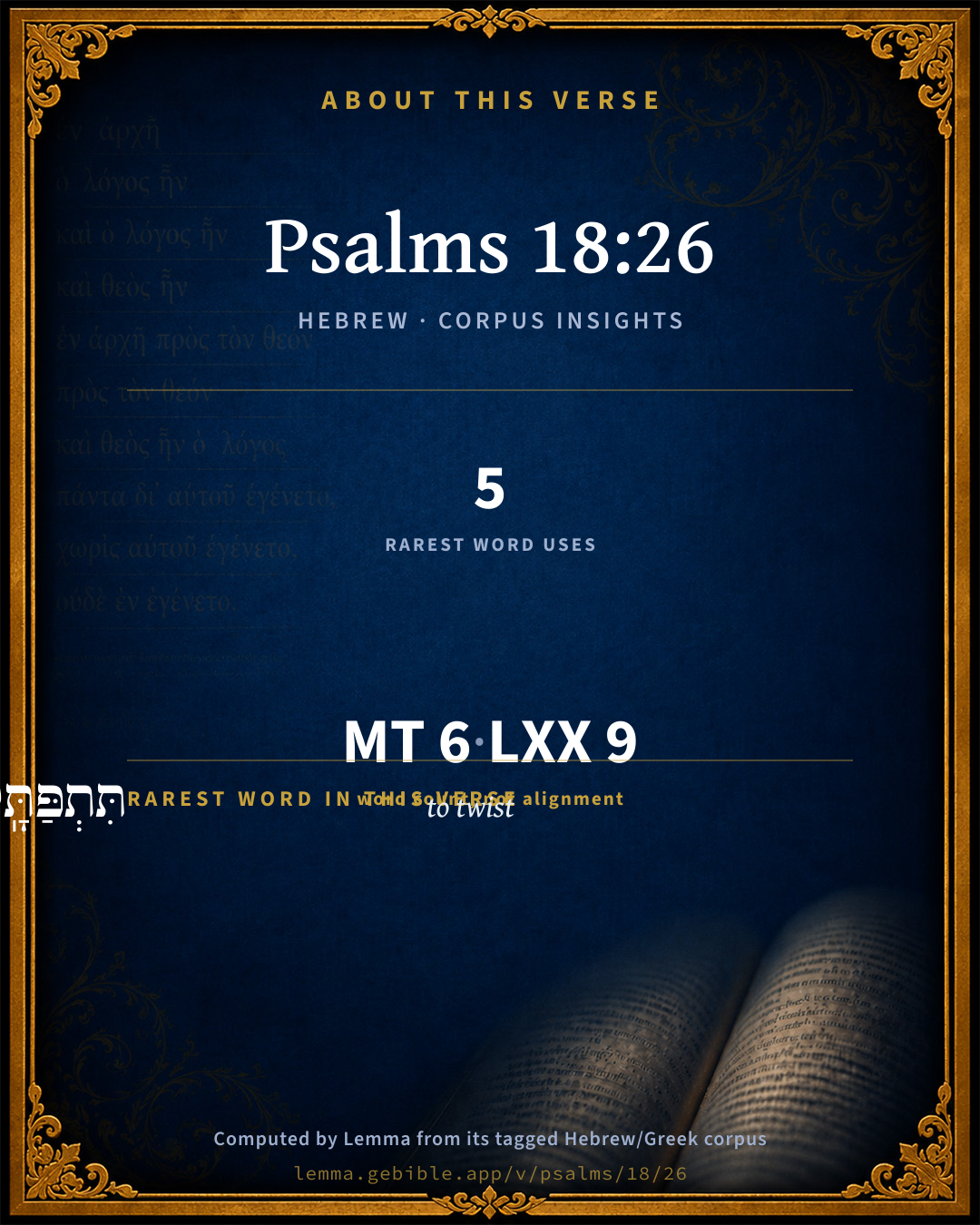
6
words
4
distinct lemmas
Wisdom
section

Notable vocabulary

The rarest word here is תִּתְפַּתָּֽל to twist H6617 — appearing just 5 times in the whole Hebrew Bible.

Shared distinctive vocabulary

תִּתְפַּתָּֽל to twist H6617 occurs in 5 verses of the Hebrew Bible. Also found in:

Grammatical profile

  • 3 verbs
  • 1 adjective
  • 2 prepositions

Verb forms

  • נָבָ֥ר Niphal · Participle Active
  • תִּתְבָּרָ֑ר Hithpael · Imperfect
  • תִּתְפַּתָּֽל Hithpael · Imperfect

Repetition

Words recur within this verse — often emphatic in Hebrew:

  • נָבָ֥ר to purify H1305 ×2
  • עִם with H5973 ×2

Hebrew & Septuagint length

In English translation the verse runs 16 words from the Hebrew and 17 from the Septuagint (LXX English) — closely comparable.

A rough comparison of the two English renderings, which tokenize alike — not a word-level alignment.

Word counts can differ between the Hebrew and the Greek without any difference in meaning — e.g. the Hebrew direct-object marker אֵת has no separate Greek word, and Greek often adds the article ὁ.

In the original languages it is 6 Hebrew tokens and 9 Greek tokens — but the two are counted differently (Hebrew bundles its prefixes and suffixes into one token; the Greek is in lemma form), so that isn’t a like-for-like length.

Cross-references

7

Topical passages linked to Psalms 18:26 in the Treasury of Scripture Knowledge — connected by theme and wording, ordered by reader-vote popularity; previews shown in the World English Bible.

  • Proverbs 3:34 Surely he mocks the mockers, But he gives grace to the humble.
  • Leviticus 26:23–24 "'If by these things you won't be reformed to me, but will walk contrary to me;
  • James 2:13 For judgment is without mercy to him who has shown no mercy. Mercy triumphs over judgment.
  • Leviticus 26:27–28 "'If you in spite of this won't listen to me, but walk contrary to me;
  • Psalms 109:17–19 Yes, he loved cursing, and it came to him. He didn't delight in blessing, and it was far from him.
  • Romans 2:4–6 Or do you despise the riches of his goodness, forbearance, and patience, not knowing that the goodness of God leads you to repentance?
  • Romans 2:9 oppression and anguish, on every soul of man who works evil, on the Jew first, and also on the Greek.

Cross-references courtesy of OpenBible.info (CC BY 4.0).

Hebrew and Greek witnesses Masoretic Hebrew ↔ Greek Septuagint

The same verse in the two great witnesses to the Old Testament, shown verse-for-verse.

You’re reading Greek Psalm 17 (Hebrew Psalm 18). The Septuagint counts the superscription, so verse numbers can differ from the Hebrew — chapter-level alignment, not verse-by-verse. Numbering follows Rahlfs.

These are two independent witnesses, not word-aligned to each other, and the Septuagint is shown in lemma (dictionary) form.

Hebrew Psalms 18:26 Masoretic · Westminster Leningrad Codex

עִם נָבָ֥ר תִּתְבָּרָ֑ר וְעִם עִ֝קֵּ֗שׁ תִּתְפַּתָּֽל

With the pure, you will show yourself pure. With the crooked you will show yourself shrewd.

World English Bible · Public Domain

Greek LXX Greek Psalm 17:26 Septuagint · lemma form

μετά ὅσιος ὁσιόω καί μετά ἀνήρ ἀθῷος ἀθῷος εἰμί

And with the excellent man you will be excellent; and with the perverse you will show frowardness.

LXX2012 (modern English Septuagint) · Public Domain

Hebrew: Westminster Leningrad Codex (CC BY 4.0). Greek: Septuagint (public domain); English from LXX2012 (modern English Septuagint) (Public Domain). How the Septuagint differs from the Hebrew →

Commentary

Notes on Psalms 18:26 from classic Christian and Jewish commentators (each source and its license shown beneath its notes). The classic Christian expositions comment on the surrounding passage and are grouped to its opening verse, so a note may address several verses; the Jewish commentaries on the Tanakh (Rashi and others) are per-verse, so they appear only where the commentator wrote on this verse.

Lemma curates 59 commentaries, every one of them public domain or Creative Commons licensed, each selected and text-cleaned for this edition rather than reprinted as found. About our sources →

Trapp's Complete Commentary

John Trapp

Psa 18:26 With the pure thou wilt shew thyself pure; and with the froward thou wilt shew thyself froward.

Ver. 26. With the pure, &c.] Cum candido candide agere soles. The pure shall have all that heart can wish.

And with the froward thou wilt show thyself froward] Or, thou wilt wrestle, viz. with such cross pieces, as proudly and perversely err from thy precepts, as it were, on purpose to thwart thee, or to try masteries with thee. Against such stubborn persons God threateneth not eight degrees (which are the highest notes in music and degrees in qualities, as the philosopher distinguisheth them), but twenty and eight degrees of wrath, Lev 26:18; Lev 26:21; Lev 26:24; Lev 26:28. Exiget ab iis rationem minutissimorum, saith R. Obad. Gaon upon this text; he will reckon with them for their least offences, and not bate them an ace of their due punishment. He will pay them home in their own coin, over shoot them in their own bow, fill them with their own ways, be as cross as they are, for the hearts of them; yet still in a way of justice, though he break the necks of them in wrestling, and send them packing to their place in hell. Ainsworth rendereth it, With the froward thou wilt show thyself wry. It is a similitude taken from wrestlers, and noteth a writhing of one’s self against an adversary. Compare herewith Deu 32:5. They are a perverse and crooked generation (the same two words that are here in this text); the latter importeth, that they wriggled and writhed after the manner of wrestlers that wave up and down, and wind the other way, when one thinks to have them here or there. But all will not serve their turn to save them from punishment. God will be sure to meet with them, his word will lay hold on them, and their sin shall find them out.

John Trapp, A Commentary or Exposition upon All the Books of the Old and New Testament (1647–1656) — public domain. Text from a community e-Sword module.

Tyndale Open Study Notes

Tyndale Open Resources

18:26 The pure have clean hands (see 18:20-24). • to the crooked you show yourself shrewd: The Lord knows each person’s character, and he justly responds to them in kind.

Tyndale Open Study Notes — © Tyndale Open Resources, licensed CC BY-SA 4.0. Text via the HelloAO Bible API.

Jamieson, Fausset & Brown

Robert Jamieson, A. R. Fausset & David Brown

froward--contrary to.

Jamieson, Fausset & Brown — Commentary Critical and Explanatory on the Whole Bible (1871) — public domain (CC PDM 1.0). Text via the HelloAO Bible API.

Adam Clarke's Commentary

Verse 26. With the froward] עקש ikkesh, the perverse man; he that is crooked in his tempers and ways.

Thou wilt show thyself froward.] תתפתל tithpattal, thou wilt set thyself to twist, twine, and wrestle. If he contend, thou wilt contend with him. Thou wilt follow him through all his windings; thou wilt trace him through all his crooked ways; untwist him in all his cunning wiles; and defeat all his schemes of stubbornness, fraud, overreaching, and deceit.

My old Psalter has, With the wiked thow sal be wike. Here the term wicked is taken in its true original sense, crooked, or perverse. With the wiked, the perverse, thou wilt show thyself wike, i.e., perverse; from [Anglo-Saxon], to draw back, to slide. As he draws back from thee, thou wilt draw back from him. It may, as before intimated, come from [A.S.], to seek for enchantments; leaving God, and going to devils; to act like a witch: but here it must mean as above. The plain import is, "If thou perversely oppose thy Maker, he will oppose thee: no work or project shall prosper that is not begun in his name, and conducted in his fear."

Adam Clarke's Commentary on the Bible (1810–1826) — public domain. Text from a community e-Sword/MySword module.

John Calvin's Commentaries

The last clause of the 26th verse, where it is said, With the perverse thou wilt show thyself perverse, seems to convey a meaning somewhat strange, but it does not imply any thing absurd; yea, rather, it is not without good reason that the Holy Spirit uses this manner of speaking; for he designs thereby to awaken hypocrites and the gross despisers of God, who lull themselves asleep in their vices without any apprehension of danger. “Qui s’endorment en leurs vices sans rien craindre.” — Fr.

“Comme s’il disoit que leur obstination et opiniastrete sera cause que luy de son coste oubliant sa moderation et douceur accoustumee, se jettera le tors et a travers contre eux.” — Fr.

John Calvin's Commentaries (1540-1563) — public domain. Text from the Calvin Translation Society English edition (1840s-50s) via the Christian Classics Ethereal Library (ccel.org). Calvin's coverage is partial (roughly two-thirds of the Bible); uncommented books and verses are honest gaps, never fabricated. The 19th-century editor's footnotes and remarks are omitted so the notes are faithfully Calvin's own voice.

Ellicott's Commentary for English Readers

(26) Froward . . . froward.—The use of this one word to render two different Hebrew terms is so far correct, as they both come from roots meaning primarily to twist. Both are combined in Pro_8:8, “froward (margin, twisted) or perverse,” and both are contrasted with “righteousness.” Plainly the metaphor might apply-either to the character itself, “twisted round,” “awry,” “perverse,” or to the line of conduct pursued, “bent,” “crooked,” or “wrong,” the opposite of “straight,” or “right.” “Froward” =from ward (opposite to “toward”), seems to have more of the latter idea, but may combine both—a disposition turned away from good. The poet therefore says, “God will turn away from those who turn away from him,” a thought which even with the Christian revelation we must admit true, for still it is true that—

“He that shuts love out, in turn shall be

Shut out from love.”—TENNYSON.

A Bible Commentary for English Readers, edited by Charles John Ellicott (1878–1897) — public domain. Text from a community e-Sword module.

The Cambridge Bible for Schools and Colleges

gen. ed. J. J. S. Perowne

26. With the pure &c.] Lit. one who purifies himself, cp. 1Jn_3:3. Cp. Psa_24:4, Psa_73:1. Mat_5:8 is the N.T. commentary on the words.

and with the froward &c.] Better, as R.V., and with the perverse thou wilt shew thyself froward. The ‘perverse’ man, whose character is morally distorted, is given over by God to follow his own crooked ways, till they bring him to destruction. God must needs be at cross purposes with the wicked, frustrating their plans, and punishing their wickedness. See Lev_26:23-24; Job_5:12-13; Isa_29:9 ff.; Pro_3:34; Rom_1:28; Rev_22:11; and for an illustration camp. the history of Balaam (Num_22:20.).

The Cambridge Bible for Schools and Colleges (gen. ed. J. J. S. Perowne; Cambridge University Press, 1878–1918) — public domain. Text from a community e-Sword module.

John Gill's Exposition

For thou wilt save the afflicted people,.... As the people of God commonly are; they are afflicted with sin, and the corruption of their own hearts, and with Satan and his temptations, and with the world, its reproaches, and persecutions; but God in his own time saves them out of them, if not here, yet hereafter. This is particularly and eminently true of the Christians who lived between the crucifixion of Christ and the destruction of Jerusalem; who were greatly afflicted and persecuted by the Jews, but were in a remarkable manner saved a little before the destruction of Jerusalem, by being directed to go out of it to a place called Pella (c); so that not one Christian suffered in it;

but wilt bring down high looks; or proud men, whom God humbles; these he abhors, resists, sets himself against, scatters and destroys. The Jews were a very proud people, and behaved in an insolent and insulting manner towards Christ and his followers; but the high looks of the chief priests, Scribes, and Pharisees, were brought down to a purpose, when their city, temple, and nation, were destroyed; see Isa 2:11.

(c) Euseb. Eccl. Hist. l. 3. c. 5.

John Gill's Exposition of the Whole Bible (1746–1763) — public domain (CC PDM 1.0). Text via the HelloAO Bible API.

Albert Barnes' Notes on the Bible

With the pure - Those who are pure in their thoughts, their motives, their conduct.

Thou wilt show thyself pure - They will find that they have to deal with a God who is himself pure; who loves purity, and who will accompany it with appropriate rewards wherever it is found.

And with the froward - The word used here - עקשׁ ‛iqqêsh - means properly perverse; a man of a perverse and wicked mind. It is derived from a verb - עקשׁ ‛âqash - which means, to turn the wrong way, to wrest, to pervert. It would be applicable to a man who perverts or wrests the words of others from their true meaning; who prevaricates or is deceitful in his own conduct; who is not straightforward in his dealings; who takes advantage of circumstances to impose on others, and to promote his own ends; who is sour, harsh, crabbed, unaccommodating, unyielding, unkind. It is rendered perverse in Deu 32:5; Pro 8:8; Pro 19:1; Pro 28:6; froward here, and in 2Sa 22:27; Psa 101:4; Pro 11:20; Pro 17:20; Pro 22:5; and crooked in Pro 2:15. The word does not occur elsewhere in the Old Testament.

Thou wilt show thyself froward - Margin, wrestle. In the corresponding place in 2Sa 22:27 it is rendered, “Thou wilt show thyself unsavory;” though the same word is used in the original. In the margin in that place, as here, the word is wrestle. The original word in each place - פתל pâthal - means to twist, to twine, to spin; and then, to be twisted; to be crooked, crafty, deceitful. In the form of the word which occurs here (Hithpael), it means, to show oneself crooked, crafty, perverse. (Gesenius, Lexicon). It cannot mean here that God would assume such a character, or that he would be crooked, crafty, perverse in his dealings with men, for no one can suppose that the psalmist meant to ascribe such a character to God; but the meaning plainly is, that God would deal with the man referred to according to his real character: instead of finding that God would deal with them as if they were pure, and righteous, and merciful, such men would find that he deals with them as they are - as perverse, crooked, wicked.

Albert Barnes' Notes on the Bible (1834–1885) — public domain. Text from a community e-Sword/MySword module.

Matthew Poole's English Annotations

Pure; free from the least mixture or appearance of unrighteousness, or unfaithfulness, or unkindness; or simply and sincerely, such as thou usest and hast promised to be to them that are such; for

purity is oft put for sincerity.

Froward, or perverse, i.e. thou wilt cross him, and walk contrary to him, as thou hast threatened, Lev 26:23,24. See also Pro 3:34. Man’s perverseness here is moral and sinful, but God’s perverseness is judicial and penal.

Matthew Poole's English Annotations on the Holy Bible (1683–1685) — public domain. Text from a community e-Sword/MySword module.

The Treasury of David

Charles H. Spurgeon

Ver. 26. With the pure thou wilt shew thyself pure; and with the froward thou wilt shew thyself froward. The sinner's frowardness is sinful and rebellious, and the only sense in which the term can be applied to the Most Holy God is that of judicial opposition and sternness, in which the Judge of all the earth will act at cross purposes with the offender, and let him see that all things are not to be made subservient to wicked whims and wilful fancies. Calvin very forcibly says, "This brutish and monstrous stupidity in men compels God to invent new modes of expression, and as it were to clothe himself with a different character." There is a similar sentence in Le 26:21-24, where God says, "and if ye walk contrary unto (or perversely with) me, then I will also walk contrary unto (or perversely, or roughly, or at random with) you." As if he had said that their obstinacy and stubbornness would make him on his part forget his accustomed forbearance and gentleness, and cast himself recklessly or at random against them. We see then what the stubborn at length gain by their obduracy; it is this, that God hardens himself still more to break them in pieces, and if they are of stone, he causes them to feel that he has the hardness of iron. The Jewish tradition was that the manna tasted according to each man's mouth; certainly God shows himself to each individual according to his character.

Ver. 26. With the pure thou wilt shew thyself pure, etc. But doth the Lord take colour from every one he meets, or change his temper as the company changes? That's the weakness of sinful man: he cannot do so with whom there is no variableness nor shadow of changing. God is pure and upright with the unclean and hypocritical, as well as with the pure and upright, and his actions show him to be so. God shows himself froward with the froward when he deals with him as he hath said he will deal with the frowarddeny them and reject them. God shows himself pure with the pure, when he deals with them as he hath said he willhear them and accept them. Though there be nothing in purity and sincerity which deserveth mercy, yet we cannot expect mercy without them. Our comforts are not grounded upon our graces, but our comforts are the fruits or consequences of our graces. Joseph Caryl.

Ver. 26. The froward one. Here, as in the first promise, the two combatants stand contrastedthe seed of the woman and the serpent the benignantly bountiful, perfect, pure One, and the froward one, whose works he came to destroy, and who made it his great business to circumvent him whom he feared. The literal meaning of the word is "tortuous, "or "crooked, "and both the ideas of perversity and cunning which the figure naturally suggests, are very applicable to "that old serpent the devil." From the concluding part of the sentence, I think there is no doubt that it is the latter idea that is intended to be conveyed. God cannot deal perversely with any one; but he outwits the wise, and takes the cunning in their own craftiness. John Brown.

Ver. 26. With the froward thou wilt shew thyself froward. The Hebrew word in the root signifieth to wrest or writhe a thing, or to wrest or turn a thing, as wrestlers do their bodies. Hence by a trope, it is translated often to wrestle, because a cunning man in wrestling, turns and winds his body, and works himself in and out every way, to get an advantage of his adversary any way; therefore your cunning headed men, your crafty men, are fitly presented under this word; they are like wrestlers who turn and wind themselves in and out, and lie for all advantages; or as we speak, they "lie at catch." A man knows not where to have them, or what they mean when they speak plainest, or swear solemnest; when we think we see their faces, we see but their vizards; all their promises and performances too are under a disguise... And this word is applied to the Lord himself, "With the froward thou wilt shew thyself froward; "that is, if men will be winding and turning, and thinking to catch others, or over reach the Lord himself with tricks and turnings of wit, the Lord will meet and answer them in their own kind; he can turn as fast as they, he can put himself into such intricate labyrinths of infinite wisdom and sacred craft, as shall entangle and ensnare the most cunning wrestler or tumbler of them all. He will Cretize the Cretians, supplant the supplanters of his people. Joseph Caryl.

Ver. 26. Wilt shew thyself froward. It is a similitude taken from wrestlers, and notes a writhing of one's self against an adversary. Compare herewith De 32:5. "They are a perverse and a crooked generation, "the same two words that are here in this text; the latter imports that they wriggled and writhed after the manner of wrestlers that wave up and down, and wind the other way, when one thinks to have him here or there. But all will not serve their turn to save them from punishment. God will be sure to meet with them, his Word will lay hold on them, and their sins shall find them out. John Trapp.

Ver. 26. Echoes, in providence, grace, and judgment.

Psalms 18:27*

Charles H. Spurgeon's The Treasury of David (1869–1885) — public domain. Psalms only. Text from a community e-Sword/MySword module.

The Pulpit Commentary

With the pure thou wilt show thyself pure; and with the froward thou wilt show thyself froward; rather, thou wilt show thyself adverse. The same root is not here used for the verb as for the adjective, as is done in the three preceding clauses. The reason is well explained in the "Speaker"s Commentary:" "In dealing with the good, God shows his approval by manifesting attributes similar or identical in essence; in dealing with the wicked, he exhibits attributes which are correlative in just proportion to their acts," but not identical. God cannot "show himself froward he can only show himself opposed, antagonistic, an adversary. What the psalmist means to say is that, if men oppose and thwart God, he in return will oppose and thwart them. But they will act in a perverse spirit, he in a spirit of justice and righteousness.

The Pulpit Commentary (1880–1919), ed. H.D.M. Spence-Jones & Joseph S. Exell — public domain. Text from a community e-Sword module.

John Wesley's Explanatory Notes

Pure - Free from the least mixture or appearance of unrighteousness, or unfaithfulness. Froward - Thou wilt cross him and walk contrary to him.

John Wesley, Explanatory Notes Upon the Whole Bible (1754–1765) — public domain. Text via the GEBible commentary corpus.

Rashi

Rabbi Shlomo Yitzchaki (Rashi)

With a kind one, You show Yourself kind Because so are His ways, to pay a measure for a measure. Kind...sincere...pure, corresponding to the three patriarchs.

Rashi on the Tanakh — English translations: “The Judaica Press complete Tanach with Rashi, translated by A. J. Rosenberg” (CC BY 4.0); “Pentateuch with Rashi's commentary by M. Rosenbaum and A.M. Silbermann, 1929-1934” (public domain); “The Metsudah Tanach series, Lakewood, N.J” (CC BY 4.0); and “The Book of Joshua, Metsudah Publications, 1997” (CC BY 4.0). Text via Sefaria.

Lesson kit

Teaching starters — assembled from the data on this page, not authored interpretation. Every prompt links to the verse data it draws on. Edit before teaching.

Psalms, in the Wisdom, opens this verse with 6 words (4 distinct Hebrew lemmas). Its most distinctive word is pâthal (“to twist”). A historical commentator’s framing appears above. Read the whole chapter for the surrounding context.

Discussion questions

  1. The word pâthal carries the sense “to twist.” How does it shape the verse?
  2. How does Genesis 30:8, which shares the word «to twist», read alongside this verse?
  3. What does the repetition of “to purify” (2× in this one verse) do in this verse?
  4. The translations on this page render this verse differently — a whole-verse word diff, not a word-by-word alignment. What might account for the different wordings?
  5. «נָבָ֥ר» is a Niphal Participle Active verb. How does that grammatical form shape the action described?
  6. Compare how Trapp's Complete Commentary and Tyndale Open Study Notes read this verse. Where do they agree or differ?

Things to notice

Reading settings

Reading text

Shown beneath each verse's original-language words.

Old Testament
Old Testament edition

Read the OT as the Masoretic Hebrew (MT) or the Greek Septuagint (LXX).

English shown for the Greek Septuagint (in the Hebrew ↔ Greek comparison).

Comparing translations? Open the Compare panel on any verse page to stack up to four side by side.