
Nehemiah 12:21

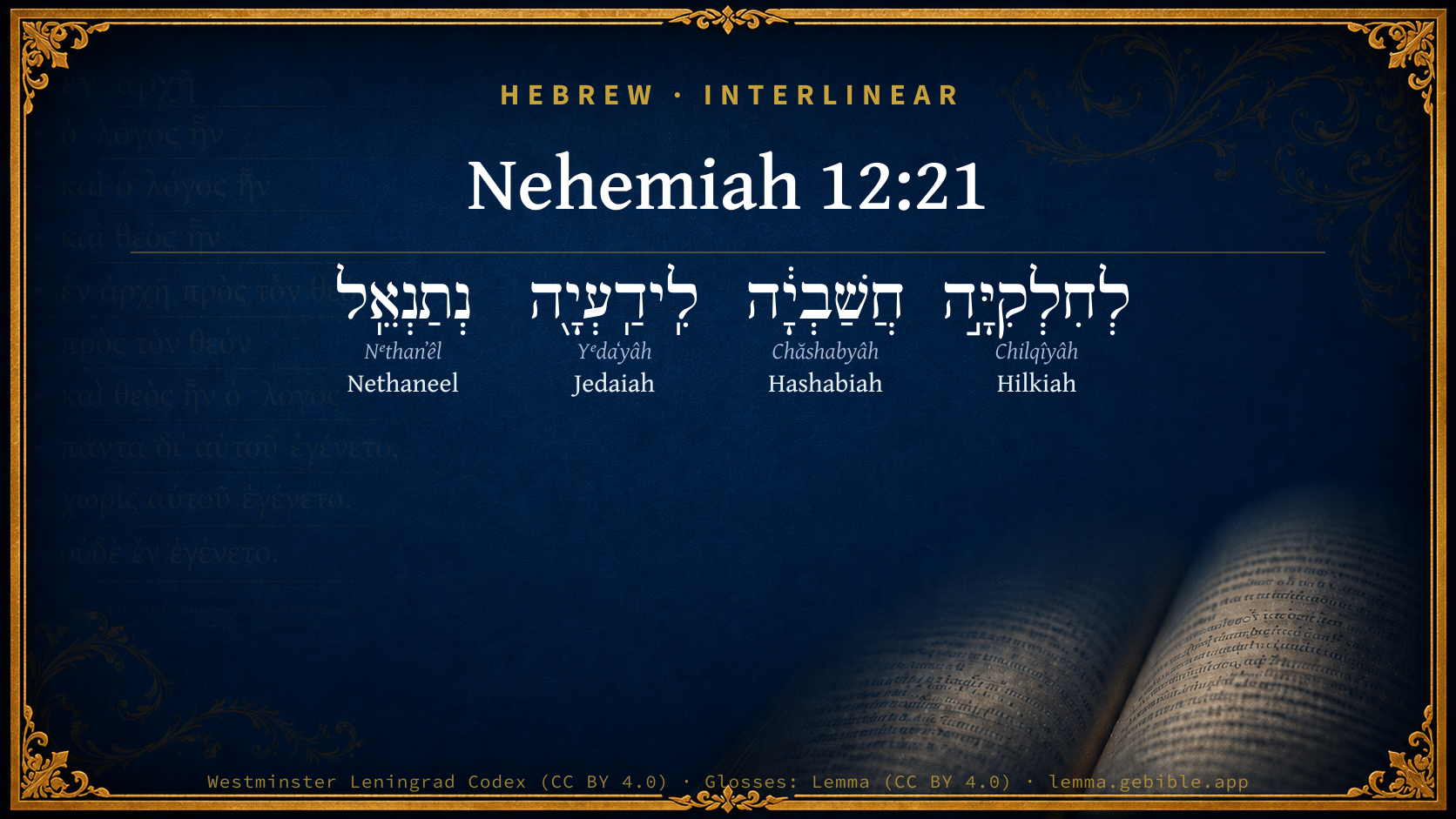
Hebrew (Westminster Leningrad Codex) Nehemiah 12:21 appears in the Hebrew Old Testament. The text above is from the Westminster Leningrad Codex. Each word links to its Strong’s number, a concise gloss, and parsing drawn from the Open Scriptures Hebrew Bible morphology. Click any word for its full Brown-Driver-Briggs (BDB) entry.
Download image
Cite this verse

Nehemiah 12:21 (World English Bible). Public Domain. Lemma interlinear Bible study tool, https://lemma.gebible.app/v/nehemiah/12/21.

Show BibTeX & RIS
BibTeX
RIS
English Translation
of Hilkiah, Hashabiah; of Jedaiah, Nethanel.
World English Bible · Public Domain
Download a study sheet

One document with this verse’s original text, its word-by-word gloss line, the meaning frame, cross-references with their text, attributed commentary, and full source and license credits — printable, and it pastes into notes with its structure intact.

This verse Autodidact and up

Study sheet (.html) Plain text (.txt)

A passage Seminary Student

Up to 50 verses in one chapter. A passage sheet keeps up to 6 commentary sources and 12 cross-references per verse, in the order this page ranks them, and says so on the sheet whenever that leaves anything out. Ask for a single verse and you get the Autodidact verse sheet above.

Everything on this page stays free to read, with no account — the sheet is a download of what is already on screen, not access to it.

Want to remove ads? Support Godless Engineer
Compare translations 3

The same verse in 3 English versions, stacked beneath the original-language interlinear above. Click any original word for its lexicon entry.

Each is an independent rendering of the whole verse — the interlinear is not word-aligned to these translations.

Highlighted words mark where these versions differ — a whole-verse word diff, not a word-by-word alignment.

  • World English Bible Public Domain
    of Hilkiah, Hashabiah; of Jedaiah, Nethanel.
  • King James Version Public Domain
    Of Hilkiah, Hashabiah; of Jedaiah, Nethaneel.
  • unfoldingWord Literal Text CC BY-SA 4.0
    of Hilkiah, Hashabiah; of Jedaiah, Nethanel.

unfoldingWord Literal Text — © unfoldingWord, licensed CC BY-SA 4.0. Word-aligned USFM3 via Door43 (git.door43.org/unfoldingWord/en_ult).

Versions to compare (up to 4)

3 of 4 selected

Show all 18 translations

Every available English version of this verse, each an independent rendering of the whole verse.

  • World English Bible Public Domain
    of Hilkiah, Hashabiah; of Jedaiah, Nethanel.
  • Berean Standard Bible Public Domain
    of Hilkiah, Hashabiah; and of Jedaiah, Nethanel.
  • Majority Standard Bible Public Domain
    of Hilkiah, Hashabiah; and of Jedaiah, Nethanel.
  • King James Version Public Domain
    Of Hilkiah, Hashabiah; of Jedaiah, Nethaneel.
  • American Standard Version (1901) Public Domain
    of Hilkiah, Hashabiah; of Jedaiah, Nethanel.
  • Revised Version (1885) Public Domain
    of Hilkiah, Hashabiah; of Jedaiah, Nethanel.
  • Geneva Bible (1599) Public Domain
    Vnder Hilkiah, Hashabiah, vnder Iedaiah, Nethaneel.
  • Douay-Rheims (1899) Public Domain
    Of Helcias, Hasebia: of Idaia, Nathanael.
  • Young's Literal Translation Public Domain
    of Hilkiah, Hashabiah; of Jedaiah, Nethaneel.
  • Literal Standard Version CC BY-SA 4.0
    of Hilkiah, Hashabiah; of Jedaiah, Nethaneel.
  • Unlocked Literal Bible CC BY-SA 4.0
    Hashabiah was the leader of Hilkiah, and Nethanel was the leader of Jedaiah.
  • unfoldingWord Literal Text CC BY-SA 4.0
    of Hilkiah, Hashabiah; of Jedaiah, Nethanel.
  • Darby Bible Public Domain
    of Hilkijah, Hashabiah; of Jedaiah, Nethaneel.
  • World Messianic Bible Public Domain
    of Hilkiah, Hashabiah; of Jedaiah, Nethanel.
  • Webster's Bible Public Domain
    Of Hilkiah, Hashabiah; of Jedaiah, Nethaneel.
  • Free Bible Version CC BY-SA 4.0
    of Hilkiah, Hashabiah; of Jedaiah, Nethanel.
  • Bible in Basic English Public Domain
    Of Hilkiah, Hashabiah; of Jedaiah, Nethanel.
  • JPS Tanakh (1917) Public Domain
    of Hilkiah, Hashabiah; of Jedaiah, Nethanel.

Literal Standard Version (2020), Covenant Press — licensed CC BY-SA 4.0. Text via the HelloAO Bible API (eBible.org). Unlocked Literal Bible (unfoldingWord) — licensed CC BY-SA 4.0. Text via the HelloAO Bible API (eBible.org). unfoldingWord Literal Text — © unfoldingWord, licensed CC BY-SA 4.0. Word-aligned USFM3 via Door43 (git.door43.org/unfoldingWord/en_ult). Free Bible Version, Dr. Jonathan Gallagher — licensed CC BY-SA 4.0. Text via the HelloAO Bible API (eBible.org).

Word by word

More ways to search: Search by grammar → Find every occurrence → Compare this word →

Practice this passage: Drill this verse → Learn its vocabulary →

לִֽידַֽעְיָ֖ה
Yᵉdaʻyâh
H3048
“to/for · Jedaiah”
Preposition + Noun, Proper
Part of Speech
Preposition + Noun
Type
Proper
Full BDB Definition

Origin: from H3045 and H3050

TWOT: None

Jedaiah = "Jehovah has known" - a priest in Jerusalem - a man who returned with Zerubbabel - a ruler of the priests in the days of Jeshua - a post exilic priest - one honoured by Jehovah, perhaps one of the above
  1. לְחִלְקִיָּ֣ה Chilqîyâh H2518 “to/for · Hilkiah” Preposition + Noun, Proper
  2. חֲשַׁבְיָ֔ה Chăshabyâh H2811 “Hashabiah” Noun, Proper
  3. נְתַנְאֵֽל Nᵉthanʼêl H5417 “Nethaneel” Noun, Proper

About this verse

These counts appear in no published source. They are computed here, from the morphology-tagged text and Lemma’s own curated glosses. What Lemma adds →

4
words
4
distinct lemmas
Historical
section

Notable vocabulary

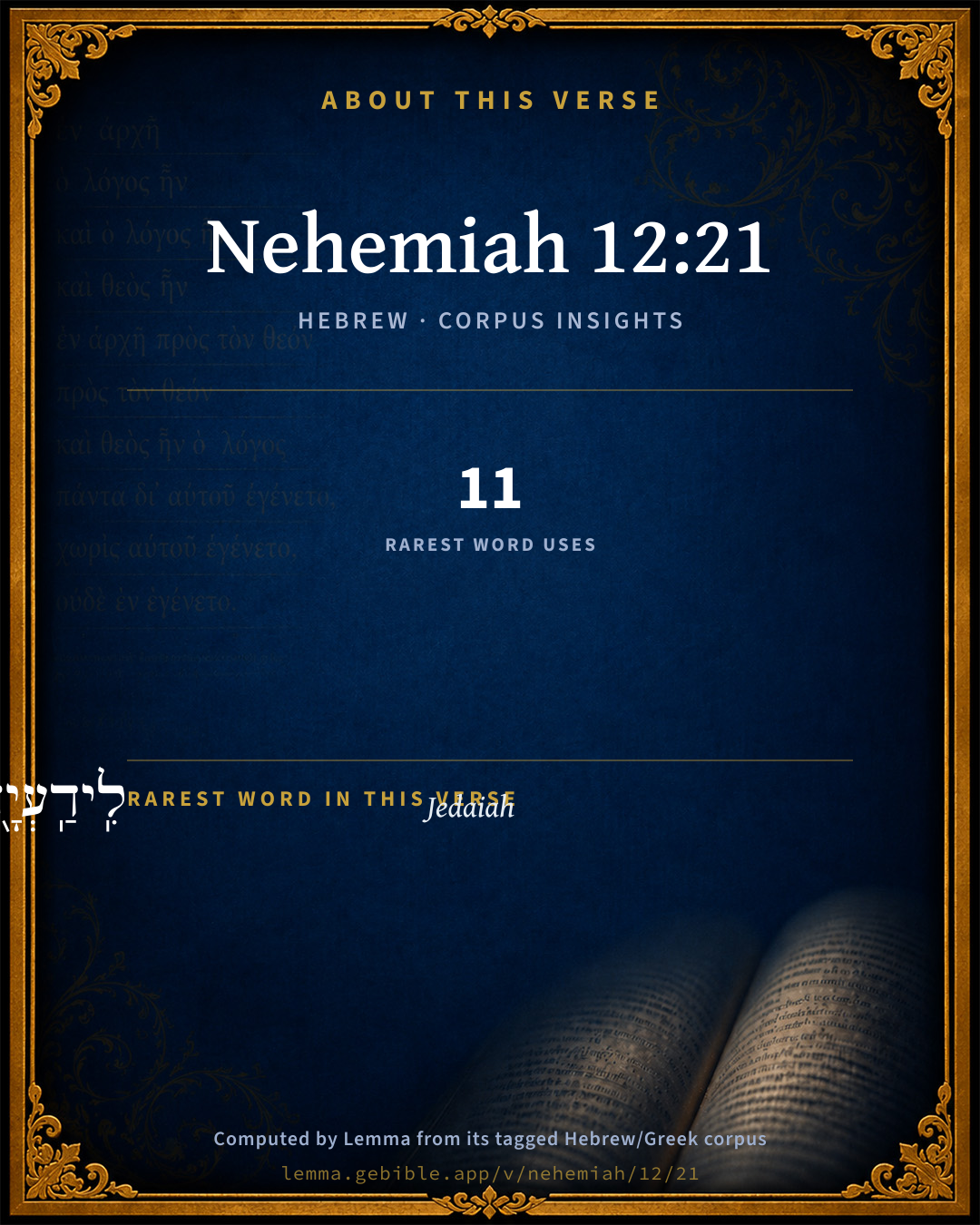
The rarest word here is לִֽידַֽעְיָ֖ה Jedaiah H3048 — appearing just 11 times in the whole Hebrew Bible.

Shared distinctive vocabulary

לִֽידַֽעְיָ֖ה Jedaiah H3048 occurs in 11 verses of the Hebrew Bible. Also found in:

Grammatical profile

  • 4 nouns
Hebrew and Greek witnesses Masoretic Hebrew ↔ Greek Septuagint

The same verse in the two great witnesses to the Old Testament, shown verse-for-verse.

These are two independent witnesses, not word-aligned to each other, and the Septuagint is shown in lemma (dictionary) form.

Hebrew Nehemiah 12:21 Masoretic · Westminster Leningrad Codex

לְחִלְקִיָּ֣ה חֲשַׁבְיָ֔ה לִֽידַֽעְיָ֖ה נְתַנְאֵֽל

of Hilkiah, Hashabiah; of Jedaiah, Nethanel.

World English Bible · Public Domain

Greek LXX Structure differs

The Septuagint has no separate book of Nehemiah. Its Greek text is the second half of Esdras B (2 Esdras), chapters 11–23; Ezra is the first half (1–10).

A verse-for-verse comparison isn’t shown here because the chapters and verses don’t line up. Switch to the LXX edition with the MT / LXX toggle above to read the Greek directly.

Hebrew: Westminster Leningrad Codex (CC BY 4.0). Greek: Septuagint (public domain); English from a public-domain English Septuagint. How the Septuagint differs from the Hebrew →

Commentary

Notes on Nehemiah 12:21 from classic Christian and Jewish commentators (each source and its license shown beneath its notes). The classic Christian expositions comment on the surrounding passage and are grouped to its opening verse, so a note may address several verses; the Jewish commentaries on the Tanakh (Rashi and others) are per-verse, so they appear only where the commentator wrote on this verse.

Lemma curates 59 commentaries, every one of them public domain or Creative Commons licensed, each selected and text-cleaned for this edition rather than reprinted as found. About our sources →

Whedon's Commentary on the Bible

Daniel D. Whedon

LISTS OF THE PRIESTS AND LEVITES, Neh_12:1-26.

In these verses we have, first, the list of priests and Levites that went up from Babylon with Zerubbabel, 1-9; next follows a genealogy of the high priests from Jeshua to Jaddua, 10-11: then the names of the chief fathers of the priestly houses in the days of Joiakim, 12-21; and, finally, sundry statements concerning the Levites, 22-26.

It will be observed that the names in Neh_12:1-9 appear again with but a few changes in Neh_12:12-21, and many of them are also identical with names in the list of Neh_10:1-13. According to Keil, “the difference between the names in the two lists of chapters 10 and 12 is to be explained simply by the fact that the names of those who sealed the covenant, Nehemiah 10, are names neither of orders nor houses, but of heads of houses living in the days of Ezra and Nehemiah. Of these names a portion coincides, indeed, with the names of the orders and houses, while the rest are different. The sameness of names does not, however, prove that the individuals belonged to the house whose name they bore. On the contrary, it appears from Neh_12:13; Neh_12:16, that of two Meshullams, one was the head of the house of Ezra, the other of the house of Ginnethon.”

The names of the priests in Neh_12:1-7 are twenty-two, all descendants of Jedaiah, Immer, Pashur, and Harim, named in Neh_7:39-42. According to the Talmud, “four divisions of priests returned from captivity, namely, Jedaiah, Harim, Pashur, and Immer. These the prophets of the returned captives again divided into twenty-four; whereupon their names were written upon tickets and put in an urn, from which Jedaiah drew five, and each of the other three before-named divisions as many. It was then ordained by those prophets that even if the division of Jehoiarib (1Ch_24:7) should return, Jedaiah should, nevertheless, retain his position, and Jehoiarib should be associated with him.” In all this we observe how the returned exiles struggled to restore and preserve their ancient institutions and orders.

Daniel D. Whedon (gen. ed.), Commentary on the Old and New Testaments (1874–1909) — public domain. Text from a community e-Sword module.

Lesson kit

Teaching starters — assembled from the data on this page, not authored interpretation. Every prompt links to the verse data it draws on. Edit before teaching.

Nehemiah, in the Historical, opens this verse with 4 words (4 distinct Hebrew lemmas). Its most distinctive word is Yᵉdaʻyâh (“Jedaiah”). Read the whole chapter for the surrounding context.

Discussion questions

  1. What does “Jedaiah” (Yᵉdaʻyâh) contribute to the verse as a whole?
  2. How does 1 Chronicles 9:10, which shares the word «Jedaiah», read alongside this verse?
  3. These translations render this verse differently; the difference is in the English rendering, not the original. What questions does that raise?

Things to notice

Reading settings

Reading text

Shown beneath each verse's original-language words.

Old Testament
Old Testament edition

Read the OT as the Masoretic Hebrew (MT) or the Greek Septuagint (LXX).

English shown for the Greek Septuagint (in the Hebrew ↔ Greek comparison).

Comparing translations? Open the Compare panel on any verse page to stack up to four side by side.