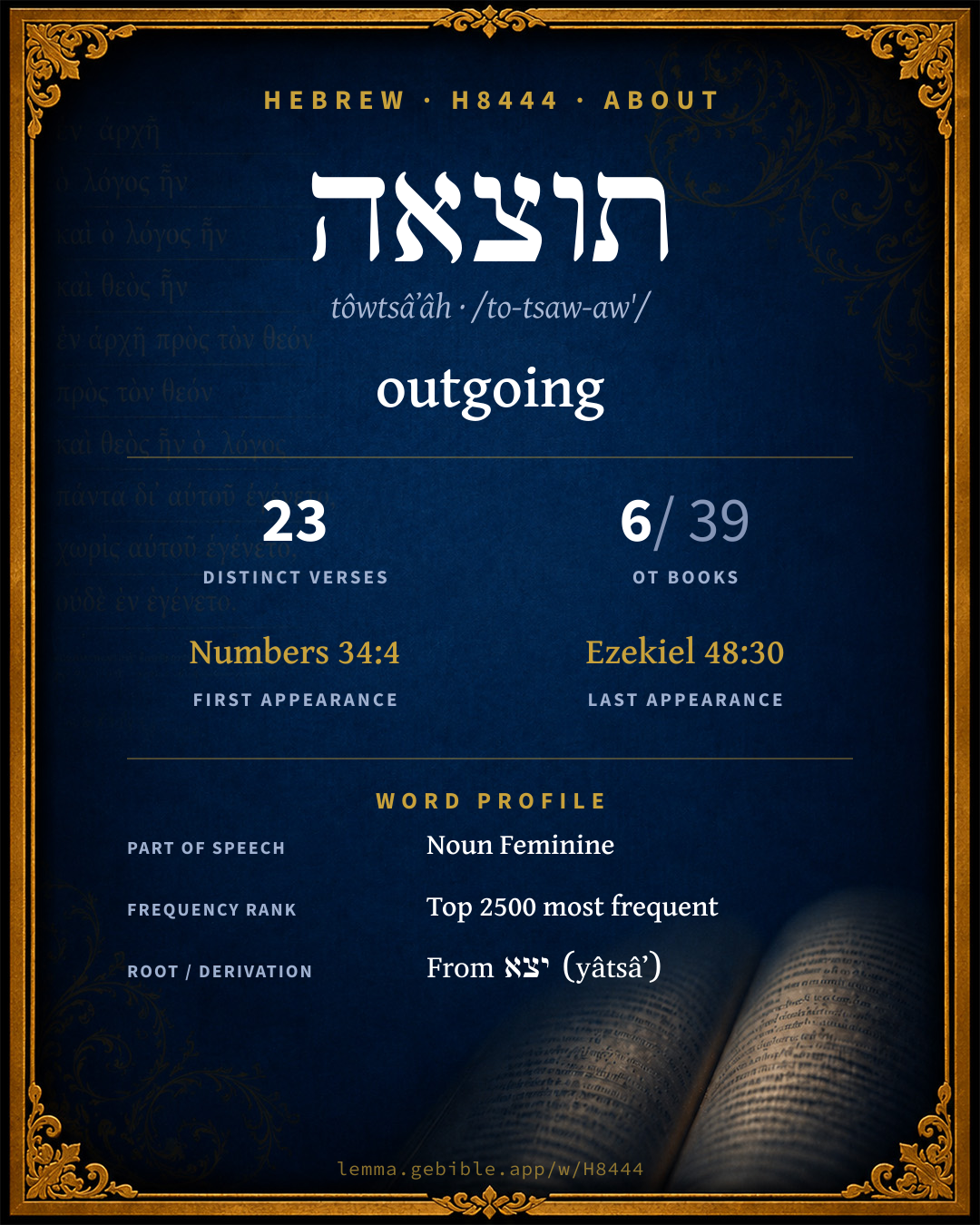
תּוֹצָאָה
outgoing
also: border, a going out, extremity, end fuller range ↓
Full lexicon entry — Brown-Driver-Briggs (BDB)
From Brown-Driver-Briggs (BDB)
Where this word appears
See every Construct-state word in the Hebrew Bible →
Grammar key — what these labels mean
Part of speech
- Noun
- A naming word — a person, place, thing, or idea.
Noun type
- Common
- A common noun — a general class of person, place, or thing (“king,” “city,” “water”), not a specific name.
State
- Construct
- A noun bound to a following noun in a possessive / “of” relationship (the construct chain).
- Absolute
- The independent form of a noun, not bound to a following word.
Gender
- Feminine
- Grammatically feminine.
Number
- Plural
- More than one (in Hebrew, generally three or more).
22 distinct verses where H8444 appears in the Construct state, across 5 books. Filtered view — show all forms. Click any verse to open its interlinear word-by-word view. Verse text shown in the World English Bible for context — . Each verse’s Hebrew form is shown with its reference; the English is not keyword-highlighted, since the data carries no word-level English alignment. Use “Compare translations” on any verse to read it across multiple English versions. This concordance covers the Hebrew Bible; Septuagint (Greek Old Testament) occurrences are not indexed here.
Numbers 5 verses
- Numbers 34:4 תּֽוֹצְאֹתָ֔י/ו n c fp cs + sfx pers 3ms and your border shall turn about southward of the ascent of Akrabbim, and pass along to Zin; and the goings out of it shall be southward of Kadesh-barnea; and it shall go forth to Hazar Addar, and pass along to Azmon;
- Numbers 34:5 תוֹצְאֹתָ֖י/ו n c fp cs + sfx pers 3ms and the border shall turn about from Azmon to the brook of Egypt, and the goings out of it shall be at the sea.
- Numbers 34:8 תּוֹצְאֹ֥ת n c fp cs from Mount Hor you shall mark out to the entrance of Hamath; and the goings out of the border shall be at Zedad;
- Numbers 34:9 תוֹצְאֹתָ֖י/ו n c fp cs + sfx pers 3ms and the border shall go forth to Ziphron, and the goings out of it shall be at Hazar Enan: this shall be your north border.
- Numbers 34:12 תוֹצְאֹתָ֖י/ו n c fp cs + sfx pers 3ms and the border shall go down to the Jordan, and the goings out of it shall be at the Salt Sea. This shall be your land according to the borders of it round about.
Joshua 14 verses
- Joshua 15:4 תֹּצְא֥וֹת n c fp cs and it passed along to Azmon, and went out at the brook of Egypt; and the goings out of the border were at the sea: this shall be your south border.
- Joshua 15:7 תֹצְאֹתָ֖י/ו n c fp cs + sfx pers 3ms and the border went up to Debir from the valley of Achor, and so northward, looking toward Gilgal, that is over against the ascent of Adummim, which is on the south side of the river; and the border passed along to the waters of En Shemesh, and the goings out of it were at En Rogel;
- Joshua 15:11 תֹּצְא֥וֹת n c fp cs and the border went out to the side of Ekron northward; and the border extended to Shikkeron, and passed along to Mount Baalah, and went out at Jabneel; and the goings out of the border were at the sea.
- Joshua 16:3 תצאת/ו תֹצְאֹתָ֖י/ו n c fp cs + sfx pers 3ms n c fp cs + sfx pers 3ms and it went down westward to the border of the Japhletites, to the border of Beth Horon the lower, even to Gezer; and the goings out of it were at the sea.
- Joshua 16:8 תֹצְאֹתָ֖י/ו n c fp cs + sfx pers 3ms From Tappuah the border went along westward to the brook of Kanah; and the goings out of it were at the sea. This is the inheritance of the tribe of the children of Ephraim according to their families;
- Joshua 17:9 תֹצְאֹתָ֖י/ו n c fp cs + sfx pers 3ms The border went down to the brook of Kanah, southward of the brook: these cities belonged to Ephraim among the cities of Manasseh: and the border of Manasseh was on the north side of the brook, and the goings out of it were at the sea:
- Joshua 17:18 תֹּֽצְאֹתָ֑י/ו n c fp cs + sfx pers 3ms but the hill-country shall be yours; for though it is a forest, you shall cut it down, and the goings out of it shall be yours; for you shall drive out the Canaanites, though they have chariots of iron, and though they are strong.
- Joshua 18:12 תֹּֽצְאֹתָ֔י/ו n c fp cs + sfx pers 3ms Their border on the north quarter was from the Jordan; and the border went up to the side of Jericho on the north, and went up through the hill-country westward; and the goings out of it were at the wilderness of Beth Aven.
- Joshua 18:14 תֹֽצְאֹתָ֗י/ו n c fp cs + sfx pers 3ms The border extended [there], and turned about on the west quarter southward, from the mountain that lies before Beth Horon southward; and the goings out of it were at Kiriath Baal (the same is Kiriath Jearim), a city of the children of Judah: this was the west quarter.
- Joshua 18:19 תצאותי/ו תֹּצְא֣וֹת n c fp cs + sfx pers 3ms n c fp cs and the border passed along to the side of Beth Hoglah northward; and the goings out of the border were at the north bay of the Salt Sea, at the south end of the Jordan: this was the south border.
- Joshua 19:14 תֹּֽצְאֹתָ֔י/ו n c fp cs + sfx pers 3ms and the border turned about it on the north to Hannathon; and the goings out of it were at the valley of Iphtah El;
- Joshua 19:22 תֹּצְא֥וֹת n c fp cs and the border reached to Tabor, and Shahazumah, and Beth-shemesh; and the goings out of their border were at the Jordan: sixteen cities with their villages.
- Joshua 19:29 תֹצְאֹתָ֛י/ו n c fp cs + sfx pers 3ms and the border turned to Ramah, and to the fortified city of Tyre; and the border turned to Hosah; and the goings out of it were at the sea by the region of Achzib;
- Joshua 19:33 תֹצְאֹתָ֖י/ו n c fp cs + sfx pers 3ms Their border was from Heleph, from the oak in Zaanannim, and Adaminekeb, and Jabneel, to Lakkum; and the goings out of it were at the Jordan;
1 Chronicles 1 verse
Proverbs 1 verse
Ezekiel 1 verse
About this entry
At a glance — auto-summarized from this page’s data, not written by a person. Every figure links to its source below. This summary describes the numbers; it doesn’t interpret them.
At its core, תוצאה (tôwtsâʼâh) means “outgoing.” The word gravitates to Joshua (61%), then Numbers and 1 Chronicles. It turns up in 23 verses across 6 books, an uncommon footprint. Scripture first uses it in Numbers 34:4. Not a single-sense word, it carries 4 senses, among them “border”, “a going out”, and “extremity”. Dig into 23-verse concordance and the renderings breakdown below.
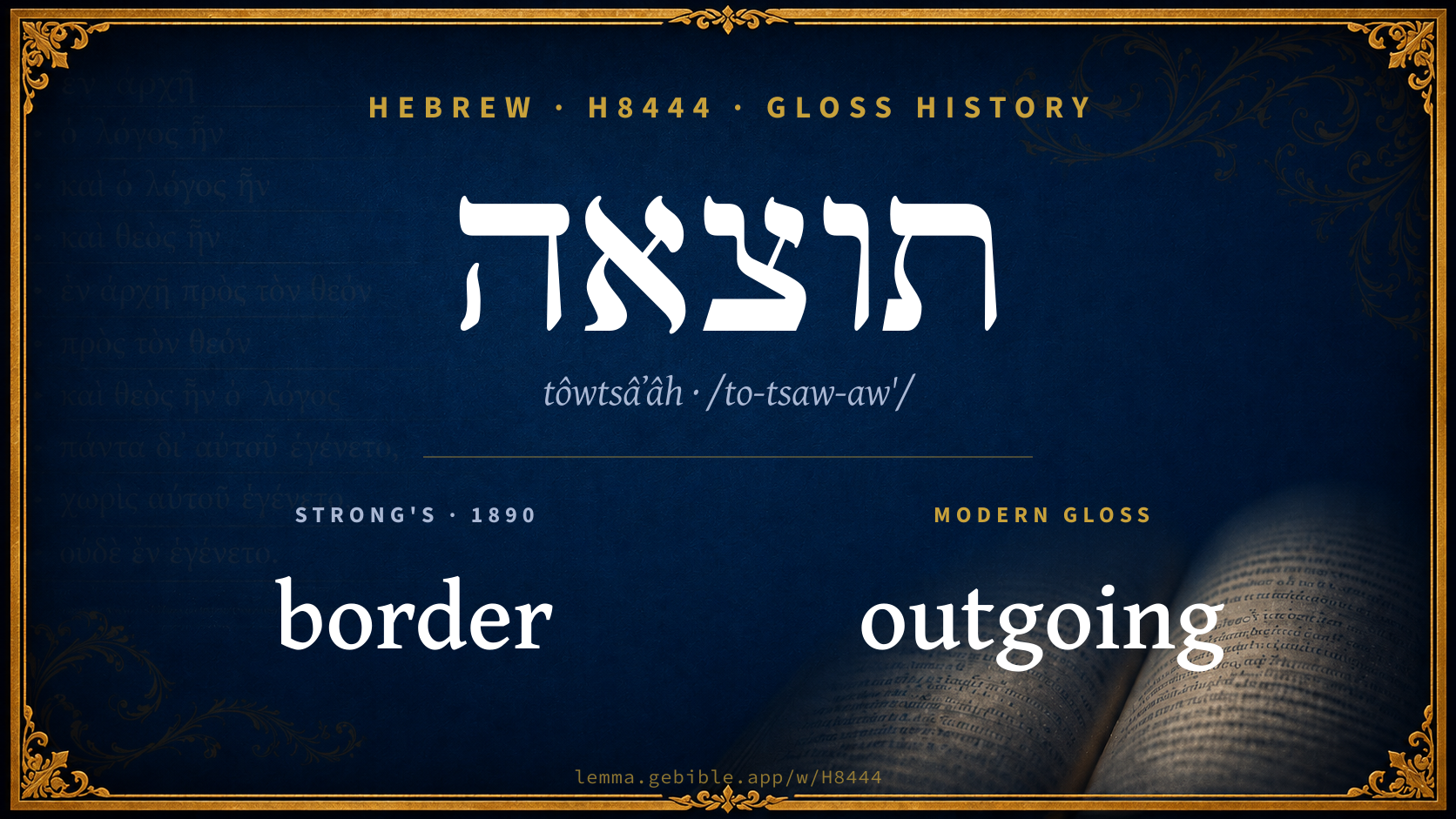
Gloss history
Strong's 1890 vs modern scholarship
About this word
Strong's H8444 catalogs a Hebrew word from the Hebrew Old Testament.
These counts are not copied from any lexicon or concordance. They are computed here, from the morphology-tagged Hebrew Old Testament. What Lemma adds →
- 23
- distinct verses
- The word appears in 23 distinct verses.
- 6 / 39
- OT books
- The word appears in 6 of 39 Old Testament books.
- #1,282
- by frequency
- Top 2500 most frequent Hebrew words (rank 1,282 of 8,640 Hebrew words by occurrence).
View all 23 occurrences in the concordance →
Most concentrated in
- Joshua 14 verses 61%
- Numbers 5 verses 22%
- 1 Chronicles 1 verse 4%
By section of the Old Testament
By traditional corpus
Conventional, traditional groupings — biblical authorship is debated, so this is a traditional corpus grouping, not an authorship claim. Each share is this word’s portion of its verses in that division of the Hebrew canon. Each figure is a share of the word’s 23 distinct verses.
- Prophets (Nevi'im) 15 verses · 65%
- Torah (Pentateuch) 5 verses · 22%
- Writings (Ketuvim) 3 verses · 13%
How translations render this word
Counts come from each version’s own published word-to-Strong’s tagging or interlinear alignment — an approximate guide to how each version renders this word, not a word-level alignment the data otherwise carries. Because each total is that version’s own tagged count, the per-version totals vary from one another and need not match the appearance or distinct-verse counts above. These counts may also differ from a printed concordance because Lemma counts each distinctly tagged rendering and does not collapse phrase taggings into a single head-word total. This is a fixed set of word-tagged versions (KJV, ASV, BSB, ULT) and does not change with the reading translation you choose elsewhere. Each version’s license is shown beside its name below (and on Sources).
- King James Version: Goings out 10×, Outgoings 7×
- American Standard Version: Goings out 11×, Goings 7×
- Berean Standard Bible: Ended 1×, Farthest limits 1×, Flow 1×
- unfoldingWord Literal Text: Goings out 10×, Goings out of 4×, Outer limits 4×
King James Version Public Domain
Renders H8444 across 23 tagged occurrences — most commonly:
Plus 6 renderings that appear only once — usually multi-word phrases or single function words the recovered tagging swept in, not distinct renderings.
American Standard Version Public Domain
Renders H8444 across 22 tagged occurrences — most commonly:
Plus 4 renderings that appear only once — usually multi-word phrases or single function words the recovered tagging swept in, not distinct renderings.
Berean Standard Bible Public Domain
Renders H8444 across 5 tagged occurrences — most commonly:
Not rendered by a distinct English word in 18 further occurrences.
unfoldingWord Literal Text CC BY-SA 4.0
Renders H8444 across 23 tagged occurrences — most commonly:
Plus 5 renderings that appear only once — usually multi-word phrases or single function words the recovered tagging swept in, not distinct renderings.
Senses in BDB
The 4 senses BDB distinguishes for this word, in lexicon order (not ranked by frequency or importance). The full entry — with sub-senses — is in the Lexicon Entry tab.
- outgoing, border, a going out, extremity, end, source, escape
- outgoing, extremity (of border)
- source (of life)
- escape (from death)
Word origin
[ תּוֹצָאָה ] n.f. outgoing, extremity, source (?), escape
— Brown-Driver-Briggs (Oxford 1906, public domain), digitized via Sefaria, supplemented by the OpenScriptures HebrewLexicon (CC BY 4.0). See Sources.
Derived from יצא (yâtsâʼ) (H3318) — to go out.
Jastrow Dictionary
A second Hebrew/Aramaic lexicon for comparison, covering Aramaic and post-biblical (Talmudic, Targumic, Midrashic) usage that the biblical-Hebrew BDB does not. Matched by lemma rather than by Strong’s number, so a lemma may carry more than one Jastrow headword (shown separately below), and the entries cover usage well beyond the Bible.
תּוֹצָאָה
- issue, mode, species (v. תּוֹלָדָה).—Pl. תּוֹצָאוֹת. Ker. III, 10 הנדה שאין בה ת׳ הרבה וכ׳ the law concerning the menstruant, in connection with which there are not many modes and many sin-offerings; שבת שיש בה ת׳ וכ׳ the Sabbath law which has many modes (תולדות) &c.; Y. Sabb. VII, 9ᵃ, sq.; Ker. 17ᵃ ת׳ הרבה לחטאות הרבה many issues for many sin-offerings. Midr. Till. to Ps. LV, 14 (expl. מידעי, ib.) המודיעני תוֹצְאוֹת בינה who taught me the issues of understanding; a. e.
A Dictionary of the Targumim, the Talmud Babli and Yerushalmi, and the Midrashic Literature (Marcus Jastrow; London, Luzac, 1903) — Public Domain. Digitized via Sefaria. Digitized via Sefaria. Full attribution on Sources.
Forms in the corpus
The 16 distinct written forms H8444 takes in the Hebrew Bible, most frequent first — each parse links to that state’s occurrences in the concordance. Hebrew forms include their vowel points and cantillation, so a single lemma takes many written forms.
Same root — word family
Other BDB entries built from the same root as H8444, grouped by Strong’s listed origin. These share a root / origin per the lexicon — not necessarily a shared meaning. Each links to that word’s own entry.
Derives from
Shares the same root
- יצא yᵉtsâʼ H3319 to finish
- יציא yâtsîyʼ H3329 offspring
- מוצא môwtsâʼ H4161 going forth
- צאה tsâʼâh H6627 filth
- צאצא tseʼĕtsâʼ H6631 offspring
Compare all same-root words → Showing 4 of 7 — not the complete family. They share a root, not necessarily a meaning.
Septuagint verse parallels
This word appears in 23 verses that also exist in the Greek Old Testament (Septuagint), out of the 23 Hebrew verses it occurs in. You can read those verses in Greek by switching the Old Testament edition to the Septuagint.
Read these verses in the Septuagint
This is a verse-level parallel only — the same verses exist in both the Hebrew and Greek Old Testaments. No word-level Hebrew↔Greek correspondence is claimed: the data carries no such alignment, so no Greek word is shown as this Hebrew word’s translation. Coverage is not total — the Septuagint omits the deuterocanon and renumbers the Psalms, so some Hebrew verses have no direct Greek parallel.