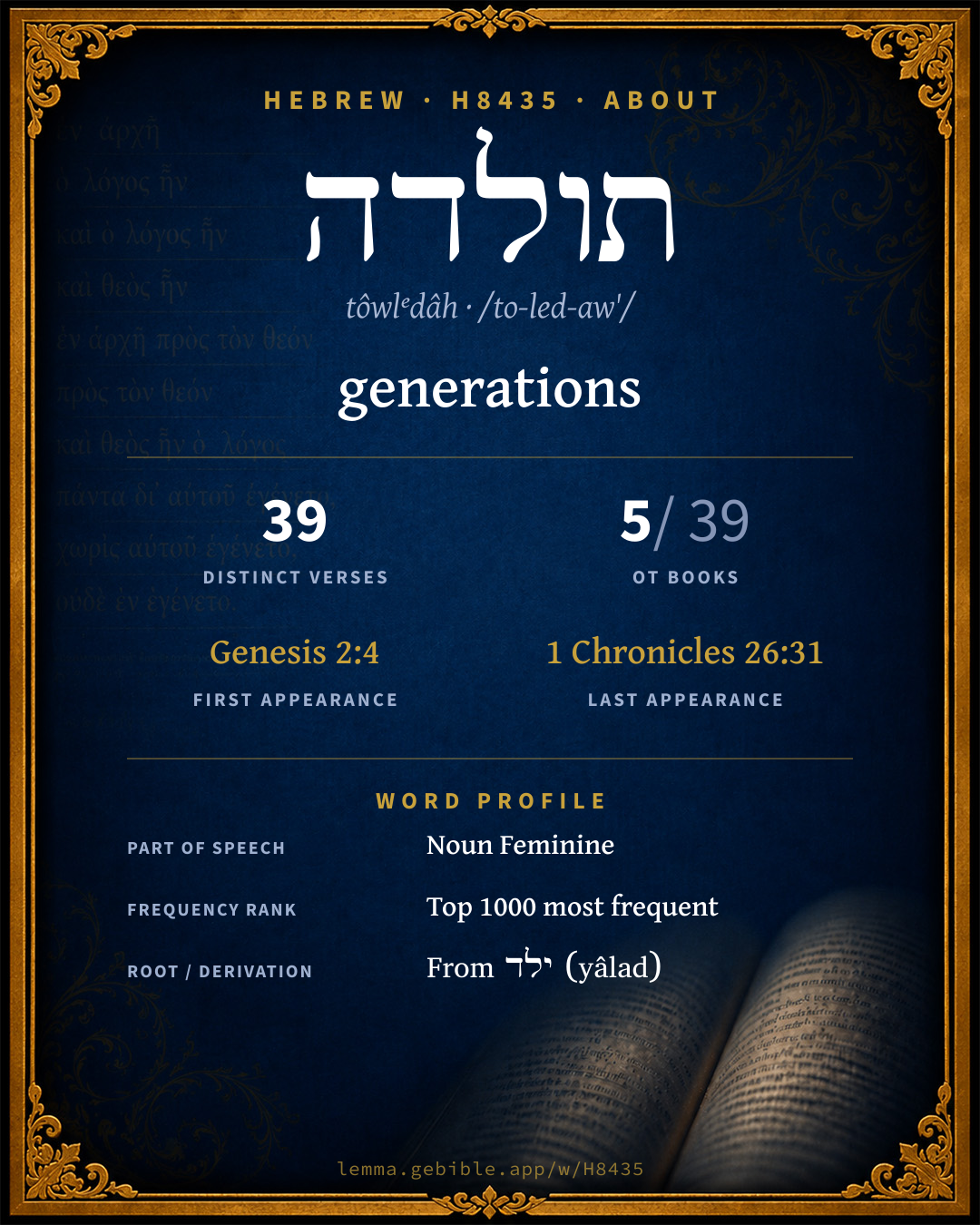
תּוֹלֵדוֹת
generations
also: descendants, results, proceedings, genealogies fuller range ↓
Full lexicon entry — Brown-Driver-Briggs (BDB)
From Brown-Driver-Briggs (BDB)
Where this word appears
Grammar key — what these labels mean
Part of speech
- Noun
- A naming word — a person, place, thing, or idea.
Noun type
- Common
- A common noun — a general class of person, place, or thing (“king,” “city,” “water”), not a specific name.
State
- Construct
- A noun bound to a following noun in a possessive / “of” relationship (the construct chain).
Gender
- Feminine
- Grammatically feminine.
Number
- Plural
- More than one (in Hebrew, generally three or more).
Every verse where H8435 appears — 39 distinct verses across 5 books. Click any verse to open its interlinear word-by-word view. Verse text shown in the World English Bible for context — . Each verse’s Hebrew form is shown with its reference; the English is not keyword-highlighted, since the data carries no word-level English alignment. Use “Compare translations” on any verse to read it across multiple English versions. This concordance covers the Hebrew Bible; Septuagint (Greek Old Testament) occurrences are not indexed here.
Genesis 13 verses
- Genesis 2:4 תוֹלְד֧וֹת n c fp cs This is the history of the generations of the heavens and of the earth when they were created, in the day that Yahweh God made earth and the heavens.
- Genesis 5:1 תּוֹלְדֹ֖ת n c fp cs This is the book of the generations of Adam. In the day that God created man, he made him in God's likeness.
- Genesis 6:9 תּוֹלְדֹ֣ת n c fp cs This is the history of the generations of Noah. Noah was a righteous man, blameless among the people of his time. Noah walked with God.
- Genesis 10:1 תּוֹלְדֹ֣ת n c fp cs Now this is the history of the generations of the sons of Noah and of Shem, Ham, and Japheth. Sons were born to them after the flood.
- Genesis 10:32 לְ/תוֹלְדֹתָ֖/ם prep + n c fp cs + sfx pers 3mp These are the families of the sons of Noah, after their generations, in their nations. Of these were the nations divided in the earth after the flood.
- Genesis 11:10 תּוֹלְדֹ֣ת n c fp cs This is the history of the generations of Shem. Shem was one hundred years old, and became the father of Arpachshad two years after the flood.
- Genesis 11:27 תּוֹלְדֹ֣ת n c fp cs Now this is the history of the generations of Terah. Terah became the father of Abram, Nahor, and Haran. Haran became the father of Lot.
- Genesis 25:12 תֹּלְדֹ֥ת n c fp cs Now this is the history of the generations of Ishmael, Abraham's son, whom Hagar the Egyptian, Sarah's handmaid, bore to Abraham.
- Genesis 25:13 לְ/תוֹלְדֹתָ֑/ם prep + n c fp cs + sfx pers 3mp These are the names of the sons of Ishmael, by their names, according to the order of their birth: the firstborn of Ishmael, Nebaioth, then Kedar, Adbeel, Mibsam,
- Genesis 25:19 תּוֹלְדֹ֥ת n c fp cs This is the history of the generations of Isaac, Abraham's son. Abraham became the father of Isaac.
- Genesis 36:1 תֹּלְד֥וֹת n c fp cs Now this is the history of the generations of Esau (the same is Edom).
- Genesis 36:9 תֹּלְד֥וֹת n c fp cs This is the history of the generations of Esau the father of the Edomites in the hill country of Seir:
- Genesis 37:2 תֹּלְד֣וֹת n c fp cs This is the history of the generations of Jacob. Joseph, being seventeen years old, was feeding the flock with his brothers. He was a boy with the sons of Bilhah and Zilpah, his father's wives. Joseph brought an evil report of them to their father.
Exodus 3 verses
- Exodus 6:16 לְ/תֹ֣לְדֹתָ֔/ם prep + n c fp cs + sfx pers 3mp These are the names of the sons of Levi according to their generations: Gershon, and Kohath, and Merari; and the years of the life of Levi were one hundred thirty-seven years.
- Exodus 6:19 לְ/תֹלְדֹתָֽ/ם prep + n c fp cs + sfx pers 3mp The sons of Merari: Mahli and Mushi. These are the families of the Levites according to their generations.
- Exodus 28:10 כְּ/תוֹלְדֹתָֽ/ם prep + n c fp cs + sfx pers 3mp six of their names on the one stone, and the names of the six that remain on the other stone, in the order of their birth.
Numbers 13 verses
- Numbers 1:20 תּוֹלְדֹתָ֥/ם n c fp cs + sfx pers 3mp The children of Reuben, Israel's firstborn, their generations, by their families, by their fathers' houses, according to the number of the names, one by one, every male from twenty years old and upward, all who were able to go out to war;
- Numbers 1:22 תּוֹלְדֹתָ֥/ם n c fp cs + sfx pers 3mp Of the children of Simeon, their generations, by their families, by their fathers' houses, those who were numbered of it, according to the number of the names, one by one, every male from twenty years old and upward, all who were able to go out to war;
- Numbers 1:24 תּוֹלְדֹתָ֥/ם n c fp cs + sfx pers 3mp Of the children of Gad, their generations, by their families, by their fathers' houses, according to the number of the names, from twenty years old and upward, all who were able to go out to war;
- Numbers 1:26 תּוֹלְדֹתָ֥/ם n c fp cs + sfx pers 3mp Of the children of Judah, their generations, by their families, by their fathers' houses, according to the number of the names, from twenty years old and upward, all who were able to go out to war;
- Numbers 1:28 תּוֹלְדֹתָ֥/ם n c fp cs + sfx pers 3mp Of the children of Issachar, their generations, by their families, by their fathers' houses, according to the number of the names, from twenty years old and upward, all who were able to go out to war;
- Numbers 1:30 תּוֹלְדֹתָ֥/ם n c fp cs + sfx pers 3mp Of the children of Zebulun, their generations, by their families, by their fathers' houses, according to the number of the names, from twenty years old and upward, all who were able to go out to war;
- Numbers 1:32 תּוֹלְדֹתָ֥/ם n c fp cs + sfx pers 3mp Of the children of Joseph, of the children of Ephraim, their generations, by thir families, by their fathers' houses, according to the number of the names, from twenty years old and upward, all who were able to go out to war;
- Numbers 1:34 תּוֹלְדֹתָ֥/ם n c fp cs + sfx pers 3mp Of the children of Manasseh, their generations, by their families, by their fathers' houses, according to the number of the names, from twenty years old and upward, all who were able to go out to war;
- Numbers 1:36 תּוֹלְדֹתָ֥/ם n c fp cs + sfx pers 3mp Of the children of Benjamin, their generations, by their families, by their fathers' houses, according to the number of the names, from twenty years old and upward, all who were able to go out to war;
- Numbers 1:38 תּוֹלְדֹתָ֥/ם n c fp cs + sfx pers 3mp Of the children of Dan, their generations, by their families, by their fathers' houses, according to the number of the names, from twenty years old and upward, all who were able to go forth to war;
- Numbers 1:40 תּוֹלְדֹתָ֥/ם n c fp cs + sfx pers 3mp Of the children of Asher, their generations, by their families, by their fathers' houses, according to the number of the names, from twenty years old and upward, all who were able to go forth to war;
- Numbers 1:42 תּוֹלְדֹתָ֥/ם n c fp cs + sfx pers 3mp Of the children of Naphtali, their generations, by their families, by their fathers' houses, according to the number of the names, from twenty years old and upward, all who were able to go forth to war;
- Numbers 3:1 תּוֹלְדֹ֥ת n c fp cs Now this is the history of the generations of Aaron and Moses in the day that Yahweh spoke with Moses in Mount Sinai.
Ruth 1 verse
1 Chronicles 9 verses
- 1 Chronicles 1:29 תֹּלְדוֹתָ֑/ם n c fp cs + sfx pers 3mp These are their generations: the firstborn of Ishmael, Nebaioth; then Kedar, and Adbeel, and Mibsam,
- 1 Chronicles 5:7 לְ/תֹלְדוֹתָ֑/ם prep + n c fp cs + sfx pers 3mp His brothers by their families, when the genealogy of their generations was reckoned: the chief, Jeiel, and Zechariah,
- 1 Chronicles 7:2 לְ/תֹלְדוֹתָ֑/ם prep + n c fp cs + sfx pers 3mp The sons of Tola: Uzzi, and Rephaiah, and Jeriel, and Jahmai, and Ibsam, and Shemuel, heads of their fathers' houses, [to wit], of Tola; mighty men of valor in their generations: their number in the days of David was twenty-two thousand six hundred.
- 1 Chronicles 7:4 לְ/תֹלְדוֹתָ֜/ם prep + n c fp cs + sfx pers 3mp With them, by their generations, after their fathers' houses, were bands of the host for war, thirty-six thousand; for they had many wives and sons.
- 1 Chronicles 7:9 לְ/תֹלְדוֹתָ֗/ם prep + n c fp cs + sfx pers 3mp They were reckoned by genealogy, after their generations, heads of their fathers' houses, mighty men of valor, twenty thousand two hundred.
- 1 Chronicles 8:28 לְ/תֹלְדוֹתָ֖/ם prep + n c fp cs + sfx pers 3mp These were heads of fathers' [houses] throughout their generations, chief men: these lived in Jerusalem.
- 1 Chronicles 9:9 לְ/תֹ֣לְדוֹתָ֔/ם prep + n c fp cs + sfx pers 3mp and their brothers, according to their generations, nine hundred fifty-six. All these men were heads of fathers' [houses] by their fathers' houses.
- 1 Chronicles 9:34 לְ/תֹלְדוֹתָ֖/ם prep + n c fp cs + sfx pers 3mp These were heads of fathers' [houses] of the Levites, throughout their generations, chief men: these lived at Jerusalem.
- 1 Chronicles 26:31 לְ/תֹלְדֹתָ֖י/ו prep + n c fp cs + sfx pers 3ms Of the Hebronites was Jerijah the chief, even of the Hebronites, according to their generations by fathers' [houses]. In the fortieth year of the reign of David they were sought for, and there were found among them mighty men of valor at Jazer of Gilead.
About this entry
At a glance — auto-summarized from this page’s data, not written by a person. Every figure links to its source below. This summary describes the numbers; it doesn’t interpret them.
תולדה — transliterated tôwlᵉdâh — is a Hebrew noun carrying the sense “generations.” Its English rendering has broadened — “generations” classically, “according to the records” (Berean Standard Bible) in modern versions; see the renderings breakdown. Spanning 39 verses in 5 books, it ranks among the moderately common words of the Hebrew Bible. Its uses concentrate in Genesis (33% of all occurrences). Alongside “generations” the lexicon also lists “descendants”, “results”, and “proceedings” — part of its full sense range. Each statement above links to its evidence; the full detail follows below.
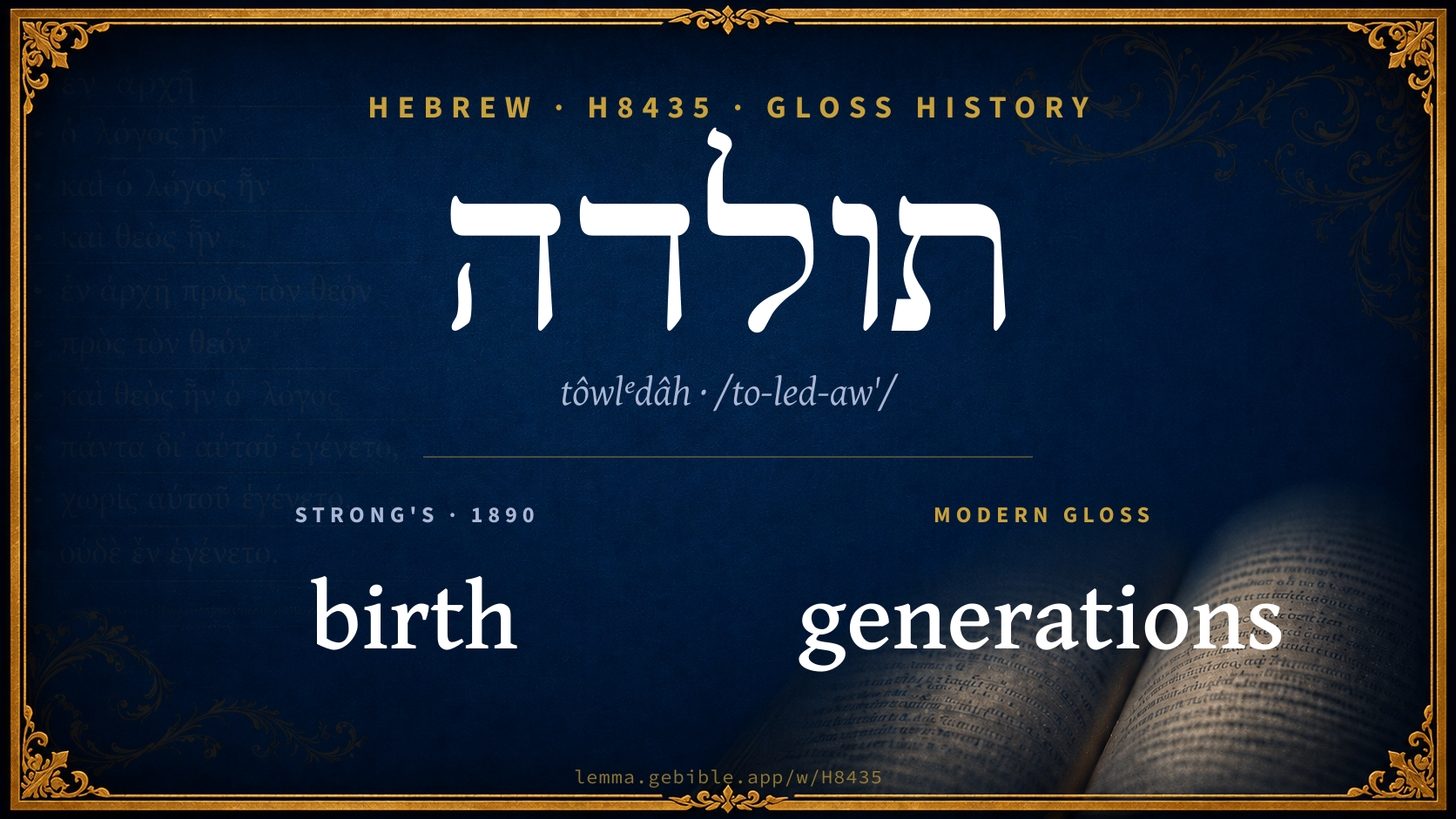
Gloss history
Strong's 1890 vs modern scholarship
About this word
Strong's H8435 catalogs a Hebrew word from the Hebrew Old Testament.
These counts are not copied from any lexicon or concordance. They are computed here, from the morphology-tagged Hebrew Old Testament. What Lemma adds →
- 39
- distinct verses
- The word appears in 39 distinct verses.
- 5 / 39
- OT books
- The word appears in 5 of 39 Old Testament books.
- #922
- by frequency
- Top 1000 most frequent Hebrew words (rank 922 of 8,640 Hebrew words by occurrence).
View all 39 occurrences in the concordance →
Most concentrated in
- Genesis 13 verses 33%
- Numbers 13 verses 33%
- 1 Chronicles 9 verses 23%
By section of the Old Testament
By traditional corpus
Conventional, traditional groupings — biblical authorship is debated, so this is a traditional corpus grouping, not an authorship claim. Each share is this word’s portion of its verses in that division of the Hebrew canon. Each figure is a share of the word’s 39 distinct verses.
- Torah (Pentateuch) 29 verses · 74%
- Writings (Ketuvim) 10 verses · 26%
How translations render this word
Counts come from each version’s own published word-to-Strong’s tagging or interlinear alignment — an approximate guide to how each version renders this word, not a word-level alignment the data otherwise carries. Because each total is that version’s own tagged count, the per-version totals vary from one another and need not match the appearance or distinct-verse counts above. These counts may also differ from a printed concordance because Lemma counts each distinctly tagged rendering and does not collapse phrase taggings into a single head-word total. This is a fixed set of word-tagged versions (KJV, ASV, BSB, ULT) and does not change with the reading translation you choose elsewhere. Each version’s license is shown beside its name below (and on Sources).
- King James Version: Generations 16×, Are the generations 7×, Now these are the generations 5×
- American Standard Version: Generations 14×, Are the generations 6×, Now these are the generations 6×
- Berean Standard Bible: According to the records 12×, Is the account 9×, Genealogies 3×
- unfoldingWord Literal Text: Generations 14×, Generations of 12×, According to their generations 6×
King James Version Public Domain
Renders H8435 across 39 tagged occurrences — most commonly:
Plus 5 renderings that appear only once — usually multi-word phrases or single function words the recovered tagging swept in, not distinct renderings.
American Standard Version Public Domain
Renders H8435 across 39 tagged occurrences — most commonly:
Plus 8 renderings that appear only once — usually multi-word phrases or single function words the recovered tagging swept in, not distinct renderings.
Berean Standard Bible Public Domain
Renders H8435 across 39 tagged occurrences — most commonly:
Plus 3 renderings that appear only once — usually multi-word phrases or single function words the recovered tagging swept in, not distinct renderings.
unfoldingWord Literal Text CC BY-SA 4.0
Renders H8435 across 39 tagged occurrences — most commonly:
Plus 7 renderings that appear only once — usually multi-word phrases or single function words the recovered tagging swept in, not distinct renderings.
Senses in the full BDB
What do BDB’s symbols mean?
BDB uses these scholarly abbreviations:
| Symbol | Meaning |
|---|---|
| 𝔊 | the Septuagint (the ancient Greek translation, LXX) |
| 𝔙 | the Vulgate (the Latin translation) |
| 𝔖 | the Syriac version (the Peshitta) |
| 𝔗 | the Targum (the Aramaic translation) |
| ψ | the Psalms |
| √ | root (the underlying root or stem) |
| ‖ | parallel passage (a synonymous or contrasted parallel) |
| † | the dagger: every passage where the word occurs is cited |
The 2 senses and sub-senses the full Brown-Driver-Briggs lexicon distinguishes for this word, in lexicon order (not ranked by frequency), with BDB’s own verbatim wording and sub-sense lettering. Shown in Hebrew script with BDB’s own scholarly abbreviations. The condensed entry is in the Lexicon Entry tab. See also the Forms in the corpus table below.
- a. account of men and their descendants Gn 5:1; 6:9; 10:1; 11:10, 27; 25:12, 19; 36:1, 9; 37:2; Nu 3:1; Ru 4:18; 1 Ch 1:29; successive generations (in) of families (מִשְׁפָּחֹת) Gn 10:32 cf. 25:13, Ex 6:16, 19; 28:10; genealogical divisions, by parentage Nu 1:20 (ת׳ לְמִשְׁפְּחֹתָם) + 11 times Nu 1; וְאֶחָיו לְמִשְׁפְּחֹתָיו בְּהִתְיַחֶשׂ לתולדותם 1 Ch 5:7 cf. 7:9 and prob. also 7:2 v Be, 7:4; 8:28; 9:9, 34; 26:31. e.g. Genesis 5:1
- b. metaph. תּוֹלְדוֹת הַשָּׁמַיִם וְהָאָרֶץ Gn 2:4 lit. begettings of heaven and earth, i.e, account of heaven and earth and that which proceeded from them (cf. DrIntr. 5 n.) In Hex always P. e.g. Genesis 2:4
Senses from the full Brown-Driver-Briggs lexicon (Brown, Driver, Briggs; Oxford 1906 — public domain), digitized via Sefaria, supplemented by the OpenScriptures HebrewLexicon (CC BY 4.0). Full attribution on Sources.
Word origin
n.f.pl. generations, especially in genealogies = account of a man and his descendants;—cstr. תּוֹלְדוֹת Gn 2:4 Ru 4:18; תּוֹלְדֹת Gn 5:1 + 6 times; תֹּלְדוֹת 36:1 + 2 times; תֹּלְדֹת 25:12; sf. תֹּלְדֹתָיו 1 Ch 26:31; תּוֹלְדֹתָם Ex 28:10 + 16 times; תֹּלְדוֹתָם 1 Ch 5:7 + 5 times; תֹּלְדֹתָם Ex 6:16, 19;—
— Brown-Driver-Briggs (Oxford 1906, public domain), digitized via Sefaria, supplemented by the OpenScriptures HebrewLexicon (CC BY 4.0). See Sources.
Derived from ילד (yâlad) (H3205) — to bear.
Jastrow Dictionary
A second Hebrew/Aramaic lexicon for comparison, covering Aramaic and post-biblical (Talmudic, Targumic, Midrashic) usage that the biblical-Hebrew BDB does not. Matched by lemma rather than by Strong’s number, so a lemma may carry more than one Jastrow headword (shown separately below), and the entries cover usage well beyond the Bible.
תּוֹלָדָה
- 1. birth, procreation, offspring. — Pl. תּוֹלָדוֹת. Gen. R. s. 12 שלשה דברים הללו … שלש ת׳ וכ׳ the following three things form the real creations of the world, and each of them delayed three days, and then produced offspring: the earth &c. Ib. לכל יש ת׳ … יש להן ת׳ וכ׳ all things have origins (mentioned in the Bible), heaven and earth have origins &c. Ib. כל מי שיש לו ת׳ וכ׳ whatever has an origin, dies and decays, is created, but does not create, but that which has no origin does not die &c. Num. R. s. 1412 בעת שהעמיד ת׳ during the time of his begetting children. Y. Sot. VIII, 22ᶜ bot. שלישי לת׳ ורביעי וכ׳ he was the third in the order of birth, and the fourth in the order of accession; a. fr.
- 2. secondary act, subspecies, opp. אב or עיקר, v. אָב II. Y. Sabb. II, 5ᵃ bot. שחיטה עיקר וחבורה ת׳ slaughtering is the primary act (forbidden on the Sabbath), and wounding is the secondary act. B. Kam. 2ᵃ הך … קרי לה ת׳ an act which was essential at the building of the Tabernacle is called ab, and one which was not essential, is called toladah; a. fr.—Pl. as ab. Ib. מדקתני אבות מכלל דאיכא ת׳ since the Mishnah speaks of main damages, we must conclude that there are also secondary ones; תּוֹלְדוֹתֵיהֶן כיוצא בהן וכ׳ are their subspecies subject to the same laws or not? Sabb. 2ᵇ הכא … תני אבות ותני ת׳ וכ׳ here (Sabb. I, 1) where the main subject is the Sabbath, the Mishnah specifies the main act and the secondary acts, &c.; Shebu. 5ᵃ; a. fr.
A Dictionary of the Targumim, the Talmud Babli and Yerushalmi, and the Midrashic Literature (Marcus Jastrow; London, Luzac, 1903) — Public Domain. Digitized via Sefaria. Digitized via Sefaria. Full attribution on Sources.
Forms in the corpus
The 21 distinct written forms H8435 takes in the Hebrew Bible, most frequent first — each parse links to that state’s occurrences in the concordance. Hebrew forms include their vowel points and cantillation, so a single lemma takes many written forms.
| Form | Parsing | Example | Uses |
|---|---|---|---|
| תּוֹלְדֹתָ֥/ם | Noun, Common, Feminine, Plural, Construct | Numbers 1:20 | 12 |
| תּוֹלְדֹ֣ת | Noun, Common, Feminine, Plural, Construct | Genesis 6:9 | 4 |
| לְ/תֹלְדוֹתָ֑/ם | Noun, Common, Feminine, Plural, Construct | 1 Chronicles 5:7 | 2 |
| לְ/תֹלְדוֹתָ֖/ם | Noun, Common, Feminine, Plural, Construct | 1 Chronicles 8:28 | 2 |
| תֹּלְד֥וֹת | Noun, Common, Feminine, Plural, Construct | Genesis 36:1 | 2 |
| תּוֹלְדֹ֥ת | Noun, Common, Feminine, Plural, Construct | Genesis 25:19 | 2 |
| כְּ/תוֹלְדֹתָֽ/ם | Noun, Common, Feminine, Plural, Construct | Exodus 28:10 | 1 |
| לְ/תֹ֣לְדֹתָ֔/ם | Noun, Common, Feminine, Plural, Construct | Exodus 6:16 | 1 |
| לְ/תֹ֣לְדוֹתָ֔/ם | Noun, Common, Feminine, Plural, Construct | 1 Chronicles 9:9 | 1 |
| לְ/תֹלְדֹתָ֖י/ו | Noun, Common, Feminine, Plural, Construct | 1 Chronicles 26:31 | 1 |
| לְ/תֹלְדֹתָֽ/ם | Noun, Common, Feminine, Plural, Construct | Exodus 6:19 | 1 |
| לְ/תֹלְדוֹתָ֗/ם | Noun, Common, Feminine, Plural, Construct | 1 Chronicles 7:9 | 1 |
| לְ/תֹלְדוֹתָ֜/ם | Noun, Common, Feminine, Plural, Construct | 1 Chronicles 7:4 | 1 |
| לְ/תוֹלְדֹתָ֑/ם | Noun, Common, Feminine, Plural, Construct | Genesis 25:13 | 1 |
| לְ/תוֹלְדֹתָ֖/ם | Noun, Common, Feminine, Plural, Construct | Genesis 10:32 | 1 |
| תֹּלְד֣וֹת | Noun, Common, Feminine, Plural, Construct | Genesis 37:2 | 1 |
| תֹּלְדֹ֥ת | Noun, Common, Feminine, Plural, Construct | Genesis 25:12 | 1 |
| תֹּלְדוֹתָ֑/ם | Noun, Common, Feminine, Plural, Construct | 1 Chronicles 1:29 | 1 |
| תּוֹלְד֣וֹת | Noun, Common, Feminine, Plural, Construct | Ruth 4:18 | 1 |
| תּוֹלְדֹ֖ת | Noun, Common, Feminine, Plural, Construct | Genesis 5:1 | 1 |
| תוֹלְד֧וֹת | Noun, Common, Feminine, Plural, Construct | Genesis 2:4 | 1 |
Same root — word family
Other BDB entries built from the same root as H8435, grouped by Strong’s listed origin. These share a root / origin per the lexicon — not necessarily a shared meaning. Each links to that word’s own entry.
Derives from
Shares the same root
- ילד yeled H3206 child
- ילוד yillôwd H3209 born
- יליד yâlîyd H3211 born
- מולדת môwledeth H4138 offspring
Proper names from this root
People and places named from this root — a name, not an additional meaning of the word.
Compare all same-root words → Showing 4 of 9 — not the complete family. 3 of the same-root words are proper names (people or places). They share a root, not necessarily a meaning.
Septuagint verse parallels
This word appears in 39 verses that also exist in the Greek Old Testament (Septuagint), out of the 39 Hebrew verses it occurs in. You can read those verses in Greek by switching the Old Testament edition to the Septuagint.
Read these verses in the Septuagint
This is a verse-level parallel only — the same verses exist in both the Hebrew and Greek Old Testaments. No word-level Hebrew↔Greek correspondence is claimed: the data carries no such alignment, so no Greek word is shown as this Hebrew word’s translation. Coverage is not total — the Septuagint omits the deuterocanon and renumbers the Psalms, so some Hebrew verses have no direct Greek parallel.