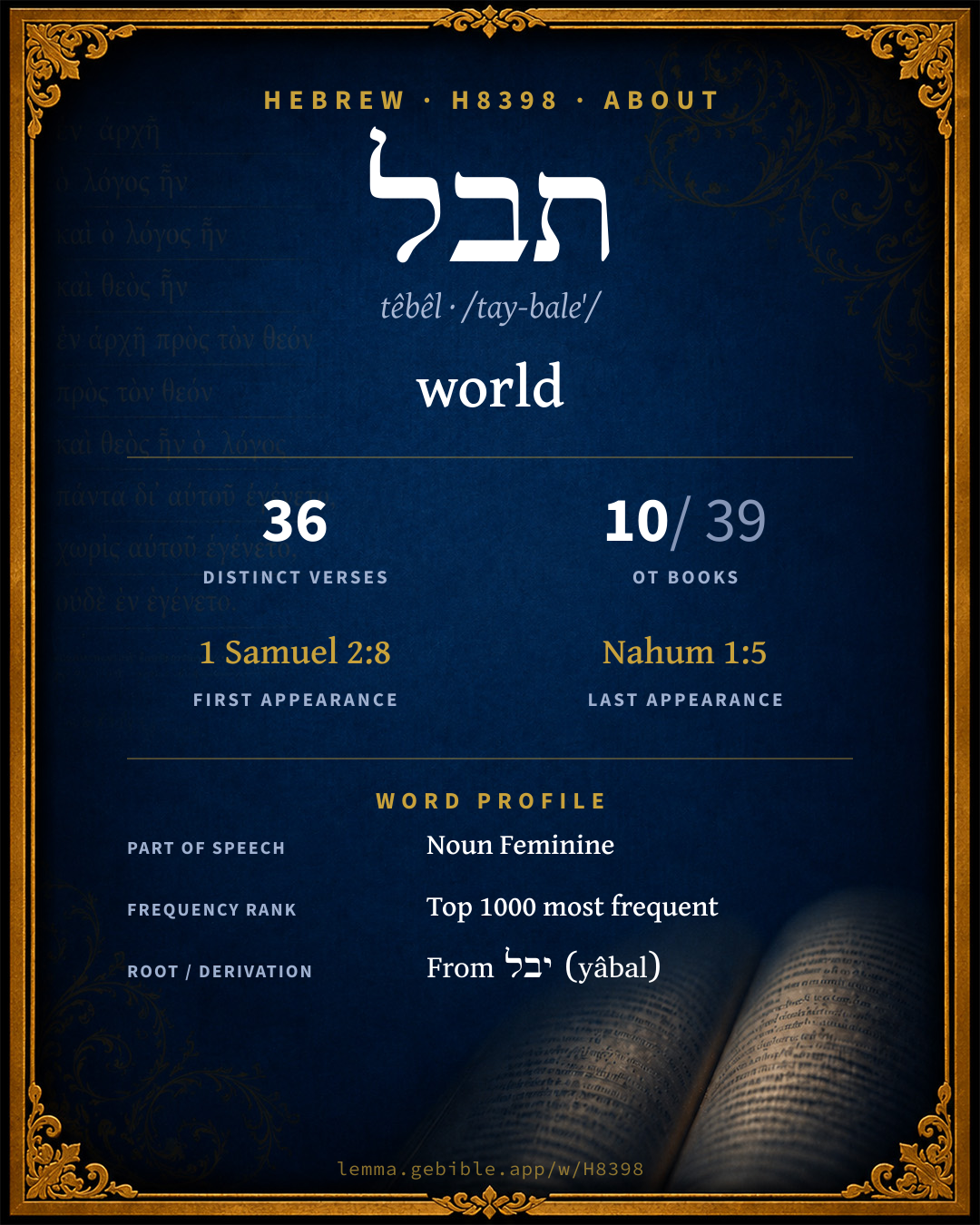
תֵּבֵל
world
Full lexicon entry — Brown-Driver-Briggs (BDB)
From Brown-Driver-Briggs (BDB)
Where this word appears
See every Absolute-state word in the Hebrew Bible →
Grammar key — what these labels mean
Part of speech
- Noun
- A naming word — a person, place, thing, or idea.
Noun type
- Common
- A common noun — a general class of person, place, or thing (“king,” “city,” “water”), not a specific name.
State
- Absolute
- The independent form of a noun, not bound to a following word.
- Construct
- A noun bound to a following noun in a possessive / “of” relationship (the construct chain).
Gender
- Feminine
- Grammatically feminine.
Number
- Singular
- One.
1 distinct verse where H8398 appears in the Construct state, across 1 book. Filtered view — show all forms. Click any verse to open its interlinear word-by-word view. Verse text shown in the World English Bible for context — . Each verse’s Hebrew form is shown with its reference; the English is not keyword-highlighted, since the data carries no word-level English alignment. Use “Compare translations” on any verse to read it across multiple English versions. This concordance covers the Hebrew Bible; Septuagint (Greek Old Testament) occurrences are not indexed here.
Proverbs 1 verse
About this entry
At a glance — auto-summarized from this page’s data, not written by a person. Every figure links to its source below. This summary describes the numbers; it doesn’t interpret them.
The Hebrew noun תבל centers on the idea of “world.” Its earliest occurrence is 1 Samuel 2:8. The Hebrew Bible uses it across 36 verses — moderately common. Psalms dominates its distribution — 15 of 36 verses. Sharing its root, it stands alongside יבל, אובל and יבול. Dig into 36-verse concordance and the renderings breakdown below.
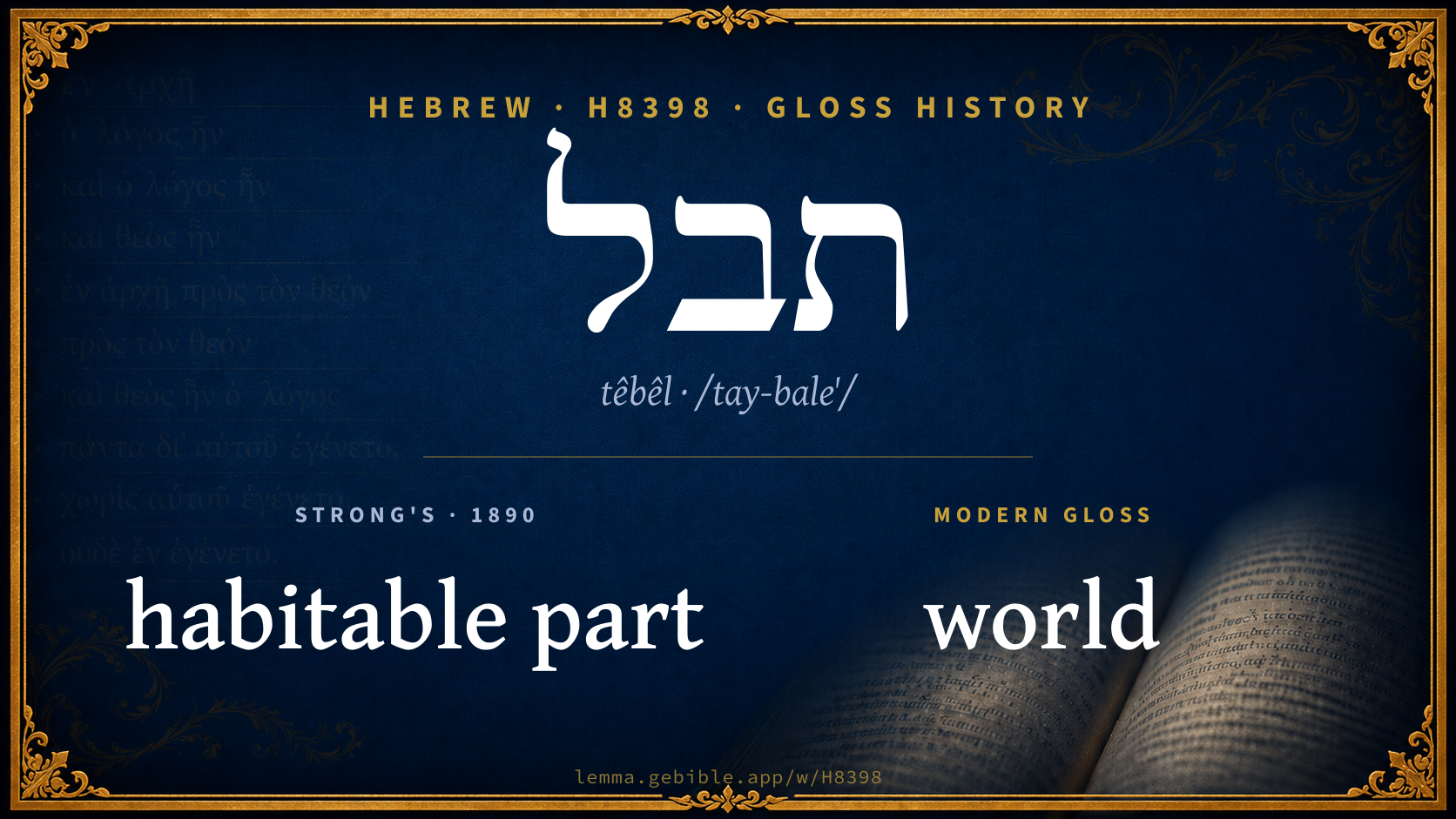
Gloss history
Strong's 1890 vs modern scholarship
About this word
Strong's H8398 catalogs a Hebrew word from the Hebrew Old Testament.
These counts are not copied from any lexicon or concordance. They are computed here, from the morphology-tagged Hebrew Old Testament. What Lemma adds →
- 36
- distinct verses
- The word appears in 36 distinct verses.
- 10 / 39
- OT books
- The word appears in 10 of 39 Old Testament books.
- #990
- by frequency
- Top 1000 most frequent Hebrew words (rank 990 of 8,640 Hebrew words by occurrence).
View all 36 occurrences in the concordance →
By section of the Old Testament
By traditional corpus
Conventional, traditional groupings — biblical authorship is debated, so this is a traditional corpus grouping, not an authorship claim. Each share is this word’s portion of its verses in that division of the Hebrew canon. Each figure is a share of the word’s 36 distinct verses.
- Writings (Ketuvim) 22 verses · 61%
- Prophets (Nevi'im) 14 verses · 39%
How translations render this word
Counts come from each version’s own published word-to-Strong’s tagging or interlinear alignment — an approximate guide to how each version renders this word, not a word-level alignment the data otherwise carries. Because each total is that version’s own tagged count, the per-version totals vary from one another and need not match the appearance or distinct-verse counts above. These counts may also differ from a printed concordance because Lemma counts each distinctly tagged rendering and does not collapse phrase taggings into a single head-word total. This is a fixed set of word-tagged versions (KJV, ASV, BSB, ULT) and does not change with the reading translation you choose elsewhere. Each version’s license is shown beside its name below (and on Sources).
- King James Version: World 28×, Thereof the world 2×
- American Standard Version: World 25×, Thereof 2×
- Berean Standard Bible: World 29×, Earth 3×
- unfoldingWord Literal Text: World 33×
King James Version Public Domain
Renders H8398 across 36 tagged occurrences — most commonly:
Plus 6 renderings that appear only once — usually multi-word phrases or single function words the recovered tagging swept in, not distinct renderings.
American Standard Version Public Domain
Renders H8398 across 36 tagged occurrences — most commonly:
Plus 9 renderings that appear only once — usually multi-word phrases or single function words the recovered tagging swept in, not distinct renderings.
Berean Standard Bible Public Domain
Renders H8398 across 35 tagged occurrences — most commonly:
Plus 3 renderings that appear only once — usually multi-word phrases or single function words the recovered tagging swept in, not distinct renderings. Not rendered by a distinct English word in 1 further occurrence.
unfoldingWord Literal Text CC BY-SA 4.0
Renders H8398 across 35 tagged occurrences — most commonly:
Plus 2 renderings that appear only once — usually multi-word phrases or single function words the recovered tagging swept in, not distinct renderings.
Senses in BDB
The 1 sense BDB distinguishes for this word, in lexicon order (not ranked by frequency or importance). The full entry — with sub-senses — is in the Lexicon Entry tab.
- world
Word origin
n.f. Na 1:5 (appar. m. Is 14:17) world, poet. synon. of אֶרֶץ (perhaps orig. as productive, cf. יְבוּל, בּוּל, but this sense not clearly maintained; cf. also Assyrian tabalu in êlî tabali, by land, ‖ êlî nâru, by water (river) MeissnerZA 1889, iv. 3, 261, 263, 265 f. SASm Assyrian Letters iv. pl. viii. ix, 1. 33)—usually abs. ת׳ (no art.), cstr. Jb 37:12 Pr 8:31; world, usually ‖ אֶרֶץ: 1 S 2:8 (י׳ set ת׳ on מְצֻקֵי אֶרֶץ), Is 14:21; 24:4; 34:1 Je 10:12 = 51:15, 1 Ch 16:30 (‖ ψ 96:10 infr.) Jb 34:13 ψ 19:5; 77:19 = 97:4, 90:2; 96:13 (+ עַמִּים), 98:9 (+ id.); ת׳ וְיֹשְׁבֵי בָהּ Na 1:5 ψ 24:1; יֹשְׁבֵי ת׳ 33:8 Is 18:3 (‖ שֹׁכְנֵי ארץ), 26:9, 18 La 4:12; ת׳ וּמְלֹאָהּ ψ 89:12 (+ שָׁמַיִם, cf. ארץ ומלאה 24:1); עַל־פְּנֵי ת׳ אָ֑רְצָה Jb 37:12 upon the face of the world of earth (earthly world, the whole expanse of earth); בְּת׳ אַרְצוֹ Pr 8:31; on the other hand עַפְרוֹת ת׳ v 26; ת׳ alone Jb 18:18; other combin. ת׳ וּמְלֹאָהּ ψ 50:12 (cf. 89:12 supr.); פְּנֵי־ת׳ Is 27:6 (cf. Jb 37:12 supr.); מֹסְדוֹת ת׳ 2 S 22:16 foundations of the world = ψ 18:16, cf. תִּכּוֹן ת׳ ψ 93:1; 96:10 (= 1 Ch 16:30); world as object of י׳’s judgment 9:9 (‖ לְאֻמִּים; v. also 96:13 supr.), cf. ת׳ וישׁבי בה 98:7 (‖ יַם), Is 13:11 (‖ רשׁעים); as devastated by Babylonian conqueror Is 14:17 (‖ עָרָיו).
— Brown-Driver-Briggs (Oxford 1906, public domain), digitized via Sefaria, supplemented by the OpenScriptures HebrewLexicon (CC BY 4.0). See Sources.
Derived from יבל (yâbal) (H2986) — to bring.
Jastrow Dictionary
A second Hebrew/Aramaic lexicon for comparison, covering Aramaic and post-biblical (Talmudic, Targumic, Midrashic) usage that the biblical-Hebrew BDB does not. Matched by lemma rather than by Strong’s number, so a lemma may carry more than one Jastrow headword (shown separately below), and the entries cover usage well beyond the Bible.
תָּבַל
- , Pi. תִּבֵּל
- 1. (denom. of תֶּבֶל) to mix; to spice, season. Men. 23ᵇ תִּיבְּלָהּ בקצח וכ׳ if he seasoned it (the unleavened bread) with cumin &c. Ib. 21ᵃ יכול יְתַבְּלֶנּוּ כתבן בטיט Ms. M. a. Ar. (ed. יתבוננו) you may think (that t’bon’nennu means,) that he must mix it with salt as straw is mixed with clay; Yalk. Lev. 454 (not בתבן וטיט); v. בִּין. Orl. II, 4 כל המחמץ והמְתַבֵּל וכ׳ whosoever leavens, or seasons, or mixes with T’rumah &c. Ib. 15 תבלין … לא באלו כדי לתַבֵּל … ונצטרפו ותִבְּלוּ if spices of T’rumah and of mixed seeds get into a pot, neither being sufficient to season the dish, but seasoning it in combination. Y. Maas. Sh. II, 53ᶜ top a dish of second tithes שתִּיבְּלוֹ וכ׳ which one seasoned with spices of a profane character; a. fr.—Part. pass. מְתוּבָּל; f. מְתוּבֶּלֶת &c. Y. Pes. X, 37ᶜ מבושל כמ׳ (ed. כדי תבל, כתיתבל, corr. acc.) boiled wine is in ritual law like spiced wine. Tosef. Pes. I (II), 33 מצה המת׳ וכ׳ spiced Matsah; a. e.—Trnsf. to improve, refine. Gen. R. s. 23; Yalk. ib. 38 (play on תובל קין) ת׳ עבודתו של קין וכ׳ (Gen. R. עבירתו) he refined Cain’s work (sin); Cain killed without any tool &c.
- 2. (v. תֵּבֵל) to make rich of growth.—Part. pass. as ab. Sifré Deut. 37; Yalk. Prov. 943, v. תֵּבֵל.
- 1. to be mixed, seasoned. Tosef. Pes. l. c. בין שנִתַּבְּלָה וכ׳ (ed. Zuck. שתִּיבְּלָהּ) whether it was seasoned in a stew-dish or in a pot.
- 2. (denom. of תֶּבֶל 2) to defile one’s self. Yalk. Gen. 47 (ref. to הוחל, Gen. IV, 26, and play on תובל) חזרו מִתַּבְּלִין בכל כעס וכ׳ they turned and denied themselves with all kind of provocation (sins), as we read, Tubal Cain &c.; שחזרו להִתַּבֵּל בזנות וכ׳ they turned to defile themselves with voluptuousness, as we read (Lev. XX, 12) tebel ʿasu e.g. Genesis 4:26
תְּבַל
- , Pa. תַּבֵּל same, to spice, season. Ḥull. 112ᵃ מְתַבֵּל, v. תַּבְלָא I.
תֵּבֵל
- , v. Ges. Thes. s. v.) world. Sifré Deut. 37 (ref. to Prov. VIII, 26) ת׳ זו ארץ ישראל … שהיא מתובלת בכל tebel means Palestine, and why is it called tebel? Because it is rich in every thing; Yalk. Prov. 943 (ref. to Prov. VIII, 31) ת׳ זו ארצו … שהיא מתובלת מכל ארצות tebel means his (God’s) land, because it is richer than all other lands; ib. ת׳ שהיא מתובלת בפירותיה tebel, because it (the earth) is flavored with its fruits. Gen. R. s. 13 תבל … שמתבלת וכ׳ the earth is called tebel corresponding to the period of Tammuz (midsummer) which lends savor to its fruits; Yalk. ib. 20. e.g. Proverbs 8:26
תֵּבֵל ²
- Targ. Ps. XVIII, 16. Ib. XC, 2. Targ. Prov. VIII, 26; 31; a. fr.
תֶּבֶל
- (בָּלַל)
- 1. mixture, spice, seasoning. Y. Orl. I, 61ᵇ top אין ת׳ ביותר וכ׳ spices have no seasoning effect in a mixture larger than two hundred times their quantity. Arakh. II, 6 כדי ליתן ת׳ בנעימה in order to put spice (sweetness) in the melody (to raise the effect of the melody through the accompaniment of young voices). Yalk. Prov. 943 (ref. to תֵּבֵל, Prov. VIII, 31) Palestine is called tebel על שם ת׳ שבתוכה וכ׳ for the spice which is in it, and what is this? The Law; Sifré Deut. 37 תבלין, v. infra.—Pl. תְּבָלִין, (tradit. pronunc.) תַּבְלִין. Orl. II, 10 ת׳ שנים וכ׳ spices of two or three different legal categories, of one kind or of three. Ib. 15, v. תָּבַל. Kel. II, 7, a. e. בית ת׳ spice box. Y. Pes. X, 37ᵈ top תַּבְלֵי מצוה; Bab. Pes. 116ᵃ תֹבלין למצוה spices for the Passover ceremony (חֲרוֹסֶת); a. fr.—Also used as sing. Sabb. 119ᵃ ת׳ אחד יש לנו וכ׳ we have a certain spice the name of which is Sabbath &c. B. Bath. 16ᵃ הקב"ה … תורה ת׳ the Lord created the evil inclination (in man), and he created the Law with which to season (temper) it; Kidd. 30ᵇ. Sifré Deut. 37, v. supra; a. e.—Ned. 51ᵃ (play on תבל, Lev. XVIII, 23) ת׳ הוא ת׳ יש בה וכ׳ is it a spice? is there any spice (additional gratification) in it? &c.—[ e.g. Proverbs 8:31
- 2. (b. h.)confusion, unnatural act, defilement, v. supra, a. תָּבַל.]—[Y. Shebu. III, 34ᶜ top מן התבל, read: הטֶבֶל.]
A Dictionary of the Targumim, the Talmud Babli and Yerushalmi, and the Midrashic Literature (Marcus Jastrow; London, Luzac, 1903) — Public Domain. Digitized via Sefaria. Digitized via Sefaria. Full attribution on Sources.
Forms in the corpus
The 19 distinct written forms H8398 takes in the Hebrew Bible, most frequent first — each parse links to that state’s occurrences in the concordance. Hebrew forms include their vowel points and cantillation, so a single lemma takes many written forms.
Same root — word family
Other BDB entries built from the same root as H8398, grouped by Strong’s listed origin. These share a root / origin per the lexicon — not necessarily a shared meaning. Each links to that word’s own entry.
Derives from
Shares the same root
- אובל ʼûwbâl H180 stream
- יבול yᵉbûwl H2981 produce
- יבל yᵉbal H2987 to bring
- יבל yâbâl H2988 stream
- יבל yabbêl H2990 running sore
- יובל yôwbêl H3104 ram's horn
- יובל yûwbal H3105 stream
- מבול mabbûwl H3999 flood
Proper names from this root
People and places named from this root — a name, not an additional meaning of the word.
Compare all same-root words → Showing 4 of 12 — not the complete family. 2 of the same-root words are proper names (people or places). They share a root, not necessarily a meaning.
Septuagint verse parallels
This word appears in 35 verses that also exist in the Greek Old Testament (Septuagint), out of the 36 Hebrew verses it occurs in. You can read those verses in Greek by switching the Old Testament edition to the Septuagint.
Read these verses in the Septuagint
- 1 Samuel 2:8
- 2 Samuel 22:16
- 1 Chronicles 16:30
- Job 18:18
- Psalms 9:8
- Proverbs 8:26
- Isaiah 13:11
- Jeremiah 10:12
- Lamentations 4:12
- Nahum 1:5
This is a verse-level parallel only — the same verses exist in both the Hebrew and Greek Old Testaments. No word-level Hebrew↔Greek correspondence is claimed: the data carries no such alignment, so no Greek word is shown as this Hebrew word’s translation. Coverage is not total — the Septuagint omits the deuterocanon and renumbers the Psalms, so some Hebrew verses have no direct Greek parallel.