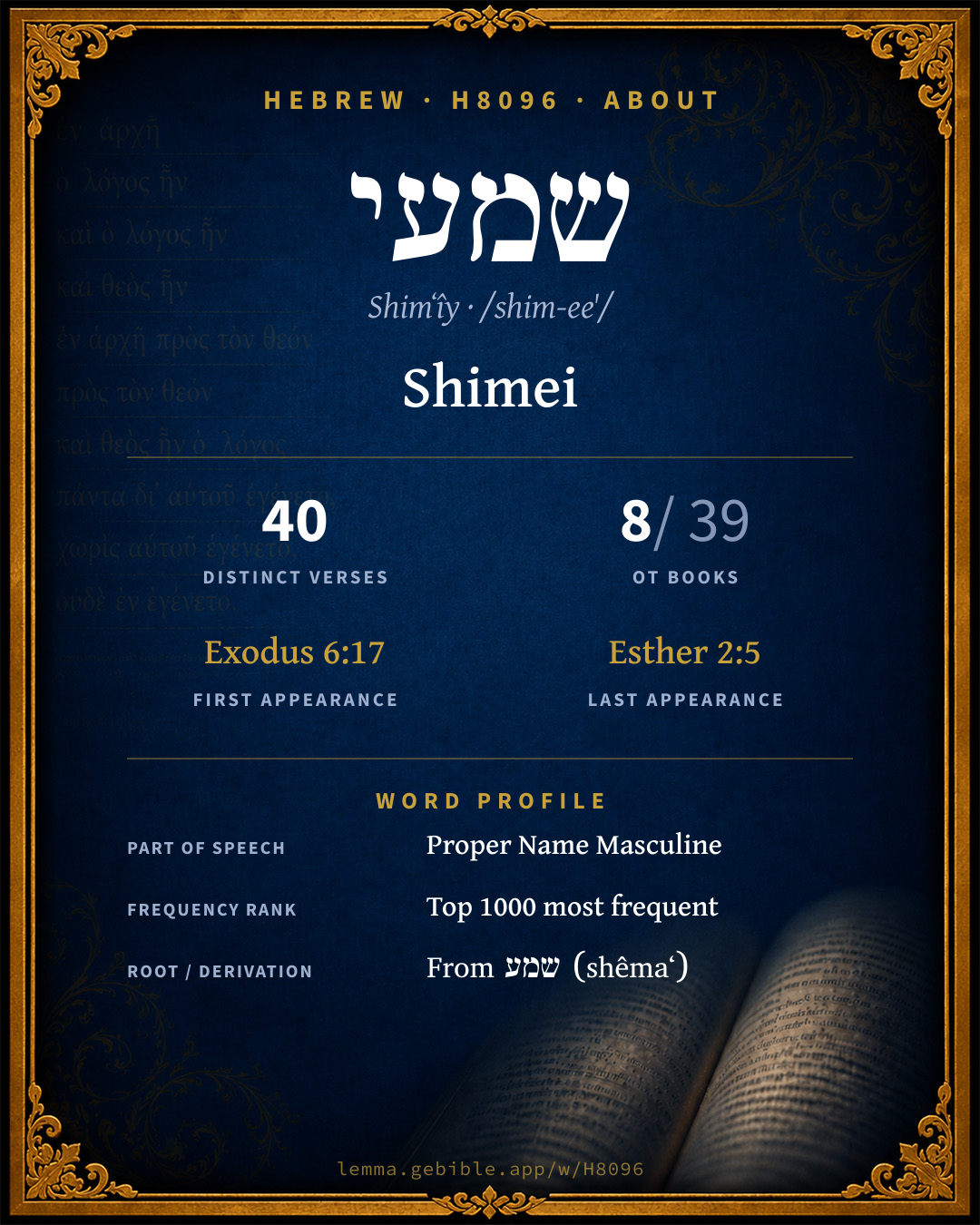
שִׁמְעִי
Shimei
BDB lists 10 entries for ‘Shimei’ fuller range ↓
Full lexicon entry — Brown-Driver-Briggs (BDB)
From Brown-Driver-Briggs (BDB)
Where this word appears
Grammar key — what these labels mean
Part of speech
- Noun
- A naming word — a person, place, thing, or idea.
Noun type
- Proper
- A name of a specific person, place, or people (e.g. Abraham, Zion, Israel).
Every verse where H8096 appears in the Book of 2 Samuel — 8 distinct verses. Click any verse to open its interlinear word-by-word view. Verse text shown in the World English Bible for context — . Each verse’s Hebrew form is shown with its reference; the English is not keyword-highlighted, since the data carries no word-level English alignment. Use “Compare translations” on any verse to read it across multiple English versions. This concordance covers the Hebrew Bible; Septuagint (Greek Old Testament) occurrences are not indexed here.
2 Samuel
- 2 Samuel 16:5 שִׁמְעִ֣י n Proper When king David came to Bahurim, behold, a man of the family of the house of Saul came out, whose name was Shimei, the son of Gera. He came out, and cursed still as he came.
- 2 Samuel 16:7 שִׁמְעִ֖י n Proper Thus said Shimei when he cursed, Be gone, be gone, you man of blood, and base fellow:
- 2 Samuel 16:13 וְ/שִׁמְעִ֡י conj + n Proper So David and his men went by the way; and Shimei went along on the hill-side over against him, and cursed as he went, and threw stones at him, and cast dust.
- 2 Samuel 19:16 שִׁמְעִ֤י n Proper Shimei the son of Gera, the Benjamite, who was of Bahurim, hurried and came down with the men of Judah to meet king David.
- 2 Samuel 19:18 וְ/שִׁמְעִ֣י conj + n Proper There went over a ferry-boat to bring over the king's household, and to do what he thought good. Shimei the son of Gera fell down before the king, when he was come over the Jordan.
- 2 Samuel 19:21 שִׁמְעִ֑י n Proper But Abishai the son of Zeruiah answered, Shall Shimei not be put to death for this, because he cursed Yahweh's anointed?
- 2 Samuel 19:23 שִׁמְעִ֖י n Proper The king said to Shimei, You shall not die. The king swore to him.
- 2 Samuel 21:21 שמעי n Proper When he defied Israel, Jonathan the son of Shimei, David's brother, killed him.
About this entry
At a glance — auto-summarized from this page’s data, not written by a person. Every figure links to its source below. This summary describes the numbers; it doesn’t interpret them.
At its core, שמעי (Shimʻîy) means “Shimei.” First canonically at Exodus 6:17, it enters the text early. It appears 40 verses across 8 books of the Hebrew Bible, among its moderately common vocabulary. The word gravitates to 1 Chronicles (33%), then 1 Kings and 2 Samuel. Each statement above links to its evidence; the full detail follows below.
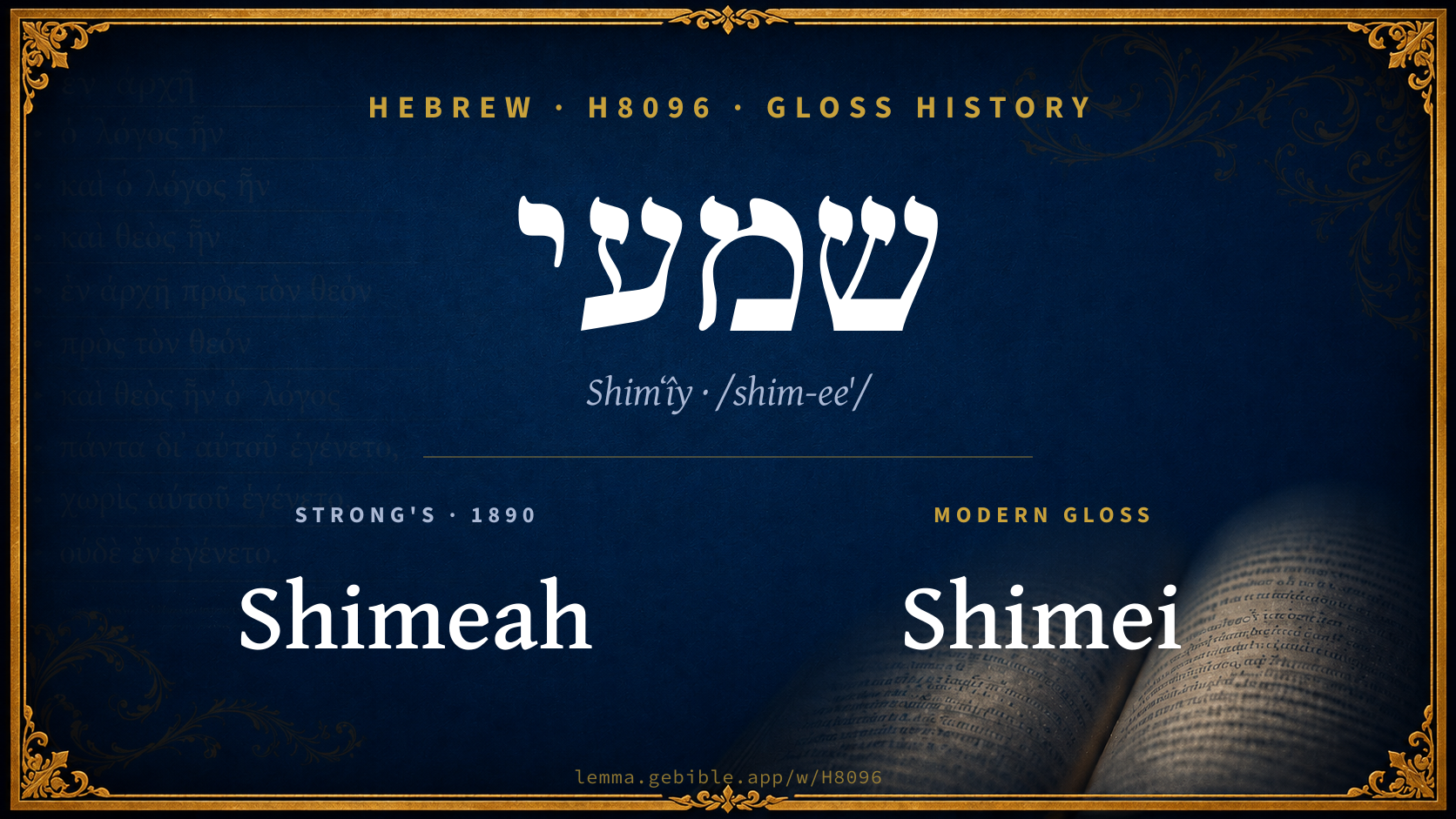
Gloss history
Strong's 1890 vs modern scholarship
About this word
Strong's H8096 catalogs a Hebrew word from the Hebrew Old Testament.
These counts are not copied from any lexicon or concordance. They are computed here, from the morphology-tagged Hebrew Old Testament. What Lemma adds →
- 40
- distinct verses
- The word appears in 40 distinct verses.
- 8 / 39
- OT books
- The word appears in 8 of 39 Old Testament books.
- #819
- by frequency
- Top 1000 most frequent Hebrew words (rank 819 of 8,640 Hebrew words by occurrence).
View all 40 occurrences in the concordance →
Most concentrated in
- 1 Chronicles 13 verses 33%
- 1 Kings 10 verses 25%
- 2 Samuel 8 verses 20%
By section of the Old Testament
By traditional corpus
Conventional, traditional groupings — biblical authorship is debated, so this is a traditional corpus grouping, not an authorship claim. Each share is this word’s portion of its verses in that division of the Hebrew canon. Each figure is a share of the word’s 40 distinct verses.
- Writings (Ketuvim) 20 verses · 50%
- Prophets (Nevi'im) 18 verses · 45%
- Torah (Pentateuch) 2 verses · 5%
How translations render this word
Counts come from each version’s own published word-to-Strong’s tagging or interlinear alignment — an approximate guide to how each version renders this word, not a word-level alignment the data otherwise carries. Because each total is that version’s own tagged count, the per-version totals vary from one another and need not match the appearance or distinct-verse counts above. These counts may also differ from a printed concordance because Lemma counts each distinctly tagged rendering and does not collapse phrase taggings into a single head-word total. This is a fixed set of word-tagged versions (KJV, ASV, BSB, ULT) and does not change with the reading translation you choose elsewhere. Each version’s license is shown beside its name below (and on Sources).
BDB lists this Strong’s number as 2 distinct words (homographs). Each count above pools all of them and is not split by sense — see the Senses section below. A low-frequency rendering may belong to a different one of those words, not the primary meaning.
- King James Version†: Shimei 36×, Was shimei 2×
- American Standard Version†: Shimei 38×, Was shimei 2×
- Berean Standard Bible†: Shimei 40×
- unfoldingWord Literal Text†: Shimei 40×, Was shimei 2×
King James Version Public Domain
Renders H8096 across 43† tagged occurrences — most commonly:
Plus 5 renderings that appear only once — usually multi-word phrases or single function words the recovered tagging swept in, not distinct renderings.
American Standard Version Public Domain
Renders H8096 across 43† tagged occurrences — most commonly:
Plus 3 renderings that appear only once — usually multi-word phrases or single function words the recovered tagging swept in, not distinct renderings.
Berean Standard Bible Public Domain
Renders H8096 across 42† tagged occurrences — most commonly:
Plus 2 renderings that appear only once — usually multi-word phrases or single function words the recovered tagging swept in, not distinct renderings. Not rendered by a distinct English word in 2 further occurrences.
unfoldingWord Literal Text CC BY-SA 4.0
Renders H8096 across 45† tagged occurrences — most commonly:
Plus 3 renderings that appear only once — usually multi-word phrases or single function words the recovered tagging swept in, not distinct renderings.
21 senses and sub-senses in the full BDB
What do BDB’s symbols mean?
BDB uses these scholarly abbreviations:
| Symbol | Meaning |
|---|---|
| 𝔊 | the Septuagint (the ancient Greek translation, LXX) |
| 𝔙 | the Vulgate (the Latin translation) |
| 𝔖 | the Syriac version (the Peshitta) |
| 𝔗 | the Targum (the Aramaic translation) |
| ψ | the Psalms |
| √ | root (the underlying root or stem) |
| ‖ | parallel passage (a synonymous or contrasted parallel) |
| † | the dagger: every passage where the word occurs is cited |
The 21 senses and sub-senses the full Brown-Driver-Briggs lexicon distinguishes for this word, in lexicon order (not ranked by frequency), with BDB’s own verbatim wording and sub-sense lettering. Shown in Hebrew script with BDB’s own scholarly abbreviations. The condensed entry is in the Lexicon Entry tab. See also the Forms in the corpus table below.
שמעי I I. שִׁמְעִי43 n.pr.m. usually Σεμεει
- 1. in Benj.:
- a. 2 S 16:5, 7, 13; 19:17, 19, 22, 24, 1 K 2:8 + 10 times 1 K 2. e.g. 2 Samuel 16:5
- b. 1 K 1:8, perhaps = 4:18. e.g. 1 Kings 1:8
- 2. a Ramathite 1 Ch 27:27. e.g. 1 Chronicles 27:27
- 3. Levites:
- a. ‘son’ of Gershon Ex 6:17 Nu 3:18 1 Ch 6:2; 23:7, 9, 10(×2). e.g. Exodus 6:17
- b. 6:14. e.g. 1 Chronicles 6:14
- c. v 27. e.g. 1 Chronicles 6:27
- d. 25:17 e.g. 1 Chronicles 25:17
- e. 2 Ch 29:14. e.g. 2 Chronicles 29:14
- f. 31:12, 13. e.g. 2 Chronicles 31:12
- g. Ezr 10:23. e.g. Ezra 10:23
- 4. brother of Zerub. 1 Ch 3:19. e.g. 1 Chronicles 3:19
- 5. in Simeon 4:26, 27. e.g. 1 Chronicles 4:26
- 6. in Reuben 5:4. e.g. 1 Chronicles 5:4
- 7. 1 Ch 8:13 = (ii.) שֶׁמַע v 13. e.g. 1 Chronicles 8:13
- 8. post-ex. names:
- a. Ezr 10:33. e.g. Ezra 10:33
- b. v 38 (cf. 3 g supr.). e.g. Ezra 10:38
- 9. grandfather of Mordecai Est 2:5. e.g. Esther 2:5
- 10. 2 S 21:21 Kt (Qr שִׁמְעָא q.v. 1). e.g. 2 Samuel 21:21
שמעי II of 3 a
Senses from the full Brown-Driver-Briggs lexicon (Brown, Driver, Briggs; Oxford 1906 — public domain), digitized via Sefaria, supplemented by the OpenScriptures HebrewLexicon (CC BY 4.0). Full attribution on Sources.
Word origin
I. I. שִׁמְעִי43 n.pr.m. usually Σεμεει:
II. adj.gent. of 3 a;—c. art. as n.coll. הַשּׁ׳ Nu 3:21; cf. Zc 12:13.
— Brown-Driver-Briggs (Oxford 1906, public domain), digitized via Sefaria, supplemented by the OpenScriptures HebrewLexicon (CC BY 4.0). See Sources.
Derived from שמע (shêmaʻ) (H8088) — hearing.
Jastrow Dictionary
A second Hebrew/Aramaic lexicon for comparison, covering Aramaic and post-biblical (Talmudic, Targumic, Midrashic) usage that the biblical-Hebrew BDB does not. Matched by lemma rather than by Strong’s number, so a lemma may carry more than one Jastrow headword (shown separately below), and the entries cover usage well beyond the Bible.
שִׁמְעִי
- (b. h.) pr. n. m. Shimei,
- 1. son of Gera the Benjamite, who insulted David on his flight. Ber. 8ᵃ. Koh. R. to VII, 15. Meg. 12ᵇ; a. e.
- 2. brother of Onias, the founder of the Temple of Onias (v. חוֹנְיוּ). Men. 109ᵇ
A Dictionary of the Targumim, the Talmud Babli and Yerushalmi, and the Midrashic Literature (Marcus Jastrow; London, Luzac, 1903) — Public Domain. Digitized via Sefaria. Digitized via Sefaria. Full attribution on Sources.
Forms in the corpus
The 23 distinct written forms H8096 takes in the Hebrew Bible, most frequent first — each parse links to that state’s occurrences in the concordance. Hebrew forms include their vowel points and cantillation, so a single lemma takes many written forms.
| Form | Parsing | Example | Uses |
|---|---|---|---|
| שִׁמְעִ֖י | Noun, Proper | 1 Chronicles 23:10 | 4 |
| שִׁמְעִ֥י | Noun, Proper | 1 Chronicles 4:26 | 4 |
| שִׁמְעִֽי | Noun, Proper | Ezra 10:33 | 4 |
| וְ/שִׁמְעִ֣י | Noun, Proper | 1 Kings 1:8 | 3 |
| וְ/שִׁמְעִֽי | Noun, Proper | 1 Chronicles 6:17 | 3 |
| שִׁמְעִ֔י | Noun, Proper | 1 Chronicles 23:10 | 3 |
| שִׁמְעִ֗י | Noun, Proper | 1 Chronicles 23:9 | 3 |
| וְ/שִׁמְעִ֑י | Noun, Proper | 1 Chronicles 3:19 | 2 |
| לְ/שִׁמְעִ֔י | Noun, Proper | 1 Kings 2:36 | 2 |
| שִׁמְעִ֛י | Noun, Proper | Esther 2:5 | 2 |
| שִׁמְעִ֤י | Noun, Proper | 1 Kings 2:38 | 2 |
| וְ/שִׁמְעִ֖י | Noun, Proper | Exodus 6:17 | 1 |
| וְ/שִׁמְעִ֗י | Noun, Proper | Ezra 10:23 | 1 |
| וְ/שִׁמְעִ֡י | Noun, Proper | 2 Samuel 16:13 | 1 |
| וְ/שִׁמְעִ֥י | Noun, Proper | 2 Chronicles 31:12 | 1 |
| וּ/לְ/שִׁמְעִ֞י | Noun, Proper | 1 Chronicles 4:27 | 1 |
| לְ/שִׁמְעִ֗י | Noun, Proper | 1 Kings 2:42 | 1 |
| לְ/שִׁמְעִי֙ | Noun, Proper | 1 Kings 2:39 | 1 |
| שִֽׁמְעִ֨י | Noun, Proper | 1 Kings 2:8 | 1 |
| שִׁמְעִ֑י | Noun, Proper | 2 Samuel 19:21 | 1 |
| שִׁמְעִ֣י | Noun, Proper | 2 Samuel 16:5 | 1 |
| שִׁמְעִ֧י | Noun, Proper | 1 Kings 2:41 | 1 |
| שמעי | Noun, Proper | 2 Samuel 21:21 | 1 |
Same root — word family
Other BDB entries built from the same root as H8096, grouped by Strong’s listed origin. These share a root / origin per the lexicon — not necessarily a shared meaning. Each links to that word’s own entry.
Derives from
Proper names from this root
People and places named from this root — a name, not an additional meaning of the word.
- שמע Shemaʻ H8087 Shema
- שמעה Shimʻâh H8093 Shimeah
- שמעת Shimʻath H8100 Shimeath
- Σεμεΐ Semeḯ G4584 Semei
- שמעי Shimʻîy H8097 Shimites
Compare all same-root words → Showing 4 of 7 — not the complete family. 5 of the same-root words are proper names (people or places). They share a root, not necessarily a meaning.
Bible dictionary
Public-domain dictionary articles matched to this entry by name (Shimei). A biblical name can be shared by more than one person or place, so an article may treat several.
Easton's Bible Dictionary · M. G. Easton, 1897
Famous. (1.) A son of Gershon, and grandson of Levi (Num. 3:18; 1 Chr. 6:17, 29); called Shimi in Ex. 6:17.
(2.) A Benjamite of the house of Saul, who stoned and cursed David when he reached Bahurim in his flight from Jerusalem on the occasion of the rebellion of Absalom (2 Sam. 16:5-13). After the defeat of Absalom he "came cringing to the king, humbly suing for pardon, bringing with him a thousand of his Benjamite tribesmen, and representing that he was heartily sorry for his crime, and had hurried the first of all the house of Israel to offer homage to the king" (19:16-23). David forgave him; but on his death-bed he gave Solomon special instructions regarding Shimei, of whose fidelity he seems to have been in doubt (1 Kings 2:8, 9). He was put to death at the command of Solomon, because he had violated his word by leaving Jerusalem and going to Gath to recover two of his servants who had escaped (36-46).
(3.) One of David's mighty men who refused to acknowledge Adonijah as David's successor (1 Kings 1:8). He is probably the same person who is called elsewhere (4:18) "the son of Elah."
(4.) A son of Pedaiah, the brother of Zerubbabel (1 Chr. 3:19).
(5.) A Simeonite (1 Chr. 4:26, 27).
(6.) A Reubenite (1 Chr. 5:4).
(7.) A Levite of the family of Gershon (1 Chr. 6:42).
(8.) A Ramathite who was "over the vineyards" of David (1 Chr. 27:27).
(9.) One of the sons of Heman, who assisted in the purification of the temple (2 Chr. 29:14).
(10.) A Levite (2 Chr. 31:12, 13).
(11.) Another Levite (Ezra 10:23). "The family of Shimei" (Zech. 12:13; R.V., "the family of the Shimeites") were the descendants of Shimei (1).
Smith's Bible Dictionary · William Smith, 1863
(renowned).
+ Son of Gershon the son of Levi, (Numbers 3:18; 1 Chronicles 6:17,29; 23:7,9,10; Zechariah 12:13) called Shimi in (Exodus 6:17) (B.C. after 1706.) + Shimei the son of Gera, a Benjamite of the house of Saul, who lived at Bahurim. (B.C. 1023.) When David and his suite were seen descending the long defile, on his flight from Absolom, (2 Samuel 16:5-13) the whole feeling of the clan of Benjamin burst forth without restraint in the person of Shimei. He ran along the ridge, cursing and throwing stones at the king and is companions. The next meeting was very different. The king was now returning from his successful campaign. Just as he was crossing the Jordan, (2 Samuel 19:18) the first person to welcome him was Shimei who threw himself at David's feet in abject penitence. But the king's suspicions were not set at rest by this submission; and on his death-bed he recalls the whole scene to the recollection of his son Solomon. Solomon gave Shimei notice that from henceforth he must consider himself confined to the walls of Jerusalem, on pain of death. (1 Kings 3:36,37) For three years the engagement was kept. At the end of that time for the purpose of capturing two slaves who had escaped to Gath, he went out on his ass, and made his journey successfully. Ibid. (1 Kings 2:40) On his return the king took him at his word, and he was slain by Benaiah. Ibid. (1 Kings 2:41-46) + One of the adherents of Solomon at the time of Adonjah's usurpation. (1 Kings 1:8) (B.C.1015.) + Solomon's commissariat officer in Benjamin. (1 Kings 4:18) + Son of Pedaiah, and brother of Zerubbabel. (1 Chronicles 3:19) (B.C. 536.) + A Simeonite, son of Zacchur. (1 Chronicles 4:26,27) + Son of Gog, a Reubenite. (1 Chronicles 5:4) + A Gershonite Levite, son of Jahath. (1 Chronicles 6:42) + Son of Jeduthun, and chief of the tenth division of the singers. (1 Chronicles 25:17) + The Ramathite who was over David's vineyards. (1 Chronicles 27:27) + A Levite of the sons of Heman, who took part in the purification of the temple under Zedekiah. (2 Chronicles 29:14) (B.C. 726.) + The brother of Cononiah the Levite, in the reign of Hezekiah. (2 Chronicles 31:12,13) Perhaps the same as the preceding. + A Levite in the time of Ezra who had married a foreign wife. (Ezra 10:23) + One of the family of Hashum, who put away his foreign wife at Ezra's command. (Ezra 10:33) + A son of Bani, who had also married a foreign wife, and put her away. (Ezra 10:38) (B.C. 459.) + Son of Kish, a Benjamite, and ancestor of Mordecai. (Esther 2:5) (B.C. before 479).
Hitchcock's Bible Names Dictionary · Roswell D. Hitchcock, 1869
Shimi, that hears or obeys; my reputation; my fame
Classic public-domain reference works; full attribution on Sources.
Septuagint verse parallels
This word appears in 40 verses that also exist in the Greek Old Testament (Septuagint), out of the 40 Hebrew verses it occurs in. You can read those verses in Greek by switching the Old Testament edition to the Septuagint.
Read these verses in the Septuagint
- Exodus 6:17
- Numbers 3:18
- 2 Samuel 16:5
- 1 Kings 1:8
- 1 Chronicles 3:19
- 2 Chronicles 29:14
- Ezra 10:23
- Esther 2:5
This is a verse-level parallel only — the same verses exist in both the Hebrew and Greek Old Testaments. No word-level Hebrew↔Greek correspondence is claimed: the data carries no such alignment, so no Greek word is shown as this Hebrew word’s translation. Coverage is not total — the Septuagint omits the deuterocanon and renumbers the Psalms, so some Hebrew verses have no direct Greek parallel.