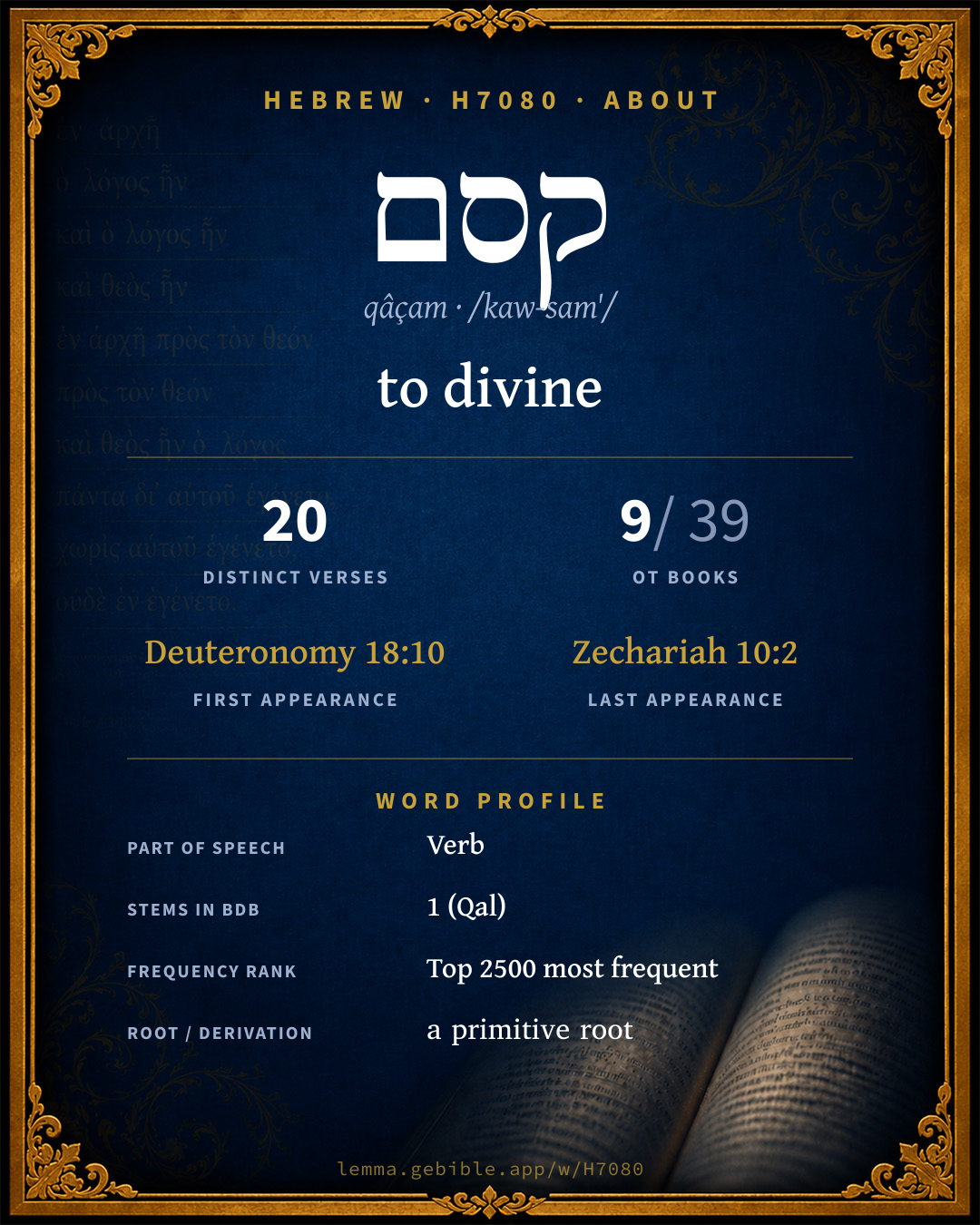
קָסַם
to divine
‘to divine’ is one of 4 main senses fuller range ↓
Full lexicon entry — Brown-Driver-Briggs (BDB)
From Brown-Driver-Briggs (BDB)
Where this word appears
Grammar key — what these labels mean
Part of speech
- Verb
- An action or state-of-being word.
- Noun
- A naming word — a person, place, thing, or idea.
- Particle
- A short function word — article, negation, interrogative, the sign of the direct object, and the like.
Noun type
- Common
- A common noun — a general class of person, place, or thing (“king,” “city,” “water”), not a specific name.
Stem
- Qal
- The basic, simple active stem — the plain form of the verb (“he wrote”). Here: ‘of diviners of the nations’
Form
- Infinitive Construct
- A bound verbal noun, frequently with prepositions (“to write / in writing”).
- Participle Active
- A verbal adjective expressing ongoing or characteristic action (“writing / one who writes”).
- Imperative
- A direct command (“write!”).
- Sequential Imperfect
- An imperfect with prefixed waw — the standard past-narrative form (waw-consecutive imperfect).
- Imperfect
- An incomplete, ongoing, or future action (“he will / would write”).
State
- Absolute
- The independent form of a noun, not bound to a following word.
- Construct
- A noun bound to a following noun in a possessive / “of” relationship (the construct chain).
Person
- 2nd Person
- The one addressed (“you”).
- 3rd Person
- The one spoken about (“he / she / it / they”).
Gender
- Masculine
- Grammatically masculine.
- Feminine
- Grammatically feminine.
Number
- Plural
- More than one (in Hebrew, generally three or more).
- Singular
- One.
Every verse where H7080 appears in the Book of Jeremiah — 2 distinct verses. Click any verse to open its interlinear word-by-word view. Verse text shown in the World English Bible for context — . Each verse’s Hebrew form is shown with its reference; the English is not keyword-highlighted, since the data carries no word-level English alignment. Use “Compare translations” on any verse to read it across multiple English versions. This concordance covers the Hebrew Bible; Septuagint (Greek Old Testament) occurrences are not indexed here.
Jeremiah
- Jeremiah 27:9 קֹֽסְמֵי/כֶ֗ם Qal ptcp.act mp cs + sfx pers 2mp But as for you, don't you listen to your prophets, nor to your diviners, nor to your dreams, nor to your soothsayers, nor to your sorcerers, who speak to you, saying, You shall not serve the king of Babylon:
- Jeremiah 29:8 וְ/קֹֽסְמֵי/כֶ֑ם conj + Qal ptcp.act mp cs + sfx pers 2mp For thus says Yahweh of hosts, the God of Israel: Don't let your prophets who are in the midst of you, and your diviners, deceive you; neither listen you to your dreams which you cause to be dreamed.
About this entry
At a glance — auto-summarized from this page’s data, not written by a person. Every figure links to its source below. This summary describes the numbers; it doesn’t interpret them.
At its core, קסם (qâçam) means “to divine.” Not a single-sense word: explore its full sense range. It appears 20 verses across 9 books of the Hebrew Bible, among its uncommon vocabulary. The word gravitates to Ezekiel (30%), then Micah and Deuteronomy. Scripture first uses it in Deuteronomy 18:10. Dig into 20-verse concordance and the renderings breakdown below.
Gloss history
Strong's 1890 vs modern scholarship
About this word
Strong's H7080 catalogs a Hebrew word from the Hebrew Old Testament.
These counts are not copied from any lexicon or concordance. They are computed here, from the morphology-tagged Hebrew Old Testament. What Lemma adds →
- 20
- distinct verses
- The word appears in 20 distinct verses.
- 9 / 39
- OT books
- The word appears in 9 of 39 Old Testament books.
- #1,368
- by frequency
- Top 2500 most frequent Hebrew words (rank 1,368 of 8,640 Hebrew words by occurrence).
View all 20 occurrences in the concordance →
Most concentrated in
- Ezekiel 6 verses 30%
- Micah 3 verses 15%
- Deuteronomy 2 verses 10%
By section of the Old Testament
By traditional corpus
Conventional, traditional groupings — biblical authorship is debated, so this is a traditional corpus grouping, not an authorship claim. Each share is this word’s portion of its verses in that division of the Hebrew canon. Each figure is a share of the word’s 20 distinct verses.
- Prophets (Nevi'im) 18 verses · 90%
- Torah (Pentateuch) 2 verses · 10%
How translations render this word
Counts come from each version’s own published word-to-Strong’s tagging or interlinear alignment — an approximate guide to how each version renders this word, not a word-level alignment the data otherwise carries. Because each total is that version’s own tagged count, the per-version totals vary from one another and need not match the appearance or distinct-verse counts above. These counts may also differ from a printed concordance because Lemma counts each distinctly tagged rendering and does not collapse phrase taggings into a single head-word total. This is a fixed set of word-tagged versions (KJV, ASV, BSB, ULT) and does not change with the reading translation you choose elsewhere. Each version’s license is shown beside its name below (and on Sources).
- King James Version: Diviners 6×, Divine 2×
- American Standard Version: Diviners 5×, Visions 3×, You 2×
- Berean Standard Bible: Diviners 7×, Divinations 3×
- unfoldingWord Literal Text: Diviners 6×, Divine 2×, Diviner 2×
King James Version Public Domain
Renders H7080 across 20 tagged occurrences — most commonly:
Plus 12 renderings that appear only once — usually multi-word phrases or single function words the recovered tagging swept in, not distinct renderings.
American Standard Version Public Domain
Renders H7080 across 20 tagged occurrences — most commonly:
Plus 10 renderings that appear only once — usually multi-word phrases or single function words the recovered tagging swept in, not distinct renderings.
Berean Standard Bible Public Domain
Renders H7080 across 19 tagged occurrences — most commonly:
Plus 9 renderings that appear only once — usually multi-word phrases or single function words the recovered tagging swept in, not distinct renderings. Not rendered by a distinct English word in 1 further occurrence.
unfoldingWord Literal Text CC BY-SA 4.0
Renders H7080 across 21 tagged occurrences — most commonly:
Plus 11 renderings that appear only once — usually multi-word phrases or single function words the recovered tagging swept in, not distinct renderings.
Senses in the full BDB
What do BDB’s symbols mean?
BDB uses these scholarly abbreviations:
| Symbol | Meaning |
|---|---|
| 𝔊 | the Septuagint (the ancient Greek translation, LXX) |
| 𝔙 | the Vulgate (the Latin translation) |
| 𝔖 | the Syriac version (the Peshitta) |
| 𝔗 | the Targum (the Aramaic translation) |
| ψ | the Psalms |
| √ | root (the underlying root or stem) |
| ‖ | parallel passage (a synonymous or contrasted parallel) |
| † | the dagger: every passage where the word occurs is cited |
The 4 senses and sub-senses the full Brown-Driver-Briggs lexicon distinguishes for this word, in lexicon order (not ranked by frequency), with BDB’s own verbatim wording and sub-sense lettering. Shown in Hebrew script with BDB’s own scholarly abbreviations. The condensed entry is in the Lexicon Entry tab. See also the Forms in the corpus table below.
Qal
- Impf. 3 mpl. יִקְסְמוּ 2 K 17:17, יִקְסֹ֑מוּ Mi 3:11; 2 fs. תִּקְסַמְנָה Ez 13:23; Imv. fs. קָסֳמִי 1 S 28:8 Qr (Kt קסומי); Inf. cstr. קְסֹם Mi 3:8 (Buhl קֶסֶם), קֶסָם־ Ez 21:26, 34 קְסָ֯ום־ Ez 21:28 (read קֶסֶם Co Buhl), especially Pt. קֹסֵם Dt 18:10; Is 3:2, etc.;— e.g. 2 Kings 17:17
- 1. of diviners of the nations, Balaam, Jos 13:22 (D), Philist. 1 S 6:2 (‖ כהנים), Bab. Is 44:25 (‖ חכמים) Ez 21:26 cf. ק׳ שׁוא Ez 21:28 (but read קֶסֶם), + Is 2:6 (ins. prob. קֹסְמִים, > קֶסֶם, or מִקְסָם; v. קֶדֶם 1 b); of Can. necromancers בָּאוֹב 1 S 28:8; ‖ מְעֹנְנִים Dt 18:14; of Ammonites ק׳ כָּזָב Ez 21:34 (+ ל pers.). e.g. Joshua 13:22
- 2. false proph. of Isr. ‖ חזה Mi 3:6 (? קֶסֶם; ‖ חזון), v 7; Is 3:2 (+ נביא; cf. v 3), ‖ נביאים Je 27:9; 29:8, בְּכֶסֶף Mi 3:11, ‖ חזה שׁקר Zc 10:2; ‖ חזה שׁוא: ק׳ קֶסֶם Ez 13:23 (but v. קֶסֶם), ק׳ כָּזָב Ez 13:9; 22:28, + 13:6 (read וְקָֽסְמוּ, or [Co Berthol] inf. abs. וְקָסֹם, Vrss. Toy). e.g. Micah 3:6
- 3. ק׳ קְסָמִים prohibited Dt 18:10 2 K 17:17. e.g. Deuteronomy 18:10
Senses from the full Brown-Driver-Briggs lexicon (Brown, Driver, Briggs; Oxford 1906 — public domain), digitized via Sefaria, supplemented by the OpenScriptures HebrewLexicon (CC BY 4.0). Full attribution on Sources.
Word origin
vb.denom. practise divination;—
— Brown-Driver-Briggs (Oxford 1906, public domain), digitized via Sefaria, supplemented by the OpenScriptures HebrewLexicon (CC BY 4.0). See Sources.
Origin: a primitive root
Jastrow Dictionary
A second Hebrew/Aramaic lexicon for comparison, covering Aramaic and post-biblical (Talmudic, Targumic, Midrashic) usage that the biblical-Hebrew BDB does not. Matched by lemma rather than by Strong’s number, so a lemma may carry more than one Jastrow headword (shown separately below), and the entries cover usage well beyond the Bible.
קָסַם
- (b. h.)
- 1. to cut, carve. Snh. IX, 6 המקלל בקוֹסֵם (Y. ed. בקַסָּם) he that curses (his neighbor) invoking God as ‘a carver’ (instead of creator ex nihilo); expl. ib. 81ᵇ יכה קוֹסֵם את קוֹסָמוֹ (Ms. M. את קוסו, emended קוסמו, Ar. קִסְמוֹ, קִיסְמוֹ) may the carver strike his carving; anoth. explan. יכהו קוסם לו ולקונו ולמקנו may the carver strike him (euphem. for thee), himself (thyself) &c., v. קָנָה; Y. ib. IX, end, 27ᵇ, v. קַיְינָא.
- 2. to decide (cmp. גָּזַר). Ḥag. 14ᵃ (ref. to Is. III, 2) קוסם זה מלך ḳosem means king (with ref. to Prov. XVI, 10); Yalk. Is. 261. e.g. Isaiah 3:2
- 3. (v. קֶסֶם) to divine. Sifré Deut. 171 איזהו קוסם זה האוחז וכ׳ who is a ḳosem? He that seizes his staff (and measuring it fist-wise says), shall I or shall I not go? (ref. to Hos. IV, 12); Yalk. Deut. 918. Snh. 106ᵃ (ref. to Josh. XIII, 22) קזסם נביא הוא a charmer? is he not a prophet? בתחלה נביא ולבסוף קוסם at first a prophet, and in the end a charmer. Num. R. s. 20 (ref. to Num. XXII, 7) הוליכו … קסמים שהיו קוֹסְמִין בהן they carried with them all kinds of divining implements with which people divine. Koh. R. to XII, 7 לִקְסוֹם קסמים, v. קֶסֶם; a. e. e.g. Hosea 4:12
- to divine. Midr. Till. to Ps. LXXIX, beg. עמד לו מְקַסֵּם וכ׳ he stood up and divined to find out whether or not to go up.
- , v. קִרְסֵם
קְסַם I
- 1. to cut, chip. Y. Shebi. II, 34ᵃ וקַסְמָהּ בידיה וכ׳ he chipped it (their argument) with his hand, i.e. made a motion with his hand to indicate his dissent (and said) &c.
- 2. to divine. Targ. Ez. XXI, 26. Targ. Deut. XVIII, 10 קָסֵים ed. Berl. (oth. ed. קָסֵם, incorr. קוֹסֵם); a. e.—Gitt. 68ᵇ חזי … קָסֵים אחיך saw a diviner who was divining, and laughed (at him). Ib. לִקְסוֹם … תותיה let him divine what is under him.
קֶסֶם
- preced.)
- 1. chip, carving, v. קָסַם.—Pl. קְסָמִים, קְסָמִין, v. קִיסָּם.
- 2. decision, esp. decision by lot or sign, divination, augury; means or tools of divination. —Pl. as ab. Lam. R. introd. (R. Josh. 2) התחיל קוסם ק׳ he began to make divinations (by throwing arrows &c.); Koh. R. to XII, 7 לקסום ק׳. Num. R. s. 20, v. קָסַם. Ib. שידעו בק׳ שלהם וכ׳ they knew that there was no profit in their divining signs; a. fr. e.g. Joshua 2:24
קְסַם II
- 1. decision. Targ. Prov. XVI, 10.
- 2. divination, divining tools. Targ. Ez. XXI, 26 (ed. Wil. קֶסֶם); 27; a. e.—Pl. קִסְמִין, קִסְמַיָּא, קֻ׳, קוּ׳, קִי׳. Targ. Deut. XVIII, 10 (Y. II קַסְ׳). Targ. Y. Gen. XXX, 27. Targ. Y. I Deut. XVIII, 14 (Y. II, v. קַסָּמָא); a. fr.—Y. Maasr. III, end, 51ᵃ, v. קַנְטֵר.
קִסָּם
- chip, v. קִיסָּם, קֵיסֶם.
קְסַם III
- pr. n. pl., v. קִיסַם
קַסָּם
- (קָסַם) carver. Snh. IX, 6 Y. ed., v. קָסַם. Cant. R. to V, 14 כל מי שנעשה ק׳ וכ׳ he that makes himself a carver (skilful worker) in the words of the Law shall finally become a king (leader) through them (with ref. to Prov. XVI, 10). [Ib. שנעשה בהם ק׳ some ed., read: סַפִּיר; v. Matt. K. a. l.] e.g. Proverbs 16:10
A Dictionary of the Targumim, the Talmud Babli and Yerushalmi, and the Midrashic Literature (Marcus Jastrow; London, Luzac, 1903) — Public Domain. Digitized via Sefaria. Digitized via Sefaria. Full attribution on Sources.
Forms in the corpus
The 23 distinct written forms H7080 takes in the Hebrew Bible, most frequent first — each parse links to that stem’s occurrences in the concordance. Hebrew forms include their vowel points and cantillation, so a single lemma takes many written forms.
| Form | Parsing | Example | Uses |
|---|---|---|---|
| בִּ/קְסָם | Verb, Qal, Infinitive Construct | Ezekiel 21:29 | 1 |
| הַ/קֹּ֣סְמִ֔ים | Verb, Qal, Participle Active, Masculine, Plural, Absolute | Micah 3:7 | 1 |
| הַ/קּוֹסֵ֑ם | Verb, Qal, Participle Active, Masculine, Singular, Absolute | Joshua 13:22 | 1 |
| וְ/הַ/קֹּסְמִ֣ים | Verb, Qal, Participle Active, Masculine, Plural, Absolute | Ezekiel 13:9 | 1 |
| וְ/הַ/קּֽוֹסְמִים֙ | Verb, Qal, Participle Active, Masculine, Plural, Absolute | Zechariah 10:2 | 1 |
| וְ/לַ/קֹּֽסְמִים֙ | Verb, Qal, Participle Active, Masculine, Plural, Absolute | 1 Samuel 6:2 | 1 |
| וְ/קֹֽסְמֵי/כֶ֑ם | Verb, Qal, Participle Active, Masculine, Plural, Construct | Jeremiah 29:8 | 1 |
| וְ/קֹסְמִ֖ים | Verb, Qal, Participle Active, Masculine, Plural, Absolute | Isaiah 44:25 | 1 |
| וְ/קֹסְמִ֥ים | Verb, Qal, Participle Active, Masculine, Plural, Absolute | Ezekiel 22:28 | 1 |
| וְ/קֹסֵ֥ם | Verb, Qal, Participle Active, Masculine, Singular, Absolute | Isaiah 3:2 | 1 |
| וַ/יִּקְסְמ֥וּ | Verb, Qal, Sequential Imperfect, 3rd Person, Masculine, Plural | 2 Kings 17:17 | 1 |
| יִקְסֹ֑מוּ | Verb, Qal, Imperfect, 3rd Person, Masculine, Plural | Micah 3:11 | 1 |
| כ/קסום | Verb, Qal, Infinitive Construct | Ezekiel 21:23 | 1 |
| כִּ/קְסָם | Noun, Common, Masculine, Singular, Construct | Ezekiel 21:23 | 1 |
| לִ/קְסָם | Verb, Qal, Infinitive Construct | Ezekiel 21:21 | 1 |
| מִ/קְּסֹ֑ם | Verb, Qal, Infinitive Construct | Micah 3:6 | 1 |
| נָ֥א | Particle, Exhortation | 1 Samuel 28:8 | 1 |
| קְסָמִ֔ים | Noun, Common, Masculine, Plural, Absolute | Deuteronomy 18:10 | 1 |
| קֹֽסְמֵי/כֶ֗ם | Verb, Qal, Participle Active, Masculine, Plural, Construct | Jeremiah 27:9 | 1 |
| קֹסְמִ֖ים | Verb, Qal, Participle Active, Masculine, Plural, Absolute | Deuteronomy 18:14 | 1 |
| קָֽסֳמִי | Verb, Qal, Imperative, 2nd Person, Feminine, Singular | 1 Samuel 28:8 | 1 |
| קסומי | Verb, Qal, Imperative, 2nd Person, Feminine, Singular | 1 Samuel 28:8 | 1 |
| תִקְסַ֣מְנָה | Verb, Qal, Imperfect, 2nd Person, Feminine, Plural | Ezekiel 13:23 | 1 |
Same root — word family
Other BDB entries built from the same root as H7080, grouped by Strong’s listed origin. These share a root / origin per the lexicon — not necessarily a shared meaning. Each links to that word’s own entry.
Derived from this word
Compare all same-root words → They share a root, not necessarily a meaning.
Septuagint verse parallels
This word appears in 19 verses that also exist in the Greek Old Testament (Septuagint), out of the 20 Hebrew verses it occurs in. You can read those verses in Greek by switching the Old Testament edition to the Septuagint.
Read these verses in the Septuagint
- Deuteronomy 18:10
- Joshua 13:22
- 1 Samuel 6:2
- 2 Kings 17:17
- Isaiah 3:2
- Jeremiah 27:9
- Ezekiel 13:9
- Micah 3:6
- Zechariah 10:2
This is a verse-level parallel only — the same verses exist in both the Hebrew and Greek Old Testaments. No word-level Hebrew↔Greek correspondence is claimed: the data carries no such alignment, so no Greek word is shown as this Hebrew word’s translation. Coverage is not total — the Septuagint omits the deuterocanon and renumbers the Psalms, so some Hebrew verses have no direct Greek parallel.