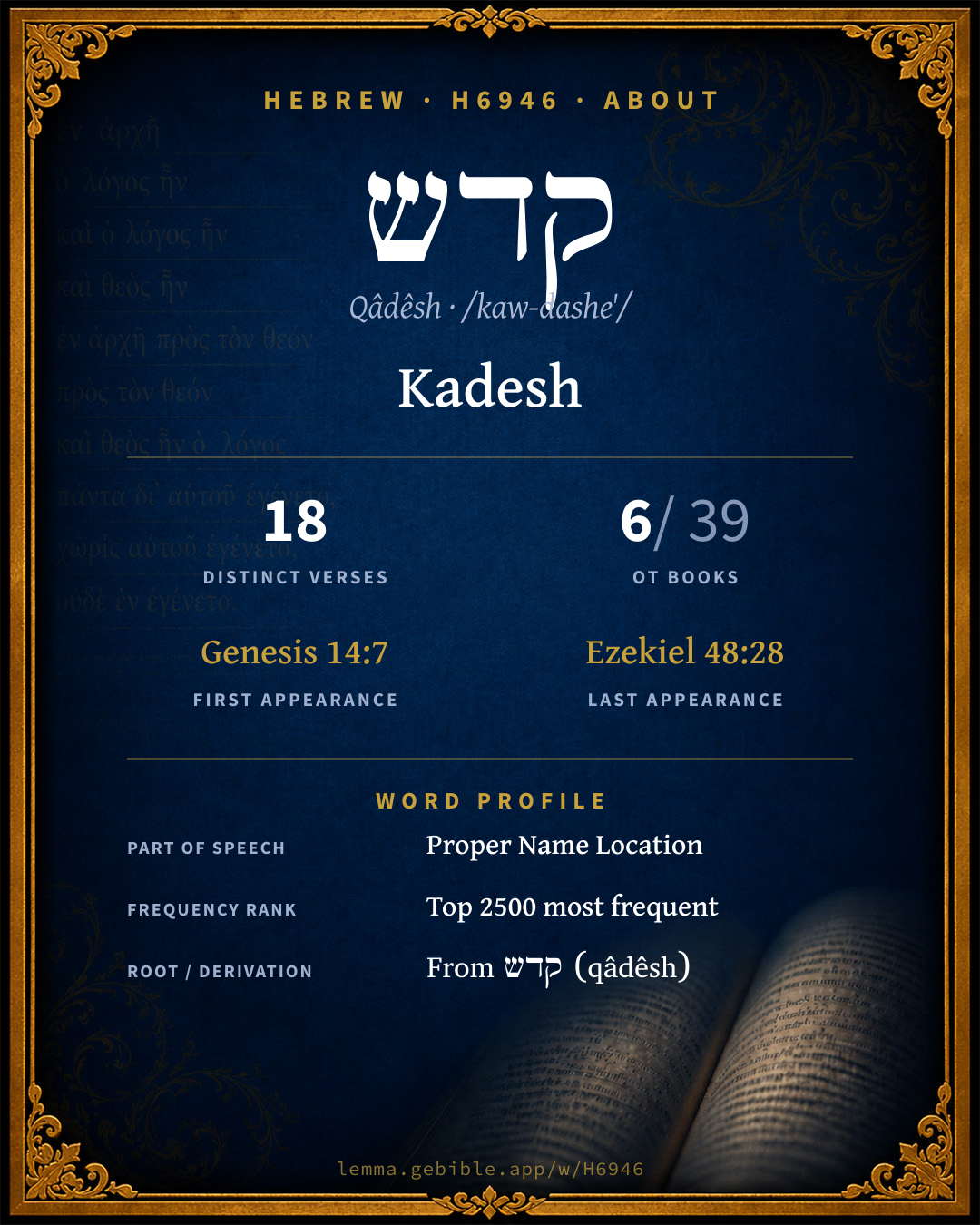
קָדֵשׁ
Kadesh
BDB lists 2 entries for ‘Kadesh’ fuller range ↓
Full lexicon entry — Brown-Driver-Briggs (BDB)
From Brown-Driver-Briggs (BDB)
Where this word appears
Grammar key — what these labels mean
Part of speech
- Noun
- A naming word — a person, place, thing, or idea.
Noun type
- Proper
- A name of a specific person, place, or people (e.g. Abraham, Zion, Israel).
Every verse where H6946 appears in the Book of Numbers — 8 distinct verses. Click any verse to open its interlinear word-by-word view. Verse text shown in the World English Bible for context — . Each verse’s Hebrew form is shown with its reference; the English is not keyword-highlighted, since the data carries no word-level English alignment. Use “Compare translations” on any verse to read it across multiple English versions. This concordance covers the Hebrew Bible; Septuagint (Greek Old Testament) occurrences are not indexed here.
Numbers
- Numbers 13:26 קָדֵ֑שָׁ/ה n Proper + sfx dem They went and came to Moses, and to Aaron, and to all the congregation of the children of Israel, to the wilderness of Paran, to Kadesh; and brought back word to them, and to all the congregation, and shown them the fruit of the land.
- Numbers 20:1 בְּ/קָדֵ֑שׁ prep + n Proper The children of Israel, even the whole congregation, came into the wilderness of Zin in the first month: and the people abode in Kadesh; and Miriam died there, and was buried there.
- Numbers 20:14 מִ/קָּדֵ֖שׁ prep + n Proper Moses sent messengers from Kadesh to the king of Edom, Thus says your brother Israel, You know all the travail that has happened to us:
- Numbers 20:16 בְ/קָדֵ֔שׁ prep + n Proper and when we cried to Yahweh, he heard our voice, and sent an angel, and brought us forth out of Egypt: and, behold, we are in Kadesh, a city in the uttermost of your border.
- Numbers 20:22 מִ/קָּדֵ֑שׁ prep + n Proper They traveled from Kadesh: and the children of Israel, even the whole congregation, came to Mount Hor.
- Numbers 27:14 קָדֵ֖שׁ n Proper because you rebelled against my word in the wilderness of Zin, in the strife of the congregation, to sanctify me at the waters before their eyes. (These are the waters of Meribah of Kadesh in the wilderness of Zin.)
- Numbers 33:36 קָדֵֽשׁ n Proper They traveled from Ezion Geber, and encamped in the wilderness of Zin (the same is Kadesh).
- Numbers 33:37 מִ/קָּדֵ֑שׁ prep + n Proper They traveled from Kadesh, and encamped in Mount Hor, in the edge of the land of Edom.
About this entry
At a glance — auto-summarized from this page’s data, not written by a person. Every figure links to its source below. This summary describes the numbers; it doesn’t interpret them.
At its core, קדש (Qâdêsh) means “Kadesh.” Scripture first uses it in Genesis 14:7. It appears 18 verses across 6 books of the Hebrew Bible, among its uncommon vocabulary. The word gravitates to Numbers (44%), then Genesis and Deuteronomy. Dig into 18-verse concordance and the renderings breakdown below.
Gloss history
Strong's 1890 vs modern scholarship
About this word
Strong's H6946 catalogs a Hebrew word from the Hebrew Old Testament.
These counts are not copied from any lexicon or concordance. They are computed here, from the morphology-tagged Hebrew Old Testament. What Lemma adds →
- 18
- distinct verses
- The word appears in 18 distinct verses.
- 6 / 39
- OT books
- The word appears in 6 of 39 Old Testament books.
- #1,612
- by frequency
- Top 2500 most frequent Hebrew words (rank 1,612 of 8,640 Hebrew words by occurrence).
View all 18 occurrences in the concordance →
Most concentrated in
- Numbers 8 verses 44%
- Genesis 3 verses 17%
- Deuteronomy 2 verses 11%
By section of the Old Testament
By traditional corpus
Conventional, traditional groupings — biblical authorship is debated, so this is a traditional corpus grouping, not an authorship claim. Each share is this word’s portion of its verses in that division of the Hebrew canon. Each figure is a share of the word’s 18 distinct verses.
- Torah (Pentateuch) 13 verses · 72%
- Prophets (Nevi'im) 4 verses · 22%
- Writings (Ketuvim) 1 verse · 6%
How translations render this word
Counts come from each version’s own published word-to-Strong’s tagging or interlinear alignment — an approximate guide to how each version renders this word, not a word-level alignment the data otherwise carries. Because each total is that version’s own tagged count, the per-version totals vary from one another and need not match the appearance or distinct-verse counts above. These counts may also differ from a printed concordance because Lemma counts each distinctly tagged rendering and does not collapse phrase taggings into a single head-word total. This is a fixed set of word-tagged versions (KJV, ASV, BSB, ULT) and does not change with the reading translation you choose elsewhere. Each version’s license is shown beside its name below (and on Sources).
BDB lists this Strong’s number as 2 distinct words (homographs). Each count above pools all of them and is not split by sense — see the Senses section below. A low-frequency rendering may belong to a different one of those words, not the primary meaning.
- King James Version†: Kadesh 12×, Is kadesh 2×
- American Standard Version†: Kadesh 10×, - kadesh 2×, Same is kadesh 2×
- Berean Standard Bible†: Kadesh 14×
- unfoldingWord Literal Text†: Kadesh 16×
King James Version Public Domain
Renders H6946 across 17† tagged occurrences — most commonly:
Plus 3 renderings that appear only once — usually multi-word phrases or single function words the recovered tagging swept in, not distinct renderings. Not rendered by a distinct English word in 1 further occurrence.
American Standard Version Public Domain
Renders H6946 across 17† tagged occurrences — most commonly:
Plus 3 renderings that appear only once — usually multi-word phrases or single function words the recovered tagging swept in, not distinct renderings.
Berean Standard Bible Public Domain
Renders H6946 across 15† tagged occurrences — most commonly:
Plus 1 rendering that appears only once — usually multi-word phrases or single function words the recovered tagging swept in, not distinct renderings. Not rendered by a distinct English word in 3 further occurrences.
unfoldingWord Literal Text CC BY-SA 4.0
Renders H6946 across 18† tagged occurrences — most commonly:
Plus 2 renderings that appear only once — usually multi-word phrases or single function words the recovered tagging swept in, not distinct renderings.
Senses in the full BDB
What do BDB’s symbols mean?
BDB uses these scholarly abbreviations:
| Symbol | Meaning |
|---|---|
| 𝔊 | the Septuagint (the ancient Greek translation, LXX) |
| 𝔙 | the Vulgate (the Latin translation) |
| 𝔖 | the Syriac version (the Peshitta) |
| 𝔗 | the Targum (the Aramaic translation) |
| ψ | the Psalms |
| √ | root (the underlying root or stem) |
| ‖ | parallel passage (a synonymous or contrasted parallel) |
| † | the dagger: every passage where the word occurs is cited |
The 2 senses and sub-senses the full Brown-Driver-Briggs lexicon distinguishes for this word, in lexicon order (not ranked by frequency), with BDB’s own verbatim wording and sub-sense lettering. Shown in Hebrew script with BDB’s own scholarly abbreviations. The condensed entry is in the Lexicon Entry tab. See also the Forms in the corpus table below.
קדש I temple-prostitute (man) (cf. RSProph. ii, N. 19, and v. Assyrian sub √)
קדש II loc. (sacred
- 1. Καδης: in S. of Judah Gn 16:14 (J), 20:1 (E), in מִדְבַּר פָּארָן Nu 13:26 (P), specif. מ׳ צִן 20:1; 33:36, cf. מ׳ קָדֵשׁ ψ 29:8; on W. border of Edom Nu 20:16 (E), 33:37 (P), cf. 20:14 (E), v 22 (P), Ju 11:16, 17 (hence RobBR ii, 175, 194 sought it at ʿAin Weibeh, in W. of Arabah); long abode of Isr. during Exod. Dt 1:46; מֵי מְרִיבַת ק׳ Nu 27:14 (cf. 20:1–13), Dt 32:51 (P); Ez 47:19 (read מְרִיבַת), 48:28, cf. Dt 33:2 (v. קֹדֶשׁ ad fin.); cf. עֵין מִשְׁפָּט Gn 14:7; = ק׳ בַּרְנֵעַ (meaning of ב׳ unknown; 𝔊 K. (τοῦ) βαρνη);—Nu 32:8 (J); Dt 1:2, 19; 2:14; 9:23; Jos 10:41; 14:6, 7 (D); Nu 34:4; Jos 15:3 (P);—mod. ʿAin Ḳadîs), c. 50 miles S. of Beersheba, JRowlands (1842) v. GWilliamsHoly City, 464 f., and especially HCTrumbull (1881) kadesh Barnea, 238–321. e.g. Genesis 16:14
- 2. Hittite capital on the Orontes, N. of Damascus, towards Hamath (Egyptian Ḳdš, Ḳdšụ, Ḳdšë̥, WMMAs. u. Eur. 213 ff.);—2 S 24:6 𝔊L We Dr Kit Bu Löhr, reading אֶרֶץ הַחִתִּים קָדֵ֫שָׁה for MT א׳ תַּחְתִּים חָדְשִׁי (הַחִתִּים already HiGesch. Isr. i. 29; קָדֵ֫שָׁה Th, קֶ֫דְשָׁה Klo, of קֶדֶשׁ in Napht.); HPS doubts. e.g. 2 Samuel 24:6
Senses from the full Brown-Driver-Briggs lexicon (Brown, Driver, Briggs; Oxford 1906 — public domain), digitized via Sefaria, supplemented by the OpenScriptures HebrewLexicon (CC BY 4.0). Full attribution on Sources.
Word origin
I. n.m. temple-prostitute (man) (cf. RSProph. ii, N. 19, and v. Assyrian sub √);—ק׳ Dt 23:18; coll. 1 K 14:24; 22:47; pl. קְדֵשִׁים 15:2 2 K 23:7; Jb 36:14; also f. קְדֵשָׁה (woman) Dt 23:18; pl. קְדֵשׁוֹת Ho 4:14; = harlot, fs. Gn 38:21(×2), 22 (J).
II. n.pr.loc. (sacred; but perhaps orig. קֶדֶשׁ, and pointing artif. to disting. from ק׳ in N);—
— Brown-Driver-Briggs (Oxford 1906, public domain), digitized via Sefaria, supplemented by the OpenScriptures HebrewLexicon (CC BY 4.0). See Sources.
Derived from קדש (qâdêsh) (H6945) — male prostitute.
Jastrow Dictionary
A second Hebrew/Aramaic lexicon for comparison, covering Aramaic and post-biblical (Talmudic, Targumic, Midrashic) usage that the biblical-Hebrew BDB does not. Matched by lemma rather than by Strong’s number, so a lemma may carry more than one Jastrow headword (shown separately below), and the entries cover usage well beyond the Bible.
קָדשׁ
- , v. קָדוֹשׁ
קָדַשׁ
- (b. h.) [to be cut off, separated, v. Ges. Hebr. Dict.12 s. v.; cmp. פָּרַשׁ,] to be, become pure, sacred, holy. Y. Sabb. III, 5ᵈ bot.; ib. IV, end, 7ᵃ ק׳ עליו היום the day became holy upon him, i.e. the Sabbath commenced while he was engaged in doing something. Meïl. II, 8 (10ᵃ) קָדְשׁוּ בכלים (Talm. ed. קדשן) after they have become sacred by being put in a sacred vessel (v. infra); Shebu. 11ᵃ (Ms. F. קידשן). Bekh. 4ᵇ קדשו בכורות וכ׳ the firstborn in the desert were consecrated; a. fr.
- 1. to sanctify, esp. ק׳ שם שמים, or ק׳ את השם to sanctify the name of the Lord, to manifest fidelity to religion by noble deeds, by martyrdom &c. Sot. 10ᵇ; 36ᵇ יוסף שק׳ שם וכ׳ Joseph who sanctified the name … in secret (when he resisted temptation); יהודה שק׳ וכ׳ Judah who sanctified … in public (when he admitted his guilt, Gen. XXXVIII, 26); a. fr. e.g. Genesis 38:26
- 2. to sanctify, consecrate; to purify, keep pure. Ber. 17ᵃ טהר וקַדֵּשׁ עצמך מכל וכ׳ keep thyself clean and pure (aloof) from every guilt &c. Yoma 39ᵃ (ref. to Lev. XI, 44) … אדם מְקַדֵּשׁ מְקַדְּשִׁין אותו הרבה if a man sanctifies himself a little (trains himself to self-restraint), they (the divine agencies) will help him much to sanctify him; מלמטה מקדשין אותו מלמעלה if he (sanctifies himself) below, they will sanctify him from above; בעולם הזה מקדשין וכ׳ he in this world, they will declare him holy in the hereafter. Yeb. 20ᵃ, a. e. קדש עצמך במותר לך sanctify thyself by self-restraint from what is permitted to thee. Ḥag. 3ᵇ, a. e. קִדְּשָׁהּ לשעתה, v. קְדוּשָּׁה. Sebu. 15ᵃ … כל הכלים מְקַדַּשְׁתָּן as regards all vessels that Moses made, the ointing of them gave them their sacred character; Snh. 16ᵇ מקדשן (corr. acc.). Men. 95ᵇ תנור מְקַדֵּשׁ the oven (the baking of the showbread) gives it its sacred character. Ib. 100ᵃ כלי שרת מְקַדְּשִׁין the vessels of the service consecrate (the things put into them); a. v. fr.—Part. pass. מְקוּדָּשׁ; f. מְקוּדֶּשֶׁת; pl. מְקוּדָּשִׁים &c. Sabb. 55ᵃ (ref. to Ez. IX, 6) א"ת מקדשי אלא מְקוּדָּשַׁי וכ׳ read not miḳdashi (my sanctuary) but m’ḳuddashai (my sanctified ones), that means those who fulfilled the whole Law &c.; Ab. Zar. 4ᵃ. Zeb. 115ᵇ (ref. to Ps. LXVIII, 36 מִמִּקְדָּשֶׁיךָ) read מִמְּקוּדָּשֶׁיךָ וכ׳ ‘from thy sanctified ones’, when the Lord passes judgment on his holy servants &c.; a. fr. e.g. Leviticus 11:44
- 3. (with, or sub., ידיו ורגליו) to wash hands and feet prior to a sacred act. Yoma III, 6. Ib. IV, 5. Ib. 22ᵃ; a. fr.
- 4. to prepare the water of lustration (Num. XIX). Par. VI, 1 המקדש ונפל הקִדּוּשׁ על ידו if he prepares the lustration, and some of the consecrated water falls upon his hand. Ib. 2 נוטל ומקדש he may take (of the ashes) and prepare the water with them. Ib. 3 המקדש בשוקת וכ׳ he who puts ashes into a large vessel of water; a. fr.
- 5. (of seasons) to proclaim the sanctity of esp., a) (ק׳ החדש) to proclaim in court that the new month had begun (v. infra). R. Hash. II, 7 אם לא … אין מקדשין אותו שכבד קִדְּשׁוּהוּ שמים unless the new moon is seen in its due time (on the evening of the twenty-ninth day), no announcement is made, for the heavens have already proclaimed it (and the new month begins with the thirty-first day). Ib. 24ᵃ בין כך שנים אתה מקדש וכ׳ … in neither case is the ceremony of announcement required, for we read (Lev. XXV, 10), ‘ye shall sanctify the fiftieth year’, years thou must sanctify &c. Ex. R. s. 15 אני ואתם נְקַדֵּשׁ את החדש I and you, let us (as a court) proclaim the month (of Nisan); a. fr.—Part. pass. as ab. R. Hash. II, 7 ראש ב"ד אומר מק׳ וכ׳ the president of the court says, ‘(the new month is) proclaimed’, and all the people say after him, ‘proclaimed, proclaimed.’ Ib. III, 1 נחקרו … ולא הספיקו לומר מק׳ וכ׳ when the witnesses were examined, and the court had no time to say m’ḳuddash before night set in; a. e.—b) ק׳ השבת, היום to pronounce the sanctity of the Sabbath, the Holy Day &c., to recite the Sabbath or the festive benediction (over wine), to say Ḳiddush. Pes. 105ᵃ מי שלא ק׳ בע"ש מקדש וכ׳ he who fails to bless the Sabbath on the Sabbath eve, may do so during the entire day. Ib. 106ᵇ טעם אינו מקדש if a man tasted something without Ḳiddush, he must not bless the Sabbath; Ib. 107ᵃ טעם מקדש even if he has tasted something, he must bless the Sabbath. Ib. כגון זה ראוי לקַדֵּשׁ עליו a beverage like this is fit for Ḳiddush; a. fr. e.g. Leviticus 25:10
- 6. ק׳ אשה [to consecrate a woman,] a) to betroth (expl. Kidd. 2ᵇ לישנא דרבנן דאסר לה … כהקדש the rabbinical term, in place of the Biblical קנה,—because he makes her forbidden to others like a consecrated object, v. הֶקְדֵּשׁ). Kidd. II, 1 האיש מקדש בו וכ׳ a man may betroth a woman either in person or through a deputy. Ib. 41ᵃ אסור לאדם שיְקַדֵּשׁ … עד וכ׳ a man is forbidden to betroth a woman to himself, before he has seen her. Ib. II, 4 האומר … צא וקַדֵּשׁ … והלך וקִדְּשָׁהּ וכ׳ if a man said to his deputy, go and betroth to me that certain woman in that certain place, and he went and betrothed her in a different place, she is not betrothed (the betrothal is invalid); a. v. fr.—Part. pass. מְקוּדֶּשֶׁת; pl. מְקוּדָּשׁוֹת. Ib. הרי זו מק׳ in such a case the betrothal is binding. Ib. 7; a. fr.—b) (of the father of a minor נַעֲרָה) to accept a betrothal in behalf of one’s daughter. Ib. 1 האיש מקדש את בתו וכ׳ a man may accept his daughter’s betrothal, if she is a naʿărah, either in person or through a deputy. Ib. 41ᵃ אסור לאדם שיקדש את בתו וכ׳ a man is forbidden to betroth his daughter as a child, (but must wait,) until she is grown up and says, I like this man; a. fr.
- 7. to cause a thing to be prohibited, esp. (by ref. to Deut. XXII, 9) by planting seeds in a vineyard, or vines among seeds; to cause condemnation. Kil. IV, 5 הזורע … ק׳ שורה אחת if a person sows within four cubits of a vineyard, he has caused the condemnation of one row of vines. Ib. V, 5 הרי זה מקדש ארבעים וכ׳ he has made forty-five vines forbidden. Ib. VII, 2 גפן … ואינה מְקַדֶּשֶׁת to plant seeds near a dried-up vine is forbidden, but it (the vine) does not cause the condemnation of the seeds. Ib. 3 אלו אוסרין ולא מְקַדְּשִׁין the following plants make the planting of seeds in their neighborhood forbidden, but do not cause condemnation of the seeds, if planted, or their own condemnation. Ib. 5 אין אדם מקדש דבר וכ׳ no man can cause condemnation of a thing not his own. Ib. הרי זה ק׳ וכ׳ he has caused the condemnation of his neighbor’s seeds and must pay damages; a. fr. e.g. Deuteronomy 22:9
- 1. to be sanctified, glorified as holy. Yeb. 79ᵃ מוטב … ויִתְקַדֵּשׁ שם וכ׳ let a letter of the Law be uprooted (disregarded), but let the name of God be sanctified in public. Tanḥ. Sh’mini 1 מִתְקַדֵּשׁ אני שם במכבדי there (at the dedication of the Tabernacle) I shall be sanctified by (the death of) those that honor me. Lev. R. s. 12; a. fr.
- 2. to be consecrated, dedicated; (of the New Moon) to be proclaimed. R. Hash. 21ᵇ יכול … עד שיִתְקַדְּשׁוּ וכ׳ you may have thought, as well as the Sabbath is to be disregarded (by the witnesses travelling to the seat of the court), until they (the months) are proclaimed, it may also be disregarded (by the messengers carrying the announcement), until they are established. Ex. R. s. 15 היה הכהן … והכלי מִתְקַדֶּשֶׁת the priest received in it some sacred object, by which the vessel was consecrated; וכלי חול מִתְקַדֵּשׁ and a profane vessel became sacred. Shebu. 15ᵃ אין העזרה מִתְקַדֶּשֶׁת וכ׳ the Temple hall was not consecrated, until the priests ate therein the remnants of the meal-offering. Ib. 16ᵃ תחתונה נִתְקַדְּשָׁה בכל אלו the lower reservoir became consecrated through all these (ceremonies mentioned); a. fr.
- 3. (of mixed seeds) to be condemnable, condemned. Kil. VII, 7 מאימתי … מתקדשת from what time are seeds of grain (planted among vines) to be condemned? Ib. אין מִתְקַדְּשׁוֹת are not to be condemned; a. fr.
- 4. to be betrothed. Kidd. II, 1 האשה מתקדשת בה וכ׳ a woman may be betrothed in person or through her deputy. Ib. האומר … הִתְקַדְּשִׁי לי וכ׳ if a man says to a woman, be betrothed to me with this fig. Ib. 45ᵇ נִתְקַדְּשָׁה לדעת אביה וניסת וכ׳ if she (the minor) was betrothed with her father’s consent, but was married without it; a. fr.
- 5. to sanctify one’s self. Sifra Vayikra, N’dab., ch. II, Par. 2 מי שהוא עתיד להִתְקַדֵּשׁ he that is ready to sanctify himself (by vowing a sacrifice).
- 1. to be sanctified; to become consecrated. Tem. 14ᵃ כאן לִיקָּדֵשׁ כאן ליקרב in the one case it refers to being consecrated (by being put in a sacred vessel), in the other to being offered. Bekh. 4ᵇ הוֹזהרו … ליקדש they were admonished concerning the firstborn, that they be consecrated; a. e.
- 2. to be betrothed. Kidd. 48ᵃ if she says, עשה לי … ואֶקָּדֵשׁ וכ׳ make for me chains &c., and I shall be betrothed unto thee.
- 1. to cause sanctification. Zeb. 115ᵇ לא מתו … להַקְדִּישׁ שמו וכ׳ thy (Aaron’s) sons died only in order to give thee an opportunity to sanctify the name of the Lord.
- 2. to sanctify, dedicate an object as Temple property (Lev. XXVII, 14-24). Arakh. VI, 2 המַקְדִּישׁ נכסיו וכ׳ if a person dedicates his property to the Temple, but owes his (divorced) wife her k’thubah (כְּתוּבָּה) &c. Ib. VII, 1 אין מַקְדִּישִׁין לפני היובל וכ׳ you cannot dedicate landed property within less than two or three years before the jubilee. Ib. 3 הִקְדִּישָׁהּ וגאלה if he dedicated and then redeemed it. Ib. 5 אין אדם מַקְדִּישׁ דבר וכ׳ nobody can dedicate a thing not belonging to him. B. Kam. VII, 2; a. v. fr. e.g. Leviticus 27:14
- to be dedicated, consecrated. Meïl. II, 8 המנחות … משהוּקְדָּשׁוּ the law concerning misappropriation of sacred things applies to meal-offerings as soon as they have been dedicated. Ib. 1 משהוּקְדָּשָׁה as soon as it has been designated for a sin-offering; a. fr.—Part. מוּקְדָּשׁ; f. מוּקְדֶּשֶׁת; pl. מוּקְדָּשִׁים &c. Ned. V, 6 (48ᵃ) אם … הרי הם מוק׳ לשמים if they are mine, be they dedicated to the Lord. Ib. כל מתנה … מקודשת אינה מתנה (read: מוקדשׁת) a gift which is not made so that if the recipient dedicates it to sacred use, it is dedicated, is no gift. Bekh. V, 1 כל פסולי המוק׳ all dedicated sacrifices which became unfit for the altar; a. fr.
קְדַשׁ
- , to be sanctified, sacred (v. קְדוֹשׁ). Shebu. 15ᵇ שתי הלחם … דקַדְשֵׁי (Rashi דמִיקַּדְּשֵׁי Ithpa.) it is through the slaughtering of the sheep that the two loaves received their sacred character. Bekh. 4ᵇ דקְדוּשׁ קדוש וכ׳ those firstborn that were consecrated, were consecrated &c.
- as preced. Pi., to sanctify; to proclaim; to betroth &c. Targ. Ex. XXVIII, 41. Ib. XXIX, 1 לקַדָּשָׁא (Y. לקַדְשָׁא). Ib. 44; a. fr.—Targ. Y. Deut. XX, 7 (not דקָדֵישׁ; h. text ארש). Ib. XXII, 16 (h. text נתתי); a. e.—Shebu. 16ᵃ ועזרא קַדּוּשֵׁי ק׳ וכ׳ and Ezra consecrated (the various places), although the Urim and Tummim were no longer extant. Pes. 106ᵃ עיקר קידושא … דכי ק׳ תחלת יומא בעי לקַדּוּשֵׁי the actual sanctification of the Sabbath must take place in the evening, for when one sanctifies the Sabbath, one must sanctify the beginning of the day. Ib. ליקַדֵּישׁ לן וכ׳ please, sir, recite for us the great Ḳiddush, v. קִידּוּשָׁא. Ib. 101ᵃ לקדושי בביתא to recite the Ḳiddush in the house. Ib. 106ᵇ זימנין … מקדש אריפתא at times, when he cared more for bread, he recited the Ḳiddush over bread.—R. Hash. 25ᵃ זיל … וקַדְּשֵׁיה וכ׳ go to ‘En-Ṭab and proclaim the New Moon Day. Ib. אמר … בעינן לקדושי בך וכ׳ he said (to the moon), to-night we desire to initiate the new month through thee, and thou standest here? Ib.ᵇ ולִיקַדְּשֵׁיה בליליא Ms. M. and we may proclaim it at night. Shebu. 15ᵇ דעד דקַדֵּישׁ יומא וכ׳ so that immediately after one has recited the blessing at the exit of the day (הַבְדָּלָה), one might finish the building and consecrate it.—Kidd. 50ᵇ באתרא דמְקַדְּשֵׁי והדר מסבלי where it is customary to send the gifts after betrothal, v. סְבַל. Ib. 59ᵃ לקדושי … לבריה to betroth a wife for his son (as his deputy); a. v. fr.—Part. pass. מְקַדַּשׁ; f. מְקַדְּשָׁא, &c. Shebu. l. c. תרוייהו … מְקַדְּשֵׁי both of them are consecrated at the same time. Ib. חדא מי מק׳ how can even one of them be consecrated?—Pes. 101ᵃ ולא מק׳ לכו בבית אכילה (Ms. M. 2 מתקדש) and no Ḳiddush will be recited for you in your dining place; a. fr.
- ; Ithpe. אִיקְּדִישׁ to sanctify one’s self; to be sanctified; (of mixed seeds) to be condemnable; (of woman) to be betrothed. Targ. Ex. XXIX, 37. Targ. Lev. XX, 7. Targ. O. ib. X, 3; a. fr.—Kidd. 54ᵃ ירושלים מי מִיקַּדְּשָׁא is Jerusalem itself consecrated ground? Ned. 31ᵃ כיון דאיק׳ אברהם וכ׳ when Abraham was consecrated (as the bearer of religion), they (the Israelites) were called after him (they are no longer included among ‘the sons of Noah’).—Keth. 62ᵇ אי מִיקַּדַּשְׁנָא (some ed. מְקַדַּשְׁנָא) if I consent to be betrothed unto thee, wilt thou go to college? Ib. אִיקַּדְּשָׁא ליה וכ׳ she was betrothed to him in secret, and she sent him (Akiba) away (to study). Kidd. 9ᵃ אי … מִיקַּדְּשַׁת לי if I give it thee, wilt thou be betrothed to me? Ib. 12ᵃ אשה … לא מִיקַּדְּשָׁא a woman cannot be betrothed with a P’ruṭah; a. fr.—Pes. 105ᵃ זיל חזי אי מִקְּדִישׁ יומא (Ms. M. קדיש) go and see whether the sacred day has begun.
- 1. to sanctify, dedicate. Targ. Lev. XXVII, 14 (Y. ed. Vien. יִקְדַּשׁ). Ib. 15. Targ. Jud. XVII, 3; a. fr.
- 2. to betroth. Kidd. 9ᵇ עד דמַקְדִּישׁ והדר בעיל (Rashi דמקדש) until he betroth her and consummates. Ib. 12ᵃ ההוא גברא דא׳ וכ׳ a man betrothed a woman with a piece of &c., v. כּוֹחֲלָא. Ib. 12ᵇ; a. fr. (interch. with Pa.).
קַדֵּשׁ
- m., v. קַדִּישׁ
קָדֵשׁ
- [cut off, rejected, cmp. חרם] sodomite. Sifré Deut. 260 ק׳ חמור the sodomite whose crime is the severer one (v. infra).—Pl. קְדֵשִׁים. Esth. R. to I, 9 (expl. מעולל, Is. III, 12) ק׳ בהון sodomites were among them (with ref. to ויתעללו, Jud. XIX, 25).—Fem. קְדֵשָׁה prostitute. Sifré l. c. ק׳ קלה the Ḳ’deshah whose crime is a minor one (compared with that of the Ḳadesh). e.g. Isaiah 3:12
קֶדֶשׁ
- (b. h.) pr. n. pl. Kedesh in Naftali, one of the cities of refuge. Macc. 9ᵇ. Y. Meg. I, 70ᵃ bot., v. אַגָּנָא.
קַדַשׁ
- , v. נוּנָא
קֹדֶשׁ
- , v. קוֹדֶשׁ, קוֹדַשׁ, קוּדְשָׁא.
A Dictionary of the Targumim, the Talmud Babli and Yerushalmi, and the Midrashic Literature (Marcus Jastrow; London, Luzac, 1903) — Public Domain. Digitized via Sefaria. Digitized via Sefaria. Full attribution on Sources.
Forms in the corpus
The 11 distinct written forms H6946 takes in the Hebrew Bible, most frequent first — each parse links to that state’s occurrences in the concordance. Hebrew forms include their vowel points and cantillation, so a single lemma takes many written forms.
| Form | Parsing | Example | Uses |
|---|---|---|---|
| קָדֵ֖שׁ | Noun, Proper | Deuteronomy 32:51 | 4 |
| קָדֵ֔שׁ | Noun, Proper | Ezekiel 47:19 | 3 |
| מִ/קָּדֵ֑שׁ | Noun, Proper | Numbers 20:22 | 2 |
| קָדֵֽשׁ | Noun, Proper | Numbers 33:36 | 2 |
| בְ/קָדֵ֔שׁ | Noun, Proper | Numbers 20:16 | 1 |
| בְ/קָדֵ֖שׁ | Noun, Proper | Deuteronomy 1:46 | 1 |
| בְּ/קָדֵ֑שׁ | Noun, Proper | Numbers 20:1 | 1 |
| בְּ/קָדֵֽשׁ | Noun, Proper | Judges 11:17 | 1 |
| מִ/קָּדֵ֖שׁ | Noun, Proper | Numbers 20:14 | 1 |
| קָדֵ֑שָׁ/ה | Noun, Proper | Numbers 13:26 | 1 |
| קָדֵֽשָׁ/ה | Noun, Proper | Judges 11:16 | 1 |
Same root — word family
Other BDB entries built from the same root as H6946, grouped by Strong’s listed origin. These share a root / origin per the lexicon — not necessarily a shared meaning. Each links to that word’s own entry.
Derives from
Shares the same root
Proper names from this root
People and places named from this root — a name, not an additional meaning of the word.
Compare all same-root words → 1 of the same-root words is a proper name (a person or place). They share a root, not necessarily a meaning.
Bible dictionary
Public-domain dictionary articles matched to this entry by name (Kadesh). A biblical name can be shared by more than one person or place, so an article may treat several.
Easton's Bible Dictionary · M. G. Easton, 1897
Holy, or Kadesh-Barnea, sacred desert of wandering, a place on the south-eastern border of Palestine, about 165 miles from Horeb. It lay in the "wilderness" or "desert of Zin" (Gen. 14:7; Num. 13:3-26; 14:29-33; 20:1; 27:14), on the border of Edom (20:16). From this place, in compliance with the desire of the people, Moses sent forth "twelve spies" to spy the land. After examining it in all its districts, the spies brought back an evil report, Joshua and Caleb alone giving a good report of the land (13:18-31). Influenced by the discouraging report, the people abandoned all hope of entering into the Promised Land. They remained a considerable time at Kadesh. (See HORMAH; KORAH.) Because of their unbelief, they were condemned by God to wander for thirty-eight years in the wilderness. They took their journey from Kadesh into the deserts of Paran, "by way of the Red Sea" (Deut. 2:1). (One theory is that during these thirty-eight years they remained in and about Kadesh.)
At the end of these years of wanderings, the tribes were a second time gathered together at Kadesh. During their stay here at this time Miriam died and was buried. Here the people murmured for want of water, as their forefathers had done formerly at Rephidim; and Moses, irritated by their chidings, "with his rod smote the rock twice," instead of "speaking to the rock before their eyes," as the Lord had commanded him (comp. Num. 27:14; Deut. 9:23; Ps. 106:32, 33). Because of this act of his, in which Aaron too was involved, neither of them was to be permitted to set foot within the Promised Land (Num. 20:12, 24). The king of Edom would not permit them to pass on through his territory, and therefore they commenced an eastward march, and "came unto Mount Hor" (20:22).
This place has been identified with Ain el-Kadeis, about 12 miles east-south-east of Beersheba. (See SPIES.)
Hitchcock's Bible Names Dictionary · Roswell D. Hitchcock, 1869
holiness
Classic public-domain reference works; full attribution on Sources.
Septuagint verse parallels
This word appears in 18 verses that also exist in the Greek Old Testament (Septuagint), out of the 18 Hebrew verses it occurs in. You can read those verses in Greek by switching the Old Testament edition to the Septuagint.
Read these verses in the Septuagint
This is a verse-level parallel only — the same verses exist in both the Hebrew and Greek Old Testaments. No word-level Hebrew↔Greek correspondence is claimed: the data carries no such alignment, so no Greek word is shown as this Hebrew word’s translation. Coverage is not total — the Septuagint omits the deuterocanon and renumbers the Psalms, so some Hebrew verses have no direct Greek parallel.