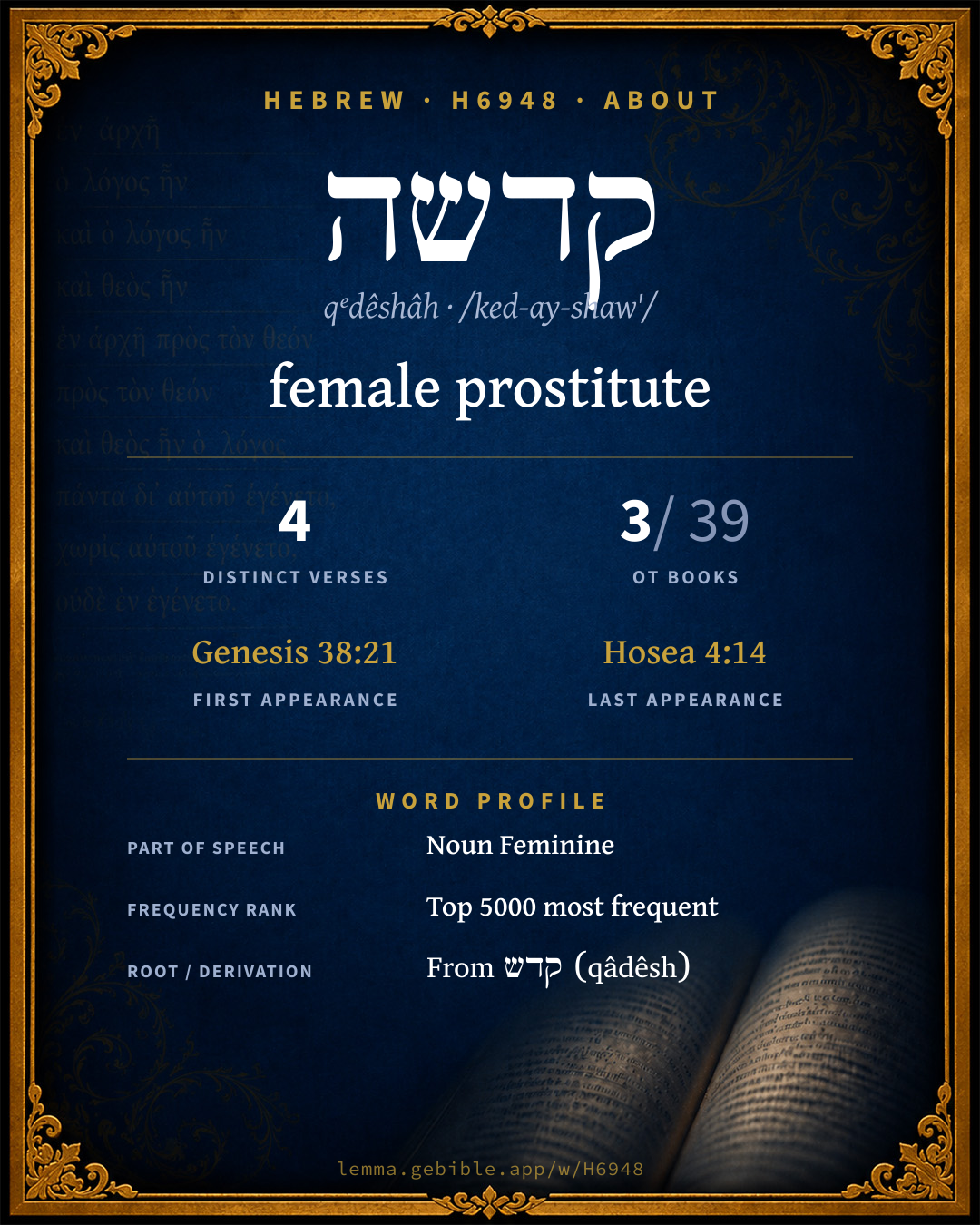
קְדֵשָׁה
female prostitute
Full lexicon entry — Brown-Driver-Briggs (BDB)
From Brown-Driver-Briggs (BDB)
Where this word appears
Grammar key — what these labels mean
Part of speech
- Adjective
- A word that describes or qualifies a noun.
Noun type
- Common
- A common noun — a general class of person, place, or thing (“king,” “city,” “water”), not a specific name.
State
- Absolute
- The independent form of a noun, not bound to a following word.
Gender
- Feminine
- Grammatically feminine.
Number
- Singular
- One.
- Plural
- More than one (in Hebrew, generally three or more).
Grammatical forms
- Adjective, Adjective, Feminine, Singular, Absolute 3 times (60%)
- Adjective, Adjective, Feminine, Plural, Absolute 1 time (20%)
- Noun, Common, Feminine, Singular, Absolute 1 time (20%)
Parsed forms decoded from the imported morphology (morphhb / Westminster Leningrad Codex — WLC text public domain, morphhb tagging CC BY 4.0), counted across 5 parsed occurrences — not distinct verses.
Every verse where H6948 appears — 4 distinct verses across 3 books. Click any verse to open its interlinear word-by-word view. Verse text shown in the World English Bible for context — . Each verse’s Hebrew form is shown with its reference; the English is not keyword-highlighted, since the data carries no word-level English alignment. Use “Compare translations” on any verse to read it across multiple English versions. This concordance covers the Hebrew Bible; Septuagint (Greek Old Testament) occurrences are not indexed here.
Genesis 2 verses
- Genesis 38:21 הַ/קְּדֵשָׁ֛ה קְדֵשָֽׁה ptcl def.art + n c fs adj Adjective fs Then he asked the men of her place, saying, "Where is the prostitute, that was at Enaim by the road?" They said, "There has been no prostitute here."
- Genesis 38:22 קְדֵשָֽׁה adj Adjective fs He returned to Judah, and said, "I haven't found her; and also the men of the place said, 'There has been no prostitute here.'"
Deuteronomy 1 verse
Hosea 1 verse
About this entry
At a glance — auto-summarized from this page’s data, not written by a person. Every figure links to its source below. This summary describes the numbers; it doesn’t interpret them.
קדשה (qᵉdêshâh) is a Hebrew noun most often rendered “female prostitute.” It occurs a mere 4 verses across Scripture. Genesis dominates its distribution — 2 of 4 verses. Scripture first uses it in Genesis 38:21. Sharing its root, it stands alongside קדש and קדש. For the data behind this summary, explore the sense tree and the renderings breakdown below.
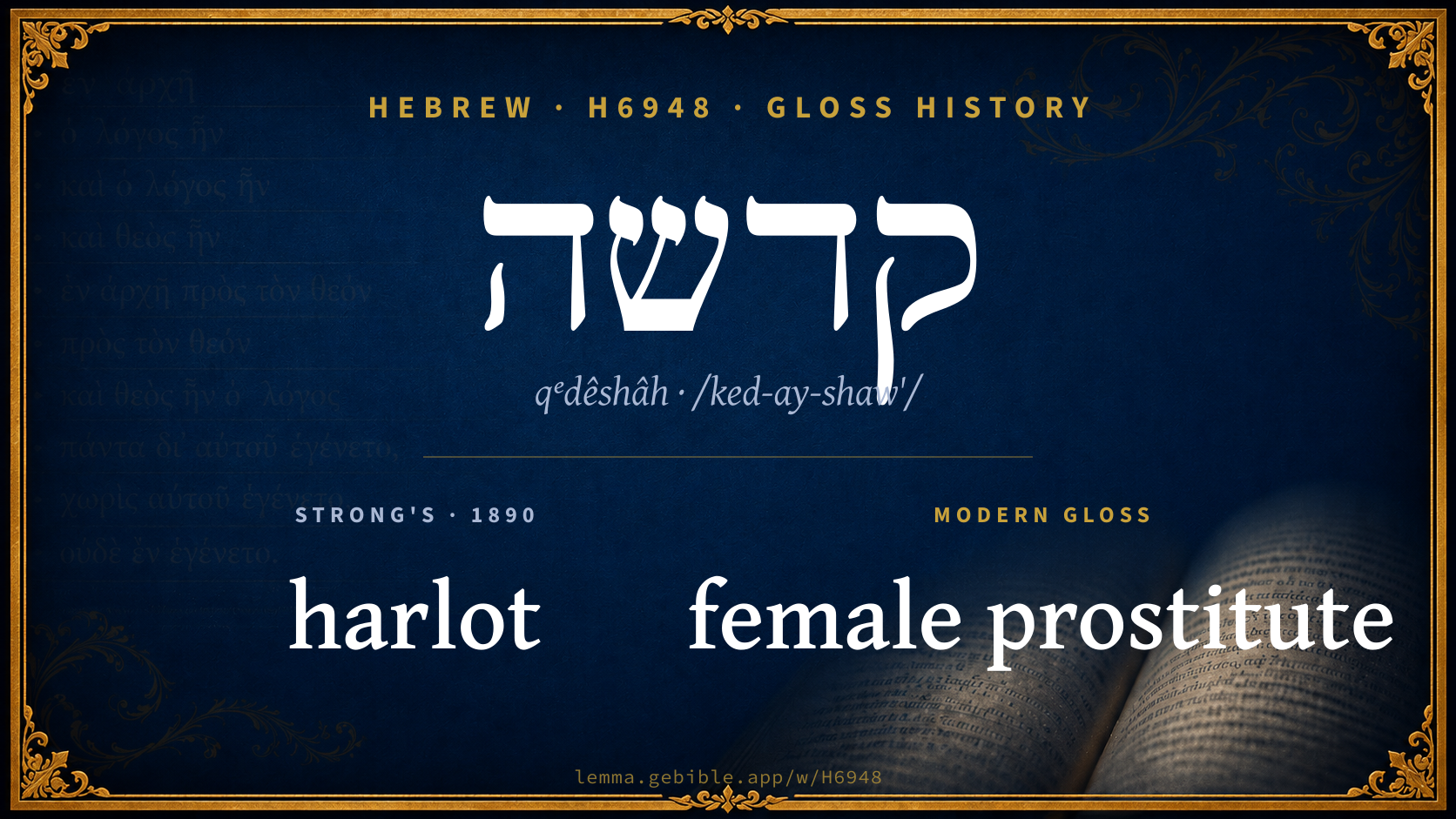
Gloss history
Strong's 1890 vs modern scholarship
About this word
Strong's H6948 catalogs a Hebrew word from the Hebrew Old Testament.
These counts are not copied from any lexicon or concordance. They are computed here, from the morphology-tagged Hebrew Old Testament. What Lemma adds →
- 4
- distinct verses
- The word appears in 4 distinct verses.
- 3 / 39
- OT books
- The word appears in 3 of 39 Old Testament books.
- #3,337
- by frequency
- Top 5000 most frequent Hebrew words (rank 3,337 of 8,640 Hebrew words by occurrence).
View all 4 occurrences in the concordance →
Most concentrated in
- Genesis 2 verses 50%
- Deuteronomy 1 verse 25%
- Hosea 1 verse 25%
By section of the Old Testament
By traditional corpus
Conventional, traditional groupings — biblical authorship is debated, so this is a traditional corpus grouping, not an authorship claim. Each share is this word’s portion of its verses in that division of the Hebrew canon. Each figure is a share of the word’s 4 distinct verses.
- Torah (Pentateuch) 3 verses · 75%
- Prophets (Nevi'im) 1 verse · 25%
How translations render this word
Counts come from each version’s own published word-to-Strong’s tagging or interlinear alignment — an approximate guide to how each version renders this word, not a word-level alignment the data otherwise carries. Because each total is that version’s own tagged count, the per-version totals vary from one another and need not match the appearance or distinct-verse counts above. These counts may also differ from a printed concordance because Lemma counts each distinctly tagged rendering and does not collapse phrase taggings into a single head-word total. This is a fixed set of word-tagged versions (KJV, ASV, BSB, ULT) and does not change with the reading translation you choose elsewhere. Each version’s license is shown beside its name below (and on Sources).
BDB lists this Strong’s number as 2 distinct words (homographs). Each count above pools all of them and is not split by sense — see the Senses section below. A low-frequency rendering may belong to a different one of those words, not the primary meaning.
- King James Version†: Was no harlot 2×
- American Standard Version†: Hath been no prostitute 1×, Hath been no prostitute here 1×, Is the prostitute 1×
- Berean Standard Bible†: Shrine prostitute 2×
- unfoldingWord Literal Text†: Temple prostitute 3×
King James Version Public Domain
Renders H6948 across 5† tagged occurrences — most commonly:
Plus 3 renderings that appear only once — usually multi-word phrases or single function words the recovered tagging swept in, not distinct renderings.
American Standard Version Public Domain
Renders H6948 across 5† tagged occurrences — most commonly:
Berean Standard Bible Public Domain
Renders H6948 across 4† tagged occurrences — most commonly:
Plus 2 renderings that appear only once — usually multi-word phrases or single function words the recovered tagging swept in, not distinct renderings. Not rendered by a distinct English word in 1 further occurrence.
unfoldingWord Literal Text CC BY-SA 4.0
Renders H6948 across 5† tagged occurrences — most commonly:
Plus 2 renderings that appear only once — usually multi-word phrases or single function words the recovered tagging swept in, not distinct renderings.
Senses in the full BDB
What do BDB’s symbols mean?
BDB uses these scholarly abbreviations:
| Symbol | Meaning |
|---|---|
| 𝔊 | the Septuagint (the ancient Greek translation, LXX) |
| 𝔙 | the Vulgate (the Latin translation) |
| 𝔖 | the Syriac version (the Peshitta) |
| 𝔗 | the Targum (the Aramaic translation) |
| ψ | the Psalms |
| √ | root (the underlying root or stem) |
| ‖ | parallel passage (a synonymous or contrasted parallel) |
| † | the dagger: every passage where the word occurs is cited |
The 2 senses and sub-senses the full Brown-Driver-Briggs lexicon distinguishes for this word, in lexicon order (not ranked by frequency), with BDB’s own verbatim wording and sub-sense lettering. Shown in Hebrew script with BDB’s own scholarly abbreviations. The condensed entry is in the Lexicon Entry tab. See also the Forms in the corpus table below.
קדשה I temple-prostitute (man) (cf. RSProph. ii, N. 19, and v. Assyrian sub √)
קדשה II loc. (sacred
- 1. Καδης: in S. of Judah Gn 16:14 (J), 20:1 (E), in מִדְבַּר פָּארָן Nu 13:26 (P), specif. מ׳ צִן 20:1; 33:36, cf. מ׳ קָדֵשׁ ψ 29:8; on W. border of Edom Nu 20:16 (E), 33:37 (P), cf. 20:14 (E), v 22 (P), Ju 11:16, 17 (hence RobBR ii, 175, 194 sought it at ʿAin Weibeh, in W. of Arabah); long abode of Isr. during Exod. Dt 1:46; מֵי מְרִיבַת ק׳ Nu 27:14 (cf. 20:1–13), Dt 32:51 (P); Ez 47:19 (read מְרִיבַת), 48:28, cf. Dt 33:2 (v. קֹדֶשׁ ad fin.); cf. עֵין מִשְׁפָּט Gn 14:7; = ק׳ בַּרְנֵעַ (meaning of ב׳ unknown; 𝔊 K. (τοῦ) βαρνη);—Nu 32:8 (J); Dt 1:2, 19; 2:14; 9:23; Jos 10:41; 14:6, 7 (D); Nu 34:4; Jos 15:3 (P);—mod. ʿAin Ḳadîs), c. 50 miles S. of Beersheba, JRowlands (1842) v. GWilliamsHoly City, 464 f., and especially HCTrumbull (1881) kadesh Barnea, 238–321. e.g. Genesis 16:14
- 2. Hittite capital on the Orontes, N. of Damascus, towards Hamath (Egyptian Ḳdš, Ḳdšụ, Ḳdšë̥, WMMAs. u. Eur. 213 ff.);—2 S 24:6 𝔊L We Dr Kit Bu Löhr, reading אֶרֶץ הַחִתִּים קָדֵ֫שָׁה for MT א׳ תַּחְתִּים חָדְשִׁי (הַחִתִּים already HiGesch. Isr. i. 29; קָדֵ֫שָׁה Th, קֶ֫דְשָׁה Klo, of קֶדֶשׁ in Napht.); HPS doubts. e.g. 2 Samuel 24:6
Senses from the full Brown-Driver-Briggs lexicon (Brown, Driver, Briggs; Oxford 1906 — public domain), digitized via Sefaria, supplemented by the OpenScriptures HebrewLexicon (CC BY 4.0). Full attribution on Sources.
Word origin
I. n.m. temple-prostitute (man) (cf. RSProph. ii, N. 19, and v. Assyrian sub √);—ק׳ Dt 23:18; coll. 1 K 14:24; 22:47; pl. קְדֵשִׁים 15:2 2 K 23:7; Jb 36:14; also f. קְדֵשָׁה (woman) Dt 23:18; pl. קְדֵשׁוֹת Ho 4:14; = harlot, fs. Gn 38:21(×2), 22 (J).
II. n.pr.loc. (sacred; but perhaps orig. קֶדֶשׁ, and pointing artif. to disting. from ק׳ in N);—
— Brown-Driver-Briggs (Oxford 1906, public domain), digitized via Sefaria, supplemented by the OpenScriptures HebrewLexicon (CC BY 4.0). See Sources.
Derived from קדש (qâdêsh) (H6945) — male prostitute.
Forms in the corpus
The 4 distinct written forms H6948 takes in the Hebrew Bible, most frequent first — each parse links to that state’s occurrences in the concordance. Hebrew forms include their vowel points and cantillation, so a single lemma takes many written forms.
| Form | Parsing | Example | Uses |
|---|---|---|---|
| קְדֵשָֽׁה | Adjective, Adjective, Feminine, Singular, Absolute | Genesis 38:21 | 2 |
| הַ/קְּדֵשׁ֖וֹת | Adjective, Adjective, Feminine, Plural, Absolute | Hosea 4:14 | 1 |
| הַ/קְּדֵשָׁ֛ה | Noun, Common, Feminine, Singular, Absolute | Genesis 38:21 | 1 |
| קְדֵשָׁ֖ה | Adjective, Adjective, Feminine, Singular, Absolute | Deuteronomy 23:17 | 1 |
Same root — word family
Other BDB entries built from the same root as H6948, grouped by Strong’s listed origin. These share a root / origin per the lexicon — not necessarily a shared meaning. Each links to that word’s own entry.
Derives from
Proper names from this root
People and places named from this root — a name, not an additional meaning of the word.
Compare all same-root words → 1 of the same-root words is a proper name (a person or place). They share a root, not necessarily a meaning.
Septuagint verse parallels
This word appears in 4 verses that also exist in the Greek Old Testament (Septuagint), out of the 4 Hebrew verses it occurs in. You can read those verses in Greek by switching the Old Testament edition to the Septuagint.
Read these verses in the Septuagint
This is a verse-level parallel only — the same verses exist in both the Hebrew and Greek Old Testaments. No word-level Hebrew↔Greek correspondence is claimed: the data carries no such alignment, so no Greek word is shown as this Hebrew word’s translation. Coverage is not total — the Septuagint omits the deuterocanon and renumbers the Psalms, so some Hebrew verses have no direct Greek parallel.