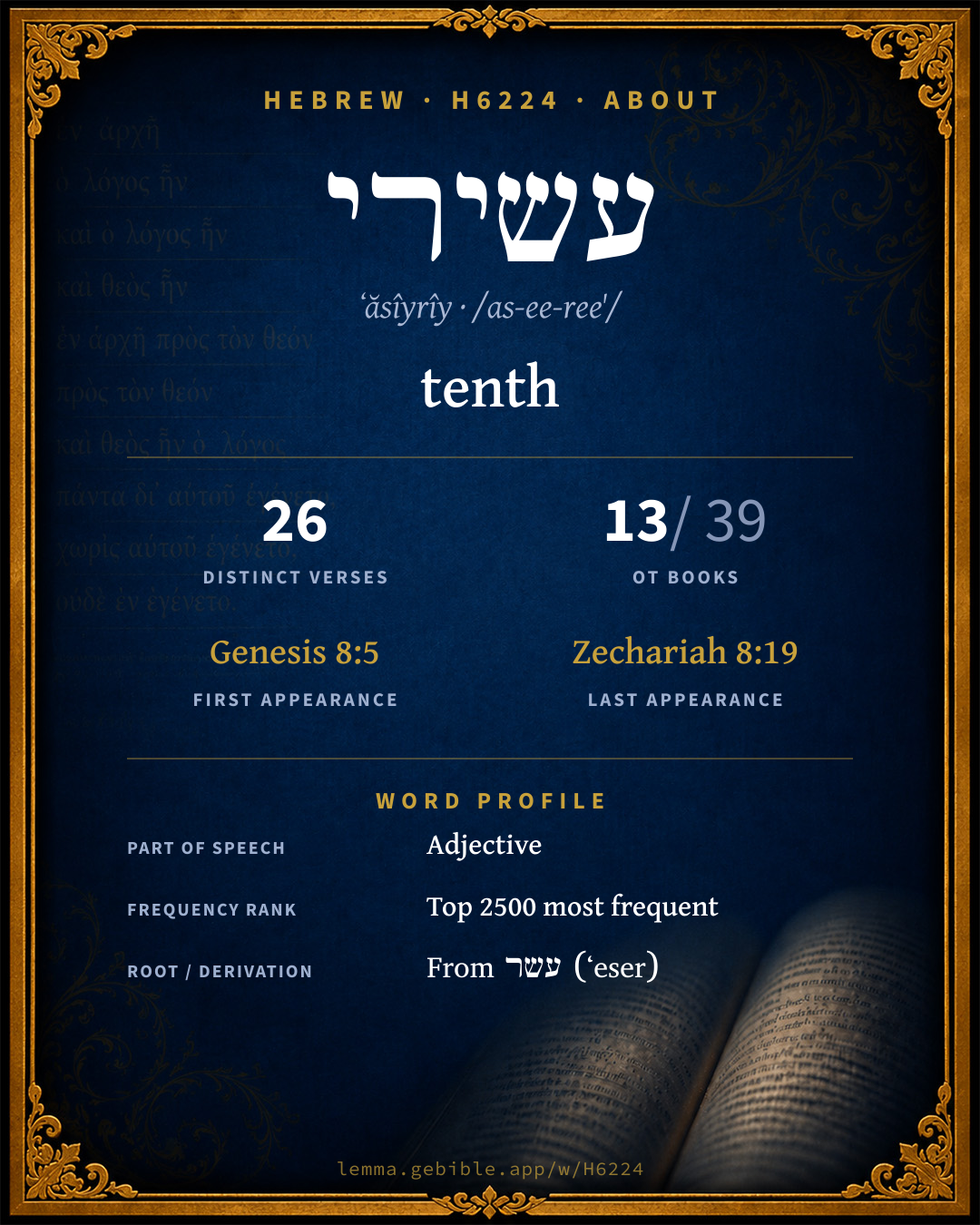
עֲשִׂירִי
tenth
‘tenth’ is one of 2 main senses fuller range ↓
Full lexicon entry — Brown-Driver-Briggs (BDB)
From Brown-Driver-Briggs (BDB)
Where this word appears
See every Absolute-state word in the Hebrew Bible →
Grammar key — what these labels mean
Part of speech
- Adjective
- A word that describes or qualifies a noun.
State
- Absolute
- The independent form of a noun, not bound to a following word.
- Construct
- A noun bound to a following noun in a possessive / “of” relationship (the construct chain).
Gender
- Masculine
- Grammatically masculine.
- Feminine
- Grammatically feminine.
Number
- Singular
- One.
Grammatical forms
- Adjective, Ordinal number, Masculine, Singular, Absolute 20 times (69%)
- Adjective, Ordinal number, Feminine, Singular, Construct 6 times (21%)
- Adjective, Ordinal number, Feminine, Singular, Absolute 3 times (10%)
Parsed forms decoded from the imported morphology (morphhb / Westminster Leningrad Codex — WLC text public domain, morphhb tagging CC BY 4.0), counted across 29 parsed occurrences — not distinct verses.
Every verse where H6224 appears — 26 distinct verses across 13 books. Click any verse to open its interlinear word-by-word view. Verse text shown in the World English Bible for context — . Each verse’s Hebrew form is shown with its reference; the English is not keyword-highlighted, since the data carries no word-level English alignment. Use “Compare translations” on any verse to read it across multiple English versions. This concordance covers the Hebrew Bible; Septuagint (Greek Old Testament) occurrences are not indexed here.
Genesis 1 verse
Exodus 1 verse
Leviticus 3 verses
- Leviticus 5:11 עֲשִׂירִ֧ת adj Ordinal number fs cs "'But if he can't afford two turtledoves, or two young pigeons, then he shall bring his offering for that in which he has sinned, the tenth part of an ephah of fine flour for a sin offering. He shall put no oil on it, neither shall he put any frankincense on it, for it is a sin offering.
- Leviticus 6:20 עֲשִׂירִ֨ת adj Ordinal number fs cs "This is the offering of Aaron and of his sons, which they shall offer to Yahweh in the day when he is anointed: the tenth part of an ephah of fine flour for a meal offering perpetually, half of it in the morning, and half of it in the evening.
- Leviticus 27:32 הָֽ/עֲשִׂירִ֕י ptcl def.art + Adjective Ordinal number ms All the tithe of the herds or the flocks, whatever passes under the rod, the tenth shall be holy to Yahweh.
Numbers 3 verses
- Numbers 5:15 עֲשִׂירִ֥ת adj Ordinal number fs cs then the man shall bring his wife to the priest, and shall bring her offering for her: the tenth part of an ephah of barley meal. He shall pour no oil on it, nor put frankincense on it, for it is a meal offering of jealousy, a meal offering of memorial, bringing iniquity to memory.
- Numbers 7:66 הָ/עֲשִׂירִ֔י ptcl def.art + Adjective Ordinal number ms On the tenth day Ahiezer the son of Ammishaddai, prince of the children of Dan
- Numbers 28:5 וַ/עֲשִׂירִ֧ית conj + Adjective Ordinal number fs cs and the tenth part of an ephah of fine flour for a meal-offering, mixed with the fourth part of a hin of beaten oil.
Deuteronomy 2 verses
- Deuteronomy 23:2 עֲשִׂירִ֔י adj Ordinal number ms A bastard shall not enter into the assembly of Yahweh; even to the tenth generation shall none of his enter into the assembly of Yahweh.
- Deuteronomy 23:3 עֲשִׂירִ֔י adj Ordinal number ms An Ammonite or a Moabite shall not enter into the assembly of Yahweh; even to the tenth generation shall none belonging to them enter into the assembly of Yahweh forever:
2 Kings 1 verse
1 Chronicles 4 verses
- 1 Chronicles 12:13 הָ/עֲשִׂירִ֔י ptcl def.art + Adjective Ordinal number ms Jeremiah the tenth, Machbannai the eleventh.
- 1 Chronicles 24:11 הָ/עֲשִׂרִֽי ptcl def.art + Adjective Ordinal number ms the ninth to Jeshua, the tenth to Shecaniah,
- 1 Chronicles 25:17 הָ/עֲשִׂירִ֣י ptcl def.art + Adjective Ordinal number ms the tenth to Shimei, his sons and his brothers, twelve:
- 1 Chronicles 27:13 הָ/עֲשִׂירִי֙ הָ/עֲשִׂירִ֔י ptcl def.art + Adjective Ordinal number ms ptcl def.art + Adjective Ordinal number ms The tenth [captain] for the tenth month was Maharai the Netophathite, of the Zerahites: and in his division were Twenty-four thousand.
Ezra 1 verse
Esther 1 verse
Isaiah 1 verse
Jeremiah 3 verses
- Jeremiah 32:1 הָ/עֲשִׂרִ֔ית ptcl def.art + Adjective Ordinal number fs The word that came to Jeremiah from Yahweh in the tenth year of Zedekiah king of Judah, which was the eighteenth year of Nebuchadrezzar.
- Jeremiah 39:1 הָ/עֲשִׂרִ֗י ptcl def.art + Adjective Ordinal number ms It happened when Jerusalem was taken, (in the ninth year of Zedekiah king of Judah, in the tenth month, came Nebuchadrezzar king of Babylon and all his army against Jerusalem, and besieged it;
- Jeremiah 52:4 הָ/עֲשִׂירִי֮ ptcl def.art + Adjective Ordinal number ms It happened in the ninth year of his reign, in the tenth month, in the tenth day of the month, that Nebuchadrezzar king of Babylon came, he and all his army, against Jerusalem, and encamped against it; and they built forts against it round about.
Ezekiel 4 verses
- Ezekiel 24:1 הָ/עֲשִׂירִ֔י ptcl def.art + Adjective Ordinal number ms Again, in the ninth year, in the tenth month, in the tenth [day] of the month, the word of Yahweh came to me, saying,
- Ezekiel 29:1 הָ/עֲשִׂירִ֔ית בָּ/עֲשִׂרִ֕י ptcl def.art + Adjective Ordinal number fs prep det + Adjective Ordinal number ms In the tenth year, in the tenth [month], in the twelfth [day] of the month, the word of Yahweh came to me, saying,
- Ezekiel 33:21 בָּ/עֲשִׂרִ֛י prep det + Adjective Ordinal number ms It happened in the twelfth year of our captivity, in the tenth [month], in the fifth [day] of the month, that one who had escaped out of Jerusalem came to me, saying, The city has been struck.
- Ezekiel 45:11 וַ/עֲשִׂירִ֤ת conj + Adjective Ordinal number fs cs The ephah and the bath shall be of one measure, that the bath may contain the tenth part of a homer, and the ephah the tenth part of a homer: the measure of it shall be after the homer.
Zechariah 1 verse
About this entry
At a glance — auto-summarized from this page’s data, not written by a person. Every figure links to its source below. This summary describes the numbers; it doesn’t interpret them.
At its core, עשירי (ʻăsîyrîy) means “tenth.” It first appears in Genesis 8:5. Spanning 26 verses in 13 books, it ranks among the moderately common words of the Hebrew Bible. Not a single-sense word: explore its full sense range. Sharing its root, it stands alongside עשר, עשור and עשר. Each statement above links to its evidence; the full detail follows below.
Gloss history
Strong's 1890 vs modern scholarship
About this word
Strong's H6224 catalogs a Hebrew word from the Hebrew Old Testament.
These counts are not copied from any lexicon or concordance. They are computed here, from the morphology-tagged Hebrew Old Testament. What Lemma adds →
- 26
- distinct verses
- The word appears in 26 distinct verses.
- 13 / 39
- OT books
- The word appears in 13 of 39 Old Testament books.
- #1,160
- by frequency
- Top 2500 most frequent Hebrew words (rank 1,160 of 8,640 Hebrew words by occurrence).
View all 26 occurrences in the concordance →
Most concentrated in
- 1 Chronicles 4 verses 15%
- Ezekiel 4 verses 15%
- Leviticus 3 verses 12%
By section of the Old Testament
By traditional corpus
Conventional, traditional groupings — biblical authorship is debated, so this is a traditional corpus grouping, not an authorship claim. Each share is this word’s portion of its verses in that division of the Hebrew canon. Each figure is a share of the word’s 26 distinct verses.
- Torah (Pentateuch) 10 verses · 38%
- Prophets (Nevi'im) 10 verses · 38%
- Writings (Ketuvim) 6 verses · 23%
How translations render this word
Counts come from each version’s own published word-to-Strong’s tagging or interlinear alignment — an approximate guide to how each version renders this word, not a word-level alignment the data otherwise carries. Because each total is that version’s own tagged count, the per-version totals vary from one another and need not match the appearance or distinct-verse counts above. These counts may also differ from a printed concordance because Lemma counts each distinctly tagged rendering and does not collapse phrase taggings into a single head-word total. This is a fixed set of word-tagged versions (KJV, ASV, BSB, ULT) and does not change with the reading translation you choose elsewhere. Each version’s license is shown beside its name below (and on Sources).
- King James Version: Tenth 24×, Tenth part 2×
- American Standard Version: Tenth 23×, Tenth part 2×
- Berean Standard Bible: Tenth 22×, Day of the tenth 2×, Tenth month 2×
- unfoldingWord Literal Text: Tenth 20×, Tenth of 3×, Tenth month 2×
King James Version Public Domain
Renders H6224 across 29 tagged occurrences — most commonly:
Plus 3 renderings that appear only once — usually multi-word phrases or single function words the recovered tagging swept in, not distinct renderings.
American Standard Version Public Domain
Renders H6224 across 29 tagged occurrences — most commonly:
Plus 4 renderings that appear only once — usually multi-word phrases or single function words the recovered tagging swept in, not distinct renderings.
Berean Standard Bible Public Domain
Renders H6224 across 28 tagged occurrences — most commonly:
Plus 2 renderings that appear only once — usually multi-word phrases or single function words the recovered tagging swept in, not distinct renderings. Not rendered by a distinct English word in 1 further occurrence.
unfoldingWord Literal Text CC BY-SA 4.0
Renders H6224 across 27 tagged occurrences — most commonly:
Plus 2 renderings that appear only once — usually multi-word phrases or single function words the recovered tagging swept in, not distinct renderings.
Senses in the full BDB
What do BDB’s symbols mean?
BDB uses these scholarly abbreviations:
| Symbol | Meaning |
|---|---|
| 𝔊 | the Septuagint (the ancient Greek translation, LXX) |
| 𝔙 | the Vulgate (the Latin translation) |
| 𝔖 | the Syriac version (the Peshitta) |
| 𝔗 | the Targum (the Aramaic translation) |
| ψ | the Psalms |
| √ | root (the underlying root or stem) |
| ‖ | parallel passage (a synonymous or contrasted parallel) |
| † | the dagger: every passage where the word occurs is cited |
The 2 senses and sub-senses the full Brown-Driver-Briggs lexicon distinguishes for this word, in lexicon order (not ranked by frequency), with BDB’s own verbatim wording and sub-sense lettering. Shown in Hebrew script with BDB’s own scholarly abbreviations. The condensed entry is in the Lexicon Entry tab. See also the Forms in the corpus table below.
- 1. דּוֹר עֲשִׂירִי Dt 23:3, 4; בַּיּוֹם הָע׳ Nu 7:66 (P); הַחֹדֶשׁ הָע׳ Gn 8:5 (P) Ez 24:1 + 5 times; בַּחֹדֶשׁ הָעֲשִׂרִי Je 39:1; ח׳ om. הָעֲשִׂירִי Gn 8:5 (P), בָּעֲשִׂרִי Ez 29:1; 33:21; other nouns om. הָעֲשִׂירִי 1 Ch 12:13; 25:17; 27:13, הָעֲשִׂרִי 24:11; בַּשָּׁנָה הָעֲשִׂרִית Ez 29:1, בַּשּׁ׳ הָעֲשִׂרִית Je 32:1. e.g. Deuteronomy 23:3
- 2. as subst. a tenth part: f. abs. עֲשִׂרִיָּה Is 6:13; f. cstr. עֲשִׂירִית הָאֵיפָה Nu 28:5, עֲשִׂרִית Ex 16:36, עֲשִׂירִת Lv 5:11; 6:13; Nu 5:15; עֲשִׂירִת הַחֹמֶר Ez 45:11; m. abs. הָעֲשִׂירִי Lv 27:32 the tithe (i.e. of cattle, etc.). e.g. Isaiah 6:13
Senses from the full Brown-Driver-Briggs lexicon (Brown, Driver, Briggs; Oxford 1906 — public domain), digitized via Sefaria, supplemented by the OpenScriptures HebrewLexicon (CC BY 4.0). Full attribution on Sources.
Word origin
m., עֲשִׂירִיָּה, and עֲשִׂירִית8 f. adj. num. ord. tenth;—
— Brown-Driver-Briggs (Oxford 1906, public domain), digitized via Sefaria, supplemented by the OpenScriptures HebrewLexicon (CC BY 4.0). See Sources.
Derived from עשר (ʻeser) (H6235) — ten.
Jastrow Dictionary
A second Hebrew/Aramaic lexicon for comparison, covering Aramaic and post-biblical (Talmudic, Targumic, Midrashic) usage that the biblical-Hebrew BDB does not. Matched by lemma rather than by Strong’s number, so a lemma may carry more than one Jastrow headword (shown separately below), and the entries cover usage well beyond the Bible.
עֲשִׂירִי
- the tenth. Ber. 8ᵇ תשיעי וע׳ the ninth and the tenth (of Tishri). Bekh. IX, 7 והיוצא ע׳ and the lamb which comes out the tenth. Ib. 8; a. fr.—Fem. עֲשִׂירִית. Yalk. Ex. 261 וכמה הוא ע׳ האיפה and how much is the tenth of an Efah?; a. e.
A Dictionary of the Targumim, the Talmud Babli and Yerushalmi, and the Midrashic Literature (Marcus Jastrow; London, Luzac, 1903) — Public Domain. Digitized via Sefaria. Digitized via Sefaria. Full attribution on Sources.
Forms in the corpus
The 23 distinct written forms H6224 takes in the Hebrew Bible, most frequent first — each parse links to that state’s occurrences in the concordance. Hebrew forms include their vowel points and cantillation, so a single lemma takes many written forms.
Same root — word family
Other BDB entries built from the same root as H6224, grouped by Strong’s listed origin. These share a root / origin per the lexicon — not necessarily a shared meaning. Each links to that word’s own entry.
Derives from
Shares the same root
- עשור ʻâsôwr H6218 ten
- עשר ʻăsar H6236 ten
- עשר ʻâsâr H6240 teen
- עשרון ʻissârôwn H6241 tithe
- עשרים ʻesrîym H6242 twenty
Compare all same-root words → Showing 4 of 7 — not the complete family. They share a root, not necessarily a meaning.
Septuagint verse parallels
This word appears in 26 verses that also exist in the Greek Old Testament (Septuagint), out of the 26 Hebrew verses it occurs in. You can read those verses in Greek by switching the Old Testament edition to the Septuagint.
Read these verses in the Septuagint
- Genesis 8:5
- Exodus 16:36
- Leviticus 5:11
- Numbers 5:15
- Deuteronomy 23:2
- 2 Kings 25:1
- 1 Chronicles 12:13
- Ezra 10:16
- Esther 2:16
- Isaiah 6:13
- Jeremiah 32:1
- Ezekiel 24:1
This is a verse-level parallel only — the same verses exist in both the Hebrew and Greek Old Testaments. No word-level Hebrew↔Greek correspondence is claimed: the data carries no such alignment, so no Greek word is shown as this Hebrew word’s translation. Coverage is not total — the Septuagint omits the deuterocanon and renumbers the Psalms, so some Hebrew verses have no direct Greek parallel.