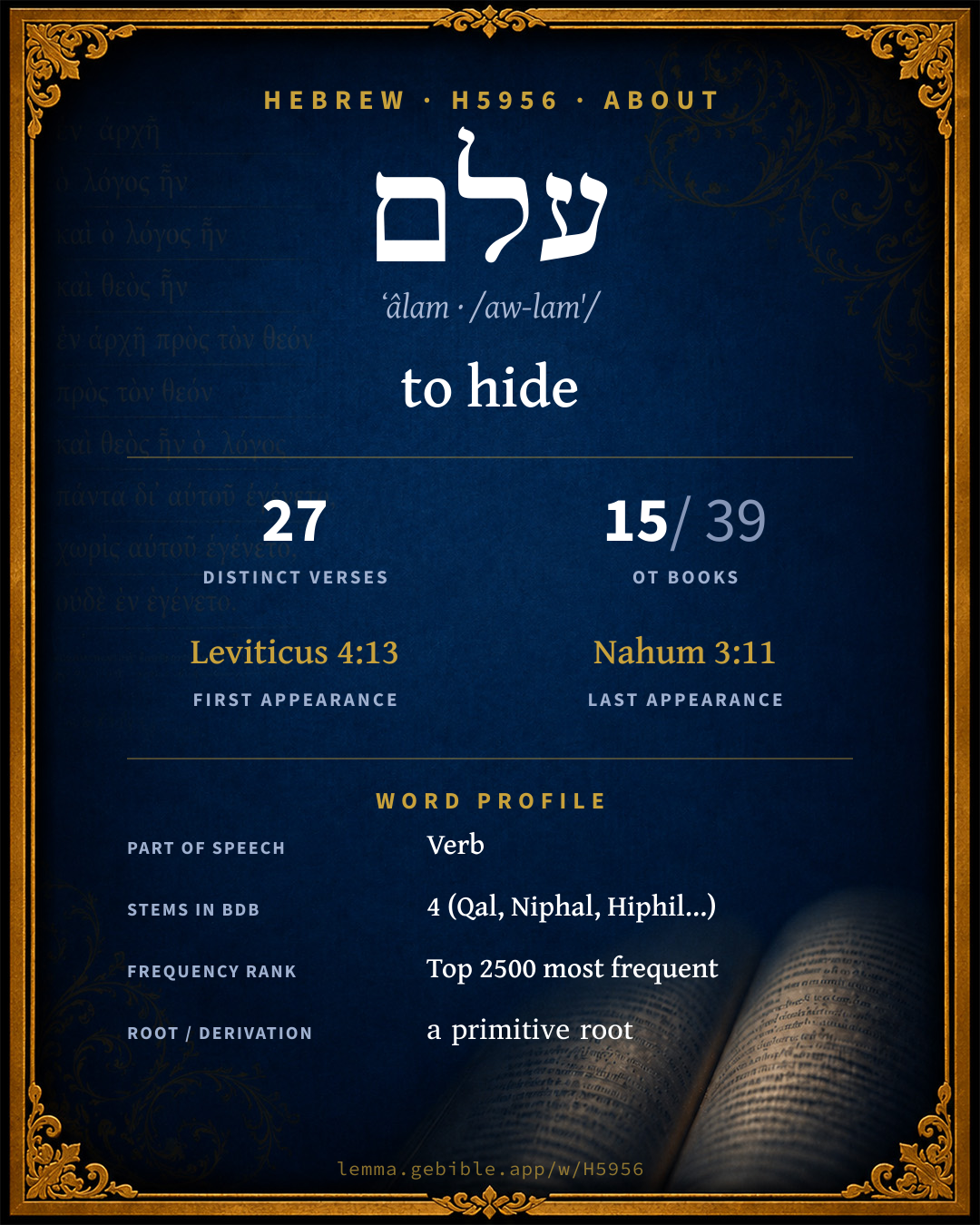
עָלַם
to hide
‘to hide’ is one of 4 main senses fuller range ↓
Full lexicon entry — Brown-Driver-Briggs (BDB)
From Brown-Driver-Briggs (BDB)
Where this word appears
See every Hiphil verb in the Hebrew Bible →
Grammar key — what these labels mean
Part of speech
- Verb
- An action or state-of-being word.
Stem
- Niphal
- Usually the simple passive or reflexive of the Qal (“he was written”). Here: ‘be concealed’
- Hithpael
- The reflexive or reciprocal stem (the subject acts on itself).
- Hiphil
- The causative active stem (“he caused / brought about”).
- Qal
- The basic, simple active stem — the plain form of the verb (“he wrote”). Here: ‘pass.’
Form
- Sequential Perfect
- A perfect with prefixed waw continuing a preceding imperfect or command (waw-consecutive perfect).
- Participle Active
- A verbal adjective expressing ongoing or characteristic action (“writing / one who writes”).
- Perfect
- A completed action or state — Hebrew marks aspect (completeness) more than strict tense (“he wrote”).
- Imperfect
- An incomplete, ongoing, or future action (“he will / would write”).
- Infinitive Construct
- A bound verbal noun, frequently with prepositions (“to write / in writing”).
- Participle Passive
- A verbal adjective expressing action received (“written”).
- Infinitive Absolute
- An unbound verbal noun, often intensifying or standing in for a finite verb.
- Jussive
- A third- or second-person volitional form expressing wish or command (“let him write”).
State
- Absolute
- The independent form of a noun, not bound to a following word.
- Construct
- A noun bound to a following noun in a possessive / “of” relationship (the construct chain).
Person
- 3rd Person
- The one spoken about (“he / she / it / they”).
- 2nd Person
- The one addressed (“you”).
- 1st Person
- The speaker (“I / we”).
Gender
- Masculine
- Grammatically masculine.
- Feminine
- Grammatically feminine.
- Common
- Either gender — not distinguished for this form.
Number
- Singular
- One.
- Plural
- More than one (in Hebrew, generally three or more).
1 verse where H5956 appears in the Niphal stem in the Book of Job. Filtered view — show all forms. Click any verse to open its interlinear word-by-word view. Verse text shown in the World English Bible for context — . Each verse’s Hebrew form is shown with its reference; the English is not keyword-highlighted, since the data carries no word-level English alignment. Use “Compare translations” on any verse to read it across multiple English versions. This concordance covers the Hebrew Bible; Septuagint (Greek Old Testament) occurrences are not indexed here.
Job
About this entry
At a glance — auto-summarized from this page’s data, not written by a person. Every figure links to its source below. This summary describes the numbers; it doesn’t interpret them.
“to hide” is the headline sense of the Hebrew verb עלם (ʻâlam). Older and newer Bibles part ways — “hide” in the King James Version, “hidden” (unfoldingWord Literal Text) in modern versions. See the renderings breakdown. It turns up in 27 verses across 15 books, a moderately common footprint. Its earliest occurrence is Leviticus 4:13. The verb spans 4 stems, from Qal to Niphal. See the sense tree, 27-verse concordance, and the renderings breakdown below.
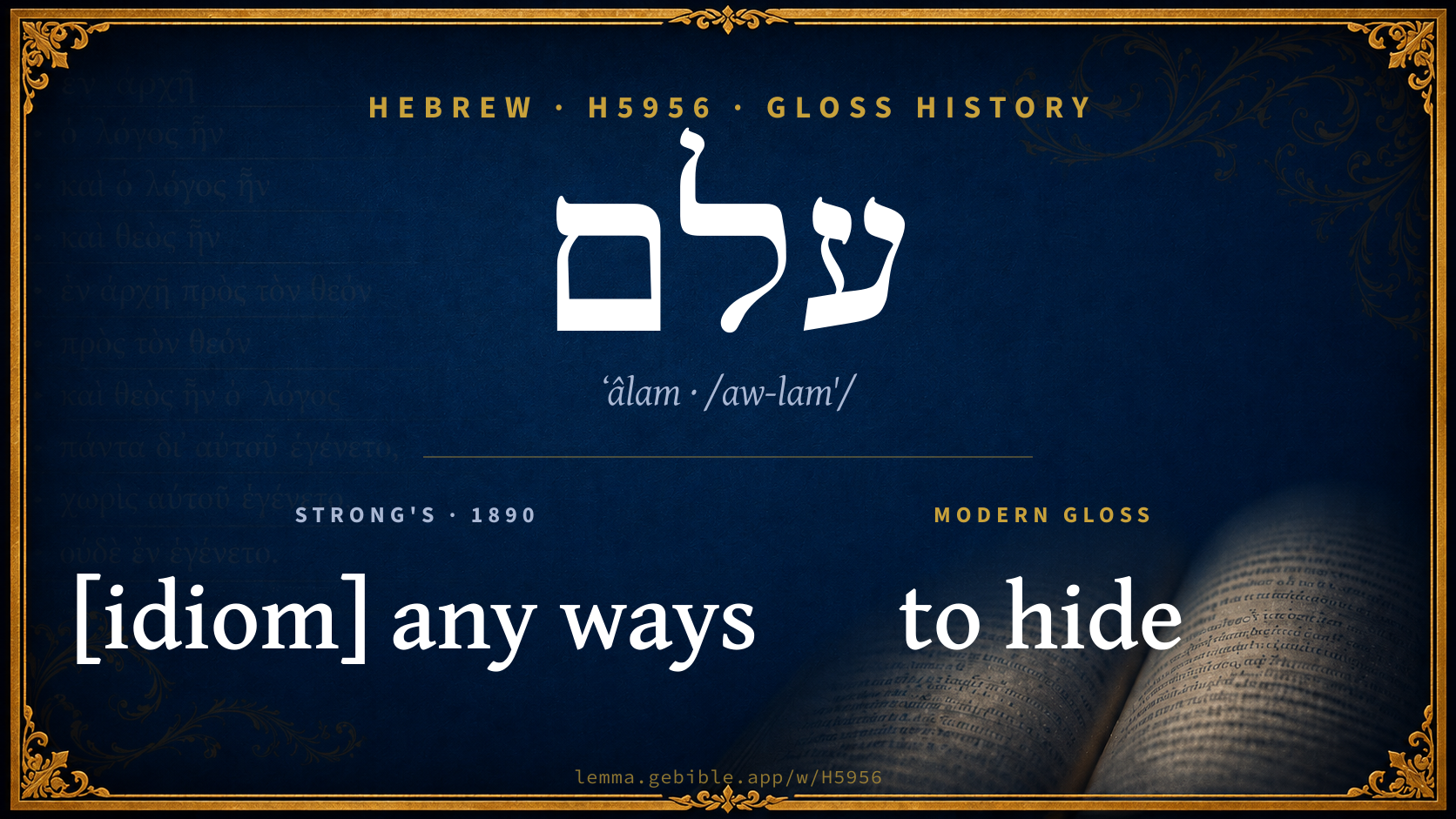
Gloss history
Strong's 1890 vs modern scholarship
About this word
Strong's H5956 catalogs a Hebrew word from the Hebrew Old Testament.
These counts are not copied from any lexicon or concordance. They are computed here, from the morphology-tagged Hebrew Old Testament. What Lemma adds →
- 27
- distinct verses
- The word appears in 27 distinct verses.
- 15 / 39
- OT books
- The word appears in 15 of 39 Old Testament books.
- #1,190
- by frequency
- Top 2500 most frequent Hebrew words (rank 1,190 of 8,640 Hebrew words by occurrence).
View all 27 occurrences in the concordance →
Most concentrated in
- Leviticus 5 verses 19%
- Psalms 4 verses 15%
- Deuteronomy 3 verses 11%
By section of the Old Testament
By traditional corpus
Conventional, traditional groupings — biblical authorship is debated, so this is a traditional corpus grouping, not an authorship claim. Each share is this word’s portion of its verses in that division of the Hebrew canon. Each figure is a share of the word’s 27 distinct verses.
- Writings (Ketuvim) 11 verses · 41%
- Torah (Pentateuch) 9 verses · 33%
- Prophets (Nevi'im) 7 verses · 26%
How translations render this word
Counts come from each version’s own published word-to-Strong’s tagging or interlinear alignment — an approximate guide to how each version renders this word, not a word-level alignment the data otherwise carries. Because each total is that version’s own tagged count, the per-version totals vary from one another and need not match the appearance or distinct-verse counts above. These counts may also differ from a printed concordance because Lemma counts each distinctly tagged rendering and does not collapse phrase taggings into a single head-word total. This is a fixed set of word-tagged versions (KJV, ASV, BSB, ULT) and does not change with the reading translation you choose elsewhere. Each version’s license is shown beside its name below (and on Sources).
- King James Version: Hide 6×, Be hid 3×
- American Standard Version: Hide 5×, Be hid 4×
- Berean Standard Bible: He is unaware 3×, Ignore it 3×, Ignore 2×
- unfoldingWord Literal Text: Hidden 5×, Hide yourself 5×, Is hidden 4×
King James Version Public Domain
Renders H5956 across 28 tagged occurrences — most commonly:
Plus 19 renderings that appear only once — usually multi-word phrases or single function words the recovered tagging swept in, not distinct renderings.
American Standard Version Public Domain
Renders H5956 across 27 tagged occurrences — most commonly:
Plus 18 renderings that appear only once — usually multi-word phrases or single function words the recovered tagging swept in, not distinct renderings.
Berean Standard Bible Public Domain
Renders H5956 across 27 tagged occurrences — most commonly:
Plus 19 renderings that appear only once — usually multi-word phrases or single function words the recovered tagging swept in, not distinct renderings. Not rendered by a distinct English word in 1 further occurrence.
unfoldingWord Literal Text CC BY-SA 4.0
Renders H5956 across 35 tagged occurrences — most commonly:
Plus 19 renderings that appear only once — usually multi-word phrases or single function words the recovered tagging swept in, not distinct renderings.
7 senses and sub-senses in the full BDB
Hebrew verbs can shift meaning by stem (binyan): Qal is the basic action, Niphal is often passive or reflexive, Piel often intensifies or makes it factitive, and Hiphil is typically causative. The senses below are grouped under the stem BDB assigns to each. This entry also uses Hithpael (reflexive or reciprocal).
What do BDB’s symbols mean?
BDB uses these scholarly abbreviations:
| Symbol | Meaning |
|---|---|
| 𝔊 | the Septuagint (the ancient Greek translation, LXX) |
| 𝔙 | the Vulgate (the Latin translation) |
| 𝔖 | the Syriac version (the Peshitta) |
| 𝔗 | the Targum (the Aramaic translation) |
| ψ | the Psalms |
| √ | root (the underlying root or stem) |
| ‖ | parallel passage (a synonymous or contrasted parallel) |
| † | the dagger: every passage where the word occurs is cited |
The 7 senses and sub-senses the full Brown-Driver-Briggs lexicon distinguishes for this word, in lexicon order (not ranked by frequency), with BDB’s own verbatim wording and sub-sense lettering. Shown in Hebrew script with BDB’s own scholarly abbreviations. The condensed entry is in the Lexicon Entry tab. See also the Forms in the corpus table below.
Qal
- Pt. pass. עֲלֻמֵנוּ ψ 90:8 as subst. our secret, i.e. hidden sin (‖ עֲוֹנֹת). e.g. Psalms 90:8
Niphal
- Pf. be concealed, of wisdom, 3 fs. נֶעֶלְמָה מֵעֵינֵי Jb 28:21; of a fact or condition, נֶעְלַם 2 Ch 9:2, וְנ׳ consec. Lv 5:2, 3, 4 (all c. מִן pers.), וְנ׳ מֵעֵינֵי Lv 4:13; Nu 5:13 (all P); Pt. e.g. Job 28:21
- 1. נֶעְלָם concealed, c. הָיָה in periphrastic conjug. 1 K 10:3 (מִן pers.); abs. כָּל־נֶעְלָם Ec 12:14. e.g. 1 Kings 10:3
- 2. fs. תְּהִי נַעֲלָמָה Na 3:11 mayest thou become obscured (as to the senses; fig. for swoon), but very doubtful, read perhaps נעלפה? [Dr]. e.g. Nahum 3:11
- 3. pl. נַעֲלָמִים ψ 26:4 those who conceal themselves, i.e. their thoughts, dissemblers (‖ מְתֵי שָׁוְא). e.g. Psalms 26:4
Hiphil
- Pf. 3 ms. הֶעְלִים 2 K 4:27; 3 pl. הֶעְלִימוּ Ez 22:26; Impf. 2 ms. תַּעְלִים ψ 10:1, תַּעְלֵם La 3:56; 3 mpl. יַעְלִימוּ Lv 20:4, etc.; Inf. abs. הַעְלֵם v 4; Pt. מַעְלִים Jb 42:3; Pr 28:27;—conceal, hide, c. מִן pers. 2 K 4:27 (‖ לֹא הִגִּיד לִי); usually hide the eyes from (מִן), i.e. disregard Is 1:15; Ez 22:26, הַעְלֵם יַע׳ וגו׳ Lv 20:4, מִן om. Pr 28:27; hide the eyes by (ב) a bride 1 S 12:3 (i.e. pervert justice, but v. i. עַיִן 3 d); hide (cover) the ear La 3:56 (turn a deaf ear); hide (obscure) counsel (עֵצָה) Jb 42:3; לָמָה תַּע׳ ψ 10:1 why dost thou [י׳] hide, sc. thine eyes (so most), or practise concealment (= hide thyself)? e.g. 2 Kings 4:27
Hithpael
- Pf. 2 ms. consec. וְהִתְעַלַּמְתָּ מֵהֶם Dt 22:1, 4 and thou hide thyself completely from them (utterly neglect to aid), so Inf. cstr. (מֵהֶם om.) לְהִתְעַלֵּם v 3; so also Impf. c. מִן, תִּתְעַלַּם ψ 55:2, תִּתְעַלָּ֑ם Is 58:7; once lit. יִתְעַלֶּם־שָׁ֑לֶג Jb 6:16 wherein snow hides itself. e.g. Deuteronomy 22:1
Senses from the full Brown-Driver-Briggs lexicon (Brown, Driver, Briggs; Oxford 1906 — public domain), digitized via Sefaria, supplemented by the OpenScriptures HebrewLexicon (CC BY 4.0). Full attribution on Sources.
Word origin
vb. conceal (NH id., der. spec.);—
— Brown-Driver-Briggs (Oxford 1906, public domain), digitized via Sefaria, supplemented by the OpenScriptures HebrewLexicon (CC BY 4.0). See Sources.
Origin: a primitive root
Jastrow Dictionary
A second Hebrew/Aramaic lexicon for comparison, covering Aramaic and post-biblical (Talmudic, Targumic, Midrashic) usage that the biblical-Hebrew BDB does not. Matched by lemma rather than by Strong’s number, so a lemma may carry more than one Jastrow headword (shown separately below), and the entries cover usage well beyond the Bible.
עָלַם I
- (v. אָלַם)
- 1. to surround, tie up.
- 2. to be strong.
- to tie up. Yalk. Prov. 946 quot. fr. Y’lamd. (ref. to וחושך, Prov. X, 19) לא אמרתי שתְּעַלֵּם פיך וכ׳ I did not say that thou must tie up thy mouth and sit in silence, but restrain thy lips from &c.; Yalk. Num. 738 שתְּאַלֵּים. Num. R. s. 14 (ref. to Gen. XLIX, 22) שעי׳ עינו מאשת וכ׳ he closed his eye not to look at the wife &c. (v. עָלַם II, Hif.). e.g. Proverbs 10:19
עֲלֵם
- , to be strong. Targ. Ps. XXXVIII, 20. Targ. Josh. I, 6; a. e.—Denom. עִילָּם, fr. which imperat. עִילַּם, עִילַּמוּ. Targ. O. Deut. XXXI, 6; 7; 23 ed. Berl. (Regia עַלֵּים, עַלִּימוּ, v. Berl. Targ. O. II, p. 59). Targ. I Chr. XXII, 12 (13); a. e., v. אֲלַם.
- 1. same (denom. of same (denom. of עַלִּים), v. supra.
- 2. to strengthen. Targ. Ps. XXVII, 14. Targ. Y. Ex. XIV, 27 (h. text וינער, v. Mekh. B’shall., s. 6).
- 1. to be strengthened. Targ. Ps. XXXI, 25.
- 2. to be tied, to join, conspire. Targ. II Chr. XIII, 7 (h. text ויתאמצו).
עָלַם II
- v. preced.) [to surround, tie up,] to conceal. Yalk. Cant. 981, v. infra.—Part. pass. עָלוּם; f. עֲלוּמָה; pl. עֲלוּמִים, עֲלוּמִין; עֲלוּמוֹת. Ab. Zar. 35ᵇ (play on עֲלָמוֹת, Cant. I, 3) קרי ביה עלומות read it ʿălumoth (secret things). e.g. Song of Solomon 1:3
- same. Part. pass. מְעוּלָּם; f. מְעוּלֶּמֶת; pl. מְעוּלָּמִים, מְעוּלָּמִין; מְעוּלָּמוֹת. Midr. Till. to Ps. XLVI, 1 (play on עלמות, ib.) מע׳ הן הדברים וכ׳ the things we saw are hidden, we know not what we saw.
- , Nithpa. נִתְעַלֵּם to be concealed, to escape; to hide one’s self. Num. R. s. 20 אין כל דבר נ׳ ממך nothing is unknown to thee. Y. Pes. VI, beg. 33ᵃ נֶעֶלְמָה הלכה ממנו the law escaped his memory; Bab. Pes. 66ᵃ נִתְעַלְּמָה. Y. Yoma III, 40ᵈ bot. לא … מִתְעַלֵּם מהן they did not move from there before it (the pronunciation of the Tetragrammaton) escaped their memory again. Y. Ab. Zar. IV, 44ᵇ top עד שיִתְעַלֵּם מעיניהם until he is left out of their sight. Y. Ber. IV, 8ᵃ ואל תִּתְעַלֵּם מתחינתנו do not hide thyself (turn away) from our prayer; a. fr.
- 1. to conceal. Ex. R. s. 1 (ref. to העלמה Ex. II, 8) שהֶעֱלִימָה וכ׳ she kept her own secret. Cant. R. to I, 3 (play on עלמות, ib.) על שהֶעֱלַמְתָּ מהם יום וכ׳ because thou hast concealed from them the day of death and the day of consolation, they love thee; על שהעלמת מתן וכ׳ because thou hast concealed from them the reward of the righteous &c.; Yalk. ib. 981 שעָלַמְתָּ (Kal); Midr. Till. to Ps. IX; a. fr. e.g. Exodus 2:8
- 2. (v. עָלַם I) הע׳ עינים to close the eyes, to lose sight of. Y. Ab. Zar. IV, 44ᵃ bot. Sot. 10ᵇ ואל תַּעֲלֵם עיניך ממני do not avert thy eyes from me. Tosef. Peah IV, 20; B. Bath. 10ᵃ, a. e. המעלים … מן הצדקה who closes his eyes to charity; a. fr.
- to be concealed. Koh. R. to III, 11 (play on הָעֹלָם ib.) ה׳ מהם שם וכ׳ the pronunciation of the Tetragrammaton was concealed from them.
עֶלֶם I
- (preced.)
- 1. secret. Y. Yoma III, 40ᵈ bot.; Pes. 50ᵃ (ref. to לעלם, Ex. II, 15) לע׳ כתיב it is so written that you may read l’‘elem (this is my name for secrecy).—Pl. עֲלָמוֹת. Midr. Till. to Ps. IX, 1 (play on עלמות, ib.) על הע׳ שהבן עושה וכ׳ on the secret sins which the child (of God) commits and which the Day of Atonement comes to atone for &c. e.g. Exodus 2:15
- 2. forgetfulness, v. הֵעָלֵם.
עֶלֶם II
- [vigorous,] lad. Yeb. 76ᵇ (ref. to I Sam. XVII, 55, sq.) התם קרי ליה נער והכא קרי ליה ע׳ וכ׳ there he calls him young man, and here, lad! He thus said to him, הלכה נתעלמה ממך thou hast forgotten the law (v. preced.). Snh. 95ᵃ (in Chald. dict.) ע׳ אייתי לי וכ׳, v. פִּלְכָא.—Fem. עַלְמָה. Ex. R. s. 1, v. עָלַם II.—Pl. עֲלָמוֹת. Cant. R. to I, 3 חלים לפניו כע׳ they dance before him like maidens; Koh. R. to I, 11. Y. Meg. II, 73ᵇ (in Chald. dict.) כאילין ע׳, v. עֲלִימוּת; a. e. e.g. 1 Samuel 17:55
עָלַם III
- = h. עוֹלָם, eternity, world &c. Targ. Gen. IX, 16. Targ. O. Ex. XXI, 6. Targ. Ps. LXI, 7; a. v. fr.—R. Hash. 31ᵃ שיתא אלפי שני הוי ע׳ וכ׳ the world shall last six thousand years, and one thousand years it will be waste. Gitt. 56ᵇ, v. חֲשֵׁב; a. v. fr.—Midr. Sam. ch. XXIV; Yalk. ib. 139 ע׳ דשקר the world of falsehood (this world); Lev. R. s. 26 (some ed. עולם, h. form); ע׳ דקושטא the world of truth (the hereafter). Sot. 10ᵇ, a. fr. ע׳ דאתי the world to come (= h. עולם הבא).—בית ע׳ the house of eternity (euphem. for ‘the house of death’) burial ground, cemetery. Lam. R. to I, 5. Lev. R. s. 12, beg.; a. e.—Kidd. 80ᵇ אינשי דע׳ common people (opp. to scholars).—כל ע׳, כולי ע׳ (abbrev. כ"ע), v. כּוֹלָּא. Ber. 36ᵇ כ"ע לא פליגי all the authorities mentioned agree; a. v. fr.—בְּעַלְמָא in a general way, merely. Targ. Y. Lev. XXVI, 24; 28.—Sabb. 103ᵇ, v. בגלטורי. Ib. 9ᵇ להזיע בע׳ merely to sweat (not to bathe); לעיוני בע׳ merely to examine (not to do any labor); a. v. fr.—Pl. עָלְמִין, עָלְמַיָּיא; constr. עָלְמֵי. Targ. Ps. IX, 8. Targ. O. Ex. XV, 18; a. fr.—Targ. Is. XLII, 11 בתי עַלְמֵיהוֹן their graves (v. supra).
A Dictionary of the Targumim, the Talmud Babli and Yerushalmi, and the Midrashic Literature (Marcus Jastrow; London, Luzac, 1903) — Public Domain. Digitized via Sefaria. Digitized via Sefaria. Full attribution on Sources.
Forms in the corpus
The 24 distinct written forms H5956 takes in the Hebrew Bible, most frequent first — each parse links to that stem’s occurrences in the concordance. Hebrew forms include their vowel points and cantillation, so a single lemma takes many written forms.
Same root — word family
Other BDB entries built from the same root as H5956, grouped by Strong’s listed origin. These share a root / origin per the lexicon — not necessarily a shared meaning. Each links to that word’s own entry.
Derived from this word
- עולם ʻôwlâm H5769 forever
- עלום ʻâlûwm H5934 youth
- עלם ʻelem H5958 young man
- תעלמה taʻălummâh H8587 secret
Proper names from this root
People and places named from this root — a name, not an additional meaning of the word.
- יעלם Yaʻlâm H3281 Jaalam
- עילם ʻÊylâm H5867 Elam
- עלמון ʻAlmôwn H5960 Almon
- עלמת ʻÂlemeth H5964 Alemeth
Compare all same-root words → Showing 4 of 9 — not the complete family. 4 of the same-root words are proper names (people or places). They share a root, not necessarily a meaning.
Septuagint verse parallels
This word appears in 27 verses that also exist in the Greek Old Testament (Septuagint), out of the 27 Hebrew verses it occurs in. You can read those verses in Greek by switching the Old Testament edition to the Septuagint.
Read these verses in the Septuagint
- Leviticus 4:13
- Numbers 5:13
- Deuteronomy 22:1
- 1 Samuel 12:3
- 1 Kings 10:3
- 2 Kings 4:27
- 2 Chronicles 9:2
- Job 6:16
- Psalms 10:1
- Proverbs 28:27
- Ecclesiastes 12:14
- Isaiah 1:15
This is a verse-level parallel only — the same verses exist in both the Hebrew and Greek Old Testaments. No word-level Hebrew↔Greek correspondence is claimed: the data carries no such alignment, so no Greek word is shown as this Hebrew word’s translation. Coverage is not total — the Septuagint omits the deuterocanon and renumbers the Psalms, so some Hebrew verses have no direct Greek parallel.