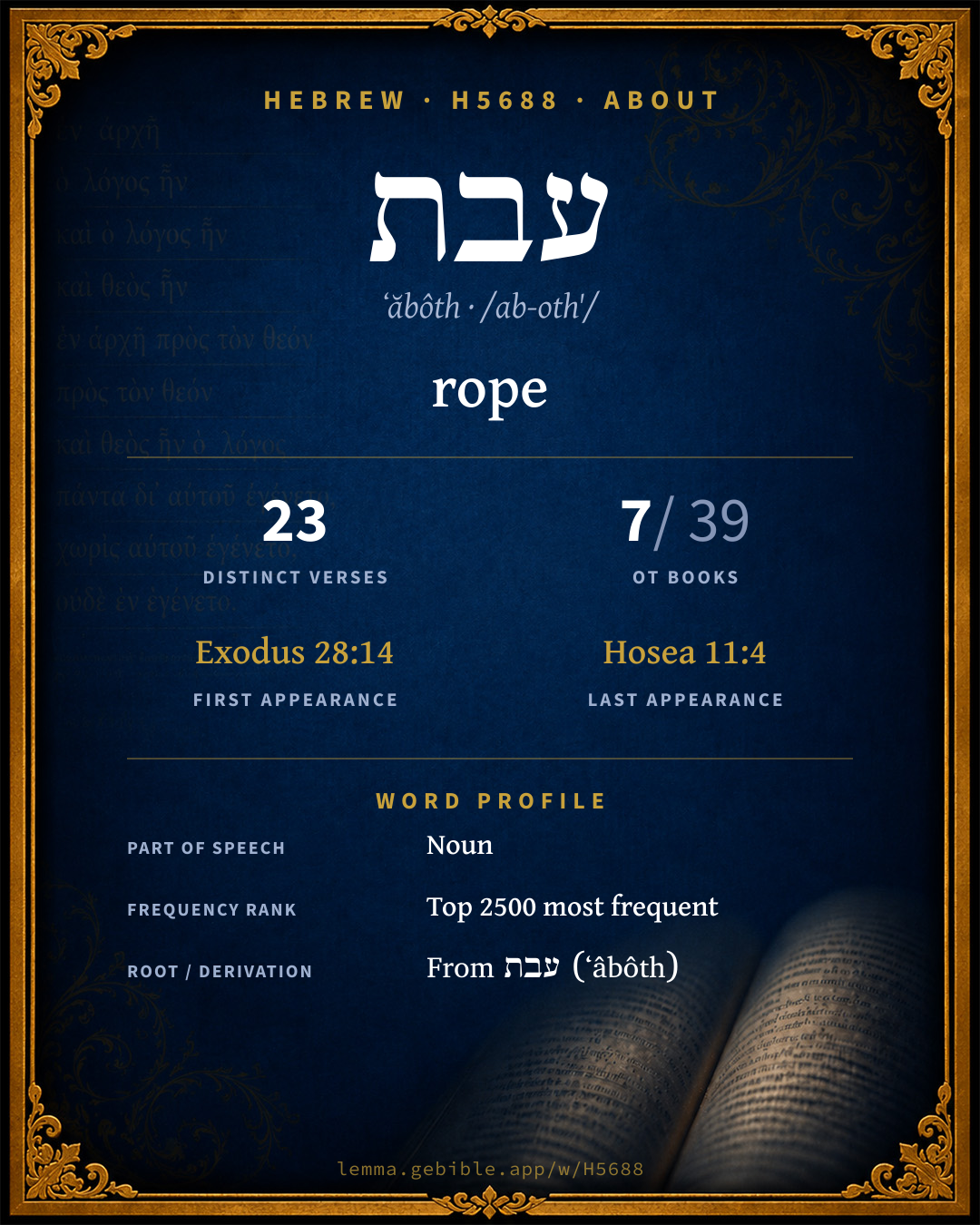
עֲבֹת
rope
also: cord, cordage, foliage, interwoven foliage fuller range ↓
Full lexicon entry — Brown-Driver-Briggs (BDB)
From Brown-Driver-Briggs (BDB)
Where this word appears
See every Absolute-state word in the Hebrew Bible →
Grammar key — what these labels mean
Part of speech
- Noun
- A naming word — a person, place, thing, or idea.
Noun type
- Common
- A common noun — a general class of person, place, or thing (“king,” “city,” “water”), not a specific name.
State
- Absolute
- The independent form of a noun, not bound to a following word.
- Construct
- A noun bound to a following noun in a possessive / “of” relationship (the construct chain).
Gender
- Both
- Attested as both masculine and feminine.
Number
- Plural
- More than one (in Hebrew, generally three or more).
- Singular
- One.
17 distinct verses where H5688 appears in the Absolute state, across 4 books. Filtered view — show all forms. Click any verse to open its interlinear word-by-word view. Verse text shown in the World English Bible for context — . Each verse’s Hebrew form is shown with its reference; the English is not keyword-highlighted, since the data carries no word-level English alignment. Use “Compare translations” on any verse to read it across multiple English versions. This concordance covers the Hebrew Bible; Septuagint (Greek Old Testament) occurrences are not indexed here.
Exodus 6 verses
- Exodus 28:14 עֲבֹ֑ת הָ/עֲבֹתֹ֖ת n c bs ptcl def.art + n c bp and two chains of pure gold; you make them like cords shall, of braided work: and you shall put the braided chains on the settings.
- Exodus 28:22 עֲבֹ֑ת n c bs You shall make on the breastplate chains like cords, of braided work of pure gold.
- Exodus 28:25 הָ/עֲבֹתֹ֔ת ptcl def.art + n c bp The other two ends of the two braided chains you shall put on the two settings, and put them on the shoulder-pieces of the ephod in the forepart of it.
- Exodus 39:15 עֲבֹ֑ת n c bs They made on the breastplate chains like cords, of braided work of pure gold.
- Exodus 39:17 הָ/עֲבֹתֹ֣ת ptcl def.art + n c bp They put the two braided chains of gold in the two rings at the ends of the breastplate.
- Exodus 39:18 הָֽ/עֲבֹתֹ֔ת ptcl def.art + n c bp The other two ends of the two braided chains they put on the two settings, and put them on the shoulder-pieces of the ephod, in the front of it.
Judges 4 verses
- Judges 15:13 עֲבֹתִ֣ים n c bp They spoke to him, saying, No; but we will bind you fast, and deliver you into their hand: but surely we will not kill you. They bound him with two new ropes, and brought him up from the rock.
- Judges 15:14 הָ/עֲבֹתִ֜ים ptcl def.art + n c bp When he came to Lehi, the Philistines shouted as they met him: and the Spirit of Yahweh came mightily on him, and the ropes that were on his arms became as flax that was burnt with fire, and his bands dropped from off his hands.
- Judges 16:11 בַּ/עֲבֹתִ֣ים prep + n c bp He said to her, If they only bind me with new ropes with which no work has been done, then shall I become weak, and be as another man.
- Judges 16:12 עֲבֹתִ֨ים n c bp So Delilah took new ropes, and bound him therewith, and said to him, The Philistines are on you, Samson. The liers-in-wait were abiding in the inner chamber. He broke them off his arms like a thread.
Psalms 1 verse
Ezekiel 6 verses
- Ezekiel 3:25 עֲבוֹתִ֔ים n c bp But you, son of man, behold, they shall lay bands on you, and shall bind you with them, and you shall not go out among them:
- Ezekiel 4:8 עֲבוֹתִ֑ים n c bp Behold, I lay bands on you, and you shall not turn you from one side to the other, until you have accomplished the days of your siege.
- Ezekiel 19:11 עֲבֹתִ֑ים n c bp It had strong rods for the scepters of those who bore rule, and their stature was exalted among the thick boughs, and they were seen in their height with the multitude of their branches.
- Ezekiel 31:3 עֲבֹתִ֔ים n c bp Behold, the Assyrian was a cedar in Lebanon with beautiful branches, and with a forest-like shade, and of high stature; and its top was among the thick boughs.
- Ezekiel 31:10 עֲבוֹתִ֔ים n c bp Therefore thus said the Lord Yahweh: Because you are exalted in stature, and he has set his top among the thick boughs, and his heart is lifted up in his height;
- Ezekiel 31:14 עֲבֹתִ֔ים n c bp to the end that none of all the trees by the waters exalt themselves in their stature, neither set their top among the thick boughs, nor that their mighty ones stand up on their height, [even] all who drink water: for they are all delivered to death, to the lower parts of the earth, in the midst of the children of men, with those who go down to the pit.
About this entry
At a glance — auto-summarized from this page’s data, not written by a person. Every figure links to its source below. This summary describes the numbers; it doesn’t interpret them.
The Hebrew noun עבת centers on the idea of “rope.” Its English rendering has broadened — “wreathen” classically, “ropes” (Berean Standard Bible) and “rope” (unfoldingWord Literal Text) in modern versions; see the renderings breakdown. Spanning 23 verses in 7 books, it ranks among the uncommon words of the Hebrew Bible. Exodus dominates its distribution — 7 of 23 verses. Beyond “rope” it also covers “cord”, “cordage”, and “foliage” — see its full sense range. Dig into 23-verse concordance and the renderings breakdown below.
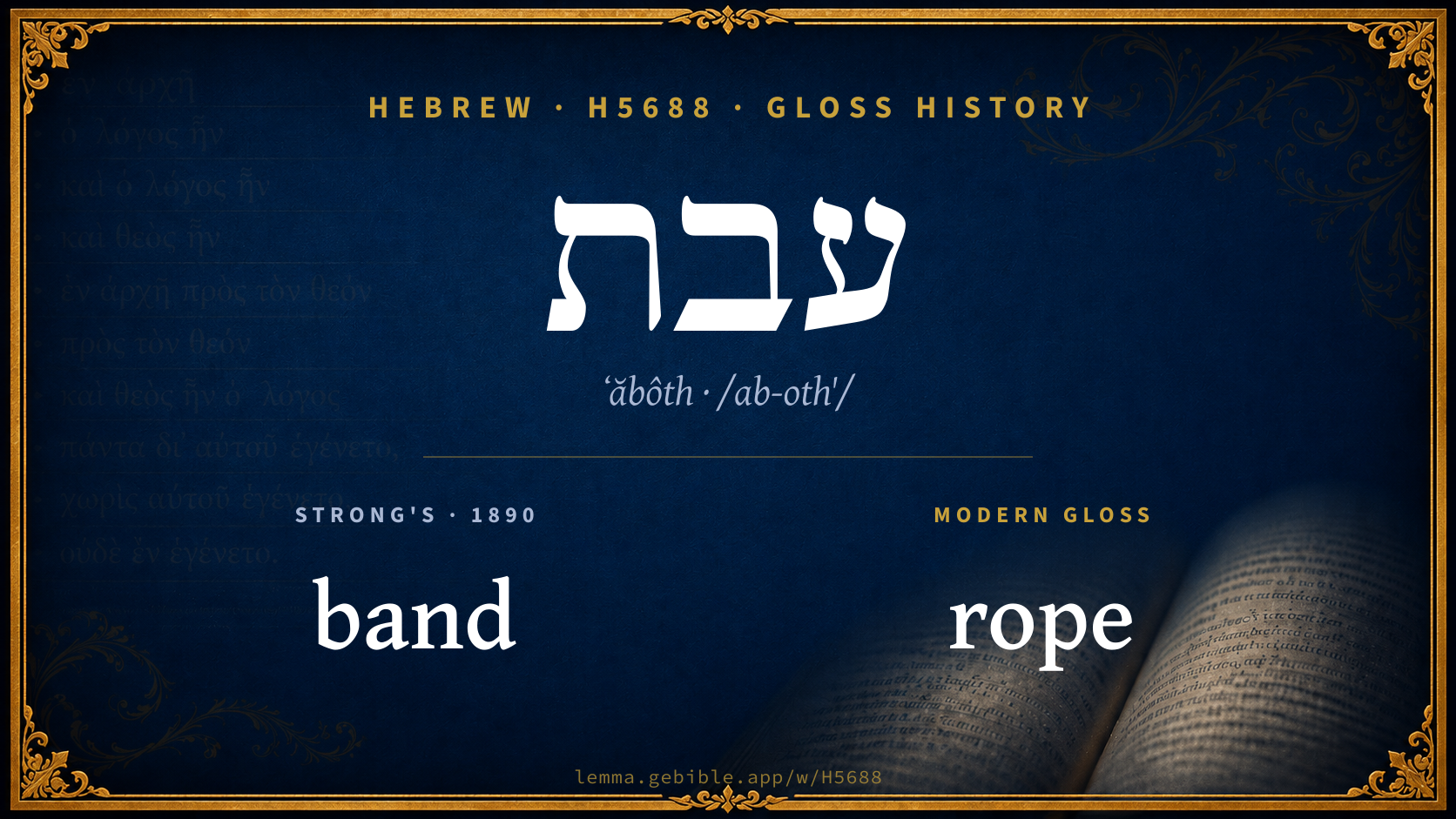
Gloss history
Strong's 1890 vs modern scholarship
About this word
Strong's H5688 catalogs a Hebrew word from the Hebrew Old Testament.
These counts are not copied from any lexicon or concordance. They are computed here, from the morphology-tagged Hebrew Old Testament. What Lemma adds →
- 23
- distinct verses
- The word appears in 23 distinct verses.
- 7 / 39
- OT books
- The word appears in 7 of 39 Old Testament books.
- #1,327
- by frequency
- Top 2500 most frequent Hebrew words (rank 1,327 of 8,640 Hebrew words by occurrence).
View all 23 occurrences in the concordance →
By section of the Old Testament
By traditional corpus
Conventional, traditional groupings — biblical authorship is debated, so this is a traditional corpus grouping, not an authorship claim. Each share is this word’s portion of its verses in that division of the Hebrew canon. Each figure is a share of the word’s 23 distinct verses.
- Prophets (Nevi'im) 12 verses · 52%
- Torah (Pentateuch) 7 verses · 30%
- Writings (Ketuvim) 4 verses · 17%
How translations render this word
Counts come from each version’s own published word-to-Strong’s tagging or interlinear alignment — an approximate guide to how each version renders this word, not a word-level alignment the data otherwise carries. Because each total is that version’s own tagged count, the per-version totals vary from one another and need not match the appearance or distinct-verse counts above. These counts may also differ from a printed concordance because Lemma counts each distinctly tagged rendering and does not collapse phrase taggings into a single head-word total. This is a fixed set of word-tagged versions (KJV, ASV, BSB, ULT) and does not change with the reading translation you choose elsewhere. Each version’s license is shown beside its name below (and on Sources).
BDB lists this Strong’s number as 2 distinct words (homographs). Each count above pools all of them and is not split by sense — see the Senses section below. A low-frequency rendering may belong to a different one of those words, not the primary meaning.
- King James Version†: Wreathen 7×, Cords 5×, Bands 3×
- American Standard Version†: Wreathen 6×, Among the thick boughs 3×, Ropes 3×
- Berean Standard Bible†: Ropes 8×, Chains 5×, Clouds 3×
- unfoldingWord Literal Text†: Rope 5×, Ropes 5×, Cords 3×
King James Version Public Domain
Renders H5688 across 25† tagged occurrences — most commonly:
Plus 6 renderings that appear only once — usually multi-word phrases or single function words the recovered tagging swept in, not distinct renderings.
American Standard Version Public Domain
Renders H5688 across 26† tagged occurrences — most commonly:
Plus 12 renderings that appear only once — usually multi-word phrases or single function words the recovered tagging swept in, not distinct renderings.
Berean Standard Bible Public Domain
Renders H5688 across 22† tagged occurrences — most commonly:
Plus 3 renderings that appear only once — usually multi-word phrases or single function words the recovered tagging swept in, not distinct renderings. Not rendered by a distinct English word in 2 further occurrences.
unfoldingWord Literal Text CC BY-SA 4.0
Renders H5688 across 31† tagged occurrences — most commonly:
Plus 7 renderings that appear only once — usually multi-word phrases or single function words the recovered tagging swept in, not distinct renderings.
Senses in the full BDB
What do BDB’s symbols mean?
BDB uses these scholarly abbreviations:
| Symbol | Meaning |
|---|---|
| 𝔊 | the Septuagint (the ancient Greek translation, LXX) |
| 𝔙 | the Vulgate (the Latin translation) |
| 𝔖 | the Syriac version (the Peshitta) |
| 𝔗 | the Targum (the Aramaic translation) |
| ψ | the Psalms |
| √ | root (the underlying root or stem) |
| ‖ | parallel passage (a synonymous or contrasted parallel) |
| † | the dagger: every passage where the word occurs is cited |
The 5 senses and sub-senses the full Brown-Driver-Briggs lexicon distinguishes for this word, in lexicon order (not ranked by frequency), with BDB’s own verbatim wording and sub-sense lettering. Shown in Hebrew script with BDB’s own scholarly abbreviations. The condensed entry is in the Lexicon Entry tab. See also the Forms in the corpus table below.
עבת I having interwoven foliage, leafy
עבת II
- 1. cord, rope:
- a. as fetter, Ju 15:13, 14; 16:11, 12; Ez 3:25; 4:8; Jb 39:10 (of wild ox), so also prob. ψ 118:27 bind the festal victim (חַג) with cords Ew Ol De Hup-Now Dr al.; > with branches Che, cf. Bae Du; fig. of authority ψ 2:3 (‖ מוֹסְרוֹתֵימוֹ), 129:4. e.g. Judges 15:13
- b. עֲבוֹת הָעֲגָלָה Is 5:18 i.e. with which a cart is drawn (in sim.; ‖ חַבְלֵי הַשָּׁוְא); fig. עֲבֹתוֹת אַהֲבָה Ho 11:4 with the cords of love, of י׳’s drawing Isr. (‖ חַבְלֵי אָדָם). e.g. Isaiah 5:18
- c. cordage, cord, of (twisted) golden chains on high priest’s breast-piece (all P): מַעֲשֵׂה עֲבֹת, cordage-work Ex 28:14, 22; 39:15; שַׁרְשְׁרֹת הָעֲבֹתֹת 28:14 the chains of cords (cordlike chains); שְׁתֵּי (הָ)עֲבֹתֹת the two cords v 24, 25; 39:17, 18. e.g. Exodus 28:14
- 2. interwoven foliage (?) in phr. (עַל־)בֵּין עֲבֹתִים of top of a vine Ez 19:11 (clouds Ew Hi-Sm Toy, read then עָבוֹת); of cedar, 31:3, 10, 14, but in these certainly clouds, so 𝔊 Ew Hi-Sm Co al. e.g. Ezekiel 19:11
Senses from the full Brown-Driver-Briggs lexicon (Brown, Driver, Briggs; Oxford 1906 — public domain), digitized via Sefaria, supplemented by the OpenScriptures HebrewLexicon (CC BY 4.0). Full attribution on Sources.
Word origin
II. adj. having interwoven foliage, leafy;—עֵץ עָבוֹת leafy trees Ez 20:28; Ne 8:15; עֵץ עָבֹת Lv 23:40 (H); f. אֵלָה עֲבֻתָּה Ez 6:13 a leafy terebinth.—עָבוֹת 2 S 23:4 ψ 77:18 v. ii. עָב sub עוּב.
I. n.m. Ju 15:13 + et f. Ju 15:14; Jb 39:10 (twisted) cord, rope; cordage; interwoven foliage (?);—abs. ע׳ Ex 28:14 + 2 times; cstr. עֲבוֹת Is 5:18 ψ 129:4; sf. 3 ms. עֲבֹתוֹ Jb 39:10, 3 mpl. עֲבֹתֵ֑ימוֹ ψ 2:3; pl. עֲבֹתִים Ju 15:13 +, עֲבֹתֹת Ex 28:14 +, etc.;—
— Brown-Driver-Briggs (Oxford 1906, public domain), digitized via Sefaria, supplemented by the OpenScriptures HebrewLexicon (CC BY 4.0). See Sources.
Derived from עבת (ʻâbôth) (H5687) — leafy.
Forms in the corpus
The 20 distinct written forms H5688 takes in the Hebrew Bible, most frequent first — each parse links to that state’s occurrences in the concordance. Hebrew forms include their vowel points and cantillation, so a single lemma takes many written forms.
Septuagint verse parallels
This word appears in 21 verses that also exist in the Greek Old Testament (Septuagint), out of the 23 Hebrew verses it occurs in. You can read those verses in Greek by switching the Old Testament edition to the Septuagint.
Read these verses in the Septuagint
This is a verse-level parallel only — the same verses exist in both the Hebrew and Greek Old Testaments. No word-level Hebrew↔Greek correspondence is claimed: the data carries no such alignment, so no Greek word is shown as this Hebrew word’s translation. Coverage is not total — the Septuagint omits the deuterocanon and renumbers the Psalms, so some Hebrew verses have no direct Greek parallel.