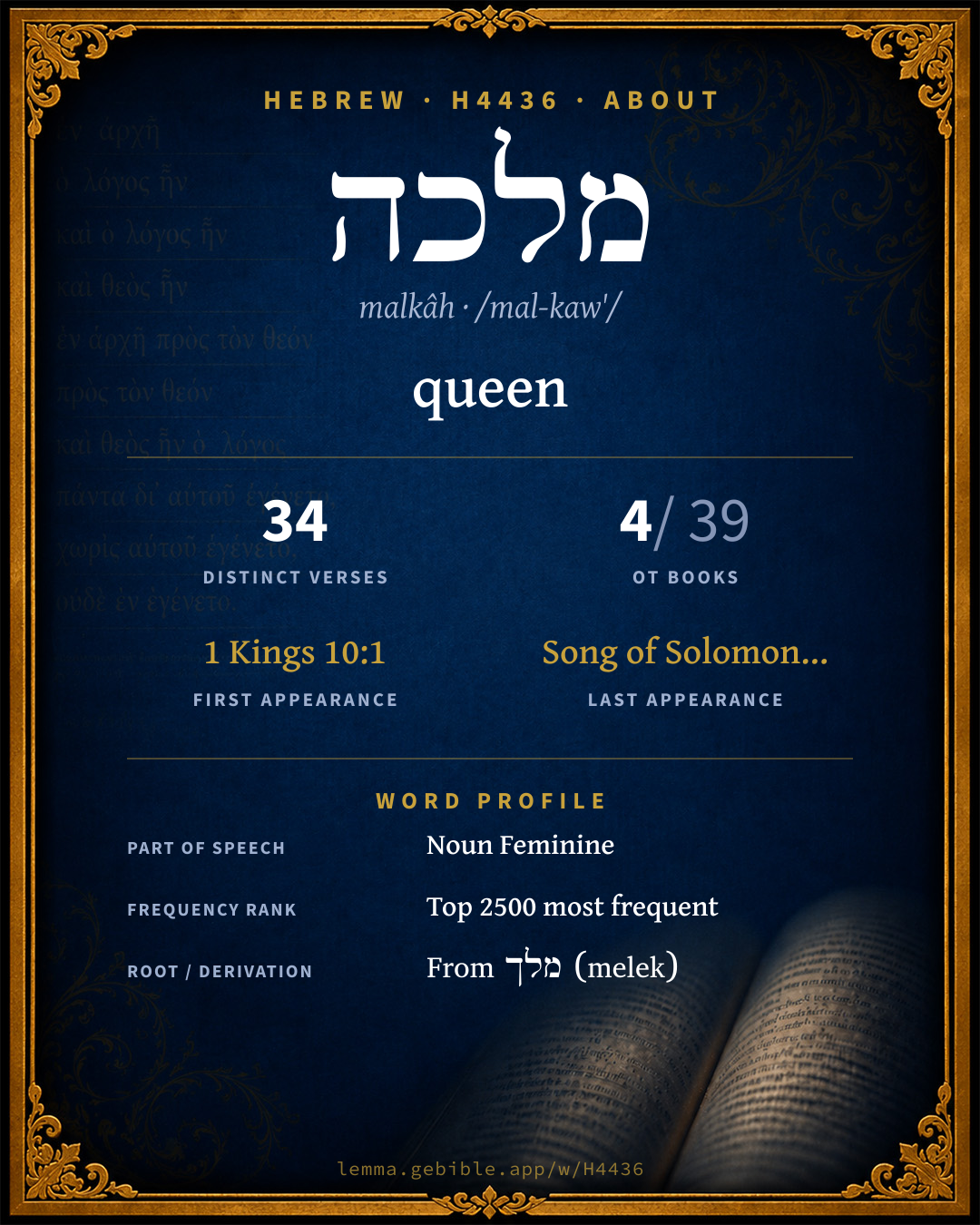
מַלְכָּה
queen
Full lexicon entry — Brown-Driver-Briggs (BDB)
From Brown-Driver-Briggs (BDB)
Where this word appears
See every Absolute-state word in the Hebrew Bible →
Grammar key — what these labels mean
Part of speech
- Noun
- A naming word — a person, place, thing, or idea.
Noun type
- Common
- A common noun — a general class of person, place, or thing (“king,” “city,” “water”), not a specific name.
State
- Absolute
- The independent form of a noun, not bound to a following word.
- Construct
- A noun bound to a following noun in a possessive / “of” relationship (the construct chain).
Gender
- Feminine
- Grammatically feminine.
Number
- Singular
- One.
- Plural
- More than one (in Hebrew, generally three or more).
Grammatical forms
- Noun, Common, Feminine, Singular, Absolute 25 times (71%)
- Noun, Common, Feminine, Singular, Construct 8 times (23%)
- Noun, Common, Feminine, Plural, Absolute 2 times (6%)
Parsed forms decoded from the imported morphology (morphhb / Westminster Leningrad Codex — WLC text public domain, morphhb tagging CC BY 4.0), counted across 35 parsed occurrences — not distinct verses.
Every verse where H4436 appears — 34 distinct verses across 4 books. Click any verse to open its interlinear word-by-word view. Verse text shown in the World English Bible for context — . Each verse’s Hebrew form is shown with its reference; the English is not keyword-highlighted, since the data carries no word-level English alignment. Use “Compare translations” on any verse to read it across multiple English versions. This concordance covers the Hebrew Bible; Septuagint (Greek Old Testament) occurrences are not indexed here.
1 Kings 4 verses
- 1 Kings 10:1 וּ/מַֽלְכַּת conj + n c fs cs When the queen of Sheba heard of the fame of Solomon concerning the name of Yahweh, she came to prove him with hard questions.
- 1 Kings 10:4 מַֽלְכַּת n c fs cs When the queen of Sheba had seen all the wisdom of Solomon, and the house that he had built,
- 1 Kings 10:10 מַֽלְכַּת n c fs cs She gave the king one hundred twenty talents of gold, and of spices very great store, and precious stones: there came no more such abundance of spices as these which the queen of Sheba gave to king Solomon.
- 1 Kings 10:13 לְ/מַֽלְכַּת prep + n c fs cs King Solomon gave to the queen of Sheba all her desire, whatever she asked, besides that which Solomon gave her of his royal bounty. So she turned, and went to her own land, she and her servants.
2 Chronicles 4 verses
- 2 Chronicles 9:1 וּ/מַֽלְכַּת conj + n c fs cs When the queen of Sheba heard of the fame of Solomon, she came to prove Solomon with hard questions at Jerusalem, with a very great train, and camels that bore spices, and gold in abundance, and precious stones: and when she was come to Solomon, she talked with him of all that was in her heart.
- 2 Chronicles 9:3 מַֽלְכַּת n c fs cs When the queen of Sheba had seen the wisdom of Solomon, and the house that he had built,
- 2 Chronicles 9:9 מַֽלְכַּת n c fs cs She gave the king one hundred and twenty talents of gold, and spices in great abundance, and precious stones: neither was there any such spice as the queen of Sheba gave to king Solomon.
- 2 Chronicles 9:12 לְ/מַֽלְכַּת prep + n c fs cs King Solomon gave to the queen of Sheba all her desire, whatever she asked, besides that which she had brought to the king. So she turned, and went to her own land, she and her servants.
Esther 24 verses
- Esther 1:9 הַ/מַּלְכָּ֔ה ptcl def.art + n c fs Also Vashti the queen made a feast for the women in the royal house which belonged to king Ahasuerus.
- Esther 1:11 הַ/מַּלְכָּ֛ה ptcl def.art + n c fs to bring Vashti the queen before the king with the crown royal, to show the peoples and the princes her beauty; for she was beautiful to look on.
- Esther 1:12 הַ/מַּלְכָּ֣ה ptcl def.art + n c fs But the queen Vashti refused to come at the king's commandment by the chamberlains: therefore was the king very angry, and his anger burned in him.
- Esther 1:15 בַּ/מַּלְכָּ֖ה prep det + n c fs What shall we do to the queen Vashti according to law, because she has not done the bidding of the king Ahasuerus by the chamberlains?
- Esther 1:16 הַ/מַּלְכָּ֑ה ptcl def.art + n c fs Memucan answered before the king and the princes, Vashti the queen has not done wrong to the king only, but also to all the princes, and to all the peoples who are in all the provinces of the king Ahasuerus.
- Esther 1:17 הַ/מַּלְכָּה֙ הַ/מַּלְכָּ֛ה ptcl def.art + n c fs ptcl def.art + n c fs For this deed of the queen will come abroad to all women, to make their husbands contemptible in their eyes, when it shall be reported, The king Ahasuerus commanded Vashti the queen to be brought in before him, but she didn't come.
- Esther 1:18 הַ/מַּלְכָּ֔ה ptcl def.art + n c fs This day will the princesses of Persia and Media who have heard of the deed of the queen say [the like] to all the king's princes. So [will there arise] much contempt and wrath.
- Esther 2:22 הַ/מַּלְכָּ֑ה ptcl def.art + n c fs The thing became known to Mordecai, who shown it to Esther the queen; and Esther told the king [of it] in Mordecai's name.
- Esther 4:4 הַ/מַּלְכָּ֖ה ptcl def.art + n c fs Esther's maidens and her chamberlains came and told it her; and the queen was exceedingly grieved: and she sent clothing to clothe Mordecai, and to take his sackcloth from off him; but he didn't receive it.
- Esther 5:2 הַ/מַּלְכָּ֗ה ptcl def.art + n c fs It was so, when the king saw Esther the queen standing in the court, that she obtained favor in his sight; and the king held out to Esther the golden scepter that was in his hand. So Esther drew near, and touched the top of the scepter.
- Esther 5:3 הַ/מַּלְכָּ֑ה ptcl def.art + n c fs Then said the king to her, What will you, queen Esther? and what is your request? it shall be given you even to the half of the kingdom.
- Esther 5:12 הַ/מַּלְכָּ֧ה ptcl def.art + n c fs Haman said moreover, Yes, Esther the queen did let no man come in with the king to the banquet that she had prepared but myself; and tomorrow also am I invited by her together with the king.
- Esther 7:1 הַ/מַּלְכָּֽה ptcl def.art + n c fs So the king and Haman came to banquet with Esther the queen.
- Esther 7:2 הַ/מַּלְכָּ֖ה ptcl def.art + n c fs The king said again to Esther on the second day at the banquet of wine, What is your petition, queen Esther? and it shall be granted you: and what is your request? even to the half of the kingdom it shall be performed.
- Esther 7:3 הַ/מַּלְכָּה֙ ptcl def.art + n c fs Then Esther the queen answered, If I have found favor in your sight, O king, and if it please the king, let my life be given me at my petition, and my people at my request:
- Esther 7:5 הַ/מַּלְכָּ֑ה ptcl def.art + n c fs Then spoke the king Ahasuerus and said to Esther the queen, Who is he, and where is he, that dared presume in his heart to do so?
- Esther 7:6 וְ/הַ/מַּלְכָּֽה conj + ptcl def.art + n c fs Esther said, An adversary and an enemy, even this wicked Haman. Then Haman was afraid before the king and the queen.
- Esther 7:7 הַ/מַּלְכָּ֔ה ptcl def.art + n c fs The king arose in his wrath from the banquet of wine [and went] into the palace garden: and Haman stood up to make request for his life to Esther the queen; for he saw that there was evil determined against him by the king.
- Esther 7:8 הַ/מַּלְכָּ֛ה ptcl def.art + n c fs Then the king returned out of the palace garden into the place of the banquet of wine; and Haman was fallen on the couch whereon Esther was. Then said the king, Will he even force the queen before me in the house? As the word went out of the king's mouth, they covered Haman's face.
- Esther 8:1 הַ/מַּלְכָּ֔ה ptcl def.art + n c fs On that day did the king Ahasuerus give the house of Haman the Jews' enemy to Esther the queen. Mordecai came before the king; for Esther had told what he was to her.
- Esther 8:7 הַ/מַּלְכָּ֔ה ptcl def.art + n c fs Then the king Ahasuerus said to Esther the queen and to Mordecai the Jew, See, I have given Esther the house of Haman, and him they have hanged on the gallows, because he laid his hand on the Jews.
- Esther 9:12 הַ/מַּלְכָּ֗ה ptcl def.art + n c fs The king said to Esther the queen, The Jews have slain and destroyed five hundred men in Shushan the palace, and the ten sons of Haman; what then have they done in the rest of the king's provinces! Now what is your petition? and it shall be granted you: or what is your request further? and it shall be done.
- Esther 9:29 הַ/מַּלְכָּ֧ה ptcl def.art + n c fs Then Esther the queen, the daughter of Abihail, and Mordecai the Jew, wrote with all authority to confirm this second letter of Purim.
- Esther 9:31 הַ/מַּלְכָּ֔ה ptcl def.art + n c fs to confirm these days of Purim in their appointed times, according as Mordecai the Jew and Esther the queen had enjoined them, and as they had ordained for themselves and for their seed, in the matter of the fastings and their cry.
Song of Solomon 2 verses
- Song of Solomon 6:8 מְּלָכ֔וֹת n c fp There are sixty queens, eighty concubines, And virgins without number.
- Song of Solomon 6:9 מְלָכ֥וֹת n c fp My dove, my perfect one, is unique. She is her mother's only daughter. She is the favorite one of her who bore her. The daughters saw her, and called her blessed, The queens and the concubines, and they praised her.
About this entry
At a glance — auto-summarized from this page’s data, not written by a person. Every figure links to its source below. This summary describes the numbers; it doesn’t interpret them.
At its core, מלכה (malkâh) means “queen.” Its uses cluster heavily in Esther (71% of all occurrences). With 34 verses in 4 books, it is a moderately common word in the Hebrew Bible. Scripture first uses it in 1 Kings 10:1. Sharing its root, it stands alongside מלך, מלך and מלכא. Each statement above links to its evidence; the full detail follows below.
Gloss history
Strong's 1890 vs modern scholarship
About this word
Strong's H4436 catalogs a Hebrew word from the Hebrew Old Testament.
These counts are not copied from any lexicon or concordance. They are computed here, from the morphology-tagged Hebrew Old Testament. What Lemma adds →
- 34
- distinct verses
- The word appears in 34 distinct verses.
- 4 / 39
- OT books
- The word appears in 4 of 39 Old Testament books.
- #1,023
- by frequency
- Top 2500 most frequent Hebrew words (rank 1,023 of 8,640 Hebrew words by occurrence).
View all 34 occurrences in the concordance →
Most concentrated in
- Esther 24 verses 71%
- 1 Kings 4 verses 12%
- 2 Chronicles 4 verses 12%
By section of the Old Testament
By traditional corpus
Conventional, traditional groupings — biblical authorship is debated, so this is a traditional corpus grouping, not an authorship claim. Each share is this word’s portion of its verses in that division of the Hebrew canon. Each figure is a share of the word’s 34 distinct verses.
- Writings (Ketuvim) 30 verses · 88%
- Prophets (Nevi'im) 4 verses · 12%
How translations render this word
Counts come from each version’s own published word-to-Strong’s tagging or interlinear alignment — an approximate guide to how each version renders this word, not a word-level alignment the data otherwise carries. Because each total is that version’s own tagged count, the per-version totals vary from one another and need not match the appearance or distinct-verse counts above. These counts may also differ from a printed concordance because Lemma counts each distinctly tagged rendering and does not collapse phrase taggings into a single head-word total. This is a fixed set of word-tagged versions (KJV, ASV, BSB, ULT) and does not change with the reading translation you choose elsewhere. Each version’s license is shown beside its name below (and on Sources).
- King James Version: Queen 31×
- American Standard Version: Queen 30×, Her 2×
- Berean Standard Bible: Queen 30×, Now when the queen 2×, Queens 2×
- unfoldingWord Literal Text: Queen 25×, Queen of 7×, Queens 2×
King James Version Public Domain
Renders H4436 across 35 tagged occurrences — most commonly:
Plus 4 renderings that appear only once — usually multi-word phrases or single function words the recovered tagging swept in, not distinct renderings.
American Standard Version Public Domain
Renders H4436 across 35 tagged occurrences — most commonly:
Plus 3 renderings that appear only once — usually multi-word phrases or single function words the recovered tagging swept in, not distinct renderings.
Berean Standard Bible Public Domain
Renders H4436 across 35 tagged occurrences — most commonly:
Plus 1 rendering that appears only once — usually multi-word phrases or single function words the recovered tagging swept in, not distinct renderings.
unfoldingWord Literal Text CC BY-SA 4.0
Renders H4436 across 35 tagged occurrences — most commonly:
Plus 1 rendering that appears only once — usually multi-word phrases or single function words the recovered tagging swept in, not distinct renderings.
Senses in BDB
The 1 sense BDB distinguishes for this word, in lexicon order (not ranked by frequency or importance). The full entry — with sub-senses — is in the Lexicon Entry tab.
- queen
Word origin
n.f. queen:—abs. מ׳ Est 1:9 + 24 times Est.; cstr. מַלְכַּת 1 K 10:1 + 7 times; pl. מְלָכוֹת Ct 6:8, 9;—queen of Sheba 1 K 10:1, 4, 10, 13 = 2 Ch 9:1, 3, 9, 12; of Persia, Vashti Est 1:9 + 7 times Est 1; Esther Est 2:22 + 16 times Est 4–9 (in Esther mostly appos. of n.pr.; it precedes n.pr. Est 1:12, 15; follows n.pr. Est 1:9 + 17 times); of Isr. queens only pl. and only Ct 6:8, 9 (both ‖ פִּילַגְשִׁים). Cf. גְּבִירָה.
— Brown-Driver-Briggs (Oxford 1906, public domain), digitized via Sefaria, supplemented by the OpenScriptures HebrewLexicon (CC BY 4.0). See Sources.
Derived from מלך (melek) (H4428) — king.
Jastrow Dictionary
A second Hebrew/Aramaic lexicon for comparison, covering Aramaic and post-biblical (Talmudic, Targumic, Midrashic) usage that the biblical-Hebrew BDB does not. Matched by lemma rather than by Strong’s number, so a lemma may carry more than one Jastrow headword (shown separately below), and the entries cover usage well beyond the Bible.
מַלְכָּה
- queen, king’s wife. B. Bath. 15ᵇ כל האומר מַלְכַּת שבא וכ׳ whoever says malkath Sheba (I Kings X, 1) means a woman is mistaken; … it means the kingdom (מַלְכֻת) of Sheba. Sabb. 119ᵃ שבת המ׳ the queen Sabbath; a. fr. e.g. 1 Kings 10:1
A Dictionary of the Targumim, the Talmud Babli and Yerushalmi, and the Midrashic Literature (Marcus Jastrow; London, Luzac, 1903) — Public Domain. Digitized via Sefaria. Digitized via Sefaria. Full attribution on Sources.
Forms in the corpus
The 16 distinct written forms H4436 takes in the Hebrew Bible, most frequent first — each parse links to that state’s occurrences in the concordance. Hebrew forms include their vowel points and cantillation, so a single lemma takes many written forms.
Same root — word family
Other BDB entries built from the same root as H4436, grouped by Strong’s listed origin. These share a root / origin per the lexicon — not necessarily a shared meaning. Each links to that word’s own entry.
Derives from
Shares the same root
Derived from this word
Proper names from this root
People and places named from this root — a name, not an additional meaning of the word.
- מלך Melek H4429 Melech
- מלכיאל Malkîyʼêl H4439 Malchiel
- מלכיה Malkîyâh H4441 Malchijah
- מלכיצדק Malkîy-Tsedeq H4442 Melchizedek
- מלכירם Malkîyrâm H4443 Malchiram
- מלכישוע Malkîyshûwaʻ H4444 Malchishua
- מלכם Malkâm H4445 Milcom
- מלכה Milkâh H4435 Milcah
Compare all same-root words → Showing 4 of 12 — not the complete family. 8 of the same-root words are proper names (people or places). They share a root, not necessarily a meaning.
Septuagint verse parallels
This word appears in 34 verses that also exist in the Greek Old Testament (Septuagint), out of the 34 Hebrew verses it occurs in. You can read those verses in Greek by switching the Old Testament edition to the Septuagint.
Read these verses in the Septuagint
This is a verse-level parallel only — the same verses exist in both the Hebrew and Greek Old Testaments. No word-level Hebrew↔Greek correspondence is claimed: the data carries no such alignment, so no Greek word is shown as this Hebrew word’s translation. Coverage is not total — the Septuagint omits the deuterocanon and renumbers the Psalms, so some Hebrew verses have no direct Greek parallel.