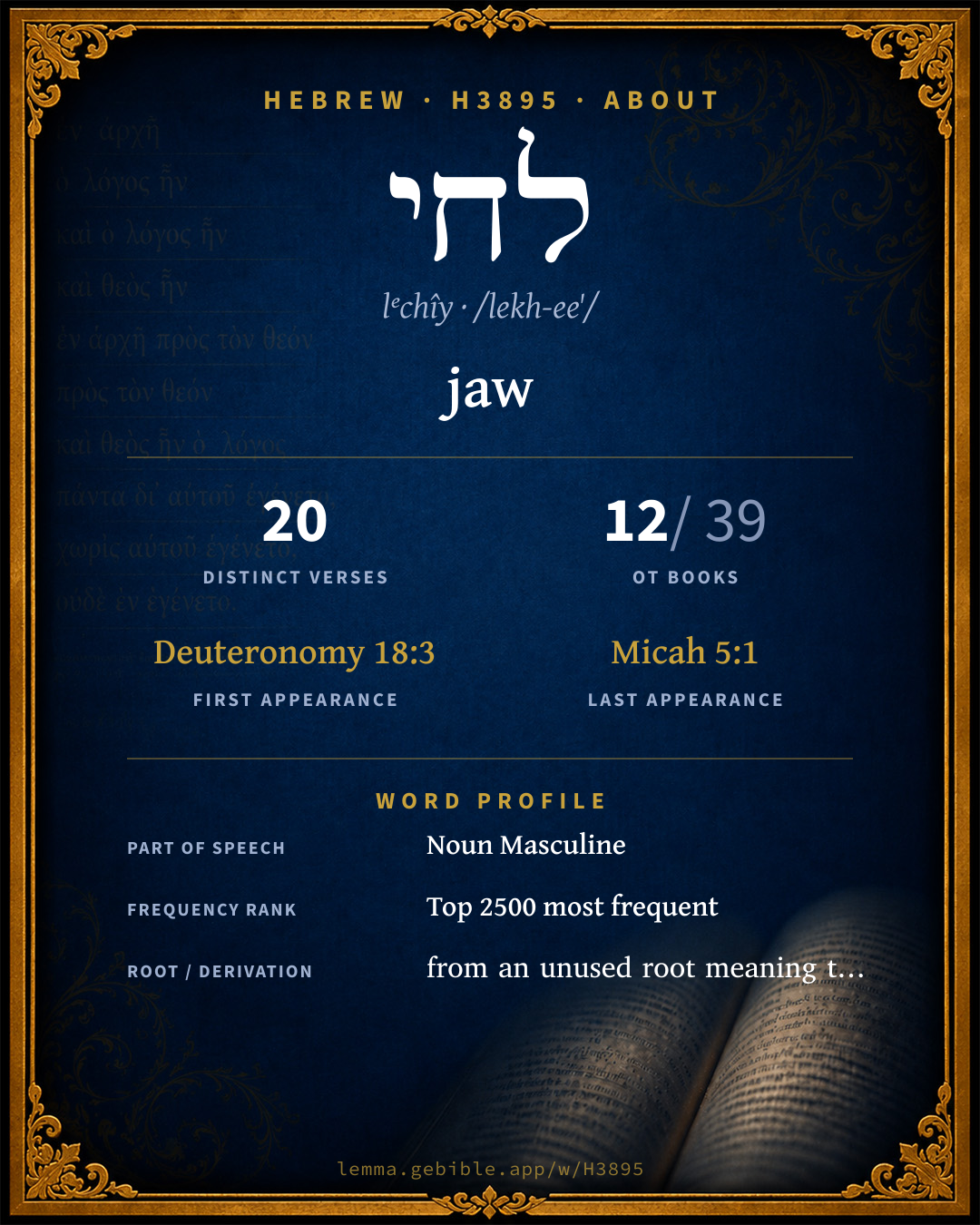
לְחִי
jaw
‘jaw’ is one of 3 main senses fuller range ↓
Full lexicon entry — Brown-Driver-Briggs (BDB)
From Brown-Driver-Briggs (BDB)
Where this word appears
See every Absolute-state word in the Hebrew Bible →
Grammar key — what these labels mean
Part of speech
- Noun
- A naming word — a person, place, thing, or idea.
Noun type
- Common
- A common noun — a general class of person, place, or thing (“king,” “city,” “water”), not a specific name.
- Proper
- A name of a specific person, place, or people (e.g. Abraham, Zion, Israel).
State
- Absolute
- The independent form of a noun, not bound to a following word.
- Construct
- A noun bound to a following noun in a possessive / “of” relationship (the construct chain).
Gender
- Both
- Attested as both masculine and feminine.
Number
- Singular
- One.
- Dual
- Exactly two — for natural pairs and some measures of time.
- Plural
- More than one (in Hebrew, generally three or more).
1 verse where H3895 appears in the Construct state in the Book of Lamentations. Filtered view — show all forms. Click any verse to open its interlinear word-by-word view. Verse text shown in the World English Bible for context — . Each verse’s Hebrew form is shown with its reference; the English is not keyword-highlighted, since the data carries no word-level English alignment. Use “Compare translations” on any verse to read it across multiple English versions. This concordance covers the Hebrew Bible; Septuagint (Greek Old Testament) occurrences are not indexed here.
Lamentations
About this entry
At a glance — auto-summarized from this page’s data, not written by a person. Every figure links to its source below. This summary describes the numbers; it doesn’t interpret them.
לחי — transliterated lᵉchîy — is a Hebrew noun carrying the sense “jaw.” Where the King James Version says “cheek,” newer translations reach for “cheeks” (Berean Standard Bible); the renderings breakdown has the detail. The Hebrew Bible uses it across 20 verses — uncommon. Debuting at Deuteronomy 18:3, it then recurs through the corpus. The lexicon spreads it across several senses; see its full sense range. See the sense tree, 20-verse concordance, and the renderings breakdown below.
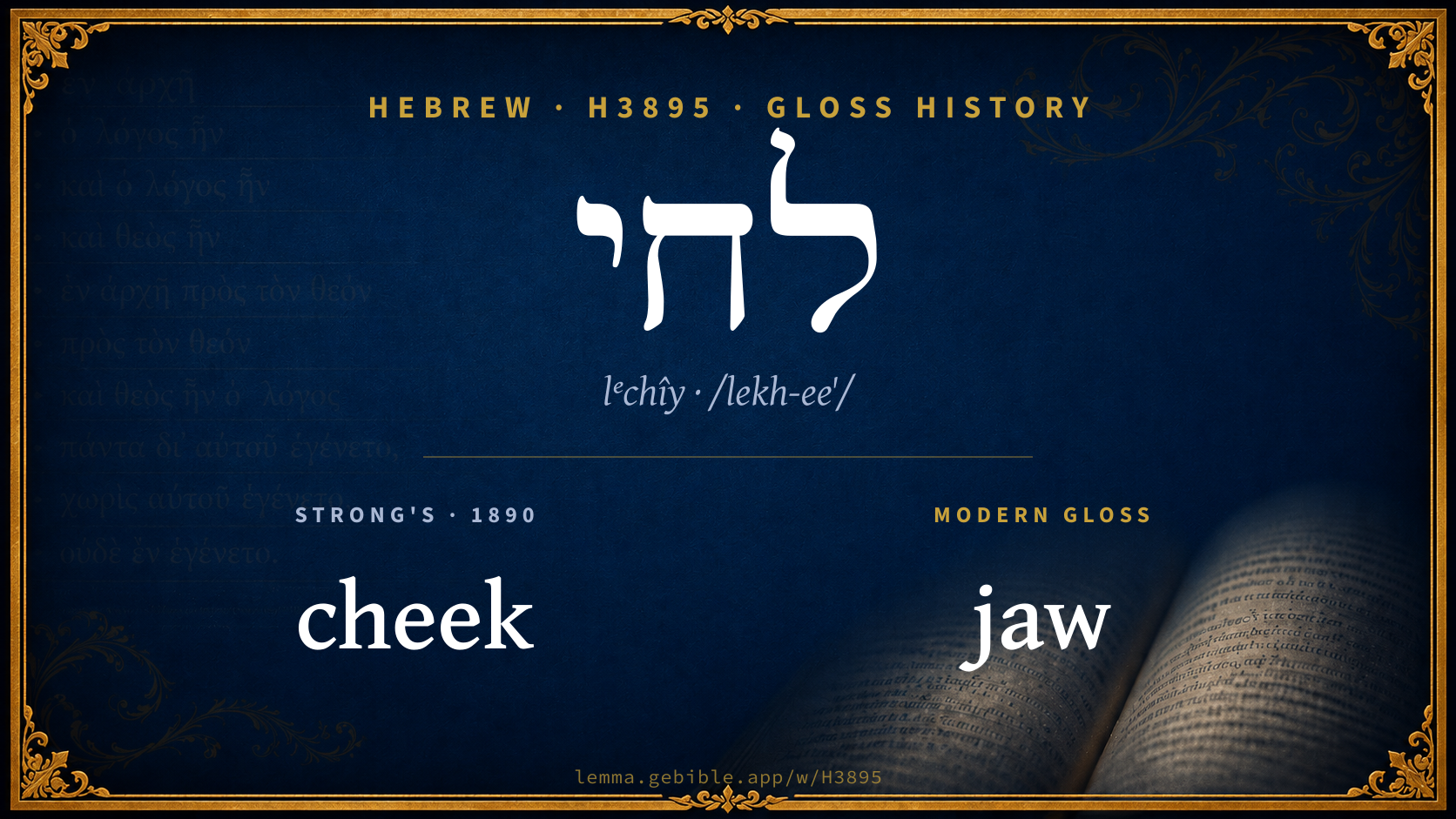
Gloss history
Strong's 1890 vs modern scholarship
About this word
Strong's H3895 catalogs a Hebrew word from the Hebrew Old Testament.
These counts are not copied from any lexicon or concordance. They are computed here, from the morphology-tagged Hebrew Old Testament. What Lemma adds →
- 20
- distinct verses
- The word appears in 20 distinct verses.
- 12 / 39
- OT books
- The word appears in 12 of 39 Old Testament books.
- #1,462
- by frequency
- Top 2500 most frequent Hebrew words (rank 1,462 of 8,640 Hebrew words by occurrence).
View all 20 occurrences in the concordance →
Most concentrated in
- Judges 4 verses 20%
- Job 2 verses 10%
- Song of Solomon 2 verses 10%
By section of the Old Testament
By traditional corpus
Conventional, traditional groupings — biblical authorship is debated, so this is a traditional corpus grouping, not an authorship claim. Each share is this word’s portion of its verses in that division of the Hebrew canon. Each figure is a share of the word’s 20 distinct verses.
- Prophets (Nevi'im) 11 verses · 55%
- Writings (Ketuvim) 8 verses · 40%
- Torah (Pentateuch) 1 verse · 5%
How translations render this word
Counts come from each version’s own published word-to-Strong’s tagging or interlinear alignment — an approximate guide to how each version renders this word, not a word-level alignment the data otherwise carries. Because each total is that version’s own tagged count, the per-version totals vary from one another and need not match the appearance or distinct-verse counts above. These counts may also differ from a printed concordance because Lemma counts each distinctly tagged rendering and does not collapse phrase taggings into a single head-word total. This is a fixed set of word-tagged versions (KJV, ASV, BSB, ULT) and does not change with the reading translation you choose elsewhere. Each version’s license is shown beside its name below (and on Sources).
BDB lists this Strong’s number as 3 distinct words (homographs). Each count above pools all of them and is not split by sense — see the Senses section below. A low-frequency rendering may belong to a different one of those words, not the primary meaning.
- King James Version†: Cheek 5×, Jaws 4×, Cheeks 3×
- American Standard Version†: Cheek 5×, Jawbone 4×, Cheeks 3×
- Berean Standard Bible†: Cheeks 5×, Jawbone 4×, Jaws 3×
- unfoldingWord Literal Text†: Cheek 6×, Cheeks 4×, Jaw 3×
King James Version Public Domain
Renders H3895 across 21† tagged occurrences — most commonly:
Plus 4 renderings that appear only once — usually multi-word phrases or single function words the recovered tagging swept in, not distinct renderings.
American Standard Version Public Domain
Renders H3895 across 21† tagged occurrences — most commonly:
Plus 6 renderings that appear only once — usually multi-word phrases or single function words the recovered tagging swept in, not distinct renderings.
Berean Standard Bible Public Domain
Renders H3895 across 21† tagged occurrences — most commonly:
Plus 3 renderings that appear only once — usually multi-word phrases or single function words the recovered tagging swept in, not distinct renderings.
unfoldingWord Literal Text CC BY-SA 4.0
Renders H3895 across 23† tagged occurrences — most commonly:
Plus 7 renderings that appear only once — usually multi-word phrases or single function words the recovered tagging swept in, not distinct renderings.
Senses in the full BDB
What do BDB’s symbols mean?
BDB uses these scholarly abbreviations:
| Symbol | Meaning |
|---|---|
| 𝔊 | the Septuagint (the ancient Greek translation, LXX) |
| 𝔙 | the Vulgate (the Latin translation) |
| 𝔖 | the Syriac version (the Peshitta) |
| 𝔗 | the Targum (the Aramaic translation) |
| ψ | the Psalms |
| √ | root (the underlying root or stem) |
| ‖ | parallel passage (a synonymous or contrasted parallel) |
| † | the dagger: every passage where the word occurs is cited |
The 2 senses and sub-senses the full Brown-Driver-Briggs lexicon distinguishes for this word, in lexicon order (not ranked by frequency), with BDB’s own verbatim wording and sub-sense lettering. Shown in Hebrew script with BDB’s own scholarly abbreviations. The condensed entry is in the Lexicon Entry tab. See also the Forms in the corpus table below.
לחי I
- 1. jaw, jawbone, of animal, Ju 15:15, 16(×2), 17 (under jaw of ass), cf. n.pr.loc. רָמַת לֶ֑חִי v 17; in sim. כִּמְרִימֵי עֹל עַל־לְחֵיהֶם Ho 11:4 like those lifting up a yoke from upon (read מֵעַל?) their jaws (Isr. under fig. of oxen); of sacrificial ox or sheep Dt 18:3; of crocodile Jb 40:26; of Pharaoh under fig. of תַּנִּים Ez 29:4 (cf. v 3); cf. 38:4 Is 30:28. e.g. Judges 15:15
- 2. cheek, of man 1 K 22:24 = 2 Ch 18:23, Jb 16:10 ψ 3:8 Ct 5:13; Is 50:6; La 3:30; Mi 4:14; of woman Ct 1:10; La 1:2 (fig. of Jerusalem). e.g. 1 Kings 22:24
לחי II loc. scene of an exploit of Samson
Senses from the full Brown-Driver-Briggs lexicon (Brown, Driver, Briggs; Oxford 1906 — public domain), digitized via Sefaria, supplemented by the OpenScriptures HebrewLexicon (CC BY 4.0). Full attribution on Sources.
Word origin
I. n.m. Ct 1:10 jaw, cheek (NH id.; Aramaic לוֹחָא; Arabic لَحْىٌ; on Assyrian laḫû cf. DlHWB 375, but ح = ḫ?);—ל׳ abs. Ju 15:17 Mi 4:14; cstr. Ju 15:15 + 2 times; לֶ֑חִי 1 K 22:24 + 3 times + Ju 15:19(×2); sf. לֶחֱיוֹ Jb 40:26; לֶחֱיָהּ La 1:2; du. לְחָיַיִם Dt 18:3; cstr. לְחָיֵי Is 30:28; sf. לְחָיַי Is 50:6, cf. Jb 16:10, etc.; לְחֵיהֶם Ho 11:4;—
II. n.pr.loc. scene of an exploit of Samson;—ל׳ Ju 15:19(×2) (𝔊 Σιαγων), לֶ֔חִי v 14; c. art. בַּלֶּחי v 9 (𝔊 Λέει, 𝔊L Λεχει), cf. רָ֫מַת לֶ֑חִי v 17 = height of Leḥi (expl. as from לְחִי jawbone, cf. GFM, 𝔊 Ἀναίρεσις σιαγόνος); also 2 S 23:11, where read לֶחְיָה to Leḥi, for לַחַיָּה, vid. ii. חַיָּה, p. 312 supr.; (𝔊 θηρία; 𝔊L σιαγόνα). It must have lain in the Shephelah, near the border of the hill-country of Judah (BuhlGeogr. 91); site unknown; conjectures are cited and criticized by GFM Ju 15:19 q.v.
— Brown-Driver-Briggs (Oxford 1906, public domain), digitized via Sefaria, supplemented by the OpenScriptures HebrewLexicon (CC BY 4.0). See Sources.
Origin: from an unused root meaning to be soft
Jastrow Dictionary
A second Hebrew/Aramaic lexicon for comparison, covering Aramaic and post-biblical (Talmudic, Targumic, Midrashic) usage that the biblical-Hebrew BDB does not. Matched by lemma rather than by Strong’s number, so a lemma may carry more than one Jastrow headword (shown separately below), and the entries cover usage well beyond the Bible.
חַי
- 1. living, alive; living creature; healthy. Ber. 27ᵇ אלמלא אני חי והוא מת יכול החי וכ׳ if I were alive and he dead, the living one might give the lie to the dead. Ib. V, 5 זה חי this one is destined to live (recover). Sabb. 94ᵃ, a. e. החי נושא את עצמו a living being carries itself (the carrying of a living being on the Sabbath is not unlawful). Ib. X, 5 את החי במטה (he who carries) a living person on a couch; a. v. fr.—אבר מן החי, v. אֵבֶר.—Pl. חַיִּים, חַיִּין. Ab. IV, 22 והח׳ לידון and the living are destined to be judged. Sabb. 94ᵃ בין ח׳ ובין שחוטין whether alive or slaughtered; a. fr.—Ab. Zar. 5ᵇ (ref. to החי, Gen. VI, 19) שחיין ראשי וכ׳ the ends of whose limbs live (exist). e.g. Genesis 6:19
- 2. in natural condition, raw (opp. בשול); unmixed (opp. מָזוּג). Snh. 70ᵃ בשר חי raw meat, יין חי unmixed wine. Ab. Zar. 38ᵃ, a. fr. הנאכל כמות שהוא חי what is eatable in its natural state; a. fr.—Fem. חַיָּה. Ḥull. 42ᵃ (ref. to Lev. XI, 2) ח׳ אכול וכ׳ what is in a healthy condition (viable), you may eat, v. טְרֵפָה. [V. חַיָּה.] e.g. Leviticus 11:2
חַי ²
- Targ. Gen. IX, 3; a. fr.—Targ. Ex. XII, 9 כד חי (half-)raw; a. fr.—Sabb. 18ᵇ קרא חייא raw cabbage.—Midr. Till. to Ps. XXII, 7 [read:] חשיך חי דבעי למיתא luckless in the living one that is dependent on the dead; Yalk. ib. 686; a. fr.—Pl. חַיִּין, חַיַּיָּא, חַיֵּי. Targ. Ps. XXXVIII, 20. Targ. Num. XVII, 13; a. fr.—Snh. 98ᵇ אי מן ח׳ הוא if he is one of the living (the present age); Y. Ber. II, 5ᵃ top; a. fr.—Fem. חַיָּיא, חַיָּא, חַיְּתָא, חַיְּי׳. Targ. Gen. I, 20. Targ. Y. ib. XXXVII, 2; a. e.—Sabb. 18ᵇ קדרא ח׳ a raw dish.—Pl. חַיָּיתָא, חַיָּין. Targ. Y. Gen. I, 21; a. fr.—Targ. Y. II, Ex. I, 19 (strong).—[B. Kam. 38ᵇ דהוה חַיָּה (h. form.) that she would have lived.
לוֹחָא
- (= לוֹעָא; v. לְחִי)
- 1. jaw, cheek. Y. R. Hash. I, 58ᵇ top לוֹחָיךְ, v. יַפַּח.—Pl. לוֹחַיָּא. Targ. Y. Deut. XVIII, 3.
- 2. fish-hook. — Pl. לוֹחֵי, לֹחֵי. Sabb. 18ᵃ לוחי וקוקרי Ms. O. a. Ar. (ed. לחי) hooks (fish-lines) and traps of little joists; Gitt. 61ᵃ top.
לֶחִי I
- (b. h.) pr. n. pl. Leḥi (v. next w). Gen. R. s. 98. (ref. to Jud. XV, 19) המקום ההוא שמו ל׳ the name of the place was L. e.g. Judges 15:19
לֶחִי II
- [joint,]
- 1. jaw. Tanḥ. Ki Thissa 18 לוחות שיגיעתן בל׳ the tablets are called luḥoth, because they must be studied with weariness of the leḥi (jaw).—Du. לְחָיַיִם. Erub. 54ᵃ (play on לחת, Ex. XXXI, 18) אם משים אדם לְחָיָיו כאבן וכ׳ Ms. M. (v. Rabb. D. S. a. l. note) if one will make his jaws as (untiring in repeating lessons as) a stone &c. Cant. R. to IV, 15; ib. to V, 12 (ref. to ib. 13) זה מלחים … עד שתהא הלכה יוצאה כמין ל׳ one scholar inserts one thing, another another thing, until the halakhah (decision) comes forth like jaws (well adjusted). Sabb. 57ᵇ (expl. סרביטין, ib. VI, 1) המגיעין לה עד לְחָיֶיהָ ed. (Ms. M. המגיעין עד הלחיים) ornaments of the head which hang down so as to reach her cheeks. Y. Taan. IV, 68ᵈ bot.; Lam. R. to II, 2 יעלו עשבים בלְחָיֶיךָ וכ׳ grass will grow through thy jaws (thou shalt be dead and buried), and the son of David shall not yet have appeared. Tosef. Ohol. I, 6 והלְחָיַיִן עמהן (ed. Zuck. והלחי) and the jaw-bones count among them. Ḥull. X, 1; a. fr. e.g. Exodus 31:18
- 2. various objects resembling a jaw, or attached to another object; a) that part of the bridle which encompasses the jaw. Kel. XI, 5.—b) the cheek-pieces of a casque. Ib. 8 (v. Maim. comment. ed. Dehr.).—c) inserted sticks, with which the plough is guided. Ib. XXI, 2.—Esp.
- 3. leḥi, a stake fastened in the ground by the side of a wall, serving as a mark or as a fictitious partition (enclosure) for the purpose of enabling the inmates of an alley to move objects, on the Sabbath, within the space thus enclosed (v. עֵירוּב). Erub. 12ᵇ ל׳ משום מחיצה a leḥi is to serve the place of a partition (palisade), contrad. to משום היכר a mark to distinguish the alley from the public road. Ib. I, 2 הכשר מבוי … ל׳ וקורה the means of fitting an alley for movements on the Sabbath … are a stake and a beam on top; ר׳ אל׳ אומר לְחָיַיִן R. E. says two stakes. Ib. 6 לחיין שאמרו וכ׳ the stakes about which they speak must be ten hand-breadths high &c. Ib. 15ᵃ ל׳ העומד מאליו … הוי ל׳ a pole put up accidentally (not with the intention of making it a Sabbath mark) … serves the ritual purposes of a leḥi. Ib. 12ᵇ הִכְשִׁירוֹ בל׳ if the alley has been made available for Sabbath movements by means of a leḥi; a. v. fr.
A Dictionary of the Targumim, the Talmud Babli and Yerushalmi, and the Midrashic Literature (Marcus Jastrow; London, Luzac, 1903) — Public Domain. Digitized via Sefaria. Digitized via Sefaria. Full attribution on Sources.
Forms in the corpus
The 19 distinct written forms H3895 takes in the Hebrew Bible, most frequent first — each parse links to that state’s occurrences in the concordance. Hebrew forms include their vowel points and cantillation, so a single lemma takes many written forms.
Same root — word family
Other BDB entries built from the same root as H3895, grouped by Strong’s listed origin. These share a root / origin per the lexicon — not necessarily a shared meaning. Each links to that word’s own entry.
Proper names from this root
People and places named from this root — a name, not an additional meaning of the word.
Compare all same-root words → 1 of the same-root words is a proper name (a person or place). They share a root, not necessarily a meaning.
Septuagint verse parallels
This word appears in 20 verses that also exist in the Greek Old Testament (Septuagint), out of the 20 Hebrew verses it occurs in. You can read those verses in Greek by switching the Old Testament edition to the Septuagint.
Read these verses in the Septuagint
- Deuteronomy 18:3
- Judges 15:15
- 1 Kings 22:24
- 2 Chronicles 18:23
- Job 16:10
- Psalms 3:7
- Song of Solomon 1:10
- Isaiah 30:28
- Lamentations 1:2
- Ezekiel 29:4
- Hosea 11:4
- Micah 5:1
This is a verse-level parallel only — the same verses exist in both the Hebrew and Greek Old Testaments. No word-level Hebrew↔Greek correspondence is claimed: the data carries no such alignment, so no Greek word is shown as this Hebrew word’s translation. Coverage is not total — the Septuagint omits the deuterocanon and renumbers the Psalms, so some Hebrew verses have no direct Greek parallel.