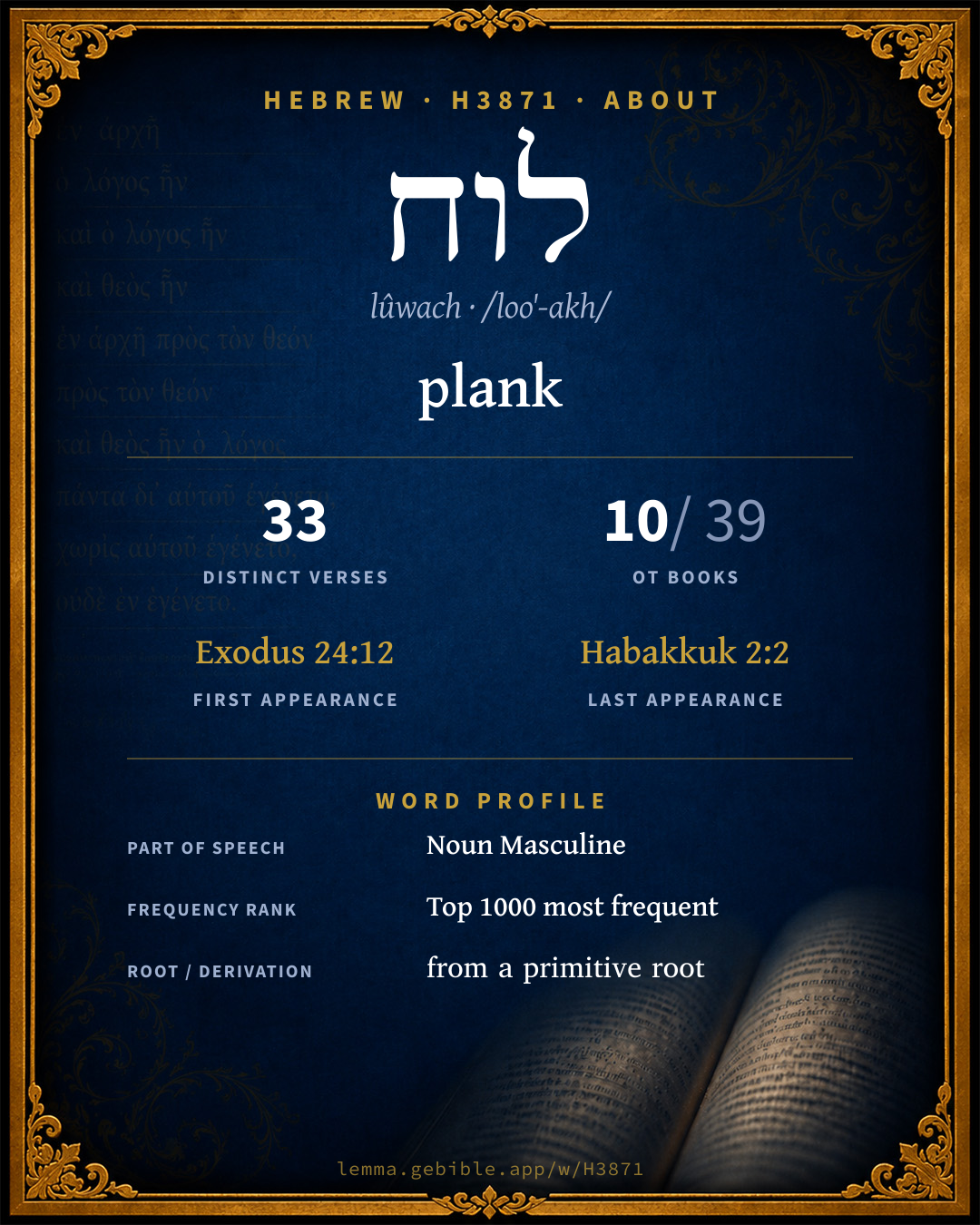
לוּחַ
plank
also: board, slab, tablet fuller range ↓
Full lexicon entry — Brown-Driver-Briggs (BDB)
From Brown-Driver-Briggs (BDB)
Where this word appears
See every Construct-state word in the Hebrew Bible →
Grammar key — what these labels mean
Part of speech
- Noun
- A naming word — a person, place, thing, or idea.
Noun type
- Common
- A common noun — a general class of person, place, or thing (“king,” “city,” “water”), not a specific name.
State
- Construct
- A noun bound to a following noun in a possessive / “of” relationship (the construct chain).
- Absolute
- The independent form of a noun, not bound to a following word.
Gender
- Masculine
- Grammatically masculine.
Number
- Plural
- More than one (in Hebrew, generally three or more).
- Singular
- One.
- Dual
- Exactly two — for natural pairs and some measures of time.
19 distinct verses where H3871 appears in the Construct state, across 6 books. Filtered view — show all forms. Click any verse to open its interlinear word-by-word view. Verse text shown in the World English Bible for context — . Each verse’s Hebrew form is shown with its reference; the English is not keyword-highlighted, since the data carries no word-level English alignment. Use “Compare translations” on any verse to read it across multiple English versions. This concordance covers the Hebrew Bible; Septuagint (Greek Old Testament) occurrences are not indexed here.
Exodus 6 verses
- Exodus 24:12 לֻחֹ֣ת n c mp cs Yahweh said to Moses, "Come up to me on the mountain, and stay here, and I will give you the tables of stone with the law and the commands that I have written, that you may teach them."
- Exodus 31:18 לֻחֹ֣ת לֻחֹ֣ת n c mp cs n c mp cs He gave to Moses, when he finished speaking with him on Mount Sinai, the two tablets of the testimony, stone tablets, written with God's finger.
- Exodus 32:15 לֻחֹ֥ת לֻחֹ֗ת n c mp cs n c mp Moses turned, and went down from the mountain, with the two tablets of the testimony in his hand; tablets that were written on both their sides; on the one side and on the other they were written.
- Exodus 34:1 לֻחֹ֥ת הַ/לֻּחֹ֔ת הַ/לֻּחֹ֥ת n c mp cs ptcl def.art + n c mp ptcl def.art + n c mp Yahweh said to Moses, "Chisel two stone tablets like the first: and I will write on the tablets the words that were on the first tablets, which you broke.
- Exodus 34:4 לֻחֹ֨ת לֻחֹ֥ת n c mp cs n c mp cs He chiseled two tablets of stone like the first; and Moses rose up early in the morning, and went up to Mount Sinai, as Yahweh had commanded him, and took in his hand two stone tablets.
- Exodus 34:29 לֻחֹ֤ת n c mp cs It happened, when Moses came down from Mount Sinai with the two tablets of the testimony in Moses' hand, when he came down from the mountain, that Moses didn't know that the skin of his face shone by reason of his speaking with him.
Deuteronomy 8 verses
- Deuteronomy 4:13 לֻח֥וֹת n c mp cs He declared to you his covenant, which he commanded you to perform, even the ten commandments; and he wrote them on two tables of stone.
- Deuteronomy 5:22 לֻחֹ֣ת n c mp cs These words Yahweh spoke to all your assembly on the mountain out of the midst of the fire, of the cloud, and of the thick darkness, with a great voice: and he added no more. He wrote them on two tables of stone, and gave them to me.
- Deuteronomy 9:9 לוּחֹ֤ת לוּחֹ֣ת n c mp cs n c mp cs When I was gone up onto the mountain to receive the tables of stone, even the tables of the covenant which Yahweh made with you, then I stayed on the mountain forty days and forty nights; I did neither eat bread nor drink water.
- Deuteronomy 9:10 לוּחֹ֣ת n c mp cs Yahweh delivered to me the two tables of stone written with the finger of God; and on them [was written] according to all the words, which Yahweh spoke with you on the mountain out of the midst of the fire in the day of the assembly.
- Deuteronomy 9:11 לֻחֹ֥ת לֻח֥וֹת n c mp cs n c mp cs It came to pass at the end of forty days and forty nights, that Yahweh gave me the two tables of stone, even the tables of the covenant.
- Deuteronomy 9:15 לֻחֹ֣ת n c mp cs So I turned and came down from the mountain, and the mountain was burning with fire: and the two tables of the covenant were in my two hands.
- Deuteronomy 10:1 לֻוחֹ֤ת n c mp cs At that time Yahweh said to me, Hew you two tables of stone like the first, and come up to me onto the mountain, and make an ark of wood.
- Deuteronomy 10:3 לֻחֹ֥ת הַ/לֻּחֹ֖ת n c mp cs ptcl def.art + n c mp So I made an ark of acacia wood, and hewed two tables of stone like the first, and went up onto the mountain, having the two tables in my hand.
1 Kings 1 verse
Proverbs 2 verses
Song of Solomon 1 verse
Jeremiah 1 verse
About this entry
At a glance — auto-summarized from this page’s data, not written by a person. Every figure links to its source below. This summary describes the numbers; it doesn’t interpret them.
לוח — transliterated lûwach — is a Hebrew noun carrying the sense “plank.” The King James Version usually renders it “tables,” while modern versions prefer “tablets” (Berean Standard Bible) and “tablets of” (unfoldingWord Literal Text) — see the renderings breakdown. With 33 verses in 10 books, it is a moderately common word in the Hebrew Bible. Its uses concentrate in Deuteronomy (36% of all occurrences). Alongside “plank” the lexicon also lists “board”, “slab”, and “tablet” — part of its full sense range. See the sense tree, 33-verse concordance, and the renderings breakdown below.
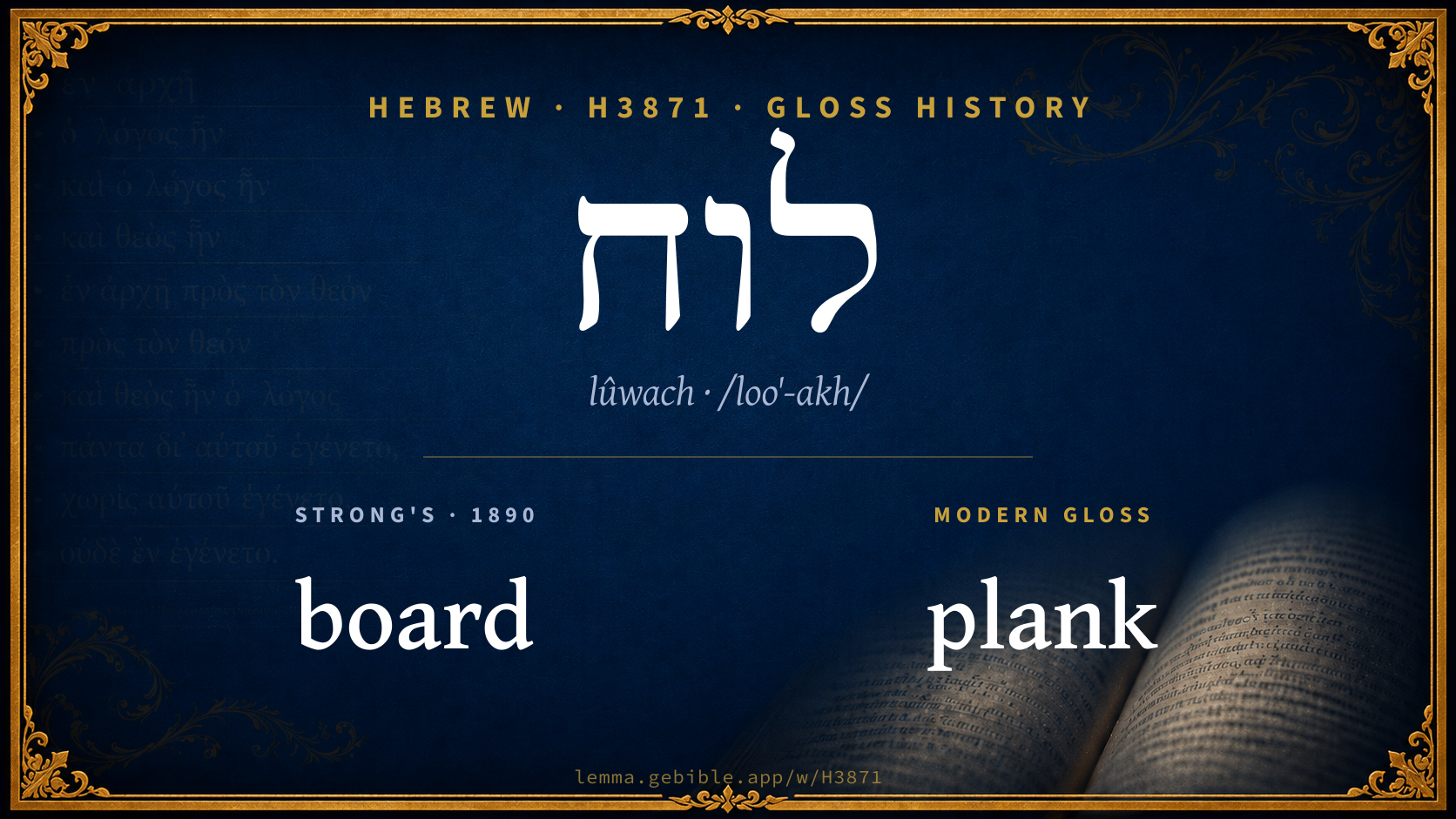
Gloss history
Strong's 1890 vs modern scholarship
About this word
Strong's H3871 catalogs a Hebrew word from the Hebrew Old Testament.
These counts are not copied from any lexicon or concordance. They are computed here, from the morphology-tagged Hebrew Old Testament. What Lemma adds →
- 33
- distinct verses
- The word appears in 33 distinct verses.
- 10 / 39
- OT books
- The word appears in 10 of 39 Old Testament books.
- #837
- by frequency
- Top 1000 most frequent Hebrew words (rank 837 of 8,640 Hebrew words by occurrence).
View all 33 occurrences in the concordance →
Most concentrated in
- Deuteronomy 12 verses 36%
- Exodus 11 verses 33%
- 1 Kings 2 verses 6%
By section of the Old Testament
By traditional corpus
Conventional, traditional groupings — biblical authorship is debated, so this is a traditional corpus grouping, not an authorship claim. Each share is this word’s portion of its verses in that division of the Hebrew canon. Each figure is a share of the word’s 33 distinct verses.
- Torah (Pentateuch) 23 verses · 70%
- Prophets (Nevi'im) 6 verses · 18%
- Writings (Ketuvim) 4 verses · 12%
How translations render this word
Counts come from each version’s own published word-to-Strong’s tagging or interlinear alignment — an approximate guide to how each version renders this word, not a word-level alignment the data otherwise carries. Because each total is that version’s own tagged count, the per-version totals vary from one another and need not match the appearance or distinct-verse counts above. These counts may also differ from a printed concordance because Lemma counts each distinctly tagged rendering and does not collapse phrase taggings into a single head-word total. This is a fixed set of word-tagged versions (KJV, ASV, BSB, ULT) and does not change with the reading translation you choose elsewhere. Each version’s license is shown beside its name below (and on Sources).
- King James Version: Tables 33×, Boards 3×, Table 3×
- American Standard Version: Tables 32×, Tablet 3×, Planks 2×
- Berean Standard Bible: Tablets 33×, Tablet 3×, Boards 2×
- unfoldingWord Literal Text: Tablets of 19×, Tablets 15×, The 6×
King James Version Public Domain
Renders H3871 across 43 tagged occurrences — most commonly:
Plus 4 renderings that appear only once — usually multi-word phrases or single function words the recovered tagging swept in, not distinct renderings.
American Standard Version Public Domain
Renders H3871 across 43 tagged occurrences — most commonly:
Plus 6 renderings that appear only once — usually multi-word phrases or single function words the recovered tagging swept in, not distinct renderings.
Berean Standard Bible Public Domain
Renders H3871 across 42 tagged occurrences — most commonly:
Plus 4 renderings that appear only once — usually multi-word phrases or single function words the recovered tagging swept in, not distinct renderings. Not rendered by a distinct English word in 1 further occurrence.
unfoldingWord Literal Text CC BY-SA 4.0
Renders H3871 across 49 tagged occurrences — most commonly:
Plus 4 renderings that appear only once — usually multi-word phrases or single function words the recovered tagging swept in, not distinct renderings.
Senses in the full BDB
What do BDB’s symbols mean?
BDB uses these scholarly abbreviations:
| Symbol | Meaning |
|---|---|
| 𝔊 | the Septuagint (the ancient Greek translation, LXX) |
| 𝔙 | the Vulgate (the Latin translation) |
| 𝔖 | the Syriac version (the Peshitta) |
| 𝔗 | the Targum (the Aramaic translation) |
| ψ | the Psalms |
| √ | root (the underlying root or stem) |
| ‖ | parallel passage (a synonymous or contrasted parallel) |
| † | the dagger: every passage where the word occurs is cited |
The 3 senses and sub-senses the full Brown-Driver-Briggs lexicon distinguishes for this word, in lexicon order (not ranked by frequency), with BDB’s own verbatim wording and sub-sense lettering. Shown in Hebrew script with BDB’s own scholarly abbreviations. The condensed entry is in the Lexicon Entry tab. See also the Forms in the corpus table below.
- 1. chiefly of stone tablets on which ten words were written Ex 24:12; 31:18b; 32:16(×2), 19 (all E), 34:1(×3), 4(×2), 28 (all J), Dt 4:13; 5:19; 9:9, 10, 11, 17; 10:1, 2(×2), 3(×2), 4, 5 1 K 8:9 2 Ch 5:10; ל׳ הָעֵדֻת Ex 31:18a; 32:15 cf. v 15, 34:29 (all P); ל׳ הַבְּרִית Dt 9:9, 11, 15; tablet for writing prophecy Is 30:8 (‖ סֵפֶר), Hb 2:2, and fig., לוּחַ לִבְּךָ Pr 3:3; 7:3 (for writing wise counsel), cf. Je 17:1 (inscribing sin of Judah); (vb. mostly כָּתַב Ex 31:18b; 32:15; Dt 9:10; כ׳ עַל Ex 34:1, 28; Dt 4:13; 5:19; 10:2, 4 Pr 3:3; 7:3; Is 30:8; חָרַשׁ עַל Je 17:1; כָּרַת sq. acc. Dt 9:9 cf. 1 K 8:9 = 2 Ch 5:10; חָרַת עַל Ex 32:16; בֵּאֵר עַל Hb 2:2). e.g. Exodus 24:12
- 2. wooden boards, composing altar of tabern. Ex 27:8; 38:7; planks composing ship (fig. of Tyre) Ez 27:5; cf. נָצוּר עָלֶיהָ לוּחַ אָ֑רֶז Ct 8:9, of door. e.g. Exodus 27:8
- 3. (metal) plates on bases of lavers in Solomon’s temple 1 K 7:36. e.g. 1 Kings 7:36
Senses from the full Brown-Driver-Briggs lexicon (Brown, Driver, Briggs; Oxford 1906 — public domain), digitized via Sefaria, supplemented by the OpenScriptures HebrewLexicon (CC BY 4.0). Full attribution on Sources.
Word origin
n.m. tablet, board or plank, plate (NH id., Aramaic לוּחָא, ܠܘܽܚܳܐ; Arabic لَوْحٌ (mod. pron. lûḥ, lôḥ, cf. e.g. SpiroArabic-Eng. Vocab. Buhl), Ethiopic ለውሕ, but Assyrian lêʾu (as if from לחה in DlHWB 366; see, however, lêjum (lêyum) JägerBAS i, 486);—ל׳ abs. Is 30:8; cstr. Pr 3:3 + 4 times; du. לֻחֹתָ֑יִם Ez 27:5; pl. לוּחֹת (לֻחוֹת), לֻחֹת) abs. Ex 32:16 + 17 times; cstr. Dt 4:13 + 16 times;—
— Brown-Driver-Briggs (Oxford 1906, public domain), digitized via Sefaria, supplemented by the OpenScriptures HebrewLexicon (CC BY 4.0). See Sources.
Origin: from a primitive root
Jastrow Dictionary
A second Hebrew/Aramaic lexicon for comparison, covering Aramaic and post-biblical (Talmudic, Targumic, Midrashic) usage that the biblical-Hebrew BDB does not. Matched by lemma rather than by Strong’s number, so a lemma may carry more than one Jastrow headword (shown separately below), and the entries cover usage well beyond the Bible.
לוּחַ I
- (or לָוַח) (cmp. לָוָה) to join.
- (denom. of next w.) to place straps close together so as to form a boardlike surface. Part. pass. מְלֻוָּוח, pl. מְלֻוָּוחִין. Tosef. Kel. B. Mets. VIII, 6 (R. S. to Kel. XVIII, 5 reads מְרֻוָּוחִים, v. רָוַח).
לוּחַ II
- tablet, board. Y. Shek. VI, 49ᵈ bot.; Ex. R. s. 47, a. e. חמשה על ל׳ זה וכ׳ five commandments on one tablet &c.; a. fr.—Pl. לוּחוֹת (mostly of the tablets containing the ten commandments); לְוָוחִים, לְוָוחִין, constr. לְוָוחֵי. Ib. Ber. 8ᵇ ל׳ ושברי ל׳ וכ׳ the (second) tablets and the broken tablets were both preserved in the ark, (therefore despise not an old scholar when his memory forsakes him); B. Bath. 14ᵃ; Men. 99ᵃ.—Y. Kil. IX, 32ᵇ top ל׳ הברית; Y. Keth. XII, 35ᵃ top ל׳ (metaphorically for R. Jehudah han-Nasi; (Keth. 104ᵃ ארון הקודש, v. אֶרְאֵל); a. fr.—Meg. 32ᵃ, v. בִּימָה.—Tosef. Kel. B. Mets. VIII, 4 לווחין וכ׳; Sabb. 47ᵃ לווחים (Ar. ed. Koh. לוחים, oth. ed. לוחיים); Tosef. ib. XIII (XIV), 15; Y. ib. XII, beg. 13ᶜ, v. סְטִיבֵס. Sabb. XII, 4 על שני לִוְחֵי פנקס (Bab. ed. 104ᵇ לווחי; Y. ed. דפי as in Mish. ib. XII, 5) on (the rims of) two boards of a writing tablet (pinax). B. Mets. 117ᵃ (expl. תקרה) לווחים boards of the ceiling; a. e.
לוּחַ
- Targ. Y. Ex. XXXVI, 19, a. e. (O. דפא, h. text קרש). Targ. Prov. III, 3. Targ. Is. VIII, 1 (h. text גִּלָּיוֹן); a. fr.—Pl. לוּחִין, לוּחַיָּא, לוּחֵי, לְוָו׳. Targ. Y. I Ex. XXVI, 15 (Y. II לְוָוחֵי). Ib. 20. Targ. Ex. XXXI, 18; a. fr.—[Sabb. 18ᵃ; Gitt. 61ᵃ top, v. next w.].
A Dictionary of the Targumim, the Talmud Babli and Yerushalmi, and the Midrashic Literature (Marcus Jastrow; London, Luzac, 1903) — Public Domain. Digitized via Sefaria. Digitized via Sefaria. Full attribution on Sources.
Forms in the corpus
The 25 distinct written forms H3871 takes in the Hebrew Bible, most frequent first — each parse links to that state’s occurrences in the concordance. Hebrew forms include their vowel points and cantillation, so a single lemma takes many written forms.
Same root — word family
Other BDB entries built from the same root as H3871, grouped by Strong’s listed origin. These share a root / origin per the lexicon — not necessarily a shared meaning. Each links to that word’s own entry.
Proper names from this root
People and places named from this root — a name, not an additional meaning of the word.
Compare all same-root words → 1 of the same-root words is a proper name (a person or place). They share a root, not necessarily a meaning.
Septuagint verse parallels
This word appears in 32 verses that also exist in the Greek Old Testament (Septuagint), out of the 33 Hebrew verses it occurs in. You can read those verses in Greek by switching the Old Testament edition to the Septuagint.
Read these verses in the Septuagint
- Exodus 24:12
- Deuteronomy 4:13
- 1 Kings 7:36
- 2 Chronicles 5:10
- Proverbs 3:3
- Song of Solomon 8:9
- Isaiah 30:8
- Ezekiel 27:5
- Habakkuk 2:2
This is a verse-level parallel only — the same verses exist in both the Hebrew and Greek Old Testaments. No word-level Hebrew↔Greek correspondence is claimed: the data carries no such alignment, so no Greek word is shown as this Hebrew word’s translation. Coverage is not total — the Septuagint omits the deuterocanon and renumbers the Psalms, so some Hebrew verses have no direct Greek parallel.