כּוּשׁ
Cush
BDB lists 5 entries for ‘Cush’ fuller range ↓
Full lexicon entry — Brown-Driver-Briggs (BDB)
From Brown-Driver-Briggs (BDB)
Where this word appears
Grammar key — what these labels mean
Part of speech
- Noun
- A naming word — a person, place, thing, or idea.
Noun type
- Proper
- A name of a specific person, place, or people (e.g. Abraham, Zion, Israel).
Every verse where H3568 appears in the Book of Esther — 2 distinct verses. Click any verse to open its interlinear word-by-word view. Verse text shown in the World English Bible for context — . Each verse’s Hebrew form is shown with its reference; the English is not keyword-highlighted, since the data carries no word-level English alignment. Use “Compare translations” on any verse to read it across multiple English versions. This concordance covers the Hebrew Bible; Septuagint (Greek Old Testament) occurrences are not indexed here.
Esther
- Esther 1:1 כּ֔וּשׁ n Proper Now it happened in the days of Ahasuerus (this is Ahasuerus who reigned from India even to Ethiopia, over one hundred twenty-seven provinces),
- Esther 8:9 כּ֗וּשׁ n Proper Then were the king's scribes called at that time, in the third month Sivan, on the three and twentieth [day] of it; and it was written according to all that Mordecai commanded to the Jews, and to the satraps, and the governors and princes of the provinces which are from India to Ethiopia, one hundred twenty-seven provinces, to every province according to the writing of it, and to every people after their language, and to the Jews according to their writing, and according to their language.
About this entry
At a glance — auto-summarized from this page’s data, not written by a person. Every figure links to its source below. This summary describes the numbers; it doesn’t interpret them.
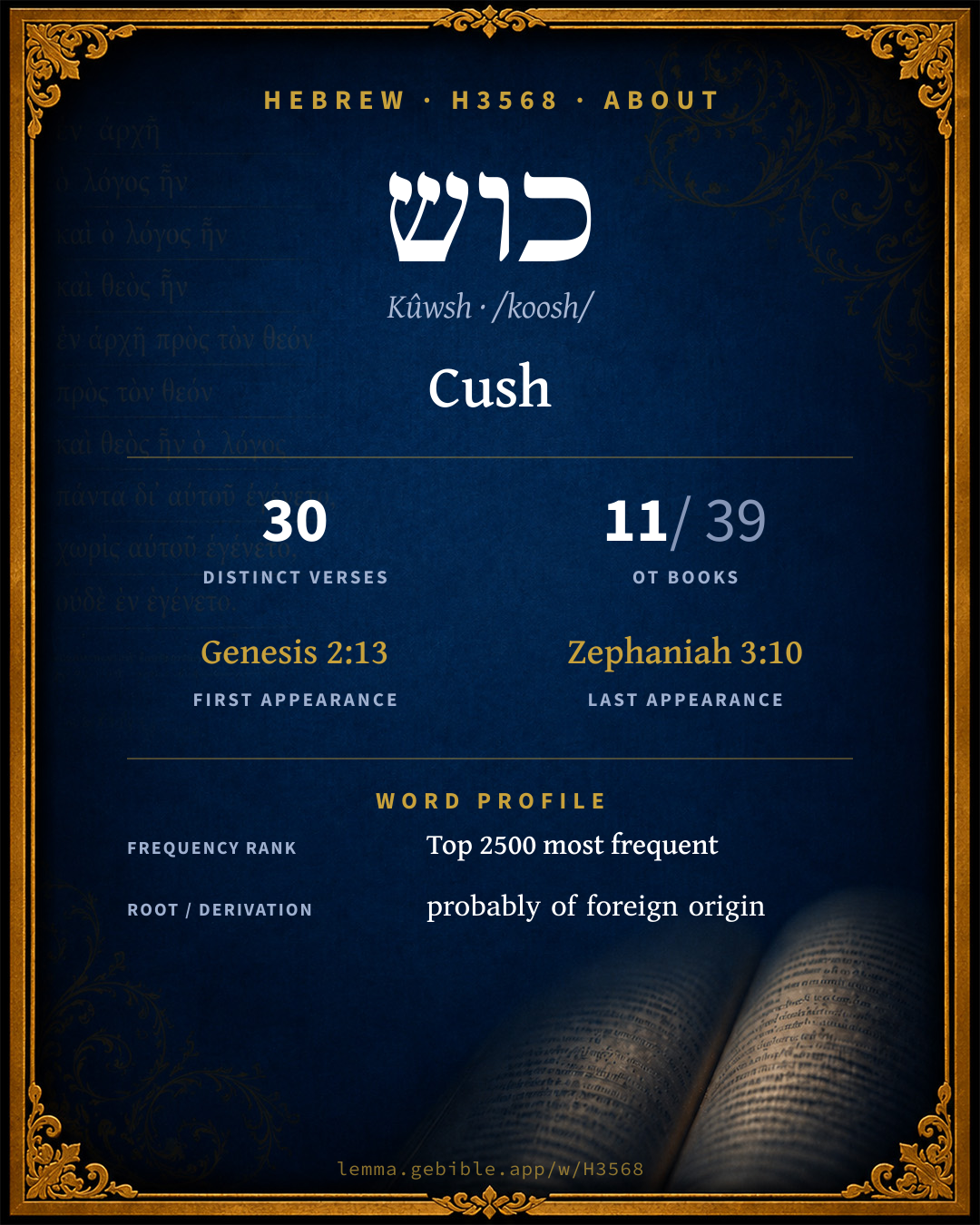
At its core, כוש (Kûwsh) means “Cush.” It first appears in Genesis 2:13. Spanning 30 verses in 11 books, it ranks among the moderately common words of the Hebrew Bible. Its uses concentrate in Isaiah (27% of all occurrences). Dig into 30-verse concordance and the renderings breakdown below.
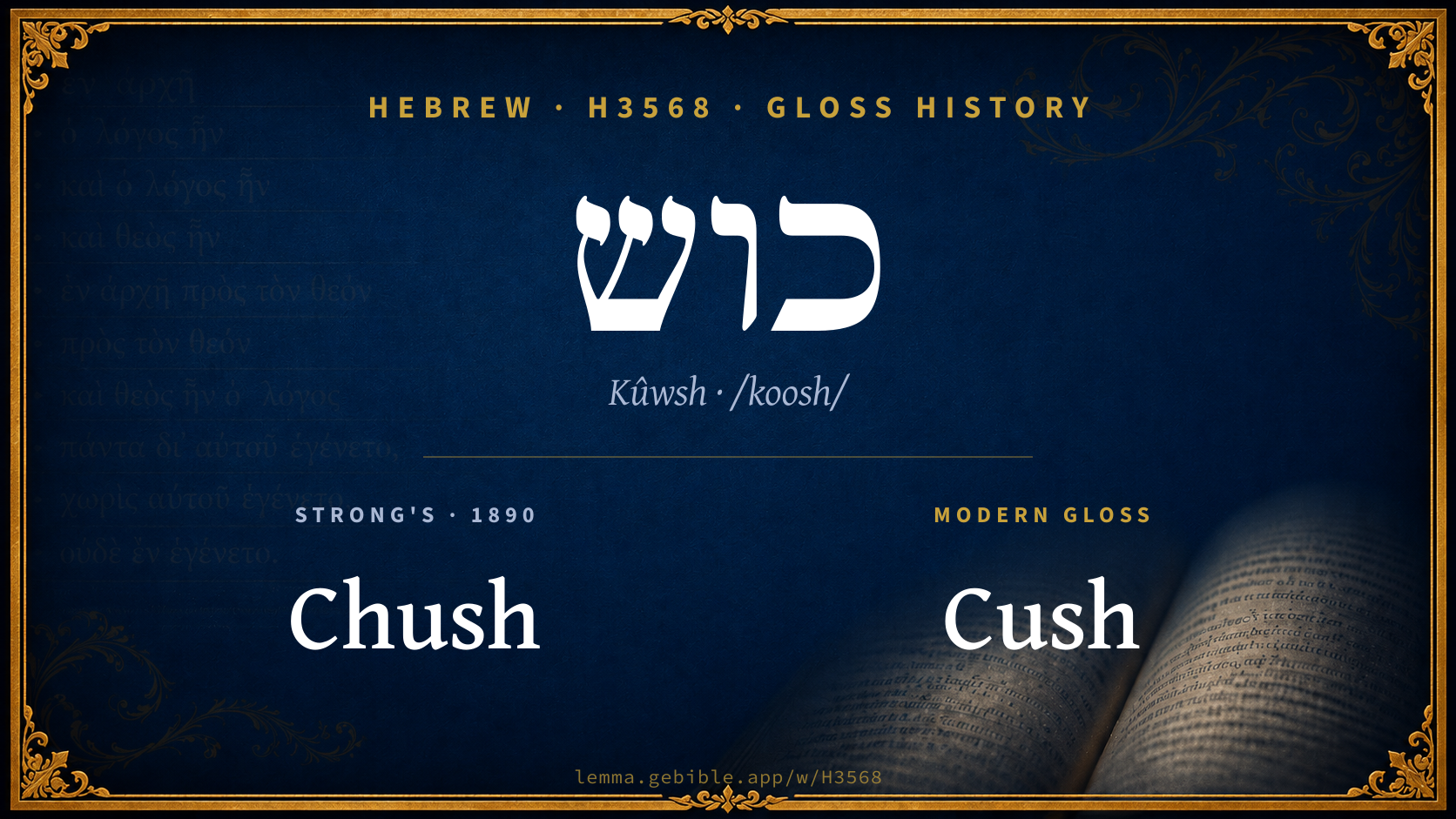
Gloss history
Strong's 1890 vs modern scholarship
About this word
Strong's H3568 catalogs a Hebrew word from the Hebrew Old Testament.
These counts are not copied from any lexicon or concordance. They are computed here, from the morphology-tagged Hebrew Old Testament. What Lemma adds →
- 30
- distinct verses
- The word appears in 30 distinct verses.
- 11 / 39
- OT books
- The word appears in 11 of 39 Old Testament books.
- #1,139
- by frequency
- Top 2500 most frequent Hebrew words (rank 1,139 of 8,640 Hebrew words by occurrence).
View all 30 occurrences in the concordance →
By section of the Old Testament
By traditional corpus
Conventional, traditional groupings — biblical authorship is debated, so this is a traditional corpus grouping, not an authorship claim. Each share is this word’s portion of its verses in that division of the Hebrew canon. Each figure is a share of the word’s 30 distinct verses.
- Prophets (Nevi'im) 17 verses · 57%
- Writings (Ketuvim) 9 verses · 30%
- Torah (Pentateuch) 4 verses · 13%
How translations render this word
Counts come from each version’s own published word-to-Strong’s tagging or interlinear alignment — an approximate guide to how each version renders this word, not a word-level alignment the data otherwise carries. Because each total is that version’s own tagged count, the per-version totals vary from one another and need not match the appearance or distinct-verse counts above. These counts may also differ from a printed concordance because Lemma counts each distinctly tagged rendering and does not collapse phrase taggings into a single head-word total. This is a fixed set of word-tagged versions (KJV, ASV, BSB, ULT) and does not change with the reading translation you choose elsewhere. Each version’s license is shown beside its name below (and on Sources).
BDB lists this Strong’s number as 2 distinct words (homographs). Each count above pools all of them and is not split by sense — see the Senses section below. A low-frequency rendering may belong to a different one of those words, not the primary meaning.
- King James Version†: Ethiopia 18×, Cush 8×, Ethiopians 3×
- American Standard Version†: Ethiopia 16×, Cush 10×
- Berean Standard Bible†: Cush 29×
- unfoldingWord Literal Text†: Cush 25×, Ethiopia 2×
King James Version Public Domain
Renders H3568 across 30† tagged occurrences — most commonly:
Plus 1 rendering that appears only once — usually multi-word phrases or single function words the recovered tagging swept in, not distinct renderings.
American Standard Version Public Domain
Renders H3568 across 29† tagged occurrences — most commonly:
Plus 3 renderings that appear only once — usually multi-word phrases or single function words the recovered tagging swept in, not distinct renderings.
Berean Standard Bible Public Domain
Renders H3568 across 30† tagged occurrences — most commonly:
Plus 1 rendering that appears only once — usually multi-word phrases or single function words the recovered tagging swept in, not distinct renderings.
unfoldingWord Literal Text CC BY-SA 4.0
Renders H3568 across 29† tagged occurrences — most commonly:
Plus 2 renderings that appear only once — usually multi-word phrases or single function words the recovered tagging swept in, not distinct renderings.
Senses in the full BDB
What do BDB’s symbols mean?
BDB uses these scholarly abbreviations:
| Symbol | Meaning |
|---|---|
| 𝔊 | the Septuagint (the ancient Greek translation, LXX) |
| 𝔙 | the Vulgate (the Latin translation) |
| 𝔖 | the Syriac version (the Peshitta) |
| 𝔗 | the Targum (the Aramaic translation) |
| ψ | the Psalms |
| √ | root (the underlying root or stem) |
| ‖ | parallel passage (a synonymous or contrasted parallel) |
| † | the dagger: every passage where the word occurs is cited |
The 6 senses and sub-senses the full Brown-Driver-Briggs lexicon distinguishes for this word, in lexicon order (not ranked by frequency), with BDB’s own verbatim wording and sub-sense lettering. Shown in Hebrew script with BDB’s own scholarly abbreviations. The condensed entry is in the Lexicon Entry tab. See also the Forms in the corpus table below.
כוש I pers.m., gent. et terr. (Egyptian Kōš, SteindorffBAS i, 593, Assyrian Kûsu, Id. ib. DlPa 251
- 1. 1st ‘son’ of חָם Gn 10:6, 7 (P) = 1 Ch 1:8, 9, 𝔊 Χονς, 𝔙 Chus, from whom descended according to these vv. the southernmost peoples known to Hebrews. e.g. Genesis 10:6
- 2. land and people of southern Nile-valley, or Upper Egypt, extending from Syene (Ez 29:10) indefinitely to the south, 𝔊 Αιθιοπια, Αιθιοπες: e.g. Ezekiel 29:10
- a. the land Is 11:11; 18:1 Zp 3:10 Ez 29:10 Jb 28:19 Est 1:1; 8:9. e.g. Isaiah 11:11
- b. the people Is 20:4 Je 46:9 Ez 38:5; personif. ψ 68:32. e.g. Isaiah 20:4
- c. indeterminate, either land or people, or including both: Is 20:3, 5; 43:3; 45:14 2 K 19:9 = Is 37:9 Na 3:9 Ez 30:4, 5, 9 ψ 87:4 (𝔊 λαὸς Αιθιοπων). e.g. Isaiah 20:3
- 3. in Gn 10:8 (J) = 1 Ch 1:10 כּוּשׁ is err. for כַּשׁ = Bab. Kaššu, according to SchrCOT on Gn 10:6, DlPa 51 ff. 72 f. and most Assyriol.; so perhaps also Gn 2:13 (J), yet v. HptÜber Ld. u. Meer, 1894–5, No. 15. e.g. Genesis 10:8
כוש II m. a Benjamite, ψ 7
Senses from the full Brown-Driver-Briggs lexicon (Brown, Driver, Briggs; Oxford 1906 — public domain), digitized via Sefaria, supplemented by the OpenScriptures HebrewLexicon (CC BY 4.0). Full attribution on Sources.
Word origin
I. n.pr.pers.m., gent. et terr. (Egyptian Kōš, SteindorffBAS i, 593, Assyrian Kûsu, Id. ib. DlPa 251; Kaši in Tel Amarna tablets, vid. WklTelAm. 39 );—
II. n.pr.m. a Benjamite, ψ 7:1 (title), 𝔊 Χουσει υἱοῦ Ιεμενει.
— Brown-Driver-Briggs (Oxford 1906, public domain), digitized via Sefaria, supplemented by the OpenScriptures HebrewLexicon (CC BY 4.0). See Sources.
Origin: probably of foreign origin
Jastrow Dictionary
A second Hebrew/Aramaic lexicon for comparison, covering Aramaic and post-biblical (Talmudic, Targumic, Midrashic) usage that the biblical-Hebrew BDB does not. Matched by lemma rather than by Strong’s number, so a lemma may carry more than one Jastrow headword (shown separately below), and the entries cover usage well beyond the Bible.
כּוּשׁ I
- (cmp. כּוֹס, כִּיס) [something hollow,] reed, esp. reed used as spindle (v. Ar. s. v.); also as fork. Yoma 82ᵃ תוחבין לה כ׳ ברוטב we put for her a reed into the juice (and let her suck it); Tosef. ib. V (IV), 4 (corr. acc.). Sabb. 123ᵃ; Y. ib. XVII, 16ᵇ top, v. כַּרְכָּר. Y. Erub. III, 20ᵈ bot. לתחוב בכ׳ ובקיסם to stick it on a reed or a chip. Kel. IX, 8 מלא כ׳ the size of a reed. Tosef. Kel. B. Mets. VI, 12 בכ׳ בכ׳ הבינוני wherever the size of a reed (or spindle) is mentioned, a middle-sized reed is meant. Kel. IX, 7 כ׳ שבלע את הצנורא a reed in which the iron hook has disappeared. Par. XII, 8; Tosef. ib. XII (XI), 16, v. אָרְבָּן; a. fr.—Pl. כּוּשִׁין. Y. Yeb. XII, 12ᵈ bot. (in Chald. diction, in a disguised answer to a ritual question propounded to R. Akiba by a pretended street vendor) אית לך כ׳ אית לך כשר hast thou spindles? hast thou ‘Kasher’? (play on כִּישׁוֹר, v. כּוּנְשְׁרָא; intimating ‘It is legal’).
כּוּשׁ II
- (b. h.) pr. n. Cush,
- 1. son of Ham. Targ. Gen. X, 6; a. e.—2) the land of Cush, Aethiopia. Targ. II Kings XIX, 9. Targ. Y. Num. XII, 1; a. e.—Yalk. Ex. 168. Pes. 94ᵃ; Taan. 10ᵃ מצרים … בכ׳ Egypt is one sixtieth as large as Aethiopia. Y. Ber. I, 2ᶜ bot. תמצית כ׳ וכ׳ the juice (moisture) of Aeth. is absorbed by Egypt; a. e.
A Dictionary of the Targumim, the Talmud Babli and Yerushalmi, and the Midrashic Literature (Marcus Jastrow; London, Luzac, 1903) — Public Domain. Digitized via Sefaria. Digitized via Sefaria. Full attribution on Sources.
Forms in the corpus
The 18 distinct written forms H3568 takes in the Hebrew Bible, most frequent first — each parse links to that state’s occurrences in the concordance. Hebrew forms include their vowel points and cantillation, so a single lemma takes many written forms.
| Form | Parsing | Example | Uses |
|---|---|---|---|
| כּ֥וּשׁ | Noun, Proper | Ezekiel 38:5 | 6 |
| כּֽוּשׁ | Noun, Proper | Ezekiel 29:10 | 3 |
| וְ/כ֖וּשׁ | Noun, Proper | Genesis 10:8 | 2 |
| כ֔וּשׁ | Noun, Proper | Genesis 10:7 | 2 |
| כּ֑וּשׁ | Noun, Proper | Job 28:19 | 2 |
| כּ֣וּשׁ | Noun, Proper | Ezekiel 30:5 | 2 |
| כּוּשׁ֙ | Noun, Proper | 2 Kings 19:9 | 2 |
| בְּ/כ֔וּשׁ | Noun, Proper | Ezekiel 30:4 | 1 |
| וּ/מִ/כּ֗וּשׁ | Noun, Proper | Isaiah 11:11 | 1 |
| כ֑וּשׁ | Noun, Proper | Zephaniah 3:10 | 1 |
| כ֝֗וּשׁ | Noun, Proper | Psalms 7:1 | 1 |
| כּ֔וּשׁ | Noun, Proper | Esther 1:1 | 1 |
| כּ֗וּשׁ | Noun, Proper | Esther 8:9 | 1 |
| כּ֛וּשׁ | Noun, Proper | Isaiah 20:4 | 1 |
| כּ֤וּשׁ | Noun, Proper | Jeremiah 46:9 | 1 |
| כּוּשׁ֮ | Noun, Proper | Isaiah 45:14 | 1 |
| כֽוּשׁ | Noun, Proper | Isaiah 18:1 | 1 |
| מִ/כּוּשׁ֙ | Noun, Proper | Isaiah 20:5 | 1 |
Same root — word family
Other BDB entries built from the same root as H3568, grouped by Strong’s listed origin. These share a root / origin per the lexicon — not necessarily a shared meaning. Each links to that word’s own entry.
Proper names from this root
People and places named from this root — a name, not an additional meaning of the word.
Compare all same-root words → 2 of the same-root words are proper names (people or places). They share a root, not necessarily a meaning.
Bible dictionary
Public-domain dictionary articles matched to this entry by name (Cush). A biblical name can be shared by more than one person or place, so an article may treat several.
Easton's Bible Dictionary · M. G. Easton, 1897
Black. (1.) A son, probably the eldest, of Ham, and the father of Nimrod (Gen. 10:8; 1 Chr. 1:10). From him the land of Cush seems to have derived its name. The question of the precise locality of the land of Cush has given rise to not a little controversy. The second river of Paradise surrounded the whole land of Cush (Gen. 2:13, R.V.). The term Cush is in the Old Testament generally applied to the countries south of the Israelites. It was the southern limit of Egypt (Ezek. 29:10, A.V. "Ethiopia," Heb. Cush), with which it is generally associated (Ps. 68:31; Isa. 18:1; Jer. 46:9, etc.). It stands also associated with Elam (Isa. 11:11), with Persia (Ezek. 38:5), and with the Sabeans (Isa. 45:14). From these facts it has been inferred that Cush included Arabia and the country on the west coast of the Red Sea. Rawlinson takes it to be the country still known as Khuzi-stan, on the east side of the Lower Tigris. But there are intimations which warrant the conclusion that there was also a Cush in Africa, the Ethiopia (so called by the Greeks) of Africa. Ezekiel speaks (29:10; comp. 30:4-6) of it as lying south of Egypt. It was the country now known to us as Nubia and Abyssinia (Isa. 18:1; Zeph. 3:10, Heb. Cush). In ancient Egyptian inscriptions Ethiopia is termed Kesh. The Cushites appear to have spread along extensive tracts, stretching from the Upper Nile to the Euphrates and Tigris. At an early period there was a stream of migration of Cushites "from Ethiopia, properly so called, through Arabia, Babylonia, and Persia, to Western India." The Hamite races, soon after their arrival in Africa, began to spread north, east, and west. Three branches of the Cushite or Ethiopian stock, moving from Western Asia, settled in the regions contiguous to the Persian Gulf. One branch, called the Cossaeans, settled in the mountainous district on the east of the Tigris, known afterwards as Susiana; another occupied the lower regions of the Euphrates and the Tigris; while a third colonized the southern shores and islands of the gulf, whence they afterwards emigrated to the Mediterranean and settled on the coast of Palestine as the Phoenicians. Nimrod was a great Cushite chief. He conquered the Accadians, a Tauranian race, already settled in Mesopotamia, and founded his kingdom, the Cushites mingling with the Accads, and so forming the Chaldean nation.
(2.) A Benjamite of this name is mentioned in the title of Ps. 7. "Cush was probably a follower of Saul, the head of his tribe, and had sought the friendship of David for the purpose of 'rewarding evil to him that was at peace with him.'"
Smith's Bible Dictionary · William Smith, 1863
the name of a son of Ham, apparently the eldest, and of a territory or territories occupied by his descendants. The Cushites appear to have spread along tracts extending from the higher Nile to the Euphrates and Tigris. History affords many traces of this relation of Babylonia, Arabia and Ethiopia.
(black), a Benjamite mentioned only in the title to (Psalms 7:1) He was probably a follower of Saul, the head of his tribe. (B.C. 1061).
Hitchcock's Bible Names Dictionary · Roswell D. Hitchcock, 1869
Cushan, Cushi, Ethiopians; blackness
Classic public-domain reference works; full attribution on Sources.
Septuagint verse parallels
This word appears in 29 verses that also exist in the Greek Old Testament (Septuagint), out of the 30 Hebrew verses it occurs in. You can read those verses in Greek by switching the Old Testament edition to the Septuagint.
Read these verses in the Septuagint
- Genesis 2:13
- 2 Kings 19:9
- 1 Chronicles 1:8
- Esther 1:1
- Job 28:19
- Psalms 7:1
- Isaiah 11:11
- Ezekiel 29:10
- Nahum 3:9
- Zephaniah 3:10
This is a verse-level parallel only — the same verses exist in both the Hebrew and Greek Old Testaments. No word-level Hebrew↔Greek correspondence is claimed: the data carries no such alignment, so no Greek word is shown as this Hebrew word’s translation. Coverage is not total — the Septuagint omits the deuterocanon and renumbers the Psalms, so some Hebrew verses have no direct Greek parallel.