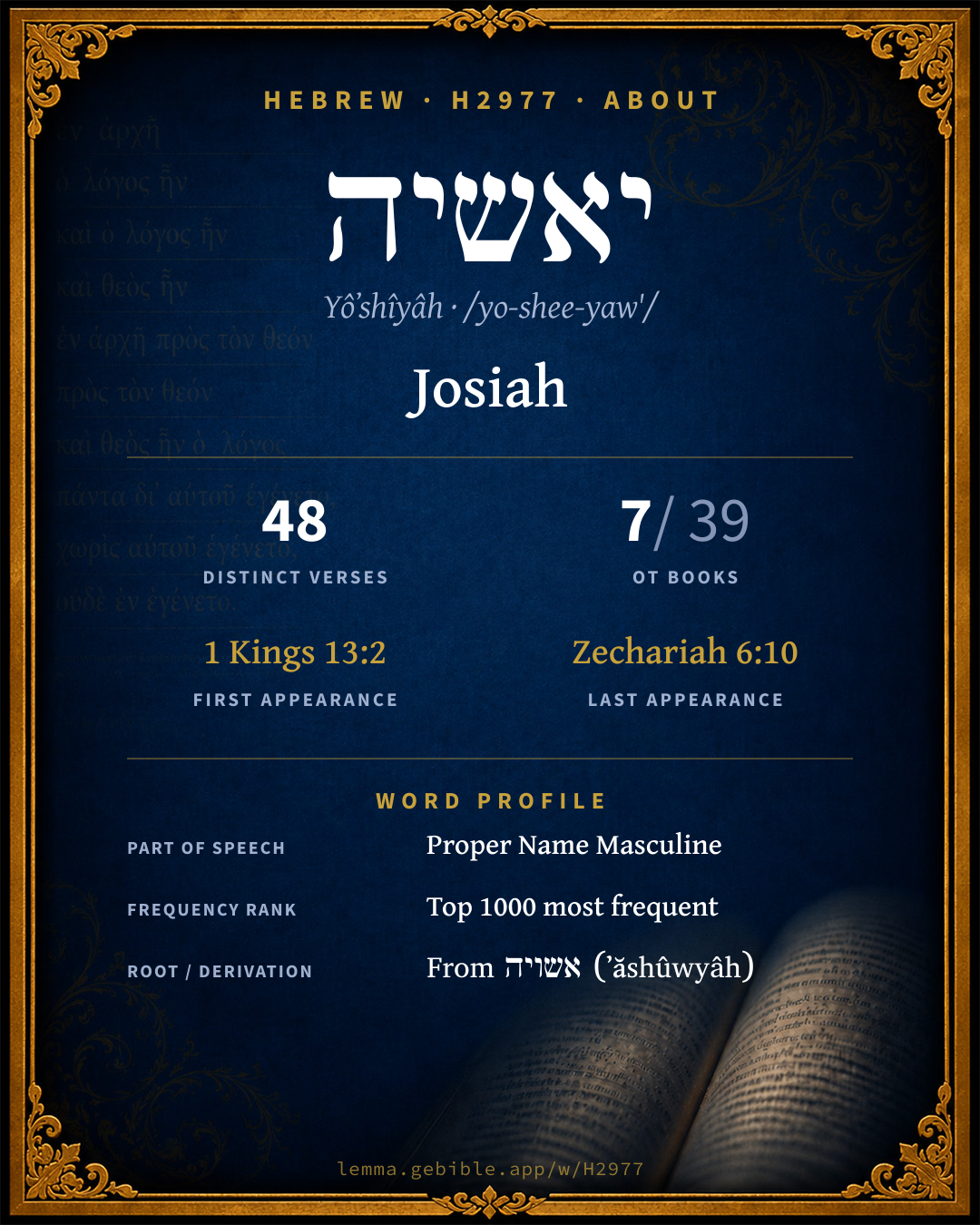
יֹאשִׁיָּ֫הוּ
Josiah
BDB lists 3 entries for ‘Josiah’ fuller range ↓
Full lexicon entry — Brown-Driver-Briggs (BDB)
From Brown-Driver-Briggs (BDB)
Where this word appears
Grammar key — what these labels mean
Part of speech
- Noun
- A naming word — a person, place, thing, or idea.
Noun type
- Proper
- A name of a specific person, place, or people (e.g. Abraham, Zion, Israel).
Every verse where H2977 appears in the Book of Zephaniah — 1 distinct verse. Click any verse to open its interlinear word-by-word view. Verse text shown in the World English Bible for context — . Each verse’s Hebrew form is shown with its reference; the English is not keyword-highlighted, since the data carries no word-level English alignment. Use “Compare translations” on any verse to read it across multiple English versions. This concordance covers the Hebrew Bible; Septuagint (Greek Old Testament) occurrences are not indexed here.
Zephaniah
About this entry
At a glance — auto-summarized from this page’s data, not written by a person. Every figure links to its source below. This summary describes the numbers; it doesn’t interpret them.
יאשיה (Yôʼshîyâh) is a Hebrew name most often rendered “Josiah.” It first appears in 1 Kings 13:2. It turns up in 48 verses across 7 books, a moderately common footprint. It concentrates in Jeremiah, which alone accounts for 33% of its uses. The sections below give every occurrence and version rendering.
Gloss history
Strong's 1890 vs modern scholarship
About this word
Strong's H2977 catalogs a Hebrew word from the Hebrew Old Testament.
These counts are not copied from any lexicon or concordance. They are computed here, from the morphology-tagged Hebrew Old Testament. What Lemma adds →
- 48
- distinct verses
- The word appears in 48 distinct verses.
- 7 / 39
- OT books
- The word appears in 7 of 39 Old Testament books.
- #709
- by frequency
- Top 1000 most frequent Hebrew words (rank 709 of 8,640 Hebrew words by occurrence).
View all 48 occurrences in the concordance →
Most concentrated in
- Jeremiah 16 verses 33%
- 2 Chronicles 15 verses 31%
- 2 Kings 12 verses 25%
By section of the Old Testament
By traditional corpus
Conventional, traditional groupings — biblical authorship is debated, so this is a traditional corpus grouping, not an authorship claim. Each share is this word’s portion of its verses in that division of the Hebrew canon. Each figure is a share of the word’s 48 distinct verses.
- Prophets (Nevi'im) 31 verses · 65%
- Writings (Ketuvim) 17 verses · 35%
How translations render this word
Counts come from each version’s own published word-to-Strong’s tagging or interlinear alignment — an approximate guide to how each version renders this word, not a word-level alignment the data otherwise carries. Because each total is that version’s own tagged count, the per-version totals vary from one another and need not match the appearance or distinct-verse counts above. These counts may also differ from a printed concordance because Lemma counts each distinctly tagged rendering and does not collapse phrase taggings into a single head-word total. This is a fixed set of word-tagged versions (KJV, ASV, BSB, ULT) and does not change with the reading translation you choose elsewhere. Each version’s license is shown beside its name below (and on Sources).
BDB lists this Strong’s number as 2 distinct words (homographs). Each count above pools all of them and is not split by sense — see the Senses section below. A low-frequency rendering may belong to a different one of those words, not the primary meaning.
- King James Version†: Josiah 46×
- American Standard Version†: Josiah 46×
- Berean Standard Bible†: Josiah 48×, Josiah’s 2×
- unfoldingWord Literal Text†: Josiah 45×
King James Version Public Domain
Renders H2977 across 53† tagged occurrences — most commonly:
Plus 7 renderings that appear only once — usually multi-word phrases or single function words the recovered tagging swept in, not distinct renderings.
American Standard Version Public Domain
Renders H2977 across 53† tagged occurrences — most commonly:
Plus 7 renderings that appear only once — usually multi-word phrases or single function words the recovered tagging swept in, not distinct renderings.
Berean Standard Bible Public Domain
Renders H2977 across 51† tagged occurrences — most commonly:
Plus 1 rendering that appears only once — usually multi-word phrases or single function words the recovered tagging swept in, not distinct renderings. Not rendered by a distinct English word in 2 further occurrences.
unfoldingWord Literal Text CC BY-SA 4.0
Renders H2977 across 46† tagged occurrences — most commonly:
Plus 1 rendering that appears only once — usually multi-word phrases or single function words the recovered tagging swept in, not distinct renderings.
Senses in the full BDB
What do BDB’s symbols mean?
BDB uses these scholarly abbreviations:
| Symbol | Meaning |
|---|---|
| 𝔊 | the Septuagint (the ancient Greek translation, LXX) |
| 𝔙 | the Vulgate (the Latin translation) |
| 𝔖 | the Syriac version (the Peshitta) |
| 𝔗 | the Targum (the Aramaic translation) |
| ψ | the Psalms |
| √ | root (the underlying root or stem) |
| ‖ | parallel passage (a synonymous or contrasted parallel) |
| † | the dagger: every passage where the word occurs is cited |
The 2 senses and sub-senses the full Brown-Driver-Briggs lexicon distinguishes for this word, in lexicon order (not ranked by frequency), with BDB’s own verbatim wording and sub-sense lettering. Shown in Hebrew script with BDB’s own scholarly abbreviations. The condensed entry is in the Lexicon Entry tab. See also the Forms in the corpus table below.
- 1. יֹאשִׁיָּהוּ king of Judah, son of Amon 1 K 13:2 2 K 21:24, 26 + 11 times K, + 19 times Ch, + 17 times Je + Zp 1:1; also יֹאו֯שִׁיָּהוּ Je 27:1. e.g. 1 Kings 13:2
- 2. יֹאשִׁיָּה a returned exile Zc 6:10. e.g. Zechariah 6:10
Senses from the full Brown-Driver-Briggs lexicon (Brown, Driver, Briggs; Oxford 1906 — public domain), digitized via Sefaria, supplemented by the OpenScriptures HebrewLexicon (CC BY 4.0). Full attribution on Sources.
Word origin
I. n.pr.m. (י׳ supporteth)
II. v. sub אשׁה p. 78b supr.
— Brown-Driver-Briggs (Oxford 1906, public domain), digitized via Sefaria, supplemented by the OpenScriptures HebrewLexicon (CC BY 4.0). See Sources.
Derived from אשויה (ʼăshûwyâh) (H803) — buttress.
Jastrow Dictionary
A second Hebrew/Aramaic lexicon for comparison, covering Aramaic and post-biblical (Talmudic, Targumic, Midrashic) usage that the biblical-Hebrew BDB does not. Matched by lemma rather than by Strong’s number, so a lemma may carry more than one Jastrow headword (shown separately below), and the entries cover usage well beyond the Bible.
יֹאשִׁיָּה
- (b. h.) Josiah,
- 1. King of Judah. M. Kat. 25ᵇ (ref. to Am. VIII, 9) זה יומו של י׳ that is the day when J. was killed. Ib. 28ᵇ כמספד די׳ וכ׳ like the lamentation over J. &c.; Meg. 3ᵃ; a. fr. e.g. Amos 8:9
- 2. R. J. a Tannai. Men. 57ᵇ. Snh. 66ᵃ (v. Fr. Darkhé, p. 146, sq.).
- 3. R. J. name of two Amoraim (v. Fr. M’bo, p. 90ᵇ sq.). Y. Shebi. IX, 39ᵃ top. Y. Snh. III, 21ᵈ; a. fr.—Kidd. 36ᵇ, v. דָּרָא I.
A Dictionary of the Targumim, the Talmud Babli and Yerushalmi, and the Midrashic Literature (Marcus Jastrow; London, Luzac, 1903) — Public Domain. Digitized via Sefaria. Digitized via Sefaria. Full attribution on Sources.
Forms in the corpus
The 22 distinct written forms H2977 takes in the Hebrew Bible, most frequent first — each parse links to that state’s occurrences in the concordance. Hebrew forms include their vowel points and cantillation, so a single lemma takes many written forms.
| Form | Parsing | Example | Uses |
|---|---|---|---|
| יֹאשִׁיָּ֖הוּ | Noun, Proper | 2 Chronicles 35:26 | 7 |
| יֹאשִׁיָּ֣הוּ | Noun, Proper | 1 Kings 13:2 | 7 |
| יֹאשִׁיָּ֥הוּ | Noun, Proper | 1 Chronicles 3:14 | 6 |
| יֹֽאשִׁיָּ֑הוּ | Noun, Proper | 2 Kings 23:19 | 4 |
| יֹאשִׁיָּ֑הוּ | Noun, Proper | 2 Chronicles 35:19 | 4 |
| יֹאשִׁיָּ֨הוּ֙ | Noun, Proper | 2 Chronicles 35:25 | 4 |
| יֹאשִׁיָּֽהוּ | Noun, Proper | 2 Chronicles 35:16 | 3 |
| יֹאשִׁיָּ֔הוּ | Noun, Proper | 1 Chronicles 3:15 | 2 |
| יֹאשִׁיָּ֗הוּ | Noun, Proper | 2 Kings 23:16 | 2 |
| יֹאשִׁיָּ֛הוּ | Noun, Proper | Jeremiah 35:1 | 2 |
| יֹ֣אשִׁיָּ֔הוּ | Noun, Proper | 2 Kings 23:30 | 1 |
| יֹֽ֠אשִׁיָּהוּ | Noun, Proper | 2 Chronicles 35:18 | 1 |
| יֹֽאשִׁיָּ֜הוּ | Noun, Proper | 2 Chronicles 34:33 | 1 |
| יֹֽאשִׁיָּ֨הוּ֙ | Noun, Proper | 2 Chronicles 35:20 | 1 |
| יֹאושִׁיָּ֖הוּ | Noun, Proper | Jeremiah 27:1 | 1 |
| יֹאשִׁיָּ֜הוּ | Noun, Proper | Jeremiah 22:11 | 1 |
| יֹאשִׁיָּ֣ה | Noun, Proper | Zechariah 6:10 | 1 |
| יֹאשִׁיָּ֤הוּ | Noun, Proper | Jeremiah 36:9 | 1 |
| יֹאשִׁיָּ֧הוּ | Noun, Proper | 2 Chronicles 35:1 | 1 |
| יֹאשִׁיָּ֨הוּ | Noun, Proper | 2 Chronicles 35:22 | 1 |
| יֹאשִׁיָּהוּ֒ | Noun, Proper | 2 Chronicles 35:25 | 1 |
| לְ/יֹאשִׁיָּ֣הוּ | Noun, Proper | Jeremiah 25:3 | 1 |
Same root — word family
Other BDB entries built from the same root as H2977, grouped by Strong’s listed origin. These share a root / origin per the lexicon — not necessarily a shared meaning. Each links to that word’s own entry.
Derives from
Shares the same root
Proper names from this root
People and places named from this root — a name, not an additional meaning of the word.
Compare all same-root words → 1 of the same-root words is a proper name (a person or place). They share a root, not necessarily a meaning.
Bible dictionary
Public-domain dictionary articles matched to this entry by name (Josiah). A biblical name can be shared by more than one person or place, so an article may treat several.
Easton's Bible Dictionary · M. G. Easton, 1897
Healed by Jehovah, or Jehovah will support. The son of Amon, and his successor on the throne of Judah (2 Kings 22:1; 2 Chr. 34:1). His history is contained in 2 Kings 22, 23. He stands foremost among all the kings of the line of David for unswerving loyalty to Jehovah (23:25). He "did that which was right in the sight of the Lord, and walked in all the way of David his father." He ascended the throne at the early age of eight years, and it appears that not till eight years afterwards did he begin "to seek after the God of David his father." At that age he devoted himself to God. He distinguished himself by beginning a war of extermination against the prevailing idolatry, which had practically been the state religion for some seventy years (2 Chr. 34:3; comp. Jer. 25:3, 11, 29).
In the eighteenth year of his reign he proceeded to repair and beautify the temple, which by time and violence had become sorely dilapidated (2 Kings 22:3, 5, 6; 23:23; 2 Chr. 34:11). While this work was being carried on, Hilkiah, the high priest, discovered a roll, which was probably the original copy of the law, the entire Pentateuch, written by Moses.
When this book was read to him, the king was alarmed by the things it contained, and sent for Huldah, the "prophetess," for her counsel. She spoke to him words of encouragement, telling him that he would be gathered to his fathers in peace before the threatened days of judgment came. Josiah immediately gathered the people together, and engaged them in a renewal of their ancient national covenant with God. The Passover was then celebrated, as in the days of his great predecessor, Hezekiah, with unusual magnificence. Nevertheless, "the Lord turned not from the fierceness of his great wrath wherewith his anger was kindled against Judah" (2 Kings 22:3-20; 23:21-27; 2 Chr. 35:1-19). During the progress of this great religious revolution Jeremiah helped it on by his earnest exhortations.
Soon after this, Pharaoh-Necho II. (q.v.), king of Egypt, in an expedition against the king of Assyria, with the view of gaining possession of Carchemish, sought a passage through the territory of Judah for his army. This Josiah refused to permit. He had probably entered into some new alliance with the king of Assyria, and faithful to his word he sought to oppose the progress of Necho.
The army of Judah went out and encountered that of Egypt at Megiddo, on the verge of the plain of Esdraelon. Josiah went into the field in disguise, and was fatally wounded by a random arrow. His attendants conveyed him toward Jerusalem, but had only reached Hadadrimmon, a few miles south of Megiddo, when he died (2 Kings 23:28, 30; comp. 2 Chr. 35:20-27), after a reign of thirty-one years. He was buried with the greatest honours in fulfilment of Huldah's prophecy (2 Kings 22:20; comp. Jer. 34:5). Jeremiah composed a funeral elegy on this the best of the kings of Israel (Lam. 4:20; 2 Chr. 35:25). The outburst of national grief on account of his death became proverbial (Zech. 12:11; comp. Rev. 16:16).
Smith's Bible Dictionary · William Smith, 1863
(whom Jehovah heals).
+ The son of Amon and Jedidah, succeeded his father B.C. 641, in the eighty years of his age, and reigned 31 years. His history is contained in (2 Kings 22:1; 2 Kings 24:30; 2 Chronicles 34:1; 2 Chronicles 35:1) ... and the first twelve chapters of Jeremiah throw much light upon the general character of the Jews in his day. He began in the eighth year of his reign to seek the Lord; and in his twelfth year, and for six years afterward, in a personal progress throughout all the land of Judah and Israel, he destroyed everywhere high places, groves, images and all outward signs and relics of idolatry. The temple was restored under a special commission; and in the course of the repairs Hilkiah the priest found that book of the law of the Lord which quickened so remarkably the ardent zeal of the king. He was aided by Jeremiah the prophet in spreading through his kingdom the knowledge and worship of Jehovah. The great day of Josiah's life was the day of the passover in the eighteenth year of his reign. After this his endeavors to abolish every trace of idolatry and superstition were still carried on; but the time drew near which had been indicated by Huldah. (2 Kings 22:20) When Pharaoh-necho went from Egypt to Carchemish to carry on his war along the seacoast. Necho reluctantly paused and gave him battle in the valley of Esdraelon. Josiah was mortally wounded, and died before he could reach Jerusalem. He was buried with extraordinary honors. + The son of Zephaniah, at whose house took place the solemn and symbolical crowning of Joshua the high priest. (Zechariah 6:10) (B.C. about 1520.)
Hitchcock's Bible Names Dictionary · Roswell D. Hitchcock, 1869
the Lord burns; the fire of the Lord
Classic public-domain reference works; full attribution on Sources.
Septuagint verse parallels
This word appears in 47 verses that also exist in the Greek Old Testament (Septuagint), out of the 48 Hebrew verses it occurs in. You can read those verses in Greek by switching the Old Testament edition to the Septuagint.
Read these verses in the Septuagint
- 1 Kings 13:2
- 2 Kings 21:24
- 1 Chronicles 3:14
- 2 Chronicles 33:25
- Jeremiah 1:2
- Zephaniah 1:1
- Zechariah 6:10
This is a verse-level parallel only — the same verses exist in both the Hebrew and Greek Old Testaments. No word-level Hebrew↔Greek correspondence is claimed: the data carries no such alignment, so no Greek word is shown as this Hebrew word’s translation. Coverage is not total — the Septuagint omits the deuterocanon and renumbers the Psalms, so some Hebrew verses have no direct Greek parallel.