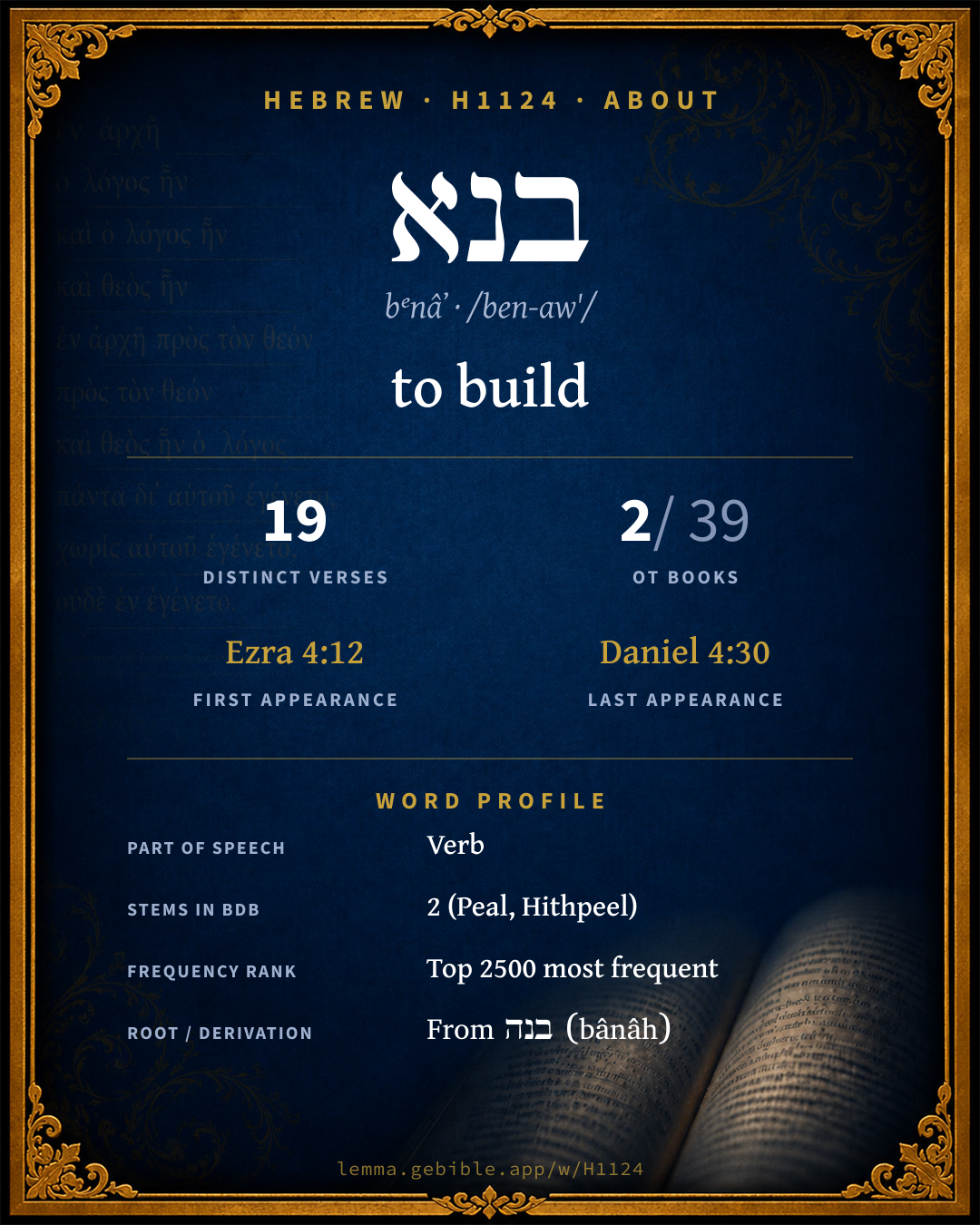
בְּנָה
to build
‘to build’ is one of 3 main senses fuller range ↓
Full lexicon entry — Brown-Driver-Briggs (BDB)
From Brown-Driver-Briggs (BDB)
Where this word appears
See every Qal verb in the Hebrew Bible →
Grammar key — what these labels mean
Part of speech
- Verb
- An action or state-of-being word.
Stem
- Qal
- The basic, simple active stem — the plain form of the verb (“he wrote”).
Form
- Infinitive Construct
- A bound verbal noun, frequently with prepositions (“to write / in writing”).
- Participle Active
- A verbal adjective expressing ongoing or characteristic action (“writing / one who writes”).
- Imperfect
- An incomplete, ongoing, or future action (“he will / would write”).
- Perfect
- A completed action or state — Hebrew marks aspect (completeness) more than strict tense (“he wrote”).
- Participle Passive
- A verbal adjective expressing action received (“written”).
State
- Absolute
- The independent form of a noun, not bound to a following word.
Person
- 3rd Person
- The one spoken about (“he / she / it / they”).
- 1st Person
- The speaker (“I / we”).
Gender
- Masculine
- Grammatically masculine.
- Feminine
- Grammatically feminine.
- Common
- Either gender — not distinguished for this form.
Number
- Plural
- More than one (in Hebrew, generally three or more).
- Singular
- One.
Grammatical forms 10 distinct
- Verb, Qal, Infinitive Construct 6 times (27%)
- Verb, Qal, Participle Active, Masculine, Plural, Absolute 4 times (18%)
- Verb, Hothpaal, Imperfect, 3rd Person, Feminine, Singular 3 times (14%)
- Verb, Hothpaal, Imperfect, 3rd Person, Masculine, Singular 2 times (9%)
- Verb, Hothpaal, Participle Active, Masculine, Singular, Absolute 2 times (9%)
- Verb, Qal, Perfect, 3rd Person, Masculine, Plural 1 time (5%)
- Verb, Qal, Imperfect, 3rd Person, Masculine, Plural 1 time (5%)
- Verb, Qal, Perfect, 1st Person, Common, Singular 1 time (5%)
+2 more forms (2 occurrences)
Parsed forms decoded from the imported morphology (morphhb / Westminster Leningrad Codex — WLC text public domain, morphhb tagging CC BY 4.0), counted across 22 parsed occurrences — not distinct verses.
Every verse where H1124 appears — 19 distinct verses across 2 books. Click any verse to open its interlinear word-by-word view. Verse text shown in the World English Bible for context — . Each verse’s Hebrew form is shown with its reference; the English is not keyword-highlighted, since the data carries no word-level English alignment. Use “Compare translations” on any verse to read it across multiple English versions. This concordance covers the Hebrew Bible; Septuagint (Greek Old Testament) occurrences are not indexed here.
Ezra 18 verses
- Ezra 4:12 בָּנַ֔יִן Qal ptcp.act mp Be it known to the king, that the Jews who came up from you are come to us to Jerusalem; they are building the rebellious and the bad city, and have finished the walls, and repaired the foundations.
- Ezra 4:13 תִּתְבְּנֵ֔א Hothpaal impf 3fs Be it known now to the king that if this city is built, and the walls finished, they will not pay tribute, custom, or toll, and in the end it will be hurtful to the kings.
- Ezra 4:16 תִּתְבְּנֵ֔א Hothpaal impf 3fs We inform the king that, if this city be built, and the walls finished, by this means you shall have no portion beyond the River.
- Ezra 4:21 תִתְבְּנֵ֔א Hothpaal impf 3fs Make you now a decree to cause these men to cease, and that this city not be built, until a decree shall be made by me.
- Ezra 5:2 לְ/מִבְנֵ֔א prep + Qal inf.cs Then rose up Zerubbabel the son of Shealtiel, and Jeshua the son of Jozadak, and began to build the house of God which is at Jerusalem; and with them were the prophets of God, helping them.
- Ezra 5:3 לִ/בְּנֵ֔א prep + Qal inf.cs At the same time came to them Tattenai, the governor beyond the River, and Shetharbozenai, and their companions, and said thus to them, Who gave you a decree to build this house, and to finish this wall?
- Ezra 5:4 בָּנַֽיִן Qal ptcp.act mp Then we told them after this manner, what the names of the men were who were making this building.
- Ezra 5:8 מִתְבְּנֵא֙ Hothpaal ptcp.act ms Be it known to the king, that we went into the province of Judah, to the house of the great God, which is built with great stones, and timber is laid in the walls; and this work goes on with diligence and prospers in their hands.
- Ezra 5:9 לְ/מִבְנְיָ֔ה prep + Qal inf.cs Then asked we those elders, and said to them thus, Who gave you a decree to build this house, and to finish this wall?
- Ezra 5:11 וּ/בָנַ֤יִן בְנֵ֜ה בְּנָ֖/הִי conj + Qal ptcp.act mp Qal ptcp.pass ms Qal pf 3ms + sfx pers 3ms Thus they returned us answer, saying, We are the servants of the God of heaven and earth, and are building the house that was built these many years ago, which a great king of Israel built and finished.
- Ezra 5:13 לִ/בְּנֵֽא prep + Qal inf.cs But in the first year of Cyrus king of Babylon, Cyrus the king made a decree to build this house of God.
- Ezra 5:15 יִתְבְּנֵ֥א Hothpaal impf 3ms and he said to him, Take these vessels, go, put them in the temple that is in Jerusalem, and let the house of God be built in its place.
- Ezra 5:16 מִתְבְּנֵ֖א Hothpaal ptcp.act ms Then came the same Sheshbazzar, and laid the foundations of the house of God which is in Jerusalem: and since that time even until now has it been in building, and yet it is not completed.
- Ezra 5:17 לְ/מִבְנֵ֛א prep + Qal inf.cs Now therefore, if it seem good to the king, let there be search made in the king's treasure-house, which is there at Babylon, whether it be so, that a decree was made of Cyrus the king to build this house of God at Jerusalem; and let the king send his pleasure to us concerning this matter.
- Ezra 6:3 יִתְבְּנֵ֔א Hothpaal impf 3ms In the first year of Cyrus the king, Cyrus the king made a decree: Concerning the house of God at Jerusalem, let the house be built, the place where they offer sacrifices, and let the foundations of it be strongly laid; the height of it sixty cubits, and the breadth of it sixty cubits;
- Ezra 6:7 יִבְנ֥וֹן Qal impf 3mp let the work of this house of God alone; let the governor of the Jews and the elders of the Jews build this house of God in its place.
- Ezra 6:8 לְ/מִבְנֵ֖א prep + Qal inf.cs Moreover I make a decree what you shall do to these elders of the Jews for the building of this house of God: that of the king's goods, even of the tribute beyond the River, expenses be given with all diligence to these men, that they be not hindered.
- Ezra 6:14 בָּנַ֣יִן וּ/בְנ֣וֹ Qal ptcp.act mp conj + Qal pf 3mp The elders of the Jews built and prospered, through the prophesying of Haggai the prophet and Zechariah the son of Iddo. They built and finished it, according to the commandment of the God of Israel, and according to the decree of Cyrus, and Darius, and Artaxerxes king of Persia.
Daniel 1 verse
About this entry
At a glance — auto-summarized from this page’s data, not written by a person. Every figure links to its source below. This summary describes the numbers; it doesn’t interpret them.
בנא (bᵉnâʼ) is a Hebrew verb most often rendered “to build.” It clusters heavily in Ezra, which alone accounts for 95% of its uses. With 19 verses in 2 books, it is an uncommon word in the Hebrew Bible. Different stems carry different senses — BDB groups them under 2 stems, among them Peal and Hithpeel. The King James Version usually renders it “build,” while modern versions prefer “rebuild” (Berean Standard Bible) — see the renderings breakdown. For the data behind this summary, explore the sense tree and the renderings breakdown below.
Gloss history
Strong's 1890 vs modern scholarship
About this word
Strong's H1124 catalogs a Hebrew word from the Hebrew Old Testament.
These counts are not copied from any lexicon or concordance. They are computed here, from the morphology-tagged Hebrew Old Testament. What Lemma adds →
- 19
- distinct verses
- The word appears in 19 distinct verses.
- 2 / 39
- OT books
- The word appears in 2 of 39 Old Testament books.
- #1,412
- by frequency
- Top 2500 most frequent Hebrew words (rank 1,412 of 8,640 Hebrew words by occurrence).
View all 19 occurrences in the concordance →
By traditional corpus
Conventional, traditional groupings — biblical authorship is debated, so this is a traditional corpus grouping, not an authorship claim. Each share is this word’s portion of its verses in that division of the Hebrew canon. Each figure is a share of the word’s 19 distinct verses.
- Writings (Ketuvim) 19 verses · 100%
How translations render this word
Counts come from each version’s own published word-to-Strong’s tagging or interlinear alignment — an approximate guide to how each version renders this word, not a word-level alignment the data otherwise carries. Because each total is that version’s own tagged count, the per-version totals vary from one another and need not match the appearance or distinct-verse counts above. These counts may also differ from a printed concordance because Lemma counts each distinctly tagged rendering and does not collapse phrase taggings into a single head-word total. This is a fixed set of word-tagged versions (KJV, ASV, BSB, ULT) and does not change with the reading translation you choose elsewhere. Each version’s license is shown beside its name below (and on Sources).
- King James Version: Build 5×, Be builded 4×, Builded 4×
- American Standard Version: Build 6×, Be builded 4×, Builded 4×
- Berean Standard Bible: Rebuild 6×, Be rebuilt 3×, Built 3×
- unfoldingWord Literal Text: Build 7×, Let 3×, Be built 2×
King James Version Public Domain
Renders H1124 across 22 tagged occurrences — most commonly:
Plus 5 renderings that appear only once — usually multi-word phrases or single function words the recovered tagging swept in, not distinct renderings.
American Standard Version Public Domain
Renders H1124 across 22 tagged occurrences — most commonly:
Plus 8 renderings that appear only once — usually multi-word phrases or single function words the recovered tagging swept in, not distinct renderings.
Berean Standard Bible Public Domain
Renders H1124 across 22 tagged occurrences — most commonly:
Plus 6 renderings that appear only once — usually multi-word phrases or single function words the recovered tagging swept in, not distinct renderings.
unfoldingWord Literal Text CC BY-SA 4.0
Renders H1124 across 26 tagged occurrences — most commonly:
Plus 12 renderings that appear only once — usually multi-word phrases or single function words the recovered tagging swept in, not distinct renderings.
Senses in the full BDB
Hebrew verbs can shift meaning by stem (binyan): Qal is the basic action, Niphal is often passive or reflexive, Piel often intensifies or makes it factitive, and Hiphil is typically causative. The senses below are grouped under the stem BDB assigns to each. This entry also uses Peal (the basic Aramaic stem, parallel to Qal) and Hithpeel (the reflexive or passive Aramaic stem).
What do BDB’s symbols mean?
BDB uses these scholarly abbreviations:
| Symbol | Meaning |
|---|---|
| 𝔊 | the Septuagint (the ancient Greek translation, LXX) |
| 𝔙 | the Vulgate (the Latin translation) |
| 𝔖 | the Syriac version (the Peshitta) |
| 𝔗 | the Targum (the Aramaic translation) |
| ψ | the Psalms |
| √ | root (the underlying root or stem) |
| ‖ | parallel passage (a synonymous or contrasted parallel) |
| † | the dagger: every passage where the word occurs is cited |
The 2 senses and sub-senses the full Brown-Driver-Briggs lexicon distinguishes for this word, in lexicon order (not ranked by frequency), with BDB’s own verbatim wording and sub-sense lettering. Shown in Hebrew script with BDB’s own scholarly abbreviations. The condensed entry is in the Lexicon Entry tab. See also the Forms in the corpus table below.
Peal
- . build
Hithpeel
- . be built
Senses from the full Brown-Driver-Briggs lexicon (Brown, Driver, Briggs; Oxford 1906 — public domain), digitized via Sefaria, supplemented by the OpenScriptures HebrewLexicon (CC BY 4.0). Full attribution on Sources.
Word origin
Derived from בנה (bânâh) (H1129) — to build.
Jastrow Dictionary
A second Hebrew/Aramaic lexicon for comparison, covering Aramaic and post-biblical (Talmudic, Targumic, Midrashic) usage that the biblical-Hebrew BDB does not. Matched by lemma rather than by Strong’s number, so a lemma may carry more than one Jastrow headword (shown separately below), and the entries cover usage well beyond the Bible.
בְּנָא
- , v. בני
בְּנֵי
- ch. = h. בָּנָה. Targ. Deut. XXV, 9 (Y. יִבְנֶה); a. fr.—Part. בָּנֵי. Targ. Gen. IV, 17.—M. Kat. 10ᵇ מִיבְנֵי to erect; a. e.
- as h. Nif.
- 1. a. 2). Targ. I Kings III, 2; a. fr.—Targ. Gen. XVI, 2; a. e.—Y. Ber. II, 5ᵃ מִתְבַּנְיֵי will be rebuilt; a. e.
נָא I
- = אֲנָא. Y. Ter. V, 43ᶜ bot. ואוף נא וכ׳ I, too, think so. Y. Ber. IV, beg. 7ᵃ וָנָא אמרית וכ׳ and I gave a reason for it; a. fr.—V. דְּנָה, לֵינָא.—Pl. נַן. Y. B. Kam. II, beg. 2ᵈ מה נן אמרין וכ׳ why do we say &c.; a. fr.
נָא II
- (also adverb)(b. h.;
- 1. hurried, half-done. Pes. 41ᵃ bot. אכלו נא if he ate it (the Passover lamb) half-done. Ib.ᵇ ישנו בבל תאכל נא is subject to the law (Ex. XII, 9) &c. Tosef. Macc. IV (III), 1, contrad. to חַי. Men. 78ᵇ מצה נא, v. הַיָנָא; a. fr. e.g. Exodus 12:9
- 2. slender, fine, brittle. — Pl. נָאִין; f. נָאוֹת. Tosef. Kel. B. Kam. II, 9 [read with R. S. to Kel. III, 2:] הוסקו והנאין (= והן נאין) if the vessels were heated but turned out brittle. B. Bath, 97ᵇ (expl. פיטסות, ib. VI, 2) נאות ומגופרות thin, but lined with pitch; Tosef. ib. VI, 3.
נָא III
- (b. h.) I pray, prithee. Yoma IV, 2; a. fr.—Ber. 9ᵃ, a. e. אין נא אלא וכ׳, v. בַּקָּשָׁה.
נַן
- , pl. of נָא I.
A Dictionary of the Targumim, the Talmud Babli and Yerushalmi, and the Midrashic Literature (Marcus Jastrow; London, Luzac, 1903) — Public Domain. Digitized via Sefaria. Digitized via Sefaria. Full attribution on Sources.
Forms in the corpus
The 21 distinct written forms H1124 takes in the Hebrew Bible, most frequent first — each parse links to that stem’s occurrences in the concordance. Hebrew forms include their vowel points and cantillation, so a single lemma takes many written forms.
Same root — word family
Other BDB entries built from the same root as H1124, grouped by Strong’s listed origin. These share a root / origin per the lexicon — not necessarily a shared meaning. Each links to that word’s own entry.
Derives from
Shares the same root
- אבן ʼeben H68 stone
- בית bayith H1004 house
- בן bên H1121 son
- בניה binyâh H1140 building
- בנין binyân H1146 building
- בת bath H1323 daughter
- מבנה mibneh H4011 building
- תבן teben H8401 stubble
- תבנית tabnîyth H8403 pattern
Proper names from this root
People and places named from this root — a name, not an additional meaning of the word.
- בנוי Binnûwy H1131 Binnui
- בני Bânîy H1137 Bani
- בני Bunnîy H1138 Bunni
- בניה Bᵉnâyâh H1141 Benaiah
- יבנאל Yabnᵉʼêl H2995 Jabneel
- יבנה Yabneh H2996 Jabneh
- יבניה Yibnᵉyâh H2997 Ibneiah
- יבניה Yibnîyâh H2998 Ibnijah
- מבני Mᵉbunnay H4012 Mebunnai
Compare all same-root words → Showing 4 of 20 — not the complete family. 9 of the same-root words are proper names (people or places). They share a root, not necessarily a meaning.
Septuagint verse parallels
This word appears in 18 verses that also exist in the Greek Old Testament (Septuagint), out of the 19 Hebrew verses it occurs in. You can read those verses in Greek by switching the Old Testament edition to the Septuagint.
Read these verses in the Septuagint
This is a verse-level parallel only — the same verses exist in both the Hebrew and Greek Old Testaments. No word-level Hebrew↔Greek correspondence is claimed: the data carries no such alignment, so no Greek word is shown as this Hebrew word’s translation. Coverage is not total — the Septuagint omits the deuterocanon and renumbers the Psalms, so some Hebrew verses have no direct Greek parallel.