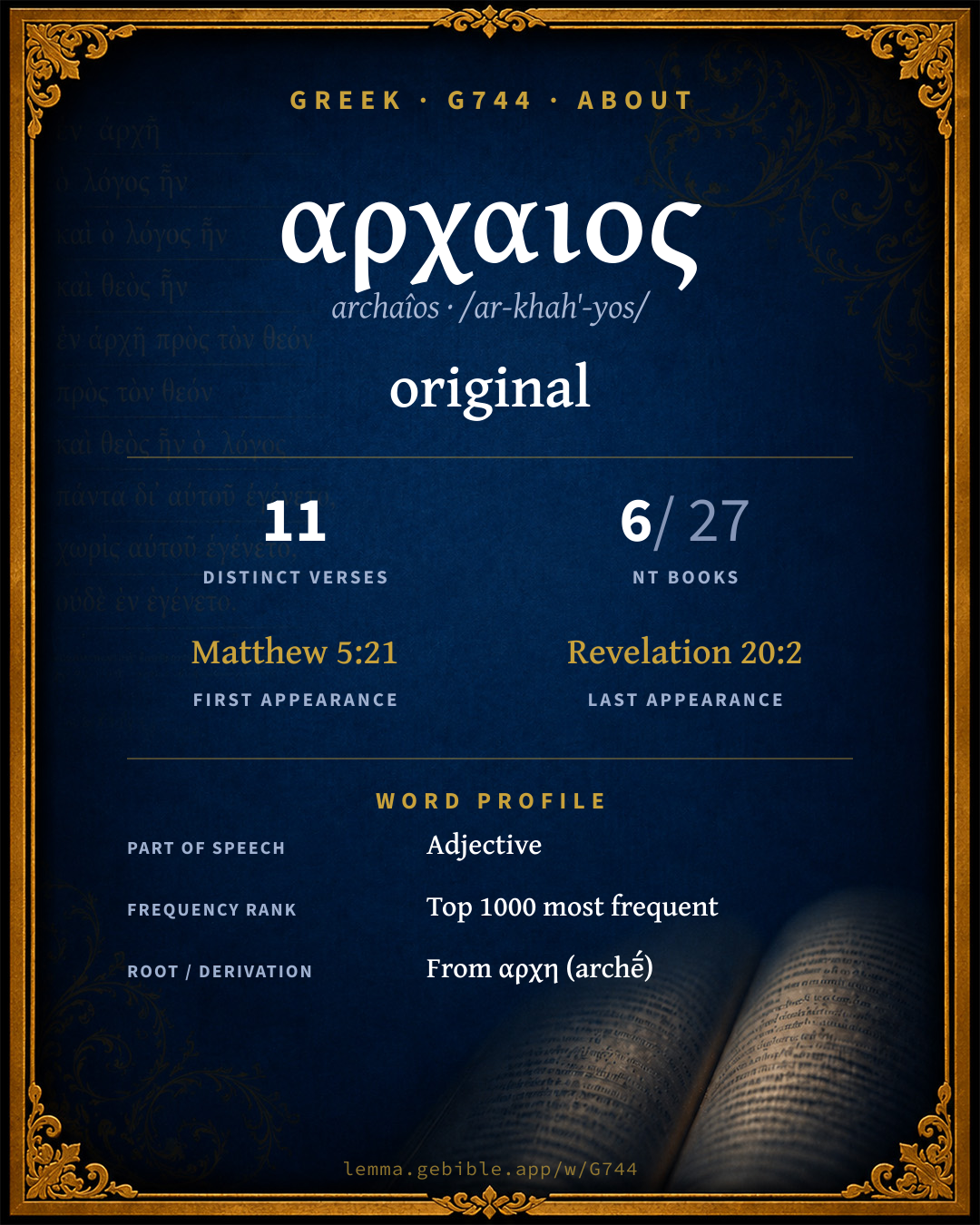
ἀρχαῖος
original
Full lexicon entry — Thayer's Greek Lexicon
From Thayer's Greek Lexicon
Where this word appears
Grammar key — what these labels mean
Part of speech
- Adjective
- A word that describes or qualifies a noun.
Case
- Dative
- The case of the indirect object, means, or location — “to / for / with / in.”
- Genitive
- The case of source, possession, or “of” — answers “whose / from what.”
- Nominative
- The case of the subject (and the predicate nominative).
Gender
- Masculine
- Grammatically masculine.
- Feminine
- Grammatically feminine.
- Neuter
- Grammatically neuter.
Number
- Plural
- More than one.
- Singular
- One.
Every verse where G744 appears in the Book of Revelation — 2 distinct verses. Click any verse to open its interlinear word-by-word view. Verse text shown in the World English Bible for context — . Each verse’s Greek form is shown with its reference; the English is not keyword-highlighted, since the data carries no word-level English alignment. Use “Compare translations” on any verse to read it across multiple English versions. This concordance covers the Greek New Testament; Septuagint (Greek Old Testament) occurrences of this word are not indexed here.
Revelation
- Revelation 12:9 ἀρχαῖος adj nom sg masc The great dragon was thrown down, the old serpent, he who is called the devil and Satan, the deceiver of the whole world. He was thrown down to the earth, and his angels were thrown down with him.
- Revelation 20:2 ἀρχαῖος adj nom sg masc He seized the dragon, the old serpent, which is the devil and Satan, who deceives the whole inhabited earth, and bound him for a thousand years,
About this entry
At a glance — auto-summarized from this page’s data, not written by a person. Every figure links to its source below. This summary describes the numbers; it doesn’t interpret them.
The Greek adjective αρχαιος centers on the idea of “original.” Its English rendering has broadened — “old” classically, “ancient” (unfoldingWord Literal Text) in modern versions; see the renderings breakdown. The Greek New Testament uses it across 11 verses — uncommon. Acts dominates its distribution — 3 of 11 verses. Its earliest occurrence is Matthew 5:21. Dig into 11-verse concordance and the renderings breakdown below.
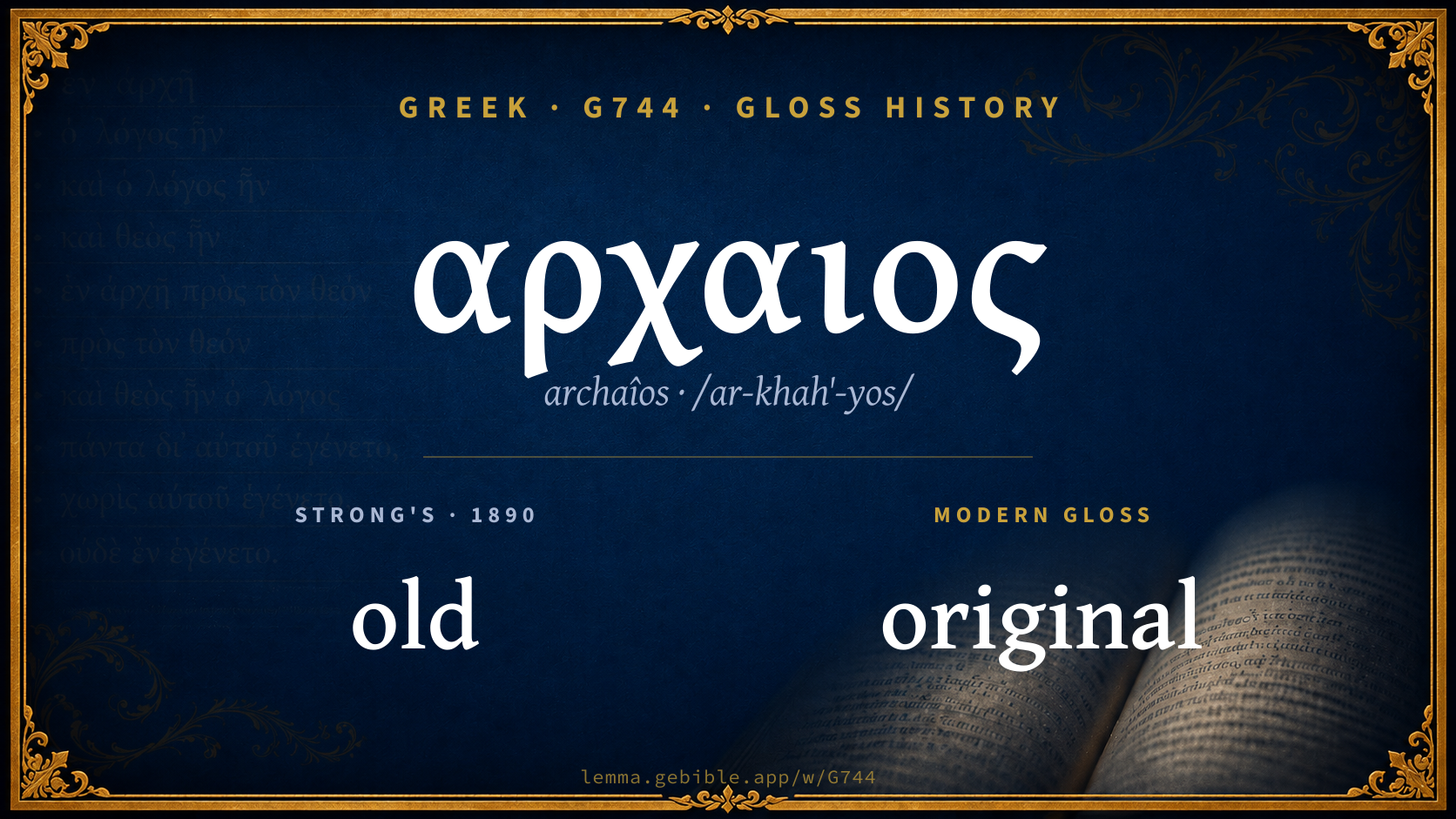
Gloss history
Strong's 1890 vs modern scholarship
About this word
Strong's G744 catalogs a Greek word from the Greek New Testament.
These counts are not copied from any lexicon or concordance. They are computed here, from the morphology-tagged Greek New Testament. What Lemma adds →
- 11
- distinct verses
- The word appears in 11 distinct verses.
- 6 / 27
- NT books
- The word appears in 6 of 27 New Testament books.
- #978
- by frequency
- Top 1000 most frequent Greek words (rank 978 of 5,347 Greek words by occurrence).
View all 11 occurrences in the concordance →
By section of the New Testament
By traditional corpus
Conventional, traditional groupings — biblical authorship is debated, so this is a traditional corpus grouping, not an authorship claim. Some books belong to more than one corpus (Luke is in both the Gospels and the Lukan corpus, and so on), so these shares overlap and need not total 100%. Each figure is a share of the word’s 11 distinct verses.
- Lukan (Luke–Acts) 5 verses · 45%
- Gospels 4 verses · 36%
- Johannine 2 verses · 18%
- Revelation 2 verses · 18%
- Pauline corpus 1 verse · 9%
- General (Catholic) Epistles 1 verse · 9%
How translations render this word
Counts come from each version’s own published word-to-Strong’s tagging or interlinear alignment — an approximate guide to how each version renders this word, not a word-level alignment the data otherwise carries. Because each total is that version’s own tagged count, the per-version totals vary from one another and need not match the appearance or distinct-verse counts above. These counts may also differ from a printed concordance because Lemma counts each distinctly tagged rendering and does not collapse phrase taggings into a single head-word total. This is a fixed set of word-tagged versions (KJV, ASV, BSB, ULT) and does not change with the reading translation you choose elsewhere. Each version’s license is shown beside its name below (and on Sources).
- King James Version: Old 7×, Old time 3×
- American Standard Version: Old 5×, Old time 2×
- Berean Standard Bible: Ancient 4×, Old 3×, Ancients 2×
- unfoldingWord Literal Text: Ancient 6×, Ancient ones 2×
King James Version Public Domain
Renders G744 across 12 tagged occurrences — most commonly:
Plus 2 renderings that appear only once — usually multi-word phrases or single function words the recovered tagging swept in, not distinct renderings.
American Standard Version Public Domain
Renders G744 across 11 tagged occurrences — most commonly:
Plus 4 renderings that appear only once — usually multi-word phrases or single function words the recovered tagging swept in, not distinct renderings.
Berean Standard Bible Public Domain
Renders G744 across 11 tagged occurrences — most commonly:
unfoldingWord Literal Text CC BY-SA 4.0
Renders G744 across 11 tagged occurrences — most commonly:
Plus 3 renderings that appear only once — usually multi-word phrases or single function words the recovered tagging swept in, not distinct renderings.
Senses in Thayer's
The 1 sense Thayer's distinguishes for this word, in lexicon order (not ranked by frequency or importance). The full entry — with sub-senses — is in the Lexicon Entry tab.
- that has been from the beginning, original, primal, old ancient
Word origin
Derived from αρχη (archḗ) (G746) — beginning.
From G746 ; original or primeval : - (them of) old (time).
— Strong’s Exhaustive Concordance (1890), public domain.
Forms in the corpus
The 6 distinct written forms G744 takes in the Greek New Testament, most frequent first — each parse links to that case’s occurrences in the concordance.
| Form | Parsing | Example | Uses |
|---|---|---|---|
| ἀρχαίων archaíōn | Adjective, Genitive, Plural, Feminine | Acts 15:7 | 4 |
| ἀρχαίοις archaíois | Adjective, Dative, Plural, Masculine | Matthew 5:21 | 2 |
| ἀρχαῖος archaîos | Adjective, Nominative, Singular, Masculine | Revelation 12:9 | 2 |
| ἀρχαίου archaíou | Adjective, Genitive, Singular, Masculine | 2 Peter 2:5 | 1 |
| ἀρχαίῳ archaíō | Adjective, Dative, Singular, Masculine | Acts 21:16 | 1 |
| ἀρχαῖα archaîa | Adjective, Nominative, Plural, Neuter | 2 Corinthians 5:17 | 1 |
Same root — word family
Other Thayer's entries built from the same root as G744, grouped by Strong’s listed origin. These share a root / origin per the lexicon — not necessarily a shared meaning. Each links to that word’s own entry.
Derives from
Shares the same root
- αρχηγος archēgós G747 leader
- αρχιερατικος archieratikós G748 high priestly
- αρχιερευς archiereús G749 high priest
- αρχιποιμην archipoímēn G750 chief shepherd
- αρχισυναγωγος archisynágōgos G752 synagogue ruler
- αρχιτεκτων architéktōn G753 architect
- αρχιτελωνης architelṓnēs G754 chief tax collector
- αρχιτρικλινος architríklinos G755 table master
Proper names from this root
People and places named from this root — a name, not an additional meaning of the word.
Compare all same-root words → Showing 4 of 11 — not the complete family. 1 of the same-root words is a proper name (a person or place). They share a root, not necessarily a meaning.
Septuagint usage
The same Greek word αρχαιος appears 19 times in the Greek Old Testament (Septuagint), across 19 verses in 7 books.
- 19
- LXX occurrences
- Tagged occurrences of this Greek word in the Septuagint.
- 19
- verses
- Distinct Septuagint verses containing this word.
- 7 / 39
- OT books
- The word appears in 7 of the 39 Old Testament books.
Sample Septuagint occurrences
- Judges 5:21 ἀρχαῖος
- 1 Samuel 24:14 ἀρχαῖος
- 1 Kings 2:35 ἀρχαῖος
- Psalms 43:2 ἀρχαῖος
- Isaiah 22:9 ἀρχαῖος
- Lamentations 1:7 ἀρχαῖος
- Ezekiel 21:26 ἀρχαῖος
Septuagint occurrences (same lexeme)
Every verse where the same Strong’s number (G744) appears in the Greek Septuagint. Verse text shown in the World English Bible for context; the Greek form is the matched word — the English is not keyword-highlighted.
- Judges 5:21 ἀρχαῖος The river Kishon swept them away, That ancient river, the river Kishon. My soul, march on with strength.
- 1 Samuel 24:14 ἀρχαῖος After whom is the king of Israel come out? after whom do you pursue? after a dead dog, after a flea.
- 1 Kings 2:35 ἀρχαῖος The king put Benaiah the son of Jehoiada in his room over the host; and Zadok the priest did the king put in the room of Abiathar.
- 1 Kings 5:10 ἀρχαῖος So Hiram gave Solomon timber of cedar and timber of fir according to all his desire.
- Psalms 43:2 ἀρχαῖος For you are the God of my strength. Why have you rejected me? Why do I go mourning because of the oppression of the enemy?
- Psalms 76:6 ἀρχαῖος At your rebuke, God of Jacob, Both chariot and horse are cast into a deep sleep.
- Psalms 78:8 ἀρχαῖος And might not be as their fathers, A stubborn and rebellious generation, A generation that didn't make their hearts loyal, Whose spirit was not steadfast with God.
- Psalms 88:50 ἀρχαῖος
- Psalms 138:5 ἀρχαῖος Yes, they will sing of the ways of Yahweh; For great is Yahweh's glory.
- Psalms 142:5 ἀρχαῖος I cried to you, Yahweh. I said, "You are my refuge, My portion in the land of the living."
- Isaiah 22:9 ἀρχαῖος You saw the breaches of the city of David, that they were many; and you gathered together the waters of the lower pool;
- Isaiah 22:11 ἀρχαῖος you made also a reservoir between the two walls for the water of the old pool. But you didn't look to him who had done this, neither did you have respect for him who purposed it long ago.
- Isaiah 23:17 ἀρχαῖος It shall happen after the end of seventy years, that Yahweh will visit Tyre, and she shall return to her hire, and shall play the prostitute with all the kingdoms of the world on the surface of the earth.
- Isaiah 25:1 ἀρχαῖος Yahweh, you are my God; I will exalt you, I will praise your name; for you have done wonderful things, [even] counsels of old, in faithfulness [and] truth.
- Isaiah 37:26 ἀρχαῖος Have you not heard how I have done it long ago, and formed it of ancient times? now have I brought it to pass, that it should be your to lay waste fortified cities into ruinous heaps.
- Isaiah 43:18 ἀρχαῖος Don't remember the former things, neither consider the things of old.
- Lamentations 1:7 ἀρχαῖος Jerusalem remembers in the days of her affliction and of her miseries all her pleasant things that were from the days of old: When her people fell into the hand of the adversary, and none did help her, The adversaries saw her, they did mock at her desolations.
- Lamentations 2:17 ἀρχαῖος Yahweh has done that which he purposed; he has fulfilled his word that he commanded in the days of old; He has thrown down, and has not pitied: He has caused the enemy to rejoice over you; he has exalted the horn of your adversaries.
- Ezekiel 21:26 ἀρχαῖος thus says the Lord Yahweh: Remove the turban, and take off the crown; this [shall be] no more the same; exalt that which is low, and abase that which is high.
These are occurrences of the same Greek lexeme (G744) in the Septuagint — not a translation of any one Hebrew word. The store carries no word-level Hebrew↔Greek alignment, so no Hebrew original is asserted here. Counts come from the recovered LXX Strong's tagging — high-frequency vocabulary is well covered, while rare or late forms may be untagged — so they reflect tagged occurrences and may slightly undercount.