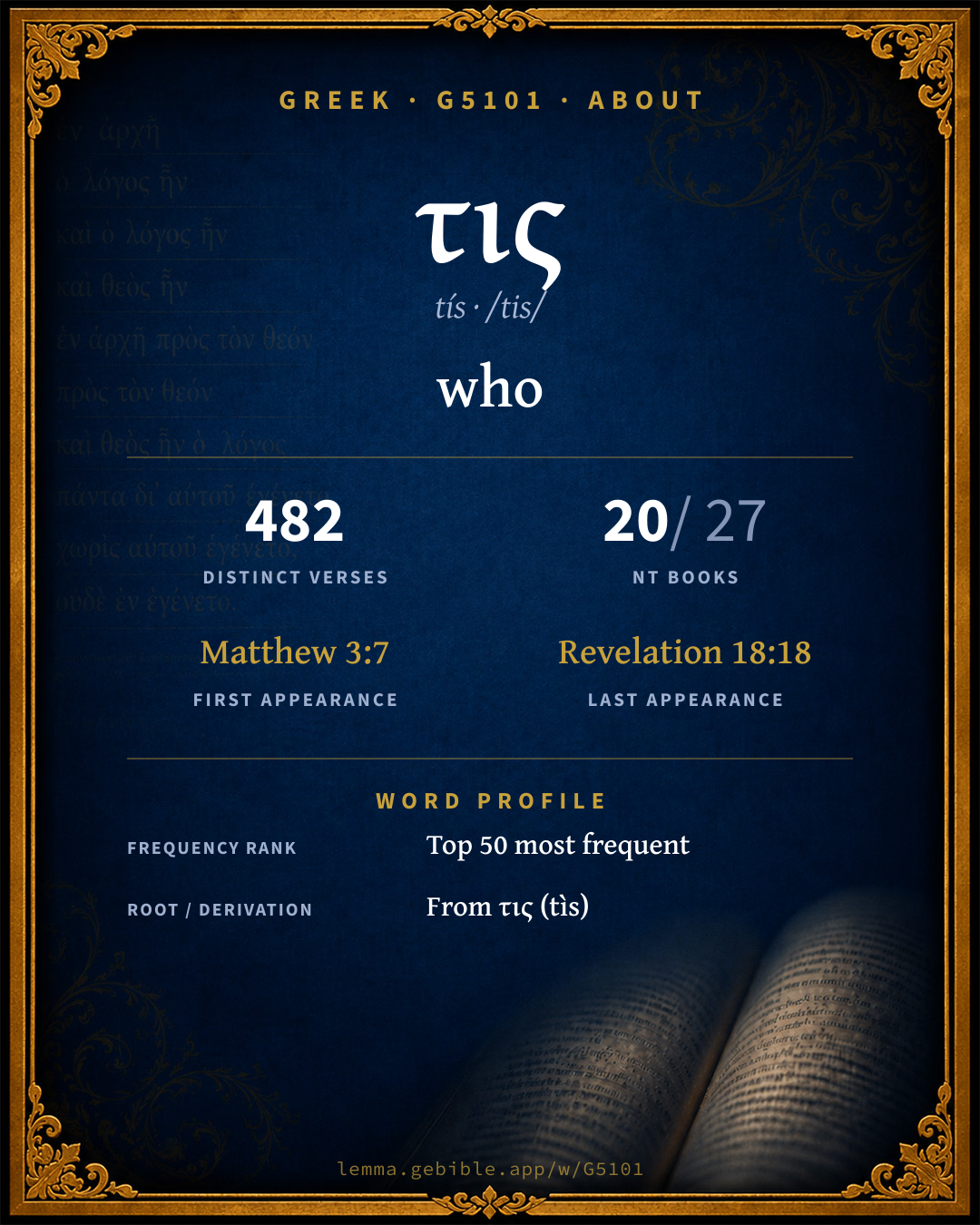
τίς
who
Full lexicon entry — Thayer's Greek Lexicon
From Thayer's Greek Lexicon
Where this word appears
See every Accusative-case word in the Greek New Testament →
Grammar key — what these labels mean
Part of speech
- Interrogative pronoun
- Asks a question (“who?”, “what?”).
- Indefinite pronoun
- Refers to someone or something unspecified (“someone,” “anything”).
Case
- Accusative
- The case of the direct object and of extent.
- Nominative
- The case of the subject (and the predicate nominative).
- Genitive
- The case of source, possession, or “of” — answers “whose / from what.”
- Dative
- The case of the indirect object, means, or location — “to / for / with / in.”
Gender
- Neuter
- Grammatically neuter.
- Masculine
- Grammatically masculine.
- Feminine
- Grammatically feminine.
Number
- Singular
- One.
- Plural
- More than one.
24 verses where G5101 appears in the Nominative case in the Book of Matthew. Filtered view — show all forms. Click any verse to open its interlinear word-by-word view. Verse text shown in the World English Bible for context — . Each verse’s Greek form is shown with its reference; the English is not keyword-highlighted, since the data carries no word-level English alignment. Use “Compare translations” on any verse to read it across multiple English versions. This concordance covers the Greek New Testament; Septuagint (Greek Old Testament) occurrences of this word are not indexed here.
Matthew
- Matthew 3:7 τίς int.pron nom sg masc But when he saw many of the Pharisees and Sadducees coming for his baptism, he said to them, "You offspring of vipers, who warned you to flee from the wrath to come?
- Matthew 6:27 τίς int.pron nom sg masc "Which of you, by being anxious, can add one cubit to the measure of his life?
- Matthew 7:9 τίς int.pron nom sg masc Or who is there among you, who, if his son asks him for bread, will give him a stone?
- Matthew 8:26 τί int.pron nom sg neut He said to them, "Why are you fearful, oh you of little faith?" Then he got up, rebuked the wind and the sea, and there was a great calm.
- Matthew 8:29 τί int.pron nom sg neut Behold, they cried out, saying, "What do we have to do with you, Jesus, Son of God? Have you come here to torment us before the time?"
- Matthew 9:5 τί int.pron nom sg neut For which is easier, to say, 'Your sins are forgiven;' or to say, 'Get up, and walk?'
- Matthew 9:13 τί int.pron nom sg neut But you go and learn what this means: 'I desire mercy, and not sacrifice,' for I came not to call the righteous, but sinners to repentance."
- Matthew 10:11 τίς int.pron nom sg masc Into whatever city or village you enter, find out who in it is worthy; and stay there until you go on.
- Matthew 12:7 τί int.pron nom sg neut But if you had known what this means, 'I desire mercy, and not sacrifice,' you would not have condemned the guiltless.
- Matthew 12:11 τίς int.pron nom sg masc He said to them, "What man is there among you, who has one sheep, and if this one falls into a pit on the Sabbath day, won't he grab on to it, and lift it out?
- Matthew 12:48 τίς τίνες int.pron nom sg masc int.pron nom pl masc But he answered him who spoke to him, "Who is my mother? Who are my brothers?"
- Matthew 17:10 τί int.pron nom sg neut His disciples asked him, saying, "Then why do the scribes say that Elijah must come first?"
- Matthew 18:1 τίς int.pron nom sg masc In that hour the disciples came to Jesus, saying, "Who then is greatest in the Kingdom of Heaven?"
- Matthew 19:25 τίς int.pron nom sg masc When the disciples heard it, they were exceedingly astonished, saying, "Who then can be saved?"
- Matthew 19:27 τί int.pron nom sg neut Then Peter answered, "Behold, we have left everything, and followed you. What then will we have?"
- Matthew 21:10 τίς int.pron nom sg masc When he had come into Jerusalem, all the city was stirred up, saying, "Who is this?"
- Matthew 21:23 τίς int.pron nom sg masc When he had come into the temple, the chief priests and the elders of the people came to him as he was teaching, and said, "By what authority do you do these things? Who gave you this authority?"
- Matthew 21:31 τίς int.pron nom sg masc Which of the two did the will of his father?" They said to him, "The first." Jesus said to them, "Most assuredly I tell you that the tax collectors and the prostitutes are entering into the Kingdom of God before you.
- Matthew 22:42 τί τίνος int.pron nom sg neut int.pron gen sg masc saying, "What do you think of the Christ? Whose son is he?" They said to him, "Of David."
- Matthew 23:17 τίς int.pron nom sg masc You blind fools! For which is greater, the gold, or the temple that sanctifies the gold?
- Matthew 23:19 τί int.pron nom sg neut You blind fools! For which is greater, the gift, or the altar that sanctifies the gift?
- Matthew 24:45 Τίς int.pron nom sg masc "Who then is the faithful and wise servant, whom his lord has set over his household, to give them their food in due season?
- Matthew 26:68 τίς int.pron nom sg masc saying, "Prophesy to us, you Christ! Who hit you?"
- Matthew 27:4 τί int.pron nom sg neut saying, "I have sinned in that I betrayed innocent blood." But they said, "What is that to us? You see to it."
About this entry
At a glance — auto-summarized from this page’s data, not written by a person. Every figure links to its source below. This summary describes the numbers; it doesn’t interpret them.
τις — transliterated tís — is a Greek word carrying the sense “who.” Debuting at Matthew 3:7, it then recurs through the corpus. Spanning 482 verses in 20 books, it ranks among the common words of the Greek New Testament. Each statement above links to its evidence; the full detail follows below.
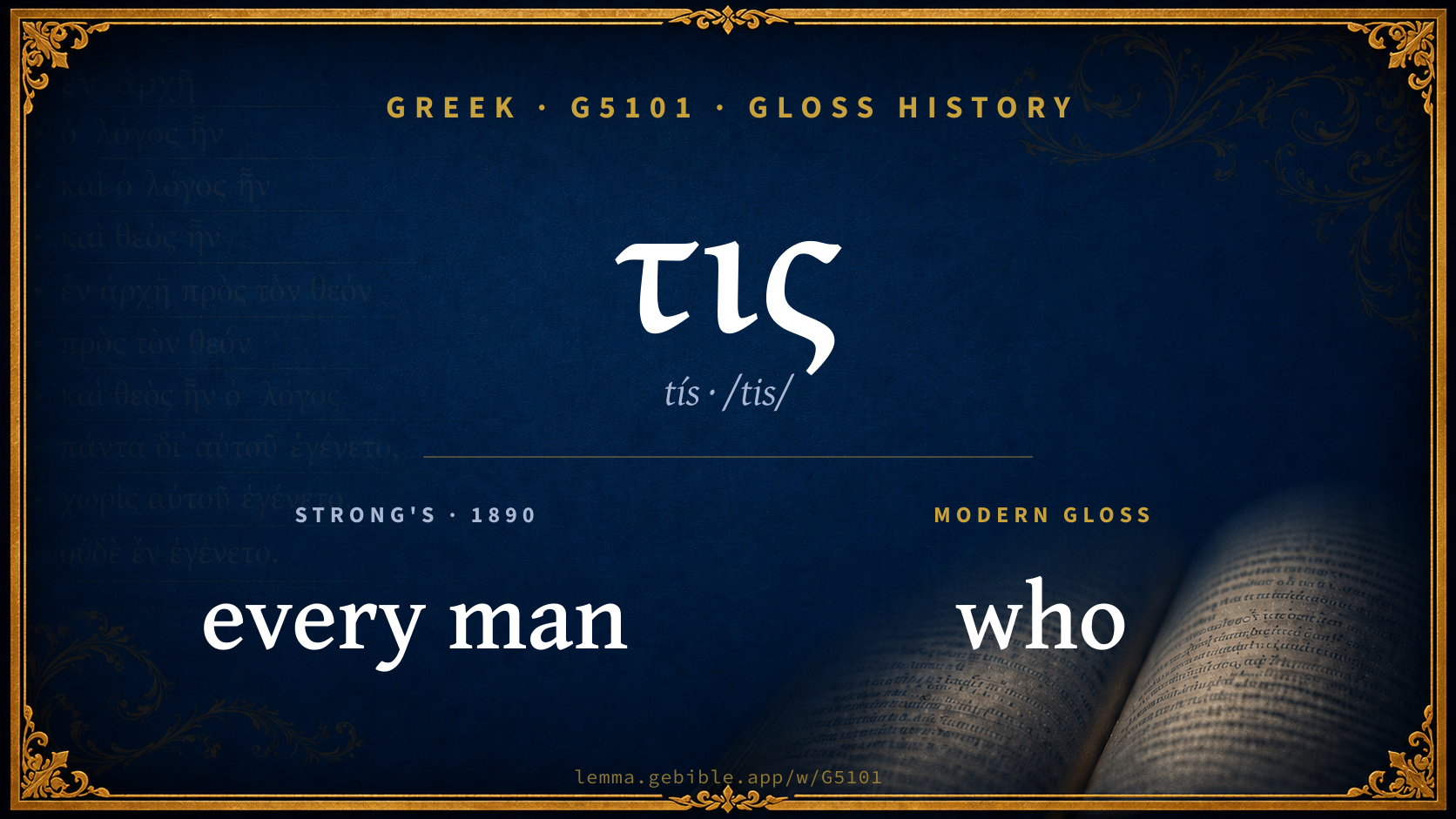
Gloss history
Strong's 1890 vs modern scholarship
About this word
Strong's G5101 catalogs a Greek word from the Greek New Testament.
These counts are not copied from any lexicon or concordance. They are computed here, from the morphology-tagged Greek New Testament. What Lemma adds →
- 482
- distinct verses
- The word appears in 482 distinct verses.
- 20 / 27
- NT books
- The word appears in 20 of 27 New Testament books.
- #36
- by frequency
- Top 50 most frequent Greek words (rank 36 of 5,347 Greek words by occurrence).
View all 482 occurrences in the concordance →
By section of the New Testament
By traditional corpus
Conventional, traditional groupings — biblical authorship is debated, so this is a traditional corpus grouping, not an authorship claim. Some books belong to more than one corpus (Luke is in both the Gospels and the Lukan corpus, and so on), so these shares overlap and need not total 100%. Each figure is a share of the word’s 482 distinct verses.
- Gospels 308 verses · 64%
- Lukan (Luke–Acts) 154 verses · 32%
- Pauline corpus 86 verses · 18%
- Johannine 83 verses · 17%
- Revelation 13 verses · 3%
- General (Catholic) Epistles 12 verses · 2%
- Hebrews 10 verses · 2%
How translations render this word
Counts come from each version’s own published word-to-Strong’s tagging or interlinear alignment — an approximate guide to how each version renders this word, not a word-level alignment the data otherwise carries. Because each total is that version’s own tagged count, the per-version totals vary from one another and need not match the appearance or distinct-verse counts above. These counts may also differ from a printed concordance because Lemma counts each distinctly tagged rendering and does not collapse phrase taggings into a single head-word total. This is a fixed set of word-tagged versions (KJV, ASV, BSB, ULT) and does not change with the reading translation you choose elsewhere. Each version’s license is shown beside its name below (and on Sources).
- King James Version: What 260×, Who 101×, Why 67×
- American Standard Version: What 246×, Who 107×, Why 76×
- Berean Standard Bible: What 232×, Who 118×, Why 78×
- unfoldingWord Literal Text: What 271×, Who 118×, Why 93×
King James Version Public Domain
Renders G5101 across 523 tagged occurrences — most commonly:
Plus 13 renderings that appear only once — usually multi-word phrases or single function words the recovered tagging swept in, not distinct renderings. Not rendered by a distinct English word in 14 further occurrences.
American Standard Version Public Domain
Renders G5101 across 541 tagged occurrences — most commonly:
Plus other, less common renderings. Plus 29 renderings that appear only once — usually multi-word phrases or single function words the recovered tagging swept in, not distinct renderings.
Berean Standard Bible Public Domain
Renders G5101 across 502 tagged occurrences — most commonly:
Plus 14 renderings that appear only once — usually multi-word phrases or single function words the recovered tagging swept in, not distinct renderings. Not rendered by a distinct English word in 58 further occurrences.
unfoldingWord Literal Text CC BY-SA 4.0
Renders G5101 across 611 tagged occurrences — most commonly:
Plus other, less common renderings. Plus 13 renderings that appear only once — usually multi-word phrases or single function words the recovered tagging swept in, not distinct renderings.
Senses in Thayer's
The 1 sense Thayer's distinguishes for this word, in lexicon order (not ranked by frequency or importance). The full entry — with sub-senses — is in the Lexicon Entry tab.
- who, which, what
Word origin
Derived from τις (tìs) (G5100) — a certain.
Probably emphatic of G5100 ; an interrogitive pronoun who which or what (in direct or indirect questions): - every man how (much) + no (-ne thing) what (manner thing) where ([-by -fore -of -unto -with -withal]) whether which who (-m -se) why.
— Strong’s Exhaustive Concordance (1890), public domain.
Forms in the corpus
The 13 distinct written forms G5101 takes in the Greek New Testament, most frequent first — each parse links to that case’s occurrences in the concordance.