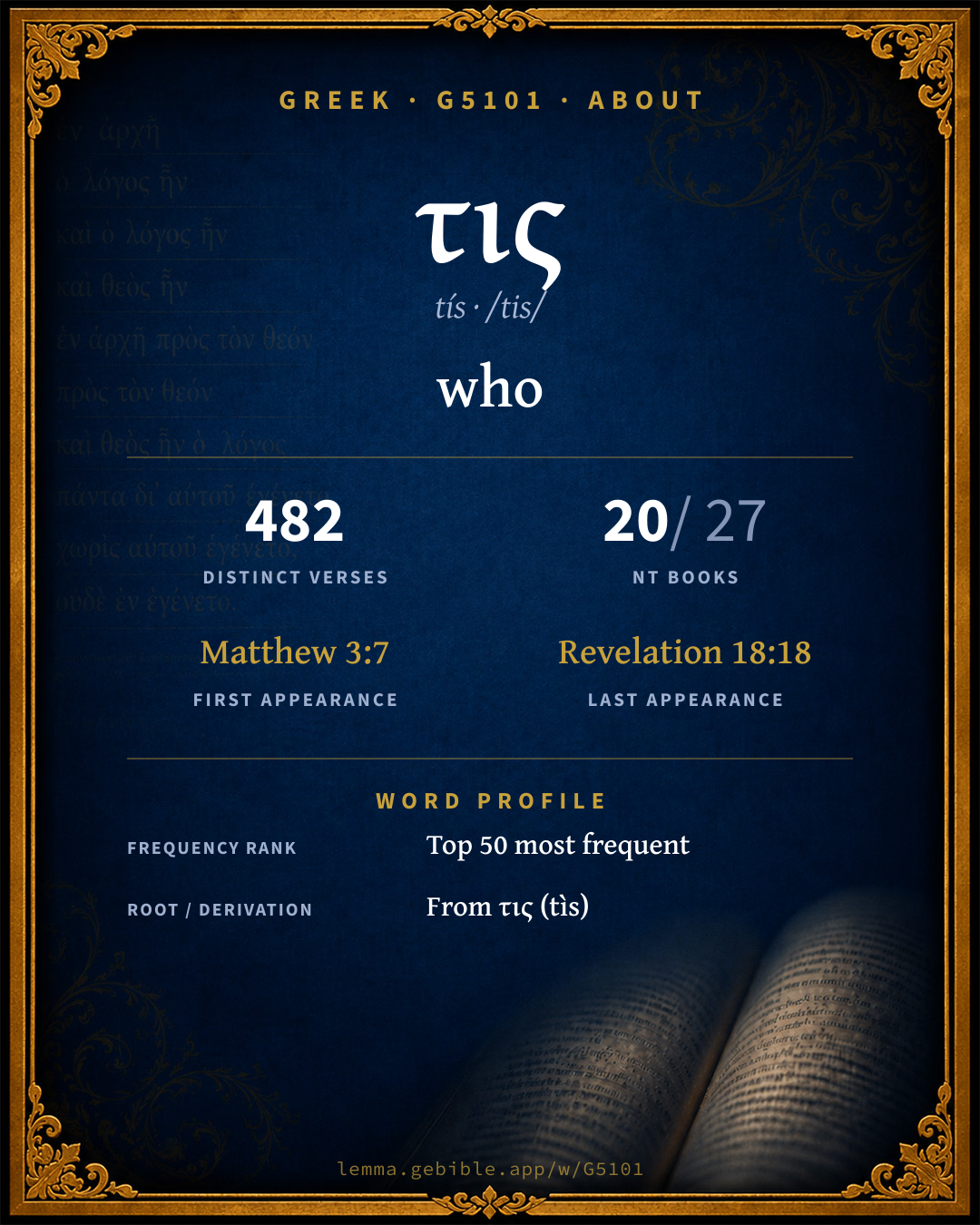
τίς
who
Full lexicon entry — Thayer's Greek Lexicon
From Thayer's Greek Lexicon
Where this word appears
See every Nominative-case word in the Greek New Testament →
Grammar key — what these labels mean
Part of speech
- Interrogative pronoun
- Asks a question (“who?”, “what?”).
- Indefinite pronoun
- Refers to someone or something unspecified (“someone,” “anything”).
Case
- Accusative
- The case of the direct object and of extent.
- Nominative
- The case of the subject (and the predicate nominative).
- Genitive
- The case of source, possession, or “of” — answers “whose / from what.”
- Dative
- The case of the indirect object, means, or location — “to / for / with / in.”
Gender
- Neuter
- Grammatically neuter.
- Masculine
- Grammatically masculine.
- Feminine
- Grammatically feminine.
Number
- Singular
- One.
- Plural
- More than one.
32 verses where G5101 appears in the Accusative case in the Book of John. Filtered view — show all forms. Click any verse to open its interlinear word-by-word view. Verse text shown in the World English Bible for context — . Each verse’s Greek form is shown with its reference; the English is not keyword-highlighted, since the data carries no word-level English alignment. Use “Compare translations” on any verse to read it across multiple English versions. This concordance covers the Greek New Testament; Septuagint (Greek Old Testament) occurrences of this word are not indexed here.
John
- John 1:39 τί int.pron acc sg neut He said to them, "Come, and see." They came and saw where he was staying, and they stayed with him that day. It was about the tenth hour.
- John 2:18 τί int.pron acc sg neut The Jews therefore answered him, "What sign do you show us, seeing that you do these things?"
- John 4:27 τί τί int.pron acc sg neut int.pron acc sg neut At this, his disciples came. They marveled that he was speaking with a woman; yet no one said, "What are you looking for?" or, "Why do you speak with her?"
- John 6:6 τί int.pron acc sg neut This he said to test him, for he himself knew what he would do.
- John 6:28 τί int.pron acc sg neut They said therefore to him, "What must we do, that we may work the works of God?"
- John 6:30 τί τί int.pron acc sg neut int.pron acc sg neut They said therefore to him, "What then do you do for a sign, that we may see, and believe you? What work do you do?
- John 6:68 τίνα int.pron acc sg masc Simon Peter answered him, "Lord, to whom would we go? You have the words of eternal life.
- John 7:19 τί int.pron acc sg neut Didn't Moses give you the law, and yet none of you keeps the law? Why do you seek to kill me?"
- John 7:51 τί int.pron acc sg neut "Does our law judge a man, unless it first hears from him personally and knows what he does?"
- John 8:5 τί int.pron acc sg neut Now in our law, Moses commanded us to stone such. What then do you say about her?"
- John 8:53 τίνα int.pron acc sg masc Are you greater than our father, Abraham, who died? The prophets died. Who do you make yourself out to be?"
- John 9:17 τί int.pron acc sg neut Therefore they asked the blind man again, "What do you say about him, because he opened your eyes?" He said, "He is a prophet."
- John 9:26 τί int.pron acc sg neut They said to him again, "What did he do to you? How did he open your eyes?"
- John 9:27 τί int.pron acc sg neut He answered them, "I told you already, and you didn't listen. Why do you want to hear it again? You don't also want to become his disciples, do you?"
- John 10:20 τί int.pron acc sg neut Many of them said, "He has a demon, and is insane! Why do you listen to him?"
- John 11:47 τί int.pron acc sg neut The chief priests therefore and the Pharisees gathered a council, and said, "What are we doing? For this man does many signs.
- John 11:56 τί int.pron acc sg neut Then they sought for Jesus and spoke one with another, as they stood in the temple, "What do you think--that he isn't coming to the feast at all?"
- John 12:27 τί int.pron acc sg neut "Now my soul is troubled. What shall I say? 'Father, save me from this time?' But for this cause I came to this time.
- John 12:49 τί τί int.pron acc sg neut int.pron acc sg neut For I spoke not from myself, but the Father who sent me, he gave me a commandment, what I should say, and what I should speak.
- John 13:12 τί int.pron acc sg neut So when he had washed their feet, put his outer garment back on, and sat down again, he said to them, "Do you know what I have done to you?
- John 13:18 τίνας int.pron acc pl masc I don't speak concerning all of you. I know whom I have chosen. But that the Scripture may be fulfilled, 'He who eats bread with me has lifted up his heel against me.'
- John 13:28 τί int.pron acc sg neut Now no man at the table knew why he said this to him.
- John 15:15 τί int.pron acc sg neut No longer do I call you servants, for the servant doesn't know what his lord does. But I have called you friends, for everything that I heard from my Father, I have made known to you.
- John 16:18 τί τί int.pron nom sg neut int.pron acc sg neut They said therefore, "What is this that he says, 'A little while?' We don't know what he is saying."
- John 18:4 τίνα int.pron acc sg masc Jesus therefore, knowing all the things that were happening to him, went forth, and said to them, "Who are you looking for?"
- John 18:7 τίνα int.pron acc sg masc Again therefore he asked them, "Who are you looking for?" They said, "Jesus of Nazareth."
- John 18:21 τί τί int.pron nom sg neut int.pron acc sg neut Why do you ask me? Ask those who have heard me what I said to them. Behold, these know the things which I said."
- John 18:23 τί int.pron acc sg neut Jesus answered him, "If I have spoken evil, testify of the evil; but if well, why do you beat me?"
- John 18:29 τίνα int.pron acc sg fem Pilate therefore went out to them, and said, "What accusation do you bring against this man?"
- John 18:35 τί int.pron acc sg neut Pilate answered, "I'm not a Jew, am I? Your own nation and the chief priests delivered you to me. What have you done?"
- John 20:13 τί int.pron acc sg neut They told her, "Woman, why are you weeping?" She said to them, "Because they have taken away my Lord, and I don't know where they have laid him."
- John 20:15 τί τίνα int.pron nom sg neut int.pron acc sg masc Jesus said to her, "Woman, why are you weeping? Who are you looking for?" She, supposing him to be the gardener, said to him, "Sir, if you have carried him away, tell me where you have laid him, and I will take him away."
About this entry
At a glance — auto-summarized from this page’s data, not written by a person. Every figure links to its source below. This summary describes the numbers; it doesn’t interpret them.
τις — transliterated tís — is a Greek word carrying the sense “who.” Debuting at Matthew 3:7, it then recurs through the corpus. Spanning 482 verses in 20 books, it ranks among the common words of the Greek New Testament. Each statement above links to its evidence; the full detail follows below.
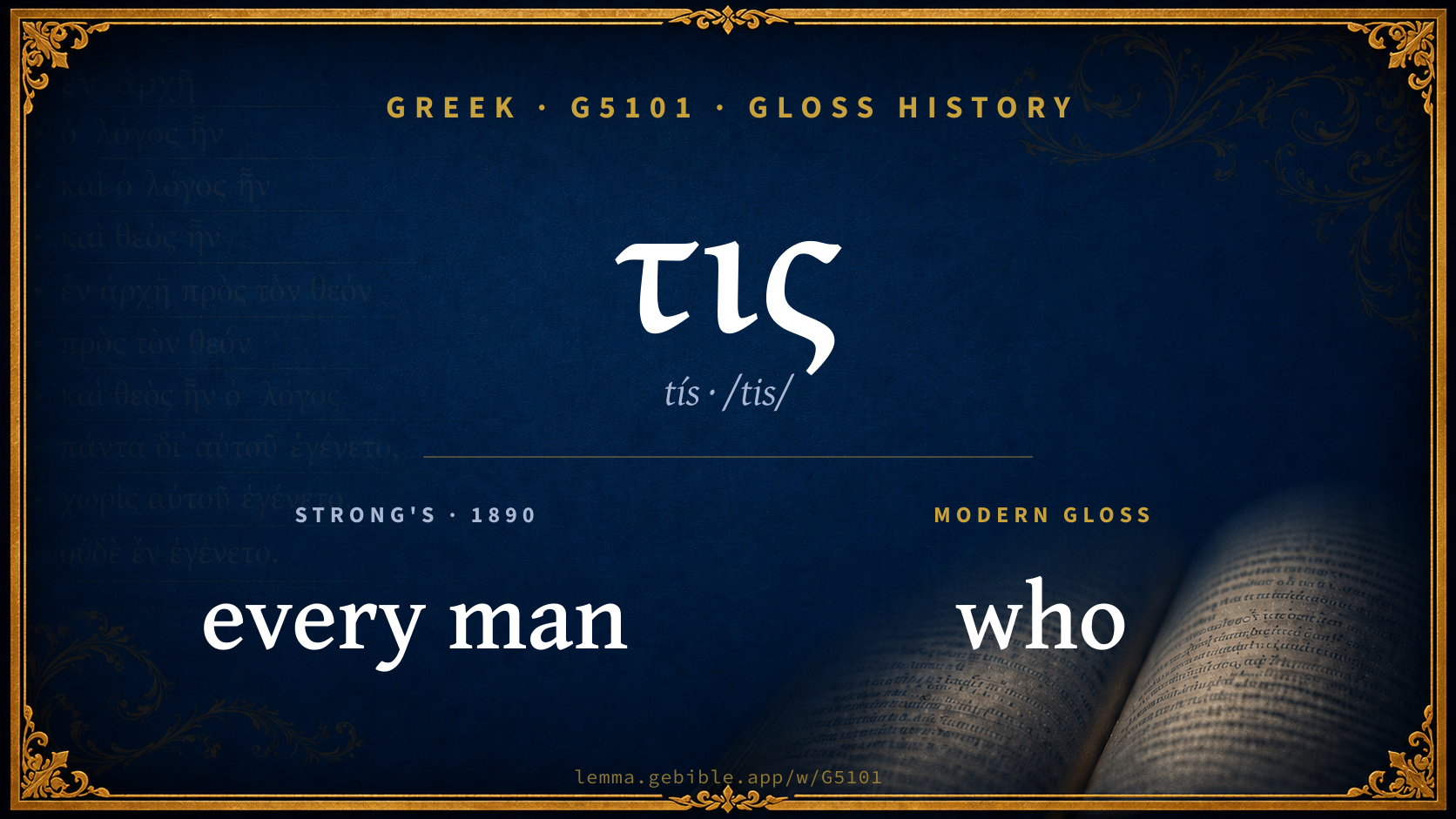
Gloss history
Strong's 1890 vs modern scholarship
About this word
Strong's G5101 catalogs a Greek word from the Greek New Testament.
These counts are not copied from any lexicon or concordance. They are computed here, from the morphology-tagged Greek New Testament. What Lemma adds →
- 482
- distinct verses
- The word appears in 482 distinct verses.
- 20 / 27
- NT books
- The word appears in 20 of 27 New Testament books.
- #36
- by frequency
- Top 50 most frequent Greek words (rank 36 of 5,347 Greek words by occurrence).
View all 482 occurrences in the concordance →
By section of the New Testament
By traditional corpus
Conventional, traditional groupings — biblical authorship is debated, so this is a traditional corpus grouping, not an authorship claim. Some books belong to more than one corpus (Luke is in both the Gospels and the Lukan corpus, and so on), so these shares overlap and need not total 100%. Each figure is a share of the word’s 482 distinct verses.
- Gospels 308 verses · 64%
- Lukan (Luke–Acts) 154 verses · 32%
- Pauline corpus 86 verses · 18%
- Johannine 83 verses · 17%
- Revelation 13 verses · 3%
- General (Catholic) Epistles 12 verses · 2%
- Hebrews 10 verses · 2%
How translations render this word
Counts come from each version’s own published word-to-Strong’s tagging or interlinear alignment — an approximate guide to how each version renders this word, not a word-level alignment the data otherwise carries. Because each total is that version’s own tagged count, the per-version totals vary from one another and need not match the appearance or distinct-verse counts above. These counts may also differ from a printed concordance because Lemma counts each distinctly tagged rendering and does not collapse phrase taggings into a single head-word total. This is a fixed set of word-tagged versions (KJV, ASV, BSB, ULT) and does not change with the reading translation you choose elsewhere. Each version’s license is shown beside its name below (and on Sources).
- King James Version: What 260×, Who 101×, Why 67×
- American Standard Version: What 246×, Who 107×, Why 76×
- Berean Standard Bible: What 232×, Who 118×, Why 78×
- unfoldingWord Literal Text: What 271×, Who 118×, Why 93×
King James Version Public Domain
Renders G5101 across 523 tagged occurrences — most commonly:
Plus 13 renderings that appear only once — usually multi-word phrases or single function words the recovered tagging swept in, not distinct renderings. Not rendered by a distinct English word in 14 further occurrences.
American Standard Version Public Domain
Renders G5101 across 541 tagged occurrences — most commonly:
Plus other, less common renderings. Plus 29 renderings that appear only once — usually multi-word phrases or single function words the recovered tagging swept in, not distinct renderings.
Berean Standard Bible Public Domain
Renders G5101 across 502 tagged occurrences — most commonly:
Plus 14 renderings that appear only once — usually multi-word phrases or single function words the recovered tagging swept in, not distinct renderings. Not rendered by a distinct English word in 58 further occurrences.
unfoldingWord Literal Text CC BY-SA 4.0
Renders G5101 across 611 tagged occurrences — most commonly:
Plus other, less common renderings. Plus 13 renderings that appear only once — usually multi-word phrases or single function words the recovered tagging swept in, not distinct renderings.
Senses in Thayer's
The 1 sense Thayer's distinguishes for this word, in lexicon order (not ranked by frequency or importance). The full entry — with sub-senses — is in the Lexicon Entry tab.
- who, which, what
Word origin
Derived from τις (tìs) (G5100) — a certain.
Probably emphatic of G5100 ; an interrogitive pronoun who which or what (in direct or indirect questions): - every man how (much) + no (-ne thing) what (manner thing) where ([-by -fore -of -unto -with -withal]) whether which who (-m -se) why.
— Strong’s Exhaustive Concordance (1890), public domain.
Forms in the corpus
The 13 distinct written forms G5101 takes in the Greek New Testament, most frequent first — each parse links to that case’s occurrences in the concordance.