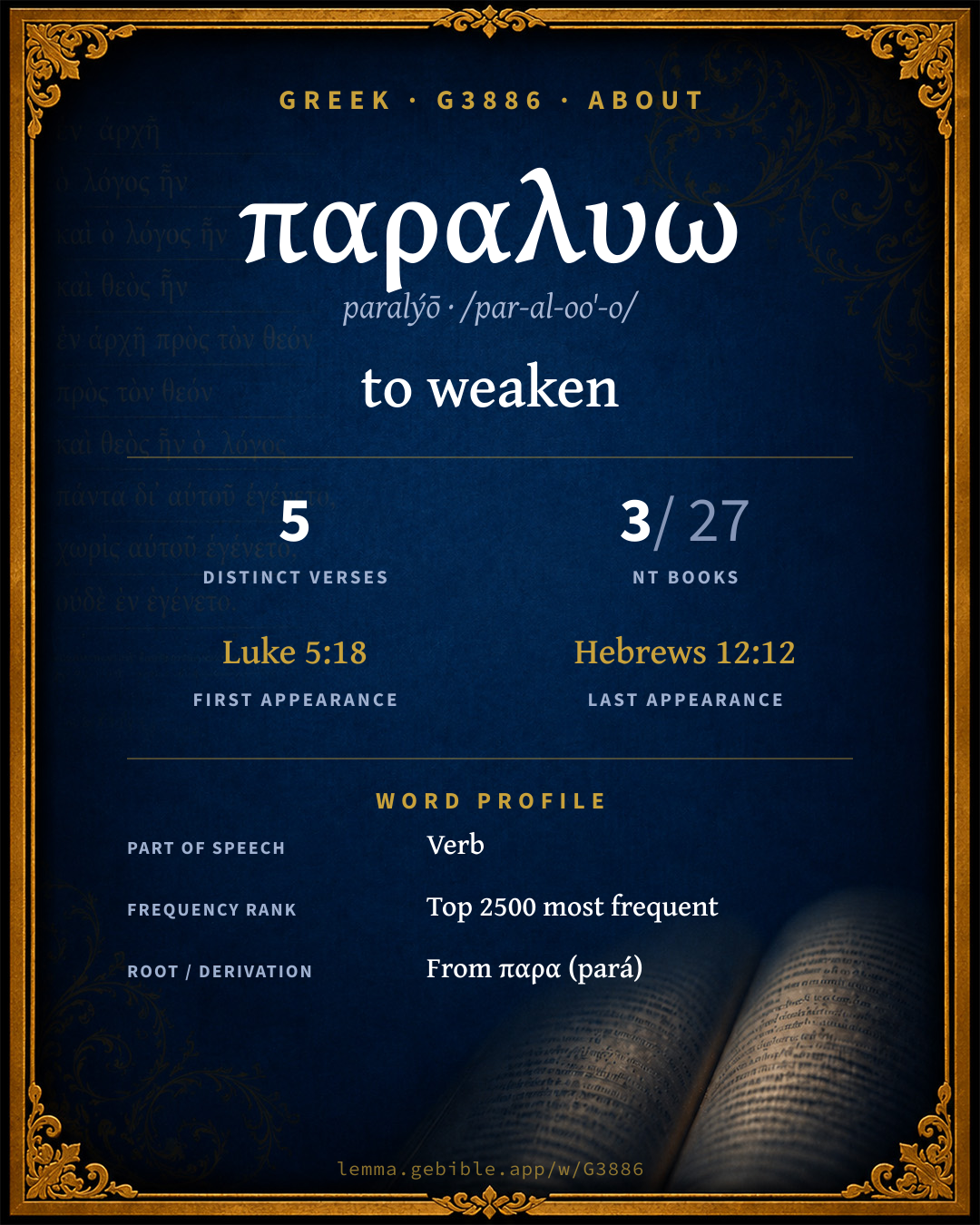
παραλύω
to weaken
‘to weaken’ is one of 6 main senses fuller range ↓
Full lexicon entry — Thayer's Greek Lexicon
From Thayer's Greek Lexicon
Where this word appears
Grammar key — what these labels mean
Part of speech
- Verb
- An action or state-of-being word.
Tense
- Perfect
- A completed past action with continuing present results.
Voice
- Passive
- The subject receives the action.
Mood
- Participle
- A verbal adjective (“writing,” “having written”).
Case
- Nominative
- The case of the subject (and the predicate nominative).
- Accusative
- The case of the direct object and of extent.
- Dative
- The case of the indirect object, means, or location — “to / for / with / in.”
Gender
- Masculine
- Grammatically masculine.
- Neuter
- Grammatically neuter.
Number
- Singular
- One.
- Plural
- More than one.
Grammatical forms
- Verb, Perfect, Passive, Participle, Nominative, Singular, Masculine 2 times (40%)
- Verb, Perfect, Passive, Participle, Accusative, Plural, Neuter 1 time (20%)
- Verb, Perfect, Passive, Participle, Dative, Singular, Masculine 1 time (20%)
- Verb, Perfect, Passive, Participle, Nominative, Plural, Masculine 1 time (20%)
Parsed forms decoded from the imported morphology (Robinson–Tischendorf, public domain), counted across 5 parsed occurrences — not distinct verses.
Every verse where G3886 appears — 5 distinct verses across 3 books. Click any verse to open its interlinear word-by-word view. Verse text shown in the World English Bible for context — . Each verse’s Greek form is shown with its reference; the English is not keyword-highlighted, since the data carries no word-level English alignment. Use “Compare translations” on any verse to read it across multiple English versions. This concordance covers the Greek New Testament; Septuagint (Greek Old Testament) occurrences of this word are not indexed here.
Luke 2 verses
- Luke 5:18 παραλελυμένος perf pass ptcp nom sg masc Behold, men brought a paralyzed man on a cot, and they sought to bring him in to lay before Jesus.
- Luke 5:24 παραλελυμένῳ perf pass ptcp dat sg masc But that you may know that the Son of Man has authority on earth to forgive sins" (he said to the paralyzed man), "I tell you, arise, and take up your cot, and go to your house."
Acts 2 verses
- Acts 8:7 παραλελυμένοι perf pass ptcp nom pl masc For unclean spirits came out of many of those who had them. They came out, crying with a loud voice. Many who had been paralyzed and lame were healed.
- Acts 9:33 παραλελυμένος perf pass ptcp nom sg masc There he found a certain man named Aeneas, who had been bedridden for eight years, because he was paralyzed.
Hebrews 1 verse
About this entry
At a glance — auto-summarized from this page’s data, not written by a person. Every figure links to its source below. This summary describes the numbers; it doesn’t interpret them.
“to weaken” is the headline sense of the Greek verb παραλυω (paralýō). The Greek New Testament uses it only 5 verses. More than a third of its appearances fall in Luke. First canonically at Luke 5:18, it enters the text early. Lexicons map it across 6 senses. The sections below give every sense, occurrence, and version rendering.
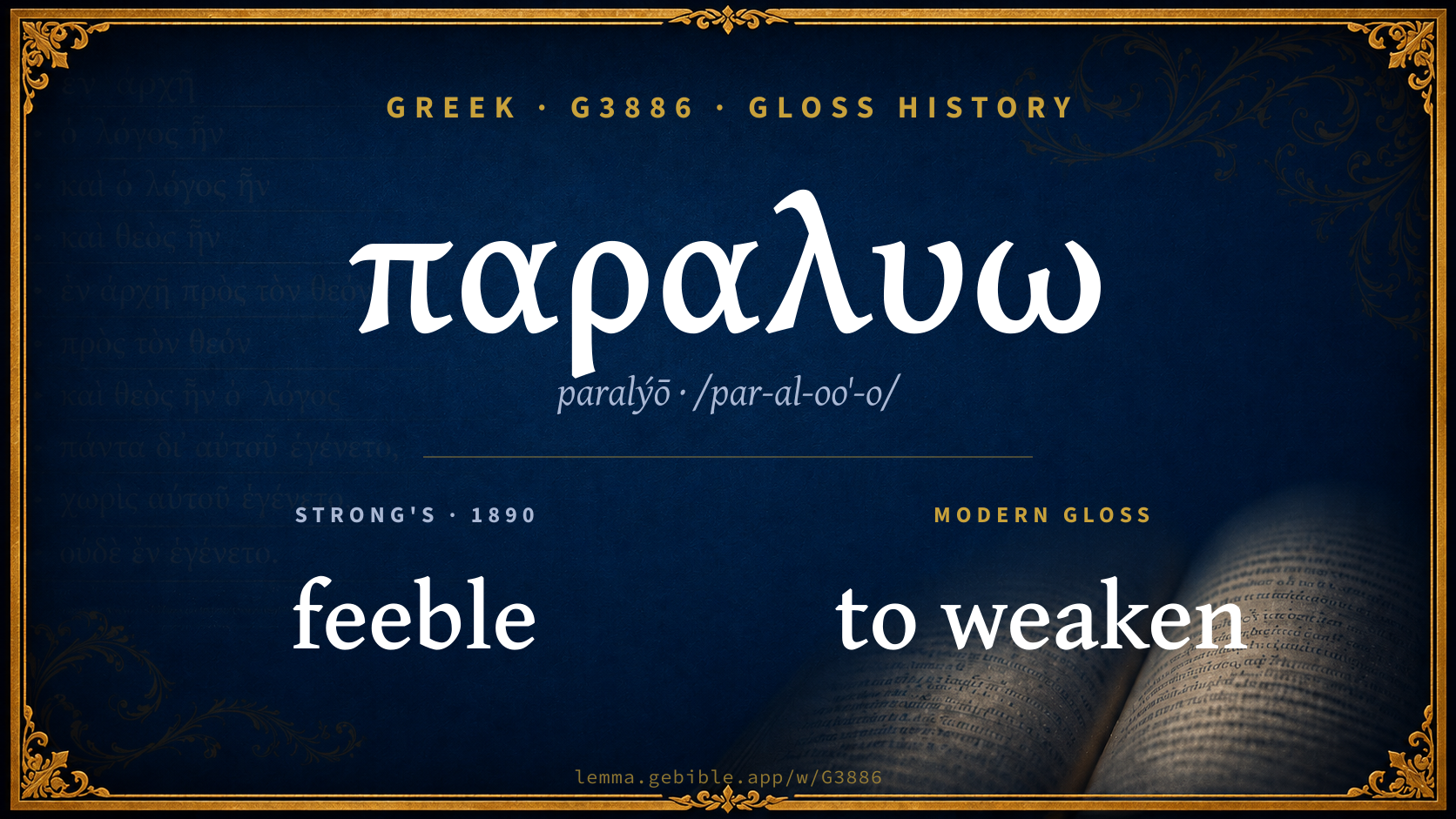
Gloss history
Strong's 1890 vs modern scholarship
About this word
Strong's G3886 catalogs a Greek word from the Greek New Testament.
These counts are not copied from any lexicon or concordance. They are computed here, from the morphology-tagged Greek New Testament. What Lemma adds →
- 5
- distinct verses
- The word appears in 5 distinct verses.
- 3 / 27
- NT books
- The word appears in 3 of 27 New Testament books.
- #1,648
- by frequency
- Top 2500 most frequent Greek words (rank 1,648 of 5,347 Greek words by occurrence).
View all 5 occurrences in the concordance →
By section of the New Testament
By traditional corpus
Conventional, traditional groupings — biblical authorship is debated, so this is a traditional corpus grouping, not an authorship claim. Some books belong to more than one corpus (Luke is in both the Gospels and the Lukan corpus, and so on), so these shares overlap and need not total 100%. Each figure is a share of the word’s 5 distinct verses.
- Lukan (Luke–Acts) 4 verses · 80%
- Gospels 2 verses · 40%
- Hebrews 1 verse · 20%
How translations render this word
Counts come from each version’s own published word-to-Strong’s tagging or interlinear alignment — an approximate guide to how each version renders this word, not a word-level alignment the data otherwise carries. Because each total is that version’s own tagged count, the per-version totals vary from one another and need not match the appearance or distinct-verse counts above. These counts may also differ from a printed concordance because Lemma counts each distinctly tagged rendering and does not collapse phrase taggings into a single head-word total. This is a fixed set of word-tagged versions (KJV, ASV, BSB, ULT) and does not change with the reading translation you choose elsewhere. Each version’s license is shown beside its name below (and on Sources).
- King James Version: Sick of the palsy 2×
- American Standard Version: Palsied 3×
- Berean Standard Bible: Paralyzed 3×
- unfoldingWord Literal Text: Paralyzed 3×
King James Version Public Domain
Renders G3886 across 5 tagged occurrences — most commonly:
Plus 3 renderings that appear only once — usually multi-word phrases or single function words the recovered tagging swept in, not distinct renderings.
American Standard Version Public Domain
Renders G3886 across 5 tagged occurrences — most commonly:
Plus 2 renderings that appear only once — usually multi-word phrases or single function words the recovered tagging swept in, not distinct renderings.
Berean Standard Bible Public Domain
Renders G3886 across 5 tagged occurrences — most commonly:
Plus 2 renderings that appear only once — usually multi-word phrases or single function words the recovered tagging swept in, not distinct renderings.
unfoldingWord Literal Text CC BY-SA 4.0
Renders G3886 across 5 tagged occurrences — most commonly:
Plus 2 renderings that appear only once — usually multi-word phrases or single function words the recovered tagging swept in, not distinct renderings.
Senses in Thayer's
The 6 senses Thayer's distinguishes for this word, in lexicon order (not ranked by frequency or importance). The full entry — with sub-senses — is in the Lexicon Entry tab.
- to loose on one side or from the side
- to loose or part things placed side by side
- to loosen, dissolve
- to weaken, enfeeble
- suffering from the relaxing of the nerves, unstrung, weak of limb
- tottering, weakened, feeble knees
Word origin
Derived from παρα (pará) (G3844) — from.
Forms in the corpus
The 4 distinct written forms G3886 takes in the Greek New Testament, most frequent first — each parse links to that tense’s occurrences in the concordance.
| Form | Parsing | Example | Uses |
|---|---|---|---|
| παραλελυμένος paralelyménos | Verb, Perfect, Passive, Participle, Nominative, Singular, Masculine | Luke 5:18 | 2 |
| παραλελυμένα paralelyména | Verb, Perfect, Passive, Participle, Accusative, Plural, Neuter | Hebrews 12:12 | 1 |
| παραλελυμένοι paralelyménoi | Verb, Perfect, Passive, Participle, Nominative, Plural, Masculine | Acts 8:7 | 1 |
| παραλελυμένῳ paralelyménō | Verb, Perfect, Passive, Participle, Dative, Singular, Masculine | Luke 5:24 | 1 |
Same root — word family
Other Thayer's entries built from the same root as G3886, grouped by Strong’s listed origin. These share a root / origin per the lexicon — not necessarily a shared meaning. Each links to that word’s own entry.
Derives from
Shares the same root
- παραβαινω parabaínō G3845 to neglect
- παραβαλλω parabállō G3846 to place beside
- παραβιαζομαι parabiázomai G3849 to compel
- παραβουλευομαι parabouleúomai G3851 to consult wrongly
- παραγγελλω parangéllō G3853 to announce
- παραγινομαι paragínomai G3854 to appear
- παραγω parágō G3855 to pass by
- παραδειγματιζω paradeigmatízō G3856 to make example
- παραδεχομαι paradéchomai G3858 to receive
- παραδιατριβη paradiatribḗ G3859 empty business
- παραδιδωμι paradídōmi G3860 to deliver
- παραδοξος parádoxos G3861 strange
- παραζηλοω parazēlóō G3863 to provoke
- παραθαλασσιος parathalássios G3864 by the sea
- παραθεωρεω paratheōréō G3865 to compare
- παραινεω parainéō G3867 to exhort
- παραιτεομαι paraitéomai G3868 to beg pardon
- παρακαθιζω parakathízō G3869 to sit beside
- παρακαλεω parakaléō G3870 to call beside
- παρακαλυπτω parakalýptō G3871 to cover up
- παρακαταθηκη parakatathḗkē G3872 deposit
- παρακειμαι parákeimai G3873 to lie beside
- παρακολουθεω parakolouthéō G3877 to follow after
- παρακουω parakoúō G3878 to disobey
+51 more words share this root (not shown).
Derived from this word
Proper names from this root
People and places named from this root — a name, not an additional meaning of the word.
Compare all same-root words → Showing 4 of 79 — not the complete family. 1 of the same-root words is a proper name (a person or place). They share a root, not necessarily a meaning.
Septuagint usage
The same Greek word παραλυω appears 16 times in the Greek Old Testament (Septuagint), across 16 verses in 8 books.
- 16
- LXX occurrences
- Tagged occurrences of this Greek word in the Septuagint.
- 16
- verses
- Distinct Septuagint verses containing this word.
- 8 / 39
- OT books
- The word appears in 8 of the 39 Old Testament books.
Sample Septuagint occurrences
- Genesis 4:15 παραλύω
- Leviticus 13:45 παραλύω
- Deuteronomy 32:36 παραλύω
- 2 Samuel 8:4 παραλύω
- 1 Chronicles 18:4 παραλύω
- Isaiah 23:9 παραλύω
- Jeremiah 6:24 παραλύω
- Ezekiel 7:27 παραλύω
Septuagint occurrences (same lexeme)
Every verse where the same Strong’s number (G3886) appears in the Greek Septuagint. Verse text shown in the World English Bible for context; the Greek form is the matched word — the English is not keyword-highlighted.
- Genesis 4:15 παραλύω Yahweh said to him, "Therefore whoever slays Cain, vengeance will be taken on him sevenfold." Yahweh appointed a sign for Cain, lest any finding him should strike him.
- Genesis 19:11 παραλύω They struck the men who were at the door of the house with blindness, both small and great, so that they wearied themselves to find the door.
- Leviticus 13:45 παραλύω "The leper in whom the plague is shall wear torn clothes, and the hair of his head shall hang loose. He shall cover his upper lip, and shall cry, 'Unclean! Unclean!'
- Deuteronomy 32:36 παραλύω For Yahweh will judge his people, Repent himself for his servants; When he sees that [their] power is gone, There is none [remaining], shut up or left at large.
- 2 Samuel 8:4 παραλύω David took from him one thousand seven hundred horsemen, and twenty thousand footmen: and David hamstrung all the chariot horses, but reserved of them for one hundred chariots.
- 1 Chronicles 18:4 παραλύω David took from him one thousand chariots, and seven thousand horsemen, and twenty thousand footmen; and David hamstrung all the chariot horses, but reserved of them for one hundred chariots.
- Isaiah 23:9 παραλύω Yahweh of hosts has purposed it, to stain the pride of all glory, to bring into contempt all the honorable of the earth.
- Isaiah 35:3 παραλύω Strengthen you the weak hands, and confirm the feeble knees.
- Jeremiah 6:24 παραλύω We have heard the report of it; our hands wax feeble: anguish has taken hold of us, [and] pangs as of a woman in travail.
- Jeremiah 26:15 παραλύω Only know for certain that, if you put me to death, you will bring innocent blood on yourselves, and on this city, and on the inhabitants of it; for of a truth Yahweh has sent me to you to speak all these words in your ears.
- Jeremiah 27:15 παραλύω For I have not sent them, says Yahweh, but they prophesy falsely in my name; that I may drive you out, and that you may perish, you, and the prophets who prophesy to you.
- Jeremiah 27:36 παραλύω
- Jeremiah 27:43 παραλύω
- Ezekiel 7:27 παραλύω The king shall mourn, and the prince shall be clothed with desolation, and the hands of the people of the land shall be troubled: I will do to them after their way, and according to their deserts will I judge them; and they shall know that I am Yahweh.
- Ezekiel 21:12 παραλύω Cry and wail, son of man; for it is on my people, it is on all the princes of Israel: they are delivered over to the sword with my people; strike therefore on your thigh.
- Ezekiel 25:9 παραλύω therefore, behold, I will open the side of Moab from the cities, from his cities which are on his frontiers, the glory of the country, Beth-jeshimoth, Baal Meon, and Kiriathaim,
These are occurrences of the same Greek lexeme (G3886) in the Septuagint — not a translation of any one Hebrew word. The store carries no word-level Hebrew↔Greek alignment, so no Hebrew original is asserted here. Counts come from the recovered LXX Strong's tagging — high-frequency vocabulary is well covered, while rare or late forms may be untagged — so they reflect tagged occurrences and may slightly undercount.