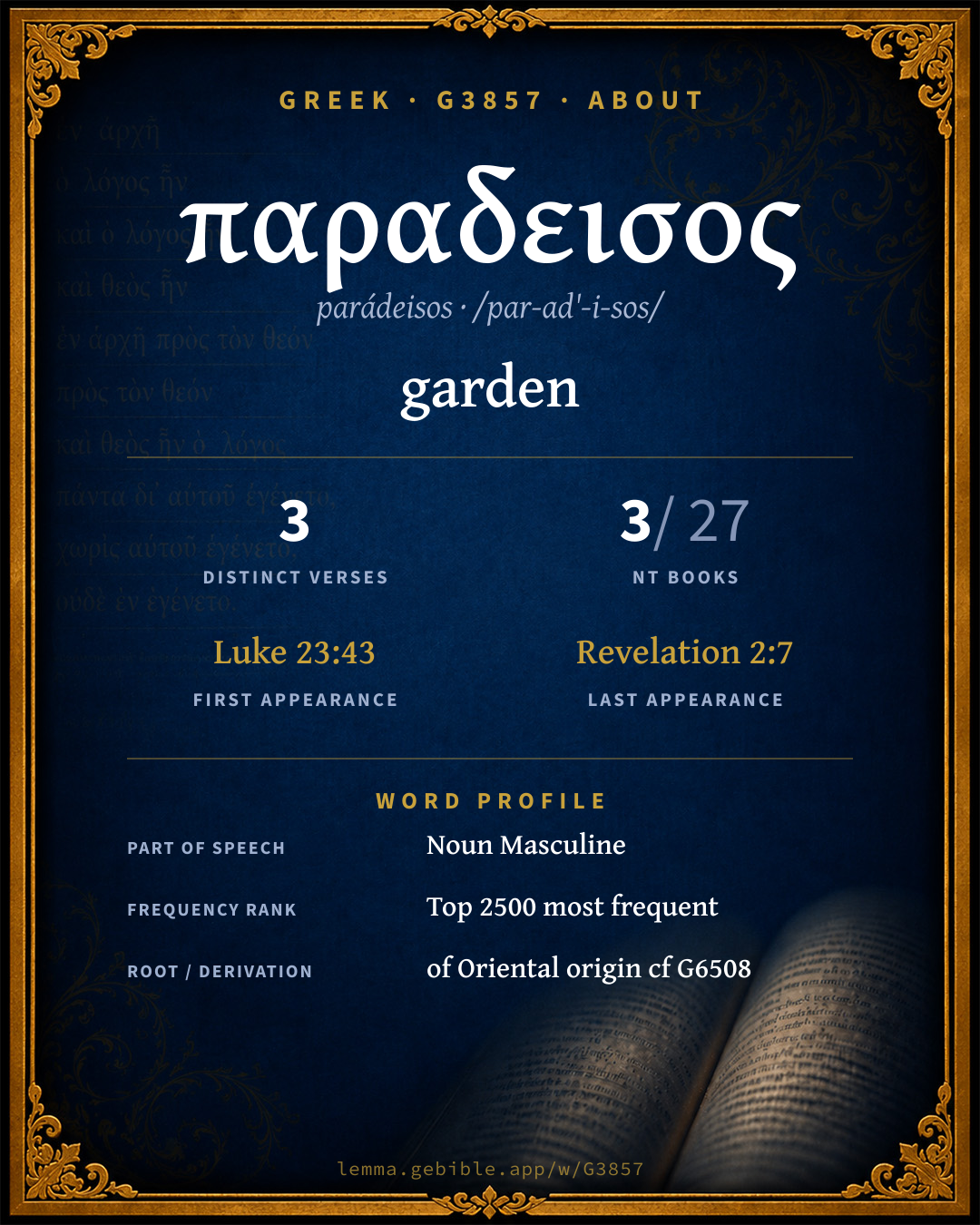
παράδεισος
garden
‘garden’ is one of 5 main senses fuller range ↓
Full lexicon entry — Thayer's Greek Lexicon
From Thayer's Greek Lexicon
Where this word appears
Grammar key — what these labels mean
Part of speech
- Noun
- A naming word — a person, place, thing, or idea.
Case
- Dative
- The case of the indirect object, means, or location — “to / for / with / in.”
- Accusative
- The case of the direct object and of extent.
Gender
- Masculine
- Grammatically masculine.
Number
- Singular
- One.
Every verse where G3857 appears in the Book of 2 Corinthians — 1 distinct verse. Click any verse to open its interlinear word-by-word view. Verse text shown in the World English Bible for context — . Each verse’s Greek form is shown with its reference; the English is not keyword-highlighted, since the data carries no word-level English alignment. Use “Compare translations” on any verse to read it across multiple English versions. This concordance covers the Greek New Testament; Septuagint (Greek Old Testament) occurrences of this word are not indexed here.
2 Corinthians
About this entry
At a glance — auto-summarized from this page’s data, not written by a person. Every figure links to its source below. This summary describes the numbers; it doesn’t interpret them.
At its core, παραδεισος (parádeisos) means “garden.” It is rare — just 3 verses in the entire Greek New Testament. Its uses concentrate in Luke (33% of all occurrences). It first appears in Luke 23:43. Ranging over 5 senses, it is not a single-sense word. Each statement above links to its evidence; the full detail follows below.
Gloss history
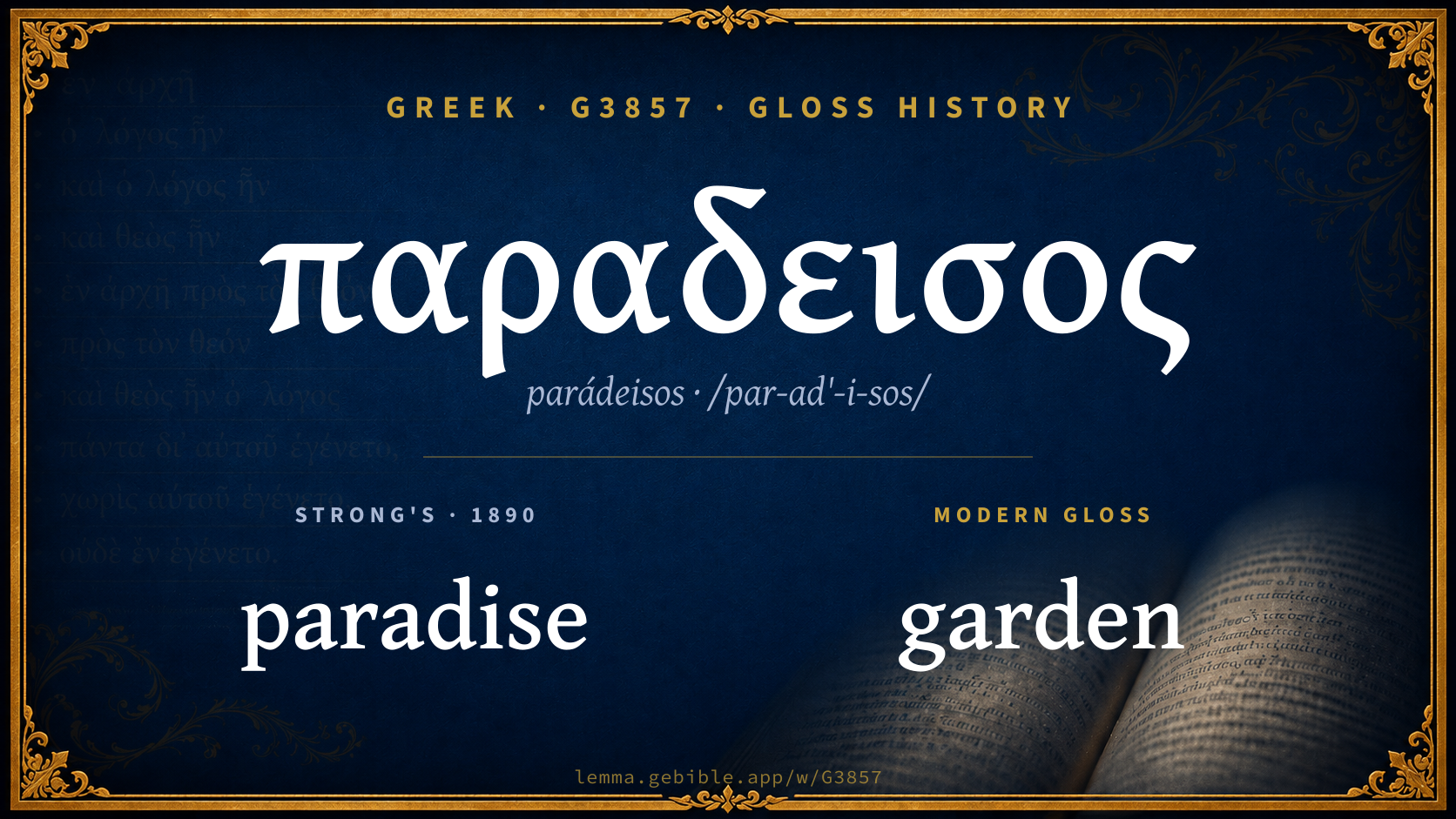
Strong's 1890 vs modern scholarship
About this word
Strong's G3857 catalogs a Greek word from the Greek New Testament.
These counts are not copied from any lexicon or concordance. They are computed here, from the morphology-tagged Greek New Testament. What Lemma adds →
- 3
- distinct verses
- The word appears in 3 distinct verses.
- 3 / 27
- NT books
- The word appears in 3 of 27 New Testament books.
- #2,203
- by frequency
- Top 2500 most frequent Greek words (rank 2,203 of 5,347 Greek words by occurrence).
View all 3 occurrences in the concordance →
Most concentrated in
- Luke 1 verse 33%
- 2 Corinthians 1 verse 33%
- Revelation 1 verse 33%
By section of the New Testament
By traditional corpus
Conventional, traditional groupings — biblical authorship is debated, so this is a traditional corpus grouping, not an authorship claim. Some books belong to more than one corpus (Luke is in both the Gospels and the Lukan corpus, and so on), so these shares overlap and need not total 100%. Each figure is a share of the word’s 3 distinct verses.
- Gospels 1 verse · 33%
- Lukan (Luke–Acts) 1 verse · 33%
- Johannine 1 verse · 33%
- Pauline corpus 1 verse · 33%
- Revelation 1 verse · 33%
How translations render this word
Counts come from each version’s own published word-to-Strong’s tagging or interlinear alignment — an approximate guide to how each version renders this word, not a word-level alignment the data otherwise carries. Because each total is that version’s own tagged count, the per-version totals vary from one another and need not match the appearance or distinct-verse counts above. These counts may also differ from a printed concordance because Lemma counts each distinctly tagged rendering and does not collapse phrase taggings into a single head-word total. This is a fixed set of word-tagged versions (KJV, ASV, BSB, ULT) and does not change with the reading translation you choose elsewhere. Each version’s license is shown beside its name below (and on Sources).
- King James Version: Paradise 3×
- American Standard Version: Paradise 3×
- Berean Standard Bible: Paradise 3×
- unfoldingWord Literal Text: Paradise 3×
King James Version Public Domain
Renders G3857 across 3 tagged occurrences — most commonly:
American Standard Version Public Domain
Renders G3857 across 3 tagged occurrences — most commonly:
Berean Standard Bible Public Domain
Renders G3857 across 3 tagged occurrences — most commonly:
unfoldingWord Literal Text CC BY-SA 4.0
Renders G3857 across 3 tagged occurrences — most commonly:
Senses in Thayer's
The 5 senses Thayer's distinguishes for this word, in lexicon order (not ranked by frequency or importance). The full entry — with sub-senses — is in the Lexicon Entry tab.
- among the Persians a grand enclosure or preserve…
- a garden, pleasure ground
- the part of Hades which was thought by the later Jews to be the abode of the souls of pious until the resurrection: but…
- the upper regions of the heavens. According to the early church Fathers…
- heaven
Word origin
Origin: of Oriental origin cf G6508
Of Oriental origin (compare [ H6508 ]); a park that is (specifically) an Eden (place of future happiness paradise): - paradise.
— Strong’s Exhaustive Concordance (1890), public domain.
Forms in the corpus
The 2 distinct written forms G3857 takes in the Greek New Testament, most frequent first — each parse links to that case’s occurrences in the concordance.
| Form | Parsing | Example | Uses |
|---|---|---|---|
| παραδείσῳ paradeísō | Noun, Dative, Singular, Masculine | Luke 23:43 | 2 |
| παράδεισον parádeison | Noun, Accusative, Singular, Masculine | 2 Corinthians 12:4 | 1 |
Septuagint usage
The same Greek word παραδεισος appears 27 times in the Greek Old Testament (Septuagint), across 25 verses in 10 books.
- 27
- LXX occurrences
- Tagged occurrences of this Greek word in the Septuagint.
- 25
- verses
- Distinct Septuagint verses containing this word.
- 10 / 39
- OT books
- The word appears in 10 of the 39 Old Testament books.
Sample Septuagint occurrences
- Genesis 2:8 παράδεισος
- Numbers 24:6 παράδεισος
- 2 Chronicles 33:20 παράδεισος
- Ezra 12:8 παράδεισος
- Ecclesiastes 2:5 παράδεισος
- Song of Solomon 4:13 παράδεισος
- Isaiah 1:30 παράδεισος
- Jeremiah 36:5 παράδεισος
- Ezekiel 28:13 παράδεισος
- Joel 2:3 παράδεισος
Septuagint occurrences (same lexeme)
Every verse where the same Strong’s number (G3857) appears in the Greek Septuagint. Verse text shown in the World English Bible for context; the Greek form is the matched word — the English is not keyword-highlighted.
- Genesis 2:8 παράδεισος Yahweh God planted a garden eastward, in Eden, and there he put the man whom he had formed.
- Genesis 2:9 παράδεισος Out of the ground Yahweh God made every tree to grow that is pleasant to the sight, and good for food; the tree of life also in the midst of the garden, and the tree of the knowledge of good and evil.
- Genesis 2:10 παράδεισος A river went out of Eden to water the garden; and from there it was parted, and became four heads.
- Genesis 2:15 παράδεισος Yahweh God took the man, and put him into the garden of Eden to dress it and to keep it.
- Genesis 2:16 παράδεισος Yahweh God commanded the man, saying, "Of every tree of the garden you may freely eat:
- Genesis 3:1 παράδεισος Now the serpent was more subtle than any animal of the field which Yahweh God had made. He said to the woman, "Yes, has God said, 'You shall not eat of any tree of the garden?'"
- Genesis 3:2 παράδεισος The woman said to the serpent, "Of the fruit of the trees of the garden we may eat,
- Genesis 3:3 παράδεισος but of the fruit of the tree which is in the midst of the garden, God has said, 'You shall not eat of it, neither shall you touch it, lest you die.'"
- Genesis 3:8 παράδεισος They heard the voice of Yahweh God walking in the garden in the cool of the day, and the man and his wife hid themselves from the presence of Yahweh God among the trees of the garden.
- Genesis 3:10 παράδεισος The man said, "I heard your voice in the garden, and I was afraid, because I was naked; and I hid myself."
- Genesis 3:23 παράδεισος Therefore Yahweh God sent him forth from the garden of Eden, to till the ground from whence he was taken.
- Genesis 3:24 παράδεισος So he drove out the man; and he placed Cherubs at the east of the garden of Eden, and the flame of a sword which turned every way, to guard the way to the tree of life.
- Genesis 13:10 παράδεισος Lot lifted up his eyes, and saw all the plain of the Jordan, that it was well watered every where, before Yahweh destroyed Sodom and Gomorrah, like the garden of Yahweh, like the land of Egypt, as you go to Zoar.
- Numbers 24:6 παράδεισος As valleys are they spread forth, As gardens by the river-side, As lign-aloes which Yahweh has planted, As cedar trees beside the waters.
- 2 Chronicles 33:20 παράδεισος So Manasseh slept with his fathers, and they buried him in his own house: and Amon his son reigned in his place.
- Ezra 12:8 παράδεισος
- Ecclesiastes 2:5 παράδεισος I made myself gardens and parks, and I planted trees in them of all kinds of fruit.
- Song of Solomon 4:13 παράδεισος Your shoots are an orchard of pomegranates, with precious fruits: Henna with spikenard plants,
- Isaiah 1:30 παράδεισος For you shall be as an oak whose leaf fades, And as a garden that has no water.
- Isaiah 51:3 παράδεισος For Yahweh has comforted Zion; he has comforted all her waste places, and has made her wilderness like Eden, and her desert like the garden of Yahweh; joy and gladness shall be found therein, thanksgiving, and the voice of melody.
- Jeremiah 36:5 παράδεισος Jeremiah commanded Baruch, saying, I am shut up; I can't go into the house of Yahweh:
- Ezekiel 28:13 παράδεισος You were in Eden, the garden of God; every precious stone adorned you: ruby, topaz, emerald, chrysolite, onx, jasper, sapphire, turquoise, and beryl. Gold work of tambourines and of pipes was in you. In the day that you were created they were prepared.
- Ezekiel 31:8 παράδεισος The cedars in the garden of God could not hide it; the fir trees were not like its boughs, and the plane trees were not as its branches; nor was any tree in the garden of God like it in its beauty.
- Ezekiel 31:9 παράδεισος I made it beautiful by the multitude of its branches, so that all the trees of Eden, that were in the garden of God, envied it.
- Joel 2:3 παράδεισος A fire devours before them, And behind them, a flame burns. The land is as the garden of Eden before them, And behind them, a desolate wilderness. Yes, and no one has escaped them.
These are occurrences of the same Greek lexeme (G3857) in the Septuagint — not a translation of any one Hebrew word. The store carries no word-level Hebrew↔Greek alignment, so no Hebrew original is asserted here. Counts come from the recovered LXX Strong's tagging — high-frequency vocabulary is well covered, while rare or late forms may be untagged — so they reflect tagged occurrences and may slightly undercount.