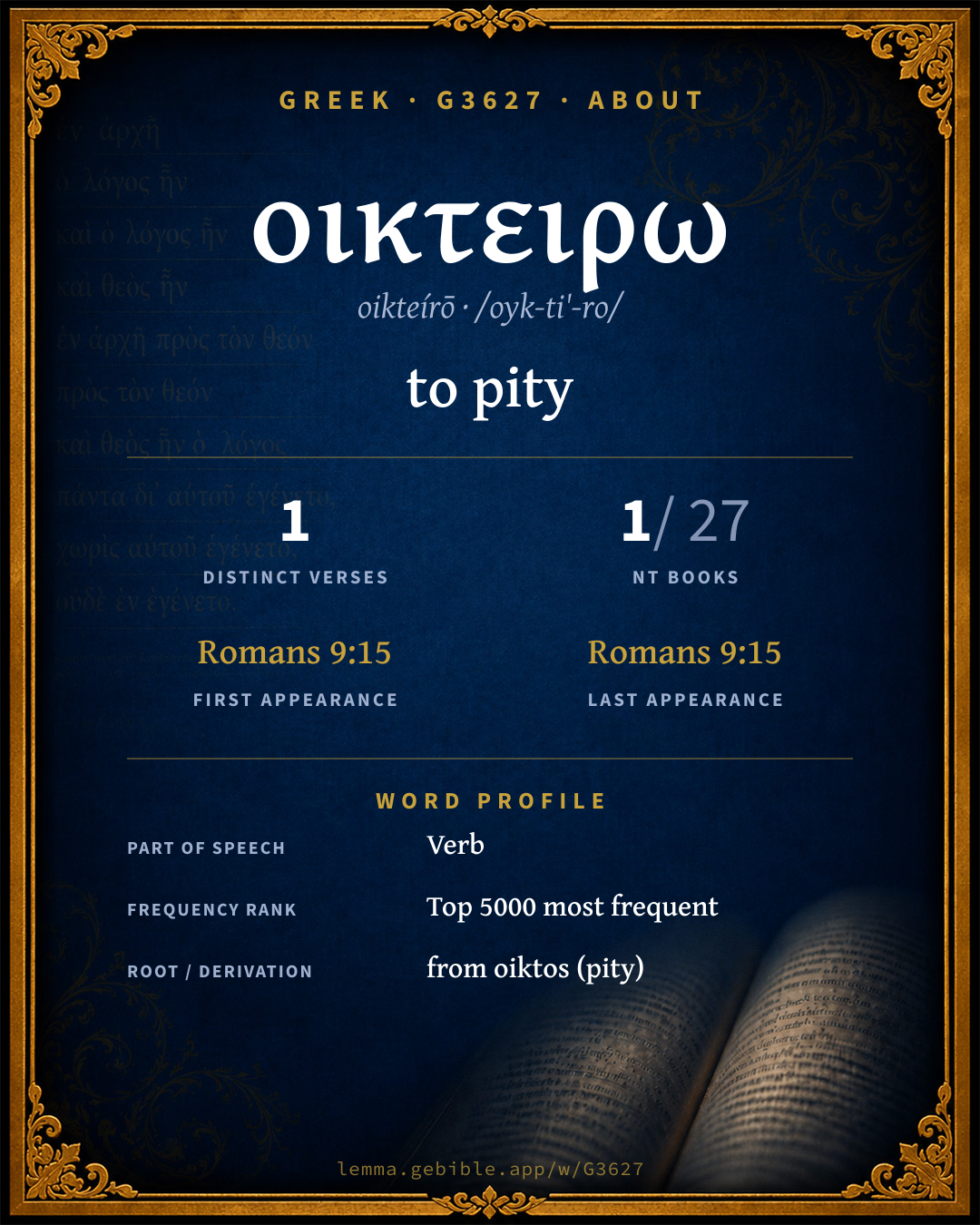
οἰκτείρω
to pity
Full lexicon entry — Thayer's Greek Lexicon
From Thayer's Greek Lexicon
Where this word appears
See every Future-tense verb in the Greek New Testament →
Grammar key — what these labels mean
Part of speech
- Verb
- An action or state-of-being word.
Tense
- Future
- Action expected in future time.
- Present
- Ongoing or general action in present time (imperfective aspect).
Voice
- Active
- The subject performs the action.
Mood
- Indicative
- States a fact or asks a factual question (the mood of reality).
- Subjunctive
- Expresses probability, purpose, or possibility (the mood of contingency).
Person
- 1st person
- The speaker (“I / we”).
Number
- Singular
- One.
Grammatical forms
- Verb, Future, Active, Indicative, 1st person, Singular 1 time (50%)
- Verb, Present, Active, Subjunctive, 1st person, Singular 1 time (50%)
Parsed forms decoded from the imported morphology (Robinson–Tischendorf, public domain), counted across 2 parsed occurrences — not distinct verses.
Every verse where G3627 appears — 1 distinct verse across 1 book. Click any verse to open its interlinear word-by-word view. Verse text shown in the World English Bible for context — . Each verse’s Greek form is shown with its reference; the English is not keyword-highlighted, since the data carries no word-level English alignment. Use “Compare translations” on any verse to read it across multiple English versions. This concordance covers the Greek New Testament; Septuagint (Greek Old Testament) occurrences of this word are not indexed here.
Romans 1 verse
About this entry
At a glance — auto-summarized from this page’s data, not written by a person. Every figure links to its source below. This summary describes the numbers; it doesn’t interpret them.
οικτειρω (oikteírō) is a Greek verb most often rendered “to pity.” The Greek New Testament uses it only 1 verse. It clusters heavily in Romans, which alone accounts for 100% of its uses. It occurs only once, in Romans 9:15. It clusters with οικτιρμος and οικτιρμων under a shared root. For the data behind this summary, explore the sense tree and the renderings breakdown below.
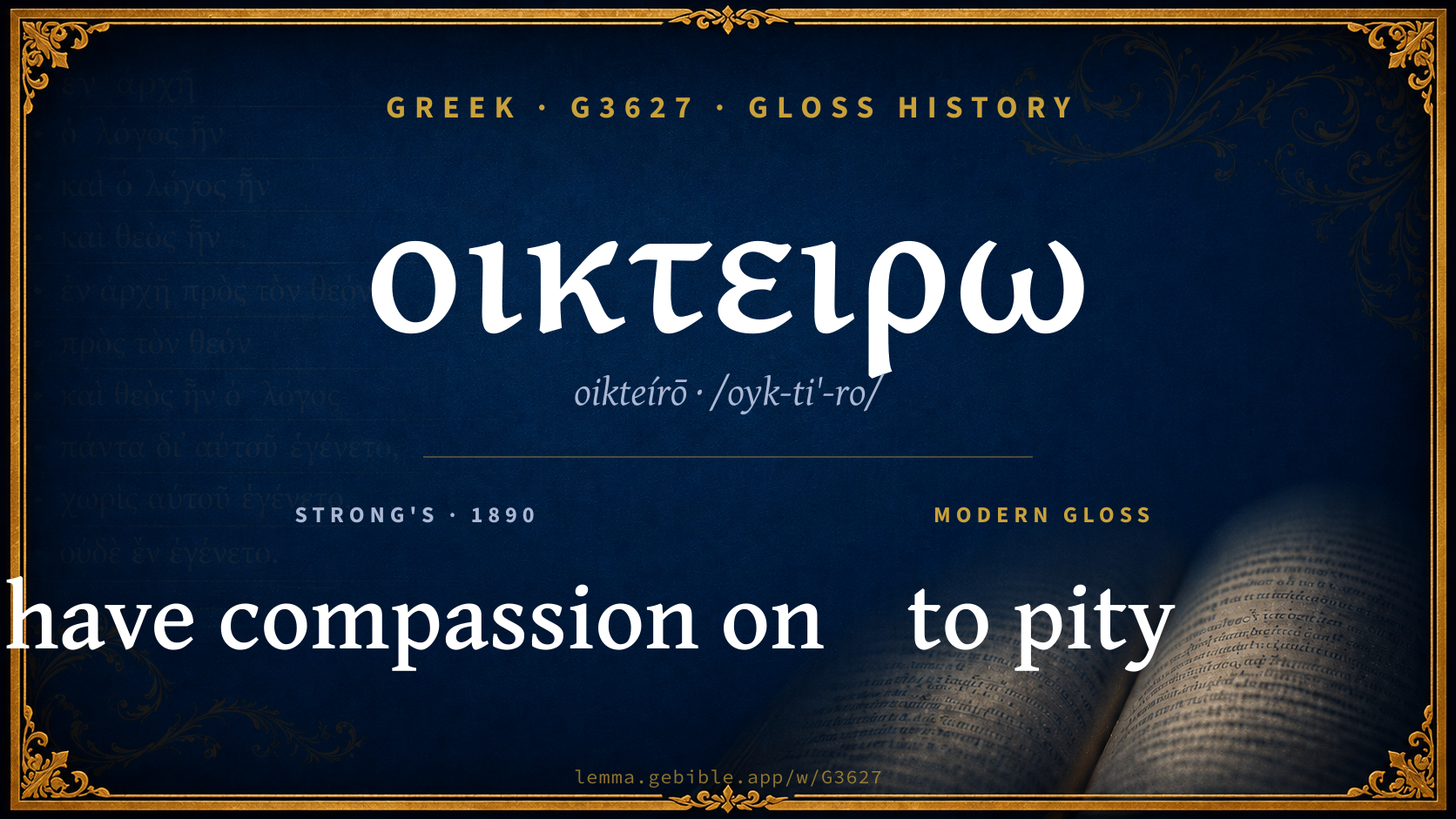
Gloss history
Strong's 1890 vs modern scholarship
About this word
Strong's G3627 catalogs a Greek word from the Greek New Testament.
These counts are not copied from any lexicon or concordance. They are computed here, from the morphology-tagged Greek New Testament. What Lemma adds →
- 1
- distinct verses
- The word appears in 1 distinct verse.
- 1 / 27
- NT books
- The word appears in 1 of 27 New Testament books.
- #2,678
- by frequency
- Top 5000 most frequent Greek words (rank 2,678 of 5,347 Greek words by occurrence).
View all 1 occurrence in the concordance →
Most concentrated in
- Romans 1 verse 100%
By section of the New Testament
By traditional corpus
Conventional, traditional groupings — biblical authorship is debated, so this is a traditional corpus grouping, not an authorship claim. Some books belong to more than one corpus (Luke is in both the Gospels and the Lukan corpus, and so on), so these shares overlap and need not total 100%. Each figure is a share of the word’s 1 distinct verse.
- Pauline corpus 1 verse · 100%
How translations render this word
Counts come from each version’s own published word-to-Strong’s tagging or interlinear alignment — an approximate guide to how each version renders this word, not a word-level alignment the data otherwise carries. Because each total is that version’s own tagged count, the per-version totals vary from one another and need not match the appearance or distinct-verse counts above. These counts may also differ from a printed concordance because Lemma counts each distinctly tagged rendering and does not collapse phrase taggings into a single head-word total. This is a fixed set of word-tagged versions (KJV, ASV, BSB, ULT) and does not change with the reading translation you choose elsewhere. Each version’s license is shown beside its name below (and on Sources).
- King James Version: I will have compassion 2×
- American Standard Version: Compassion 1×, I will have compassion on 1×
- Berean Standard Bible: I have compassion 1×, I will have compassion on 1×
- unfoldingWord Literal Text: I will have compassion 2×
King James Version Public Domain
Renders G3627 across 2 tagged occurrences — most commonly:
American Standard Version Public Domain
Renders G3627 across 2 tagged occurrences — most commonly:
Berean Standard Bible Public Domain
Renders G3627 across 2 tagged occurrences — most commonly:
unfoldingWord Literal Text CC BY-SA 4.0
Renders G3627 across 2 tagged occurrences — most commonly:
Senses in Thayer's
The 1 sense Thayer's distinguishes for this word, in lexicon order (not ranked by frequency or importance). The full entry — with sub-senses — is in the Lexicon Entry tab.
- to pity, have compassion on
Word origin
Origin: from oiktos (pity)
Also in certain tenses οἰκτερέω oiktereō oyk-ter-eh'-o ; from οἰκτος oiktos ( pity ); to exercise pity : - have compassion on.
— Strong’s Exhaustive Concordance (1890), public domain.
Forms in the corpus
The 2 distinct written forms G3627 takes in the Greek New Testament, most frequent first — each parse links to that tense’s occurrences in the concordance.
| Form | Parsing | Example | Uses |
|---|---|---|---|
| οἰκτείρω oikteírō | Verb, Present, Active, Subjunctive, 1st person, Singular | Romans 9:15 | 1 |
| οἰκτειρήσω oikteirḗsō | Verb, Future, Active, Indicative, 1st person, Singular | Romans 9:15 | 1 |
Same root — word family
Other Thayer's entries built from the same root as G3627, grouped by Strong’s listed origin. These share a root / origin per the lexicon — not necessarily a shared meaning. Each links to that word’s own entry.
Derived from this word
Compare all same-root words → They share a root, not necessarily a meaning.
Septuagint usage
The same Greek word οικτειρω appears 28 times in the Greek Old Testament (Septuagint), across 25 verses in 10 books.
- 28
- LXX occurrences
- Tagged occurrences of this Greek word in the Septuagint.
- 25
- verses
- Distinct Septuagint verses containing this word.
- 10 / 39
- OT books
- The word appears in 10 of the 39 Old Testament books.
Sample Septuagint occurrences
- Exodus 33:19 οἰκτείρω
- Judges 5:30 οἰκτείρω
- 1 Kings 8:50 οἰκτείρω
- 2 Kings 13:23 οἰκτείρω
- Psalms 4:2 οἰκτείρω
- Proverbs 12:10 οἰκτείρω
- Isaiah 27:11 οἰκτείρω
- Jeremiah 13:14 οἰκτείρω
- Lamentations 3:32 οἰκτείρω
- Micah 7:19 οἰκτείρω
Septuagint occurrences (same lexeme)
Every verse where the same Strong’s number (G3627) appears in the Greek Septuagint. Verse text shown in the World English Bible for context; the Greek form is the matched word — the English is not keyword-highlighted.
- Exodus 33:19 οἰκτείρω He said, "I will make all my goodness pass before you, and will proclaim the name of Yahweh before you. I will be gracious to whom I will be gracious, and will show mercy on whom I will show mercy."
- Judges 5:30 οἰκτείρω Have they not found, have they not divided the spoil? A lady, two ladies to every man; To Sisera a spoil of dyed garments, A spoil of dyed garments embroidered, Of dyed garments embroidered on both sides, on the necks of the spoil?
- 1 Kings 8:50 οἰκτείρω and forgive your people who have sinned against you, and all their transgressions in which they have transgressed against you; and give them compassion before those who carried them captive, that they may have compassion on them
- 2 Kings 13:23 οἰκτείρω But Yahweh was gracious to them, and had compassion on them, and had respect to them, because of his covenant with Abraham, Isaac, and Jacob, and would not destroy them, neither cast he them from his presence as yet.
- Psalms 4:2 οἰκτείρω You sons of men, how long shall my glory be turned into dishonor? Will you love vanity, and seek after falsehood? Selah.
- Psalms 36:21 οἰκτείρω
- Psalms 58:6 οἰκτείρω Break their teeth, God, in their mouth. Break out the great teeth of the young lions, Yahweh.
- Psalms 59:3 οἰκτείρω For, behold, they lie in wait for my soul. The mighty gather themselves together against me, Not for my disobedience, nor for my sin, Yahweh.
- Psalms 66:2 οἰκτείρω Sing to the glory of his name! Offer glory and praise!
- Psalms 76:10 οἰκτείρω Surely the wrath of man praises you. The survivors of your wrath are restrained.
- Psalms 101:14 οἰκτείρω
- Psalms 101:15 οἰκτείρω
- Psalms 102:13 οἰκτείρω You will arise and have mercy on Zion; For it is time to have pity on her. Yes, the set time has come.
- Psalms 111:5 οἰκτείρω He has given food to those who fear him. He always remembers his covenant.
- Psalms 122:2 οἰκτείρω Our feet are standing within your gates, Jerusalem;
- Proverbs 12:10 οἰκτείρω A righteous man regards the life of his animal, But the tender mercies of the wicked are cruel.
- Proverbs 13:9 οἰκτείρω The light of the righteous shines brightly, But the lamp of the wicked is snuffed out.
- Proverbs 13:11 οἰκτείρω Wealth gained dishonestly dwindles away, But he who gathers by hand makes it grow.
- Proverbs 21:26 οἰκτείρω There are those who covet greedily all the day long; But the righteous give and don't withhold.
- Isaiah 27:11 οἰκτείρω When the boughs of it are withered, they shall be broken off; the women shall come, and set them on fire; for it is a people of no understanding: therefore he who made them will not have compassion on them, and he who formed them will show them no favor.
- Isaiah 30:18 οἰκτείρω Therefore will Yahweh wait, that he may be gracious to you; and therefore will he be exalted, that he may have mercy on you: for Yahweh is a God of justice; blessed are all those who wait for him.
- Jeremiah 13:14 οἰκτείρω I will dash them one against another, even the fathers and the sons together, says Yahweh: I will not pity, nor spare, nor have compassion, that I should not destroy them.
- Jeremiah 21:7 οἰκτείρω Afterward, says Yahweh, I will deliver Zedekiah king of Judah, and his servants, and the people, even such as are left in this city from the pestilence, from the sword, and from the famine, into the hand of Nebuchadrezzar king of Babylon, and into the hand of their enemies, and into the hand of those who seek their life: and he shall strike them with the edge of the sword; he shall not spare them, neither have pity, nor have mercy.
- Lamentations 3:32 οἰκτείρω For though he cause grief, yet will he have compassion according to the multitude of his loving kindnesses.
- Micah 7:19 οἰκτείρω He will again have compassion on us. He will tread our iniquities under foot; And you will cast all their sins into the depths of the sea.
These are occurrences of the same Greek lexeme (G3627) in the Septuagint — not a translation of any one Hebrew word. The store carries no word-level Hebrew↔Greek alignment, so no Hebrew original is asserted here. Counts come from the recovered LXX Strong's tagging — high-frequency vocabulary is well covered, while rare or late forms may be untagged — so they reflect tagged occurrences and may slightly undercount.