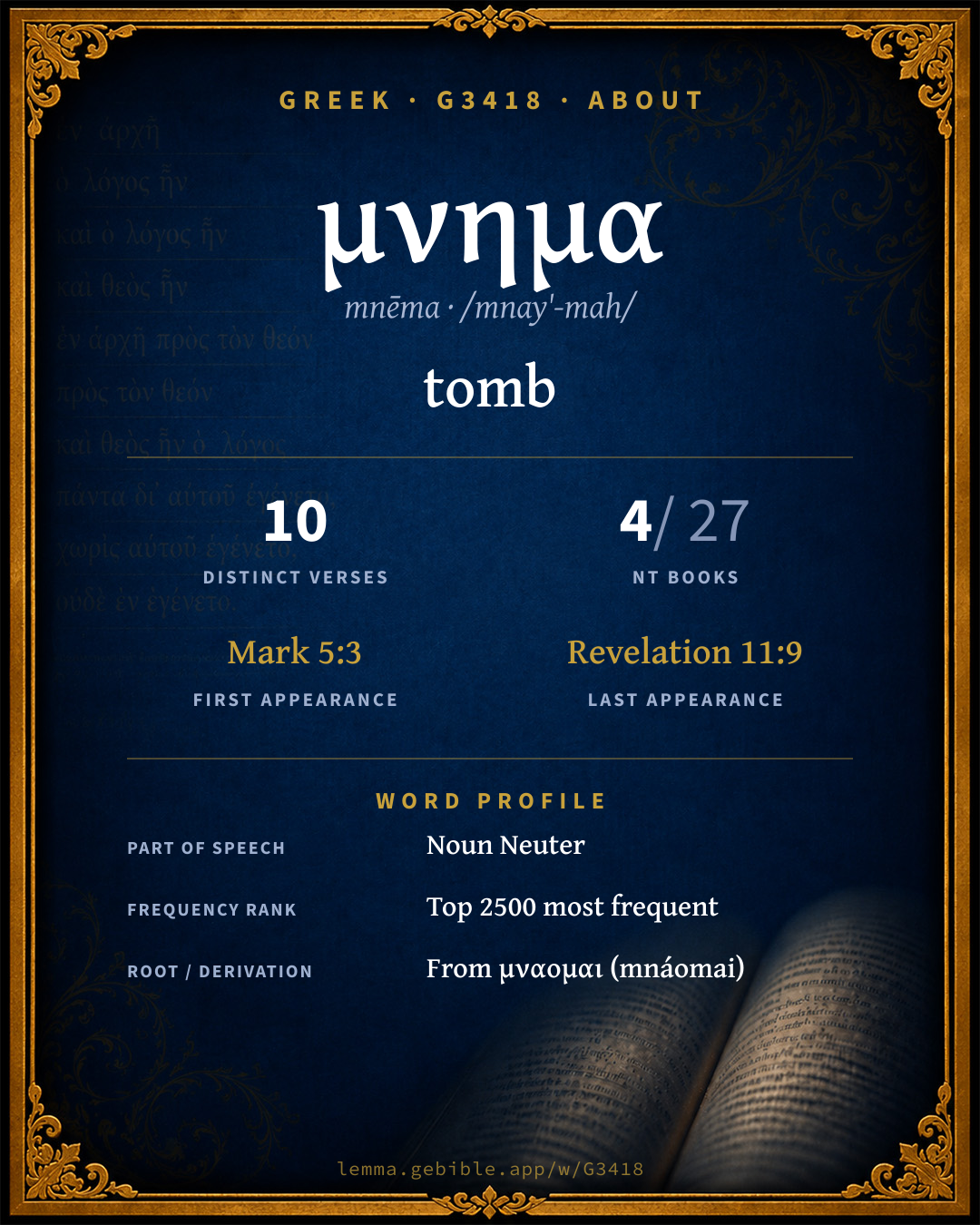
μνῆμα
tomb
‘tomb’ is one of 3 main senses fuller range ↓
Full lexicon entry — Thayer's Greek Lexicon
From Thayer's Greek Lexicon
Where this word appears
See every Dative-case word in the Greek New Testament →
Grammar key — what these labels mean
Part of speech
- Noun
- A naming word — a person, place, thing, or idea.
Case
- Accusative
- The case of the direct object and of extent.
- Dative
- The case of the indirect object, means, or location — “to / for / with / in.”
- Nominative
- The case of the subject (and the predicate nominative).
Gender
- Neuter
- Grammatically neuter.
Number
- Singular
- One.
- Plural
- More than one.
1 distinct verse where G3418 appears in the Nominative case, across 1 book. Filtered view — show all forms. Click any verse to open its interlinear word-by-word view. Verse text shown in the World English Bible for context — . Each verse’s Greek form is shown with its reference; the English is not keyword-highlighted, since the data carries no word-level English alignment. Use “Compare translations” on any verse to read it across multiple English versions. This concordance covers the Greek New Testament; Septuagint (Greek Old Testament) occurrences of this word are not indexed here.
Acts 1 verse
About this entry
At a glance — auto-summarized from this page’s data, not written by a person. Every figure links to its source below. This summary describes the numbers; it doesn’t interpret them.
μνημα — transliterated mnēma — is a Greek noun carrying the sense “tomb.” Debuting at Mark 5:3, it then recurs through the corpus. With 10 verses in 4 books, it is an uncommon word in the Greek New Testament. Its uses concentrate in Mark (40% of all occurrences). Thayer's distinguishes 3 senses for it. Each statement above links to its evidence; the full detail follows below.
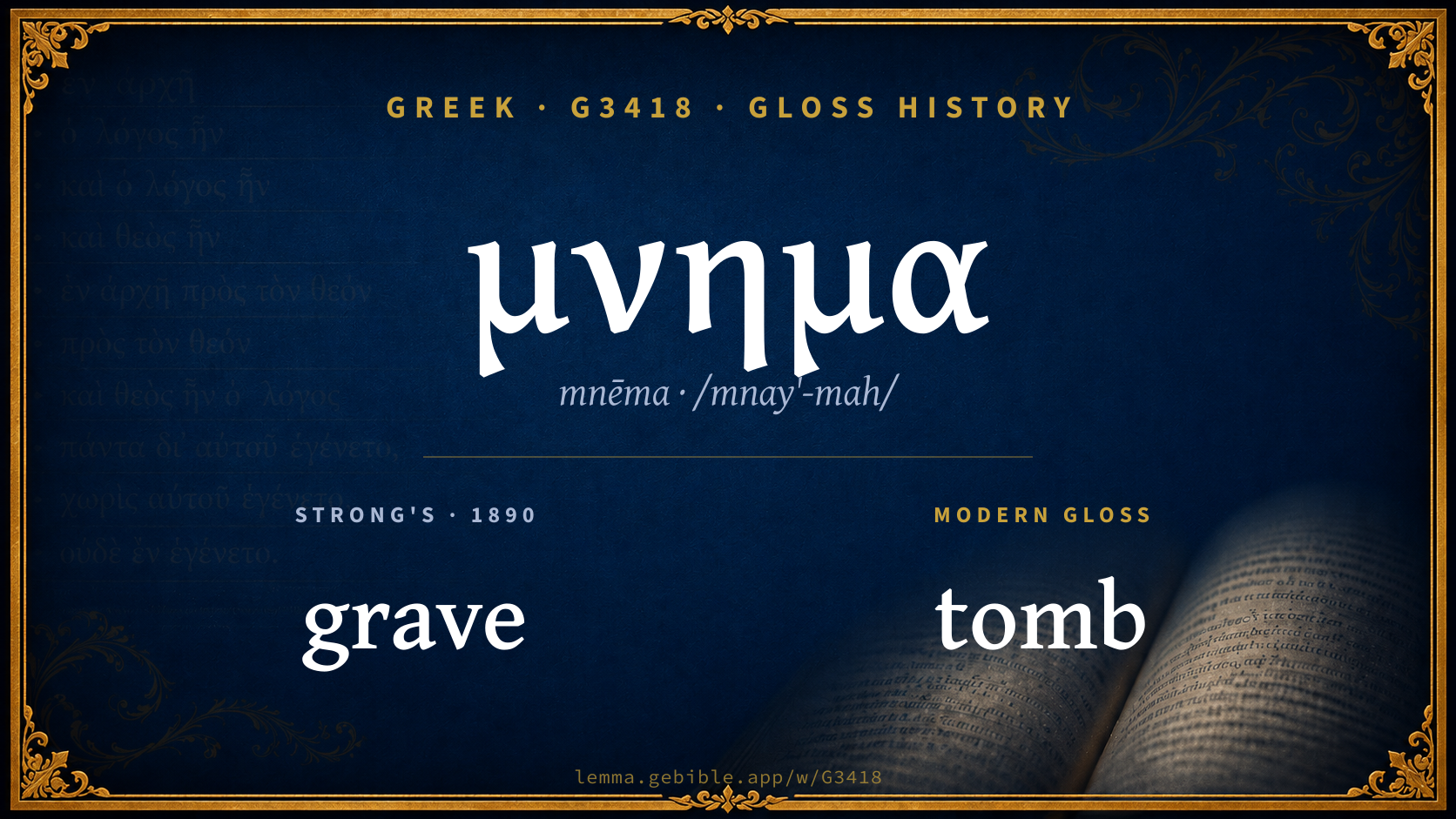
Gloss history
Strong's 1890 vs modern scholarship
About this word
Strong's G3418 catalogs a Greek word from the Greek New Testament.
These counts are not copied from any lexicon or concordance. They are computed here, from the morphology-tagged Greek New Testament. What Lemma adds →
- 10
- distinct verses
- The word appears in 10 distinct verses.
- 4 / 27
- NT books
- The word appears in 4 of 27 New Testament books.
- #1,056
- by frequency
- Top 2500 most frequent Greek words (rank 1,056 of 5,347 Greek words by occurrence).
View all 10 occurrences in the concordance →
By section of the New Testament
By traditional corpus
Conventional, traditional groupings — biblical authorship is debated, so this is a traditional corpus grouping, not an authorship claim. Some books belong to more than one corpus (Luke is in both the Gospels and the Lukan corpus, and so on), so these shares overlap and need not total 100%. Each figure is a share of the word’s 10 distinct verses.
- Gospels 7 verses · 70%
- Lukan (Luke–Acts) 5 verses · 50%
- Johannine 1 verse · 10%
- Revelation 1 verse · 10%
How translations render this word
Counts come from each version’s own published word-to-Strong’s tagging or interlinear alignment — an approximate guide to how each version renders this word, not a word-level alignment the data otherwise carries. Because each total is that version’s own tagged count, the per-version totals vary from one another and need not match the appearance or distinct-verse counts above. These counts may also differ from a printed concordance because Lemma counts each distinctly tagged rendering and does not collapse phrase taggings into a single head-word total. This is a fixed set of word-tagged versions (KJV, ASV, BSB, ULT) and does not change with the reading translation you choose elsewhere. Each version’s license is shown beside its name below (and on Sources).
- King James Version: Sepulchre 4×, Tombs 2×
- American Standard Version: Tomb 5×, Tombs 2×
- Berean Standard Bible: Tomb 5×, Tombs 3×
- unfoldingWord Literal Text: Tomb 6×, Tombs 3×
King James Version Public Domain
Renders G3418 across 7 tagged occurrences — most commonly:
Plus 1 rendering that appears only once — usually multi-word phrases or single function words the recovered tagging swept in, not distinct renderings.
American Standard Version Public Domain
Renders G3418 across 7 tagged occurrences — most commonly:
Berean Standard Bible Public Domain
Renders G3418 across 8 tagged occurrences — most commonly:
unfoldingWord Literal Text CC BY-SA 4.0
Renders G3418 across 10 tagged occurrences — most commonly:
Plus 1 rendering that appears only once — usually multi-word phrases or single function words the recovered tagging swept in, not distinct renderings.
Senses in Thayer's
The 3 senses Thayer's distinguishes for this word, in lexicon order (not ranked by frequency or importance). The full entry — with sub-senses — is in the Lexicon Entry tab.
- a monument or memorial to perpetuate the memory of any person or thing
- a sepulchral monument
- a sepulchre or tomb
Word origin
Derived from μναομαι (mnáomai) (G3415) — to remind.
From G3415 ; a memorial that is sepulchral monument ( burial place ): - grave sepulchre tomb.
— Strong’s Exhaustive Concordance (1890), public domain.
Forms in the corpus
The 3 distinct written forms G3418 takes in the Greek New Testament, most frequent first — each parse links to that case’s occurrences in the concordance.
| Form | Parsing | Example | Uses |
|---|---|---|---|
| μνῆμα mnē̂ma | Noun, Accusative, Singular, Neuter | Mark 16:2 | 4 |
| μνήμασιν mnḗmasin | Noun, Dative, Plural, Neuter | Mark 5:3 | 3 |
| μνήματι mnḗmati | Noun, Dative, Singular, Neuter | Mark 15:46 | 3 |
Same root — word family
Other Thayer's entries built from the same root as G3418, grouped by Strong’s listed origin. These share a root / origin per the lexicon — not necessarily a shared meaning. Each links to that word’s own entry.
Derives from
Shares the same root
Compare all same-root words → Showing 4 of 5 — not the complete family. They share a root, not necessarily a meaning.
Septuagint usage
The same Greek word μνημα appears 20 times in the Greek Old Testament (Septuagint), across 19 verses in 9 books.
- 20
- LXX occurrences
- Tagged occurrences of this Greek word in the Septuagint.
- 19
- verses
- Distinct Septuagint verses containing this word.
- 9 / 39
- OT books
- The word appears in 9 of the 39 Old Testament books.
Sample Septuagint occurrences
- Exodus 14:11 μνῆμα
- Numbers 11:34 μνῆμα
- Deuteronomy 9:22 μνῆμα
- Joshua 24:31 μνῆμα
- 2 Chronicles 16:14 μνῆμα
- Job 10:19 μνῆμα
- Isaiah 65:4 μνῆμα
- Jeremiah 33:23 μνῆμα
- Ezekiel 32:22 μνῆμα
Septuagint occurrences (same lexeme)
Every verse where the same Strong’s number (G3418) appears in the Greek Septuagint. Verse text shown in the World English Bible for context; the Greek form is the matched word — the English is not keyword-highlighted.
- Exodus 14:11 μνῆμα They said to Moses, "Because there were no graves in Egypt, have you taken us away to die in the wilderness? Why have you treated us this way, to bring us forth out of Egypt?
- Numbers 11:34 μνῆμα The name of that place was called Kibrothhattaavah, because there they buried the people who lusted.
- Numbers 11:35 μνῆμα From Kibrothhattaavah the people traveled to Hazeroth; and they abode at Hazeroth.
- Numbers 19:16 μνῆμα Whoever in the open field touches one who is slain with a sword, or a dead body, or a bone of a man, or a grave, shall be unclean seven days.
- Numbers 19:18 μνῆμα and a clean person shall take hyssop, and dip it in the water, and sprinkle it on the tent, and on all the vessels, and on the persons who were there, and on him who touched the bone, or the slain, or the dead, or the grave:
- Numbers 33:16 μνῆμα They traveled from the wilderness of Sinai, and encamped in Kibroth-hattaavah.
- Numbers 33:17 μνῆμα They traveled from Kibroth-hattaavah, and encamped in Hazeroth.
- Deuteronomy 9:22 μνῆμα At Taberah, and at Massah, and at Kibroth-hattaavah, you provoked Yahweh to wrath.
- Joshua 24:31 μνῆμα Israel served Yahweh all the days of Joshua, and all the days of the elders who outlived Joshua, and had known all the work of Yahweh, that he had worked for Israel.
- 2 Chronicles 16:14 μνῆμα They buried him in his own tombs, which he had hewn out for himself in the city of David, and laid him in the bed which was filled with sweet odors and various kinds [of spices] prepared by the perfumers' are: and they made a very great burning for him.
- 2 Chronicles 34:4 μνῆμα They broke down the altars of the Baals in his presence; and the sun-images that were on high above them he hewed down; and the Asherim, and the engraved images, and the molten images, he broke in pieces, and made dust of them, and strewed it on the graves [of those] who had sacrificed to them.
- 2 Chronicles 34:28 μνῆμα Behold, I will gather you to your fathers, and you shall be gathered to your grave in peace, neither shall your eyes see all the evil that I will bring on this place, and on the inhabitants of it. They brought back word to the king.
- Job 10:19 μνῆμα I should have been as though I had not been. I should have been carried from the womb to the grave.
- Isaiah 65:4 μνῆμα who sit among the graves, and lodge in the secret places; who eat pig's flesh, and broth of abominable things is in their vessels;
- Jeremiah 33:23 μνῆμα The word of Yahweh came to Jeremiah, saying,
- Ezekiel 32:22 μνῆμα Asshur is there and all her company; her graves are round about her; all of them slain, fallen by the sword;
- Ezekiel 32:24 μνῆμα There is Elam and all her multitude round about her grave; all of them slain, fallen by the sword, who are gone down uncircumcised into the lower parts of the earth, who caused their terror in the land of the living, and have borne their shame with those who go down to the pit.
- Ezekiel 32:26 μνῆμα There is Meshech, Tubal, and all their multitude; their graves are round about them; all of them uncircumcised, slain by the sword; for they caused their terror in the land of the living.
- Ezekiel 37:12 μνῆμα Therefore prophesy, and tell them, Thus says the Lord Yahweh: Behold, I will open your graves, and cause you to come up out of your graves, my people; and I will bring you into the land of Israel.
These are occurrences of the same Greek lexeme (G3418) in the Septuagint — not a translation of any one Hebrew word. The store carries no word-level Hebrew↔Greek alignment, so no Hebrew original is asserted here. Counts come from the recovered LXX Strong's tagging — high-frequency vocabulary is well covered, while rare or late forms may be untagged — so they reflect tagged occurrences and may slightly undercount.