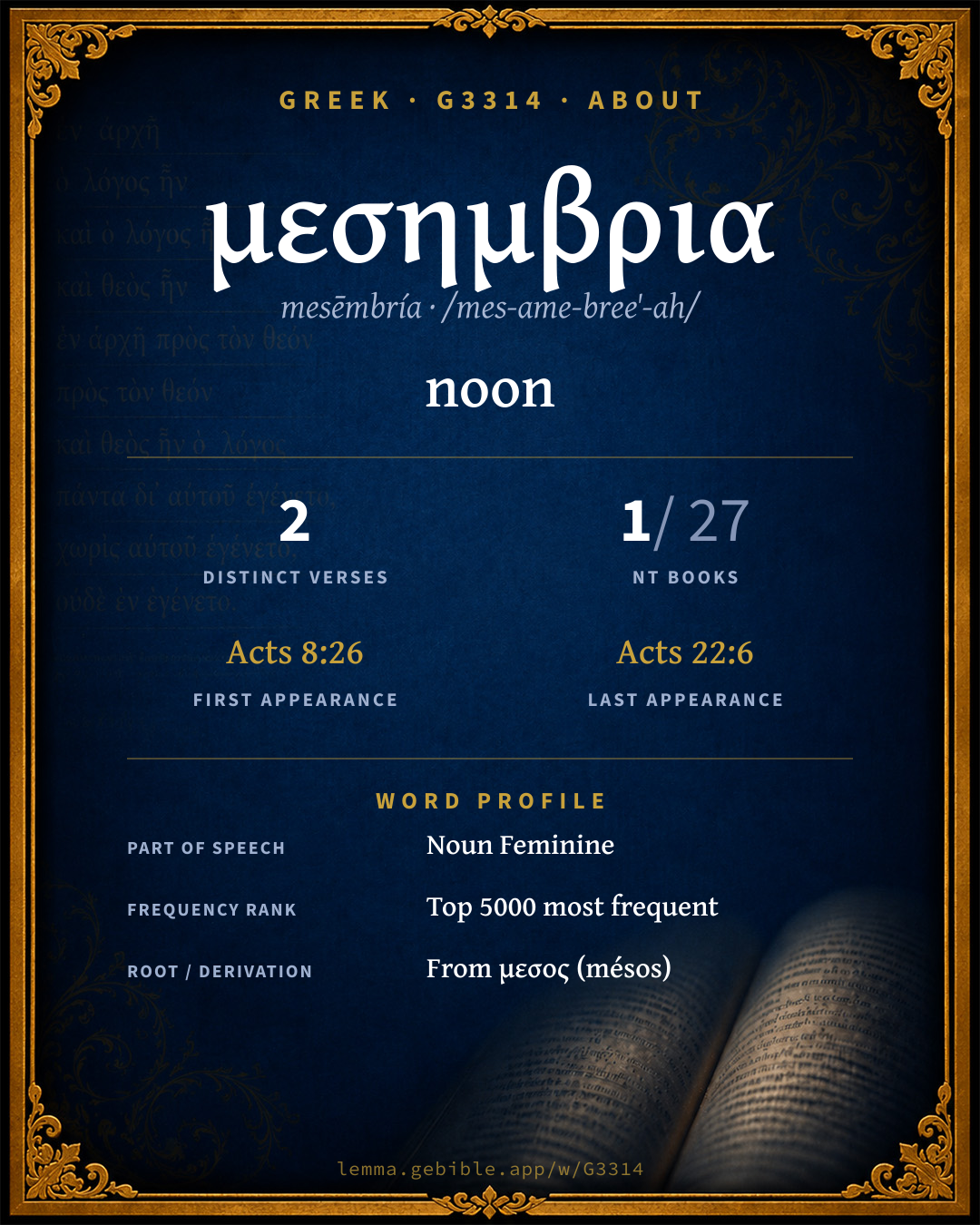
μεσημβρία
noon
‘noon’ is one of 2 main senses fuller range ↓
Full lexicon entry — Thayer's Greek Lexicon
From Thayer's Greek Lexicon
Where this word appears
Grammar key — what these labels mean
Part of speech
- Noun
- A naming word — a person, place, thing, or idea.
Case
- Accusative
- The case of the direct object and of extent.
Gender
- Feminine
- Grammatically feminine.
Number
- Singular
- One.
Every verse where G3314 appears — 2 distinct verses across 1 book. Click any verse to open its interlinear word-by-word view. Verse text shown in the World English Bible for context — . Each verse’s Greek form is shown with its reference; the English is not keyword-highlighted, since the data carries no word-level English alignment. Use “Compare translations” on any verse to read it across multiple English versions. This concordance covers the Greek New Testament; Septuagint (Greek Old Testament) occurrences of this word are not indexed here.
Acts 2 verses
- Acts 8:26 μεσημβρίαν n acc sg fem But an angel of the Lord spoke to Philip, saying, "Arise, and go toward the south to the way that goes down from Jerusalem to Gaza. This is a desert."
- Acts 22:6 μεσημβρίαν n acc sg fem It happened that, as I made my journey, and came close to Damascus, about noon, suddenly there shone from the sky a great light around me.
About this entry
At a glance — auto-summarized from this page’s data, not written by a person. Every figure links to its source below. This summary describes the numbers; it doesn’t interpret them.
μεσημβρια — transliterated mesēmbría — is a Greek noun carrying the sense “noon.” The Greek New Testament uses it only 2 verses. More than three-quarters of its appearances fall in Acts. Debuting at Acts 8:26, it then recurs through the corpus. Its lexical range runs to 2 senses. Each statement above links to its evidence; the full detail follows below.
Gloss history
Strong's 1890 vs modern scholarship
About this word
Strong's G3314 catalogs a Greek word from the Greek New Testament.
These counts are not copied from any lexicon or concordance. They are computed here, from the morphology-tagged Greek New Testament. What Lemma adds →
- 2
- distinct verses
- The word appears in 2 distinct verses.
- 1 / 27
- NT books
- The word appears in 1 of 27 New Testament books.
- #2,678
- by frequency
- Top 5000 most frequent Greek words (rank 2,678 of 5,347 Greek words by occurrence).
View all 2 occurrences in the concordance →
Most concentrated in
- Acts 2 verses 100%
By section of the New Testament
By traditional corpus
Conventional, traditional groupings — biblical authorship is debated, so this is a traditional corpus grouping, not an authorship claim. Some books belong to more than one corpus (Luke is in both the Gospels and the Lukan corpus, and so on), so these shares overlap and need not total 100%. Each figure is a share of the word’s 2 distinct verses.
- Lukan (Luke–Acts) 2 verses · 100%
How translations render this word
Counts come from each version’s own published word-to-Strong’s tagging or interlinear alignment — an approximate guide to how each version renders this word, not a word-level alignment the data otherwise carries. Because each total is that version’s own tagged count, the per-version totals vary from one another and need not match the appearance or distinct-verse counts above. These counts may also differ from a printed concordance because Lemma counts each distinctly tagged rendering and does not collapse phrase taggings into a single head-word total. This is a fixed set of word-tagged versions (KJV, ASV, BSB, ULT) and does not change with the reading translation you choose elsewhere. Each version’s license is shown beside its name below (and on Sources).
- King James Version: Noon 1×, South 1×
- American Standard Version: Noon 1×, South 1×
- Berean Standard Bible: Noon 1×, South 1×
- unfoldingWord Literal Text: Noon 1×, South 1×
King James Version Public Domain
Renders G3314 across 2 tagged occurrences — most commonly:
American Standard Version Public Domain
Renders G3314 across 2 tagged occurrences — most commonly:
Berean Standard Bible Public Domain
Renders G3314 across 2 tagged occurrences — most commonly:
unfoldingWord Literal Text CC BY-SA 4.0
Renders G3314 across 2 tagged occurrences — most commonly:
Senses in Thayer's
The 2 senses Thayer's distinguishes for this word, in lexicon order (not ranked by frequency or importance). The full entry — with sub-senses — is in the Lexicon Entry tab.
- as respects to time: noon
- the south
Word origin
Derived from μεσος (mésos) (G3319) — middle.
Same root — word family
Other Thayer's entries built from the same root as G3314, grouped by Strong’s listed origin. These share a root / origin per the lexicon — not necessarily a shared meaning. Each links to that word’s own entry.
Derives from
Shares the same root
- μεσιτης mesítēs G3316 mediator
- μεσονυκτιον mesonýktion G3317 midnight
- μεσοτοιχον mesótoichon G3320 partition wall
- μεσουρανημα mesouránēma G3321 mid-heaven
- μεσοω mesóō G3322 to be midway
Proper names from this root
People and places named from this root — a name, not an additional meaning of the word.
Compare all same-root words → Showing 4 of 8 — not the complete family. 1 of the same-root words is a proper name (a person or place). They share a root, not necessarily a meaning.
Septuagint usage
The same Greek word μεσημβρια appears 24 times in the Greek Old Testament (Septuagint), across 24 verses in 14 books.
- 24
- LXX occurrences
- Tagged occurrences of this Greek word in the Septuagint.
- 24
- verses
- Distinct Septuagint verses containing this word.
- 14 / 39
- OT books
- The word appears in 14 of the 39 Old Testament books.
Sample Septuagint occurrences
- Genesis 18:1 μεσημβρία
- Deuteronomy 28:29 μεσημβρία
- Judges 5:10 μεσημβρία
- 2 Samuel 4:5 μεσημβρία
- 1 Kings 18:26 μεσημβρία
- 2 Kings 4:20 μεσημβρία
- Job 11:17 μεσημβρία
- Psalms 36:6 μεσημβρία
- Song of Solomon 1:7 μεσημβρία
- Isaiah 18:4 μεσημβρία
- Jeremiah 6:4 μεσημβρία
- Daniel 8:4 μεσημβρία
Septuagint occurrences (same lexeme)
Every verse where the same Strong’s number (G3314) appears in the Greek Septuagint. Verse text shown in the World English Bible for context; the Greek form is the matched word — the English is not keyword-highlighted.
- Genesis 18:1 μεσημβρία Yahweh appeared to him by the oaks of Mamre, as he sat in the tent door in the heat of the day.
- Genesis 43:16 μεσημβρία When Joseph saw Benjamin with them, he said to the steward of his house, "Bring the men into the house, and butcher an animal, and make ready; for the men will dine with me at noon."
- Genesis 43:25 μεσημβρία They made ready the present for Joseph's coming at noon, for they heard that they should eat bread there.
- Deuteronomy 28:29 μεσημβρία and you shall grope at noonday, as the blind gropes in darkness, and you shall not prosper in your ways: and you shall be only oppressed and robbed always, and there shall be none to save you.
- Judges 5:10 μεσημβρία Tell [of it], you who ride on white donkeys, You who sit on rich carpets, You who walk by the way.
- 2 Samuel 4:5 μεσημβρία The sons of Rimmon the Beerothite, Rechab and Baanah, went, and came about the heat of the day to the house of Ish-bosheth, as he took his rest at noon.
- 1 Kings 18:26 μεσημβρία They took the bull which was given them, and they dressed it, and called on the name of Baal from morning even until noon, saying, Baal, hear us. But there was no voice, nor any who answered. They leaped about the altar which was made.
- 1 Kings 18:27 μεσημβρία It happened at noon, that Elijah mocked them, and said, Cry aloud; for he is a god: either he is musing, or he is gone aside, or he is on a journey, or peradventure he sleeps and must be awakened.
- 1 Kings 21:16 μεσημβρία It happened, when Ahab heard that Naboth was dead, that Ahab rose up to go down to the vineyard of Naboth the Jezreelite, to take possession of it.
- 2 Kings 4:20 μεσημβρία When he had taken him, and brought him to his mother, he sat on her knees until noon, and then died.
- Job 11:17 μεσημβρία Life shall be clearer than the noonday; Though there is darkness, it shall be as the morning.
- Psalms 36:6 μεσημβρία Your righteousness is like the mountains of God. Your judgments are like a great deep. Yahweh, you preserve man and animal.
- Psalms 54:18 μεσημβρία
- Song of Solomon 1:7 μεσημβρία Tell me, you whom my soul loves, Where you graze your flock, Where you rest them at noon; For why should I be as one who is veiled Beside the flocks of your companions? Lover
- Isaiah 18:4 μεσημβρία For thus has Yahweh said to me, I will be still, and I will see in my dwelling-place, like clear heat in sunshine, like a cloud of dew in the heat of harvest.
- Isaiah 58:10 μεσημβρία and if you draw out your soul to the hungry, and satisfy the afflicted soul: then shall your light rise in darkness, and your obscurity be as the noonday;
- Isaiah 59:10 μεσημβρία We grope for the wall like the blind; yes, we grope as those who have no eyes: we stumble at noonday as in the twilight; among those who are lusty we are as dead men.
- Jeremiah 6:4 μεσημβρία Prepare you war against her; arise, and let us go up at noon. Woe to us! for the day declines, for the shadows of the evening are stretched out.
- Jeremiah 15:8 μεσημβρία Their widows are increased to me above the sand of the seas; I have brought on them against the mother of the young men a destroyer at noonday: I have caused anguish and terrors to fall on her suddenly.
- Jeremiah 20:16 μεσημβρία Let that man be as the cities which Yahweh overthrew, and didn't repent: and let him hear a cry in the morning, and shouting at noontime;
- Daniel 8:4 μεσημβρία I saw the ram pushing westward, and northward, and southward; and no animals could stand before him, neither was there any who could deliver out of his hand; but he did according to his will, and magnified himself.
- Daniel 8:9 μεσημβρία Out of one of them came forth a little horn, which grew exceeding great, toward the south, and toward the east, and toward the glorious [land].
- Amos 8:9 μεσημβρία "It will happen in that day," says the Lord Yahweh, "That I will cause the sun to go down at noon, And I will darken the earth in the clear day.
- Zephaniah 2:4 μεσημβρία For Gaza will be forsaken, and Ashkelon a desolation. They will drive out Ashdod at noonday, and Ekron will be rooted up.
These are occurrences of the same Greek lexeme (G3314) in the Septuagint — not a translation of any one Hebrew word. The store carries no word-level Hebrew↔Greek alignment, so no Hebrew original is asserted here. Counts come from the recovered LXX Strong's tagging — high-frequency vocabulary is well covered, while rare or late forms may be untagged — so they reflect tagged occurrences and may slightly undercount.