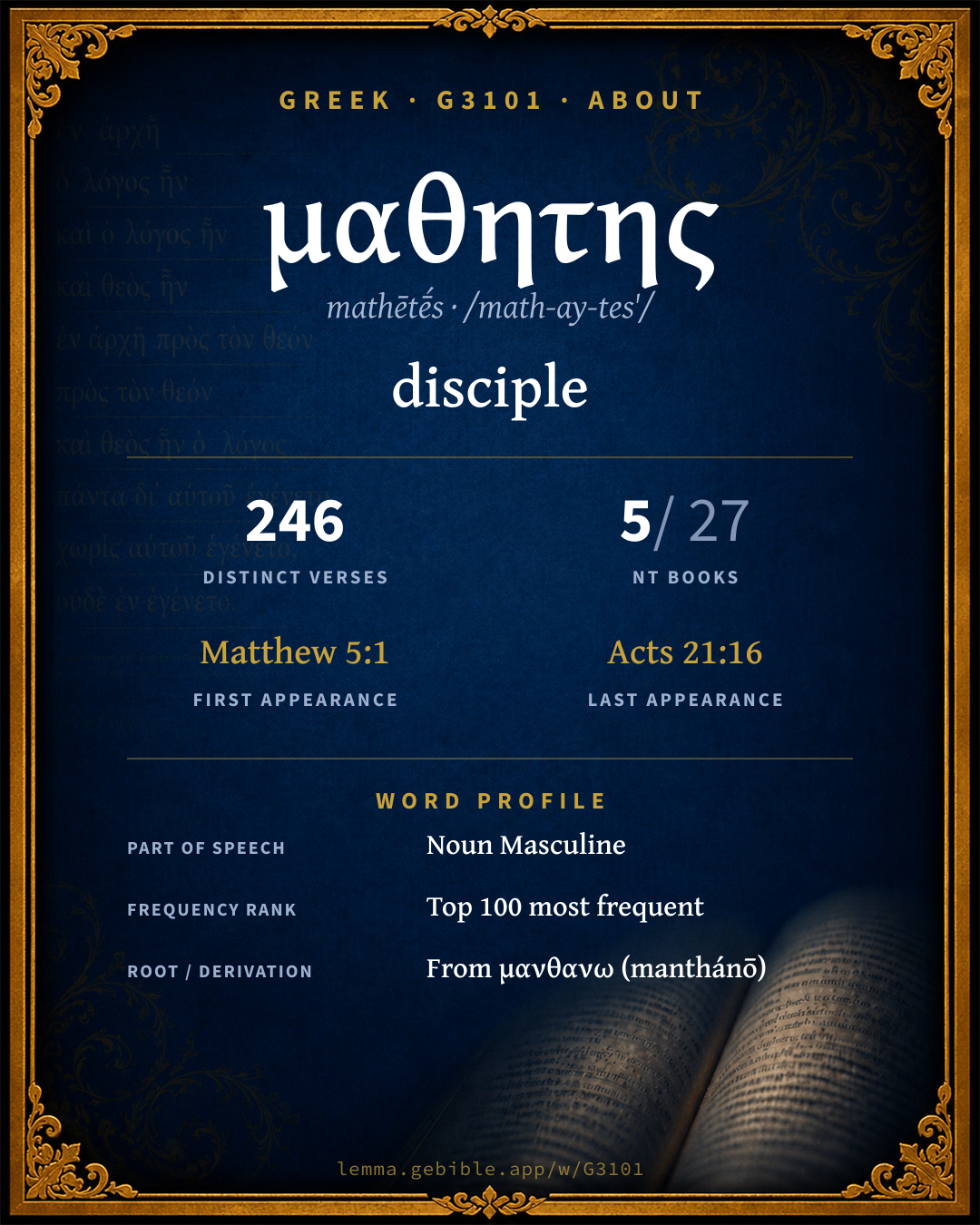
μαθητής
disciple
Full lexicon entry — Thayer's Greek Lexicon
From Thayer's Greek Lexicon
Where this word appears
See every Nominative-case word in the Greek New Testament →
Grammar key — what these labels mean
Part of speech
- Noun
- A naming word — a person, place, thing, or idea.
Case
- Nominative
- The case of the subject (and the predicate nominative).
- Genitive
- The case of source, possession, or “of” — answers “whose / from what.”
- Dative
- The case of the indirect object, means, or location — “to / for / with / in.”
- Accusative
- The case of the direct object and of extent.
Gender
- Masculine
- Grammatically masculine.
Number
- Plural
- More than one.
- Singular
- One.
Every verse where G3101 appears in the Book of Mark — 42 distinct verses. Click any verse to open its interlinear word-by-word view. Verse text shown in the World English Bible for context — . Each verse’s Greek form is shown with its reference; the English is not keyword-highlighted, since the data carries no word-level English alignment. Use “Compare translations” on any verse to read it across multiple English versions. This concordance covers the Greek New Testament; Septuagint (Greek Old Testament) occurrences of this word are not indexed here.
Mark
- Mark 2:15 μαθηταῖς n dat pl masc It happened, that he was reclining at the table in his house, and many tax collectors and sinners sat down with Jesus and his disciples, for there were many, and they followed him.
- Mark 2:16 μαθηταῖς n dat pl masc The scribes and the Pharisees, when they saw that he was eating with the sinners and tax collectors, said to his disciples, "Why is it that he eats and drinks with tax collectors and sinners?"
- Mark 2:18 μαθηταὶ μαθηταὶ μαθηταὶ μαθηταὶ n nom pl masc n nom pl masc n nom pl masc n nom pl masc John's disciples and the Pharisees were fasting, and they came and asked him, "Why do John's disciples and the disciples of the Pharisees fast, but your disciples don't fast?"
- Mark 2:23 μαθηταὶ n nom pl masc It happened that he was going on the Sabbath day through the grain fields, and his disciples began, as they went, to pluck the ears of grain.
- Mark 3:7 μαθητῶν n gen pl masc Jesus withdrew to the sea with his disciples, and a great multitude followed him from Galilee, from Judea,
- Mark 3:9 μαθηταῖς n dat pl masc He spoke to his disciples that a little boat should stay near him because of the crowd, so that they wouldn't press on him.
- Mark 4:34 μαθηταῖς n dat pl masc Without a parable he didn't speak to them; but privately to his own disciples he explained all things.
- Mark 5:31 μαθηταὶ n nom pl masc His disciples said to him, "You see the multitude pressing against you, and you say, 'Who touched me?'"
- Mark 6:1 μαθηταὶ n nom pl masc He went out from there. He came into his own country, and his disciples followed him.
- Mark 6:29 μαθηταὶ n nom pl masc When his disciples heard this, they came and took up his corpse, and laid it in a tomb.
- Mark 6:35 μαθηταὶ n nom pl masc When it was late in the day, his disciples came to him, and said, "This place is deserted, and it is late in the day.
- Mark 6:41 μαθηταῖς n dat pl masc He took the five loaves and the two fish, and looking up to heaven, he blessed and broke the loaves, and he gave to his disciples to set before them, and he divided the two fish among them all.
- Mark 6:45 μαθητὰς n acc pl masc Immediately he made his disciples get into the boat, and to go ahead to the other side, to Bethsaida, while he himself sent the multitude away.
- Mark 7:2 μαθητῶν n gen pl masc Now when they saw some of his disciples eating bread with defiled, that is, unwashed, hands, they found fault.
- Mark 7:5 μαθηταί n nom pl masc The Pharisees and the scribes asked him, "Why don't your disciples walk according to the tradition of the elders, but eat their bread with unwashed hands?"
- Mark 7:17 μαθηταὶ n nom pl masc When he had entered into a house away from the multitude, his disciples asked him about the parable.
- Mark 8:1 μαθητὰς n acc pl masc In those days, when there was a very great multitude, and they had nothing to eat, Jesus called his disciples to himself, and said to them,
- Mark 8:4 μαθηταὶ n nom pl masc His disciples answered him, "From where could one satisfy these people with bread here in a deserted place?"
- Mark 8:6 μαθηταῖς n dat pl masc He commanded the multitude to sit down on the ground, and he took the seven loaves. Having given thanks, he broke them, and gave them to his disciples to serve, and they served the multitude.
- Mark 8:10 μαθητῶν n gen pl masc Immediately he entered into the boat with his disciples, and came into the region of Dalmanutha.
- Mark 8:27 μαθηταὶ μαθητὰς n nom pl masc n acc pl masc Jesus went out, with his disciples, into the villages of Caesarea Philippi. On the way he asked his disciples, "Who do men say that I am?"
- Mark 8:33 μαθητὰς n acc pl masc But he, turning around, and seeing his disciples, rebuked Peter, and said, "Get behind me, Satan! For you have in mind not the things of God, but the things of men."
- Mark 8:34 μαθηταῖς n dat pl masc He called the multitude to himself with his disciples, and said to them, "Whoever wants to come after me, let him deny himself, and take up his cross, and follow me.
- Mark 9:14 μαθητὰς n acc pl masc Coming to the disciples, he saw a great multitude around them, and scribes questioning them.
- Mark 9:18 μαθηταῖς n dat pl masc and wherever it seizes him, it throws him down, and he foams at the mouth, and grinds his teeth, and wastes away. I asked your disciples to cast it out, and they weren't able."
- Mark 9:28 μαθηταὶ n nom pl masc When he had come into the house, his disciples asked him privately, "Why couldn't we cast it out?"
- Mark 9:31 μαθητὰς n acc pl masc For he was teaching his disciples, and said to them, "The Son of Man is being handed over to the hands of men, and they will kill him; and when he is killed, on the third day he will rise again."
- Mark 10:10 μαθηταὶ n nom pl masc In the house, his disciples asked him again about the same matter.
- Mark 10:13 μαθηταὶ n nom pl masc They were bringing to him little children, that he should touch them, but the disciples rebuked those who were bringing them.
- Mark 10:23 μαθηταῖς n dat pl masc Jesus looked around, and said to his disciples, "How difficult it is for those who have riches to enter into the Kingdom of God!"
- Mark 10:24 μαθηταὶ n nom pl masc The disciples were amazed at his words. But Jesus answered again, "Children, how hard is it for those who trust in riches to enter into the Kingdom of God!
- Mark 10:46 μαθητῶν n gen pl masc They came to Jericho. As he went out from Jericho, with his disciples and a great multitude, the son of Timaeus, Bartimaeus, a blind beggar, was sitting by the road.
- Mark 11:1 μαθητῶν n gen pl masc When they drew near to Jerusalem, to Bethsphage and Bethany, at the Mount of Olives, he sent two of his disciples,
- Mark 11:14 μαθηταὶ n nom pl masc Jesus told it, "May no one ever eat fruit from you again!" and his disciples heard it.
- Mark 12:43 μαθητὰς n acc pl masc He called his disciples to himself, and said to them, "Most assuredly I tell you, this poor widow gave more than all those who are giving into the treasury,
- Mark 13:1 μαθητῶν n gen pl masc As he went out of the temple, one of his disciples said to him, "Teacher, see what kind of stones and what kind of buildings!"
- Mark 14:12 μαθηταὶ n nom pl masc On the first day of unleavened bread, when they sacrificed the Passover, his disciples asked him, "Where do you want us to go and make ready that you may eat the Passover?"
- Mark 14:13 μαθητῶν n gen pl masc He sent two of his disciples, and said to them, "Go into the city, and there you will meet a man carrying a pitcher of water. Follow him,
- Mark 14:14 μαθητῶν n gen pl masc and wherever he enters in, tell the master of the house, 'The Teacher says, "Where is the guest room, where I may eat the Passover with my disciples?"'
- Mark 14:16 μαθηταὶ n nom pl masc His disciples went out, and came into the city, and found things as he had said to them, and they prepared the Passover.
- Mark 14:32 μαθηταῖς n dat pl masc They came to a place which was named Gethsemane. He said to his disciples, "Sit here, while I pray."
- Mark 16:7 μαθηταῖς n dat pl masc But go, tell his disciples and Peter, 'He goes before you into Galilee. There you will see him, as he said to you.'"
About this entry
At a glance — auto-summarized from this page’s data, not written by a person. Every figure links to its source below. This summary describes the numbers; it doesn’t interpret them.
μαθητης (mathētḗs) is a Greek noun most often rendered “disciple.” Debuting at Matthew 5:1, it then recurs through the corpus. The Greek New Testament uses it across 246 verses — common. John dominates its distribution — 73 of 246 verses. Related forms include μανθανω, μαθητευω and μαθητρια. The sections below give every sense, occurrence, and version rendering.
Gloss history
Strong's 1890 vs modern scholarship
About this word
Strong's G3101 catalogs a Greek word from the Greek New Testament.
These counts are not copied from any lexicon or concordance. They are computed here, from the morphology-tagged Greek New Testament. What Lemma adds →
- 246
- distinct verses
- The word appears in 246 distinct verses.
- 5 / 27
- NT books
- The word appears in 5 of 27 New Testament books.
- #61
- by frequency
- Top 100 most frequent Greek words (rank 61 of 5,347 Greek words by occurrence).
View all 246 occurrences in the concordance →
By section of the New Testament
By traditional corpus
Conventional, traditional groupings — biblical authorship is debated, so this is a traditional corpus grouping, not an authorship claim. Some books belong to more than one corpus (Luke is in both the Gospels and the Lukan corpus, and so on), so these shares overlap and need not total 100%. Each figure is a share of the word’s 246 distinct verses.
- Gospels 220 verses · 89%
- Johannine 73 verses · 30%
- Lukan (Luke–Acts) 63 verses · 26%
How translations render this word
Counts come from each version’s own published word-to-Strong’s tagging or interlinear alignment — an approximate guide to how each version renders this word, not a word-level alignment the data otherwise carries. Because each total is that version’s own tagged count, the per-version totals vary from one another and need not match the appearance or distinct-verse counts above. These counts may also differ from a printed concordance because Lemma counts each distinctly tagged rendering and does not collapse phrase taggings into a single head-word total. This is a fixed set of word-tagged versions (KJV, ASV, BSB, ULT) and does not change with the reading translation you choose elsewhere. Each version’s license is shown beside its name below (and on Sources).
- King James Version: Disciples 239×, Disciple 27×
- American Standard Version: Disciples 225×, Disciple 27×, To 8×
- Berean Standard Bible: Disciples 224×, Disciple 27×, Disciples to him 4×
- unfoldingWord Literal Text: Disciples 233×, Disciple 27×, To 23×
King James Version Public Domain
Renders G3101 across 268 tagged occurrences — most commonly:
Plus 2 renderings that appear only once — usually multi-word phrases or single function words the recovered tagging swept in, not distinct renderings.
American Standard Version Public Domain
Renders G3101 across 283 tagged occurrences — most commonly:
Plus 9 renderings that appear only once — usually multi-word phrases or single function words the recovered tagging swept in, not distinct renderings.
Berean Standard Bible Public Domain
Renders G3101 across 256 tagged occurrences — most commonly:
Plus 1 rendering that appears only once — usually multi-word phrases or single function words the recovered tagging swept in, not distinct renderings. Not rendered by a distinct English word in 6 further occurrences.
unfoldingWord Literal Text CC BY-SA 4.0
Renders G3101 across 298 tagged occurrences — most commonly:
Plus 2 renderings that appear only once — usually multi-word phrases or single function words the recovered tagging swept in, not distinct renderings.
Senses in Thayer's
The 1 sense Thayer's distinguishes for this word, in lexicon order (not ranked by frequency or importance). The full entry — with sub-senses — is in the Lexicon Entry tab.
- a learner, pupil, disciple
Word origin
Derived from μανθανω (manthánō) (G3129) — to learn.
From G3129 ; a learner that is pupil : - disciple.
— Strong’s Exhaustive Concordance (1890), public domain.
Forms in the corpus
The 11 distinct written forms G3101 takes in the Greek New Testament, most frequent first — each parse links to that case’s occurrences in the concordance.
| Form | Parsing | Example | Uses |
|---|---|---|---|
| μαθηταὶ mathētaì | Noun, Nominative, Plural, Masculine | Matthew 5:1 | 91 |
| μαθητῶν mathētō̂n | Noun, Genitive, Plural, Masculine | Matthew 8:21 | 46 |
| μαθηταῖς mathētaîs | Noun, Dative, Plural, Masculine | Matthew 9:10 | 41 |
| μαθητὰς mathētàs | Noun, Accusative, Plural, Masculine | Matthew 10:1 | 33 |
| μαθηταί mathētaí | Noun, Nominative, Plural, Masculine | Matthew 9:14 | 17 |
| μαθητὴς mathētḕs | Noun, Nominative, Singular, Masculine | Matthew 10:24 | 13 |
| μαθητής mathētḗs | Noun, Nominative, Singular, Masculine | Luke 14:26 | 7 |
| μαθητάς mathētás | Noun, Accusative, Plural, Masculine | Luke 12:22 | 6 |
| μαθητὴν mathētḕn | Noun, Accusative, Singular, Masculine | John 19:26 | 3 |
| μαθητῇ mathētē̂ | Noun, Dative, Singular, Masculine | Matthew 10:25 | 3 |
| μαθητοῦ mathētoû | Noun, Genitive, Singular, Masculine | Matthew 10:42 | 1 |
Same root — word family
Other Thayer's entries built from the same root as G3101, grouped by Strong’s listed origin. These share a root / origin per the lexicon — not necessarily a shared meaning. Each links to that word’s own entry.
Derives from
Derived from this word
Compare all same-root words → They share a root, not necessarily a meaning.