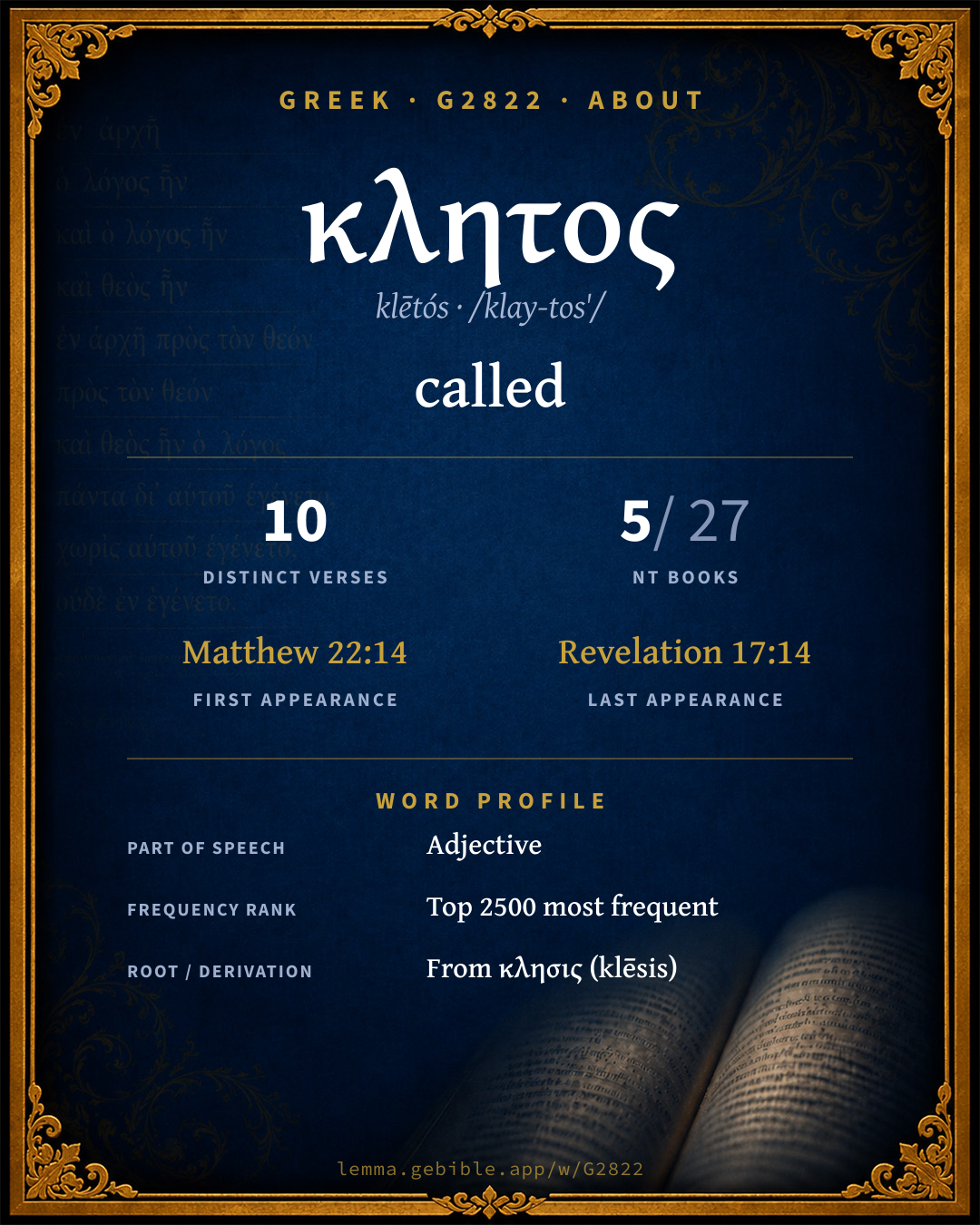
κλητός
called
Full lexicon entry — Thayer's Greek Lexicon
From Thayer's Greek Lexicon
Where this word appears
See every Dative-case word in the Greek New Testament →
Grammar key — what these labels mean
Part of speech
- Adjective
- A word that describes or qualifies a noun.
Case
- Dative
- The case of the indirect object, means, or location — “to / for / with / in.”
- Nominative
- The case of the subject (and the predicate nominative).
Gender
- Masculine
- Grammatically masculine.
Number
- Plural
- More than one.
- Singular
- One.
5 distinct verses where G2822 appears in the Dative case, across 3 books. Filtered view — show all forms. Click any verse to open its interlinear word-by-word view. Verse text shown in the World English Bible for context — . Each verse’s Greek form is shown with its reference; the English is not keyword-highlighted, since the data carries no word-level English alignment. Use “Compare translations” on any verse to read it across multiple English versions. This concordance covers the Greek New Testament; Septuagint (Greek Old Testament) occurrences of this word are not indexed here.
Romans 2 verses
- Romans 1:7 κλητοῖς adj dat pl masc to all who are in Rome, beloved of God, called to be saints: Grace to you and peace from God our Father and the Lord Jesus Christ.
- Romans 8:28 κλητοῖς adj dat pl masc We know that all things work together for good for those who love God, to those who are called according to his purpose.
1 Corinthians 2 verses
- 1 Corinthians 1:2 κλητοῖς adj dat pl masc to the assembly of God which is at Corinth; those who are sanctified in Christ Jesus, called to be saints, with all who call on the name of our Lord Jesus Christ in every place, both theirs and ours:
- 1 Corinthians 1:24 κλητοῖς adj dat pl masc but to those who are called, both Jews and Greeks, Christ is the power of God and the wisdom of God.
Jude 1 verse
About this entry
At a glance — auto-summarized from this page’s data, not written by a person. Every figure links to its source below. This summary describes the numbers; it doesn’t interpret them.
κλητος — transliterated klētós — is a Greek adjective carrying the sense “called.” Debuting at Matthew 22:14, it then recurs through the corpus. With 10 verses in 5 books, it is an uncommon word in the Greek New Testament. Its uses concentrate in Romans (40% of all occurrences). Each statement above links to its evidence; the full detail follows below.
Gloss history
Strong's 1890 vs modern scholarship
About this word
Strong's G2822 catalogs a Greek word from the Greek New Testament.
These counts are not copied from any lexicon or concordance. They are computed here, from the morphology-tagged Greek New Testament. What Lemma adds →
- 10
- distinct verses
- The word appears in 10 distinct verses.
- 5 / 27
- NT books
- The word appears in 5 of 27 New Testament books.
- #1,056
- by frequency
- Top 2500 most frequent Greek words (rank 1,056 of 5,347 Greek words by occurrence).
View all 10 occurrences in the concordance →
Most concentrated in
- Romans 4 verses 40%
- 1 Corinthians 3 verses 30%
- Matthew 1 verse 10%
By section of the New Testament
By traditional corpus
Conventional, traditional groupings — biblical authorship is debated, so this is a traditional corpus grouping, not an authorship claim. Some books belong to more than one corpus (Luke is in both the Gospels and the Lukan corpus, and so on), so these shares overlap and need not total 100%. Each figure is a share of the word’s 10 distinct verses.
- Pauline corpus 7 verses · 70%
- Gospels 1 verse · 10%
- Johannine 1 verse · 10%
- General (Catholic) Epistles 1 verse · 10%
- Revelation 1 verse · 10%
How translations render this word
Counts come from each version’s own published word-to-Strong’s tagging or interlinear alignment — an approximate guide to how each version renders this word, not a word-level alignment the data otherwise carries. Because each total is that version’s own tagged count, the per-version totals vary from one another and need not match the appearance or distinct-verse counts above. These counts may also differ from a printed concordance because Lemma counts each distinctly tagged rendering and does not collapse phrase taggings into a single head-word total. This is a fixed set of word-tagged versions (KJV, ASV, BSB, ULT) and does not change with the reading translation you choose elsewhere. Each version’s license is shown beside its name below (and on Sources).
- King James Version: Called 9×, Are called 2×
- American Standard Version: Called 8×, Are called 2×
- Berean Standard Bible: Called 8×
- unfoldingWord Literal Text: Called 8×
King James Version Public Domain
Renders G2822 across 11 tagged occurrences — most commonly:
American Standard Version Public Domain
Renders G2822 across 10 tagged occurrences — most commonly:
Berean Standard Bible Public Domain
Renders G2822 across 10 tagged occurrences — most commonly:
Plus 2 renderings that appear only once — usually multi-word phrases or single function words the recovered tagging swept in, not distinct renderings.
unfoldingWord Literal Text CC BY-SA 4.0
Renders G2822 across 10 tagged occurrences — most commonly:
Plus 2 renderings that appear only once — usually multi-word phrases or single function words the recovered tagging swept in, not distinct renderings.
Senses in Thayer's
The 1 sense Thayer's distinguishes for this word, in lexicon order (not ranked by frequency or importance). The full entry — with sub-senses — is in the Lexicon Entry tab.
- called, invited (to a banquet)
Word origin
Derived from κλησις (klēsis) (G2821) — calling.
From the same as G2821 ; invited that is appointed or (specifically) a saint : - called.
— Strong’s Exhaustive Concordance (1890), public domain.
Forms in the corpus
The 3 distinct written forms G2822 takes in the Greek New Testament, most frequent first — each parse links to that case’s occurrences in the concordance.
| Form | Parsing | Example | Uses |
|---|---|---|---|
| κλητοῖς klētoîs | Adjective, Dative, Plural, Masculine | Romans 1:7 | 5 |
| κλητοὶ klētoì | Adjective, Nominative, Plural, Masculine | Matthew 22:14 | 3 |
| κλητὸς klētòs | Adjective, Nominative, Singular, Masculine | Romans 1:1 | 2 |
Septuagint usage
The same Greek word κλητος appears 18 times in the Greek Old Testament (Septuagint), across 18 verses in 7 books.
- 18
- LXX occurrences
- Tagged occurrences of this Greek word in the Septuagint.
- 18
- verses
- Distinct Septuagint verses containing this word.
- 7 / 39
- OT books
- The word appears in 7 of the 39 Old Testament books.
Sample Septuagint occurrences
- Exodus 12:16 κλητός
- Leviticus 23:2 κλητός
- Numbers 28:25 κλητός
- Judges 14:11 κλητός
- 2 Samuel 15:11 κλητός
- 1 Kings 1:41 κλητός
- Zephaniah 1:7 κλητός
Septuagint occurrences (same lexeme)
Every verse where the same Strong’s number (G2822) appears in the Greek Septuagint. Verse text shown in the World English Bible for context; the Greek form is the matched word — the English is not keyword-highlighted.
- Exodus 12:16 κλητός In the first day there shall be to you a holy convocation, and in the seventh day a holy convocation; no manner of work shall be done in them, except that which every man must eat, that only may be done by you.
- Leviticus 23:2 κλητός "Speak to the children of Israel, and tell them, 'The set feasts of Yahweh, which you shall proclaim to be holy convocations, even these are my set feasts.
- Leviticus 23:3 κλητός "'Six days shall work be done: but on the seventh day is a Sabbath of solemn rest, a holy convocation; you shall do no manner of work. It is a Sabbath to Yahweh in all your dwellings.
- Leviticus 23:4 κλητός "'These are the set feasts of Yahweh, even holy convocations, which you shall proclaim in their appointed season.
- Leviticus 23:7 κλητός In the first day you shall have a holy convocation. You shall do no regular work.
- Leviticus 23:8 κλητός But you shall offer an offering made by fire to Yahweh seven days. In the seventh day is a holy convocation: you shall do no regular work.'"
- Leviticus 23:21 κλητός You shall make proclamation on the same day: there shall be a holy convocation to you; you shall do no regular work. This is a statute forever in all your dwellings throughout your generations.
- Leviticus 23:24 κλητός "Speak to the children of Israel, saying, 'In the seventh month, on the first day of the month, shall be a solemn rest to you, a memorial of blowing of trumpets, a holy convocation.
- Leviticus 23:27 κλητός "However on the tenth day of this seventh month is the day of atonement: it shall be a holy convocation to you, and you shall afflict yourselves; and you shall offer an offering made by fire to Yahweh.
- Leviticus 23:35 κλητός On the first day shall be a holy convocation: you shall do no regular work.
- Leviticus 23:36 κλητός Seven days you shall offer an offering made by fire to Yahweh. On the eighth day shall be a holy convocation to you; and you shall offer an offering made by fire to Yahweh. It is a solemn assembly; you shall do no regular work.
- Leviticus 23:37 κλητός "'These are the appointed feasts of Yahweh, which you shall proclaim to be holy convocations, to offer an offering made by fire to Yahweh, a burnt offering, and a meal offering, a sacrifice, and drink offerings, each on its own day;
- Numbers 28:25 κλητός On the seventh day you shall have a holy convocation: you shall do no servile work.
- Judges 14:11 κλητός It happened, when they saw him, that they brought thirty companions to be with him.
- 2 Samuel 15:11 κλητός With Absalom went two hundred men out of Jerusalem, who were invited, and went in their simplicity; and they didn't know anything.
- 1 Kings 1:41 κλητός Adonijah and all the guests who were with him heard it as they had made an end of eating. When Joab heard the sound of the trumpet, he said, Why is this noise of the city being in an uproar?
- 1 Kings 1:49 κλητός All the guests of Adonijah were afraid, and rose up, and went every man his way.
- Zephaniah 1:7 κλητός Be silent at the presence of the Lord Yahweh, for the day of Yahweh is at hand. For Yahweh has prepared a sacrifice. He has consecrated his guests.
These are occurrences of the same Greek lexeme (G2822) in the Septuagint — not a translation of any one Hebrew word. The store carries no word-level Hebrew↔Greek alignment, so no Hebrew original is asserted here. Counts come from the recovered LXX Strong's tagging — high-frequency vocabulary is well covered, while rare or late forms may be untagged — so they reflect tagged occurrences and may slightly undercount.