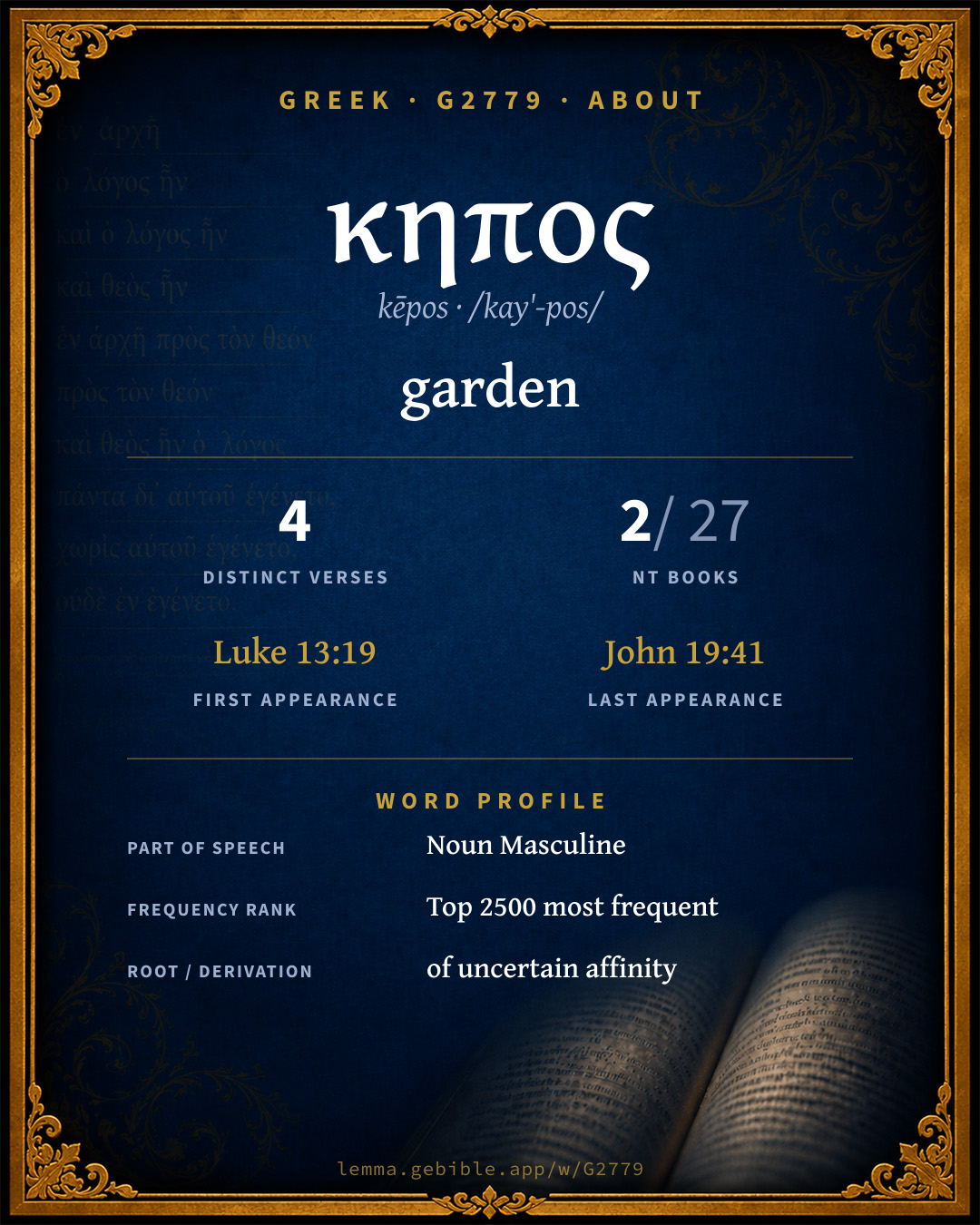
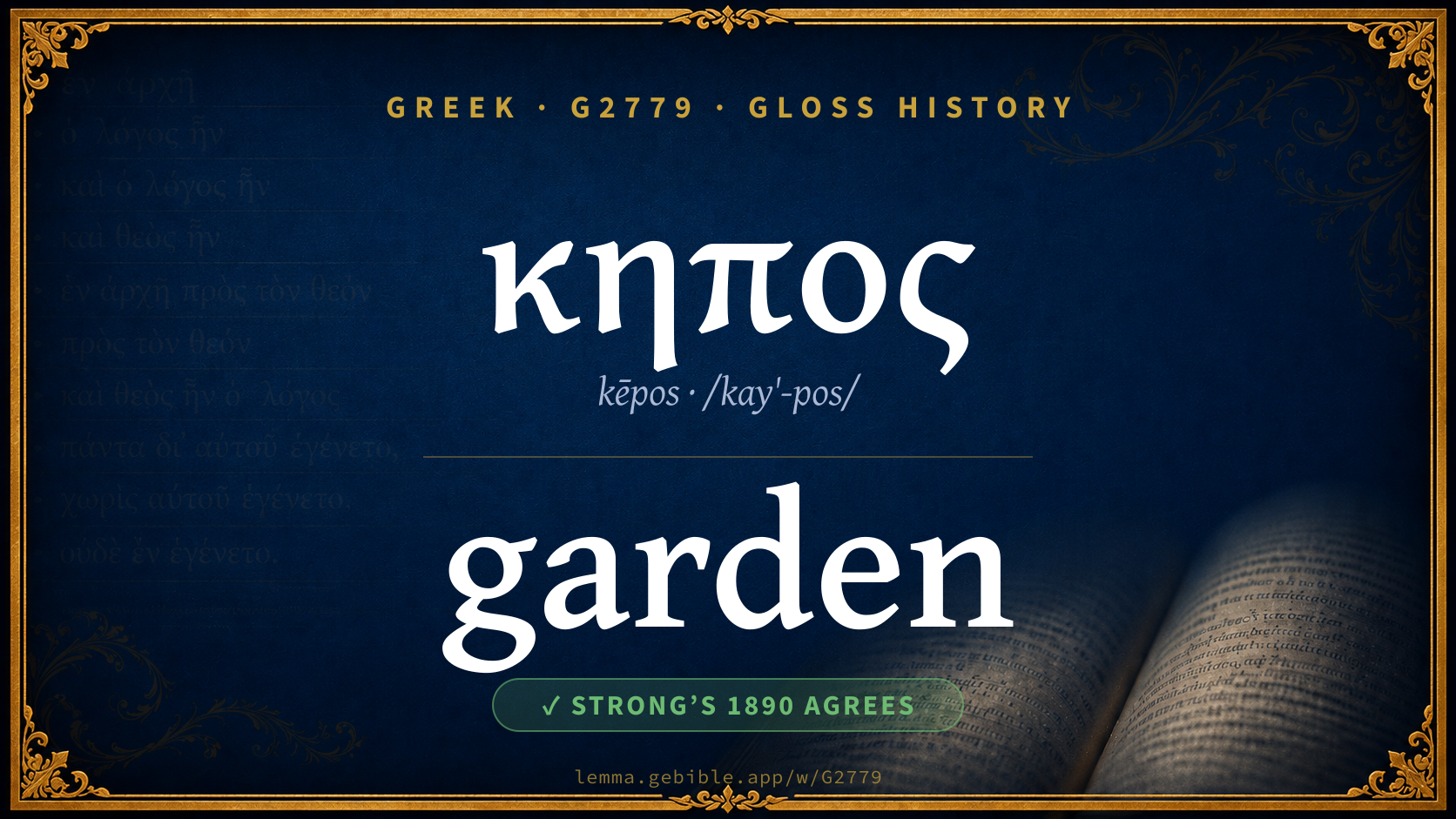
κῆπος
garden
Full lexicon entry — Thayer's Greek Lexicon
From Thayer's Greek Lexicon
Where this word appears
See every Dative-case word in the Greek New Testament →
Grammar key — what these labels mean
Part of speech
- Noun
- A naming word — a person, place, thing, or idea.
Case
- Dative
- The case of the indirect object, means, or location — “to / for / with / in.”
- Nominative
- The case of the subject (and the predicate nominative).
- Accusative
- The case of the direct object and of extent.
Gender
- Masculine
- Grammatically masculine.
Number
- Singular
- One.
2 distinct verses where G2779 appears in the Dative case, across 1 book. Filtered view — show all forms. Click any verse to open its interlinear word-by-word view. Verse text shown in the World English Bible for context — . Each verse’s Greek form is shown with its reference; the English is not keyword-highlighted, since the data carries no word-level English alignment. Use “Compare translations” on any verse to read it across multiple English versions. This concordance covers the Greek New Testament; Septuagint (Greek Old Testament) occurrences of this word are not indexed here.
John 2 verses
- John 18:26 κήπῳ n dat sg masc One of the servants of the high priest, being a relative of him whose ear Peter had cut off, said, "Didn't I see you in the garden with him?"
- John 19:41 κῆπος κήπῳ n nom sg masc n dat sg masc Now in the place where he was crucified there was a garden. In the garden a new tomb in which no man had ever yet been laid.
About this entry
At a glance — auto-summarized from this page’s data, not written by a person. Every figure links to its source below. This summary describes the numbers; it doesn’t interpret them.
At its core, κηπος (kēpos) means “garden.” It is rare — just 4 verses in the entire Greek New Testament. Its uses cluster heavily in John (75% of all occurrences). Scripture first uses it in Luke 13:19. From the same root come κηπουρος. Dig into 4-verse concordance and the renderings breakdown below.
Gloss history
Strong's 1890 vs modern scholarship
About this word
Strong's G2779 catalogs a Greek word from the Greek New Testament.
These counts are not copied from any lexicon or concordance. They are computed here, from the morphology-tagged Greek New Testament. What Lemma adds →
- 4
- distinct verses
- The word appears in 4 distinct verses.
- 2 / 27
- NT books
- The word appears in 2 of 27 New Testament books.
- #1,648
- by frequency
- Top 2500 most frequent Greek words (rank 1,648 of 5,347 Greek words by occurrence).
View all 4 occurrences in the concordance →
By traditional corpus
Conventional, traditional groupings — biblical authorship is debated, so this is a traditional corpus grouping, not an authorship claim. Some books belong to more than one corpus (Luke is in both the Gospels and the Lukan corpus, and so on), so these shares overlap and need not total 100%. Each figure is a share of the word’s 4 distinct verses.
- Gospels 4 verses · 100%
- Johannine 3 verses · 75%
- Lukan (Luke–Acts) 1 verse · 25%
How translations render this word
Counts come from each version’s own published word-to-Strong’s tagging or interlinear alignment — an approximate guide to how each version renders this word, not a word-level alignment the data otherwise carries. Because each total is that version’s own tagged count, the per-version totals vary from one another and need not match the appearance or distinct-verse counts above. These counts may also differ from a printed concordance because Lemma counts each distinctly tagged rendering and does not collapse phrase taggings into a single head-word total. This is a fixed set of word-tagged versions (KJV, ASV, BSB, ULT) and does not change with the reading translation you choose elsewhere. Each version’s license is shown beside its name below (and on Sources).
- King James Version: Garden 5×
- American Standard Version: Garden 4×
- Berean Standard Bible: Garden 5×
- unfoldingWord Literal Text: Garden 5×
King James Version Public Domain
Renders G2779 across 5 tagged occurrences — most commonly:
American Standard Version Public Domain
Renders G2779 across 5 tagged occurrences — most commonly:
Plus 1 rendering that appears only once — usually multi-word phrases or single function words the recovered tagging swept in, not distinct renderings.
Berean Standard Bible Public Domain
Renders G2779 across 5 tagged occurrences — most commonly:
unfoldingWord Literal Text CC BY-SA 4.0
Renders G2779 across 5 tagged occurrences — most commonly:
Senses in Thayer's
The 1 sense Thayer's distinguishes for this word, in lexicon order (not ranked by frequency or importance). The full entry — with sub-senses — is in the Lexicon Entry tab.
- a garden
Word origin
Origin: of uncertain affinity
Of uncertain affinity; a garden : - garden.
— Strong’s Exhaustive Concordance (1890), public domain.
Forms in the corpus
The 3 distinct written forms G2779 takes in the Greek New Testament, most frequent first — each parse links to that case’s occurrences in the concordance.
| Form | Parsing | Example | Uses |
|---|---|---|---|
| κήπῳ kḗpō | Noun, Dative, Singular, Masculine | John 18:26 | 2 |
| κῆπος kē̂pos | Noun, Nominative, Singular, Masculine | John 18:1 | 2 |
| κῆπον kē̂pon | Noun, Accusative, Singular, Masculine | Luke 13:19 | 1 |
Same root — word family
Other Thayer's entries built from the same root as G2779, grouped by Strong’s listed origin. These share a root / origin per the lexicon — not necessarily a shared meaning. Each links to that word’s own entry.
Derived from this word
Compare all same-root words → They share a root, not necessarily a meaning.
Septuagint usage
The same Greek word κηπος appears 33 times in the Greek Old Testament (Septuagint), across 28 verses in 11 books.
- 33
- LXX occurrences
- Tagged occurrences of this Greek word in the Septuagint.
- 28
- verses
- Distinct Septuagint verses containing this word.
- 11 / 39
- OT books
- The word appears in 11 of the 39 Old Testament books.
Sample Septuagint occurrences
- Deuteronomy 11:10 κῆπος
- 1 Kings 20:2 κῆπος
- 2 Kings 5:26 κῆπος
- Ezra 13:16 κῆπος
- Esther 7:7 κῆπος
- Ecclesiastes 2:5 κῆπος
- Song of Solomon 4:12 κῆπος
- Isaiah 1:29 κῆπος
- Jeremiah 36:23 κῆπος
- Ezekiel 36:35 κῆπος
- Amos 4:9 κῆπος
Septuagint occurrences (same lexeme)
Every verse where the same Strong’s number (G2779) appears in the Greek Septuagint. Verse text shown in the World English Bible for context; the Greek form is the matched word — the English is not keyword-highlighted.
- Deuteronomy 11:10 κῆπος For the land, where you go in to possess it, isn't as the land of Egypt, from whence you came out, where you sowed your seed, and watered it with your foot, as a garden of herbs;
- 1 Kings 20:2 κῆπος He sent messengers to Ahab king of Israel, into the city, and said to him, Thus says Ben Hadad,
- 2 Kings 5:26 κῆπος He said to him, Didn't my heart go with you, when the man turned from his chariot to meet you? Is it a time to receive money, and to receive garments, and olive groves and vineyards, and sheep and oxen, and men-servants and maid-servants?
- 2 Kings 21:18 κῆπος Manasseh slept with his fathers, and was buried in the garden of his own house, in the garden of Uzza: and Amon his son reigned in his place.
- 2 Kings 21:26 κῆπος He was buried in his tomb in the garden of Uzza: and Josiah his son reigned in his place.
- 2 Kings 25:4 κῆπος Then a breach was made in the city, and all the men of war [fled] by night by the way of the gate between the two walls, which was by the king's garden (now the Chaldeans were against the city round about); and [the king] went by the way of the Arabah.
- Ezra 13:16 κῆπος
- Ezra 13:26 κῆπος
- Esther 7:7 κῆπος The king arose in his wrath from the banquet of wine [and went] into the palace garden: and Haman stood up to make request for his life to Esther the queen; for he saw that there was evil determined against him by the king.
- Esther 7:8 κῆπος Then the king returned out of the palace garden into the place of the banquet of wine; and Haman was fallen on the couch whereon Esther was. Then said the king, Will he even force the queen before me in the house? As the word went out of the king's mouth, they covered Haman's face.
- Ecclesiastes 2:5 κῆπος I made myself gardens and parks, and I planted trees in them of all kinds of fruit.
- Song of Solomon 4:12 κῆπος A locked up garden is my sister, my bride; A locked up spring, A sealed fountain.
- Song of Solomon 4:15 κῆπος A fountain of gardens, A well of living waters, Flowing streams from Lebanon. Beloved
- Song of Solomon 4:16 κῆπος Awake, north wind; and come, you south; Blow on my garden, that its spices may flow out. Let my beloved come into his garden, And taste his precious fruits. Lover
- Song of Solomon 5:1 κῆπος I have come into my garden, my sister, my bride. I have gathered my myrrh with my spice; I have eaten my honeycomb with my honey; I have drunk my wine with my milk. Friends Eat, friends! Drink, yes, drink abundantly, beloved. Beloved
- Song of Solomon 6:2 κῆπος My beloved has gone down to his garden, To the beds of spices, To feed in the gardens, and to gather lilies.
- Song of Solomon 6:11 κῆπος I went down into the nut tree grove, To see the green plants of the valley, To see whether the vine budded, And the pomegranates were in flower.
- Song of Solomon 8:13 κῆπος You who dwell in the gardens, with friends in attendance, Let me hear your voice! Beloved
- Isaiah 1:29 κῆπος For they shall be ashamed of the oaks which you have desired, And you shall be confounded for the gardens that you have chosen.
- Isaiah 58:11 κῆπος and Yahweh will guide you continually, and satisfy your soul in dry places, and make strong your bones; and you shall be like a watered garden, and like a spring of water, whose waters don't fail.
- Isaiah 61:11 κῆπος For as the earth brings forth its bud, and as the garden causes the things that are sown in it to spring forth; so the Lord Yahweh will cause righteousness and praise to spring forth before all the nations.
- Isaiah 65:3 κῆπος a people who provoke me to my face continually, sacrificing in gardens, and burning incense on bricks;
- Isaiah 66:17 κῆπος Those who sanctify themselves and purify themselves [to go] to the gardens, behind one in the midst, eating pig's flesh, and the abomination, and the mouse, they shall come to an end together, says Yahweh.
- Jeremiah 36:23 κῆπος It happened, when Jehudi had read three or four leaves, that [the king] cut it with the penknife, and cast it into the fire that was in the brazier, until all the scroll was consumed in the fire that was in the brazier.
- Jeremiah 52:7 κῆπος Then a breach was made in the city, and all the men of war fled, and went forth out of the city by night by the way of the gate between the two walls, which was by the king's garden; (now the Chaldeans were against the city round about;) and they went toward the Arabah.
- Ezekiel 36:35 κῆπος They shall say, This land that was desolate is become like the garden of Eden; and the waste and desolate and ruined cities are fortified and inhabited.
- Amos 4:9 κῆπος I struck you with blight and mildew many times in your gardens and your vineyards; And your fig trees and your olive trees have the swarming locust devoured: Yet you haven't returned to me," says Yahweh.
- Amos 9:14 κῆπος I will bring back the captivity of my people Israel, And they will rebuild the ruined cities, and inhabit them; and they will plant vineyards, and drink wine from them. They shall also make gardens, And eat the fruit of them.
These are occurrences of the same Greek lexeme (G2779) in the Septuagint — not a translation of any one Hebrew word. The store carries no word-level Hebrew↔Greek alignment, so no Hebrew original is asserted here. Counts come from the recovered LXX Strong's tagging — high-frequency vocabulary is well covered, while rare or late forms may be untagged — so they reflect tagged occurrences and may slightly undercount.