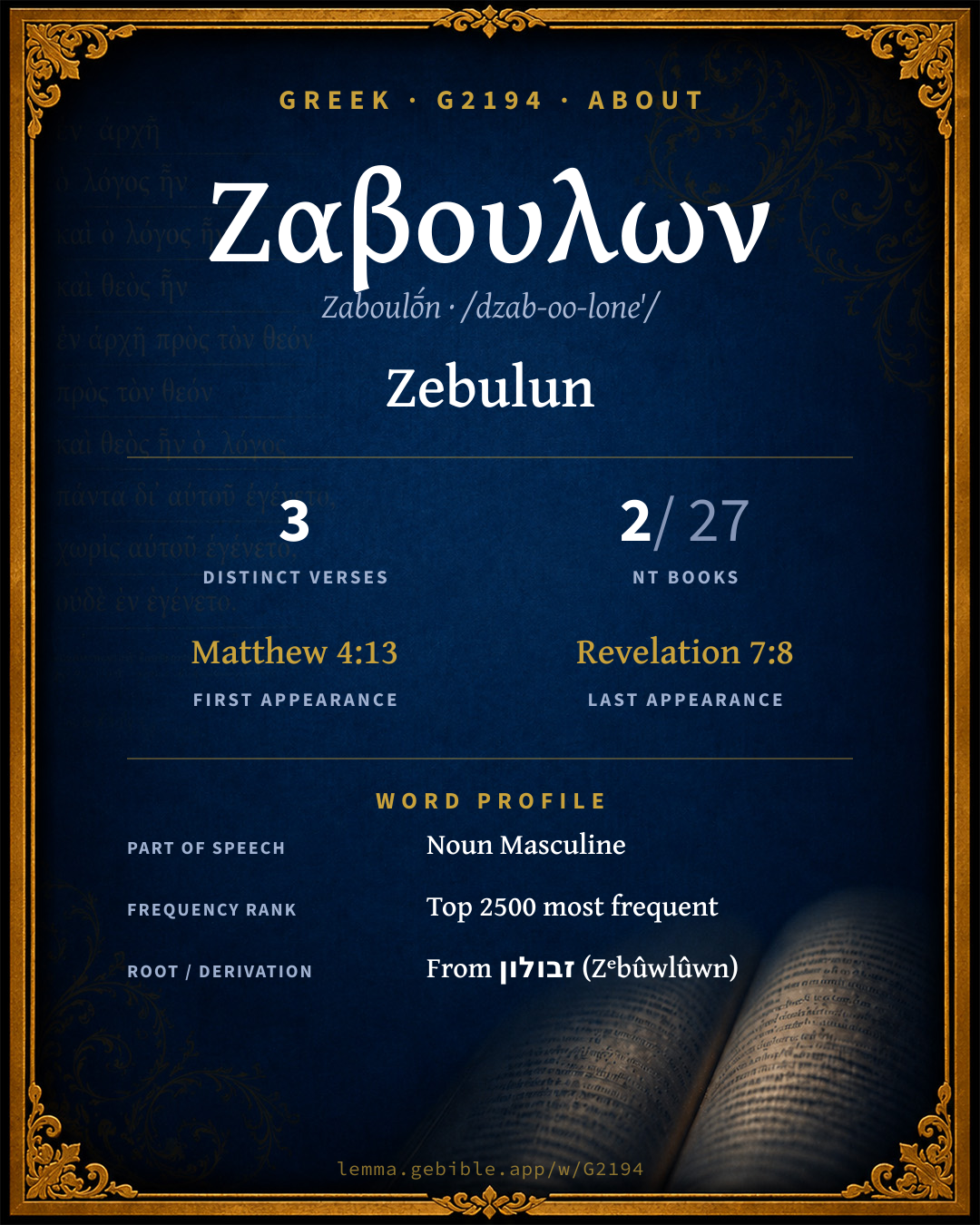
Ζαβουλών
Zebulun
Thayer's lists 3 entries for ‘Zebulun’ fuller range ↓
Full lexicon entry — Thayer's Greek Lexicon
From Thayer's Greek Lexicon
Where this word appears
Every verse where G2194 appears — 3 distinct verses across 2 books. Click any verse to open its interlinear word-by-word view. Verse text shown in the World English Bible for context — . Each verse’s Greek form is shown with its reference; the English is not keyword-highlighted, since the data carries no word-level English alignment. Use “Compare translations” on any verse to read it across multiple English versions. This concordance covers the Greek New Testament; Septuagint (Greek Old Testament) occurrences of this word are not indexed here.
Matthew 2 verses
Revelation 1 verse
About this entry
At a glance — auto-summarized from this page’s data, not written by a person. Every figure links to its source below. This summary describes the numbers; it doesn’t interpret them.
At its core, Ζαβουλων (Zaboulṓn) means “Zebulun.” It occurs a mere 3 verses across Scripture. Its uses cluster heavily in Matthew (67% of all occurrences). First canonically at Matthew 4:13, it enters the text early. Dig into 3-verse concordance and the renderings breakdown below.
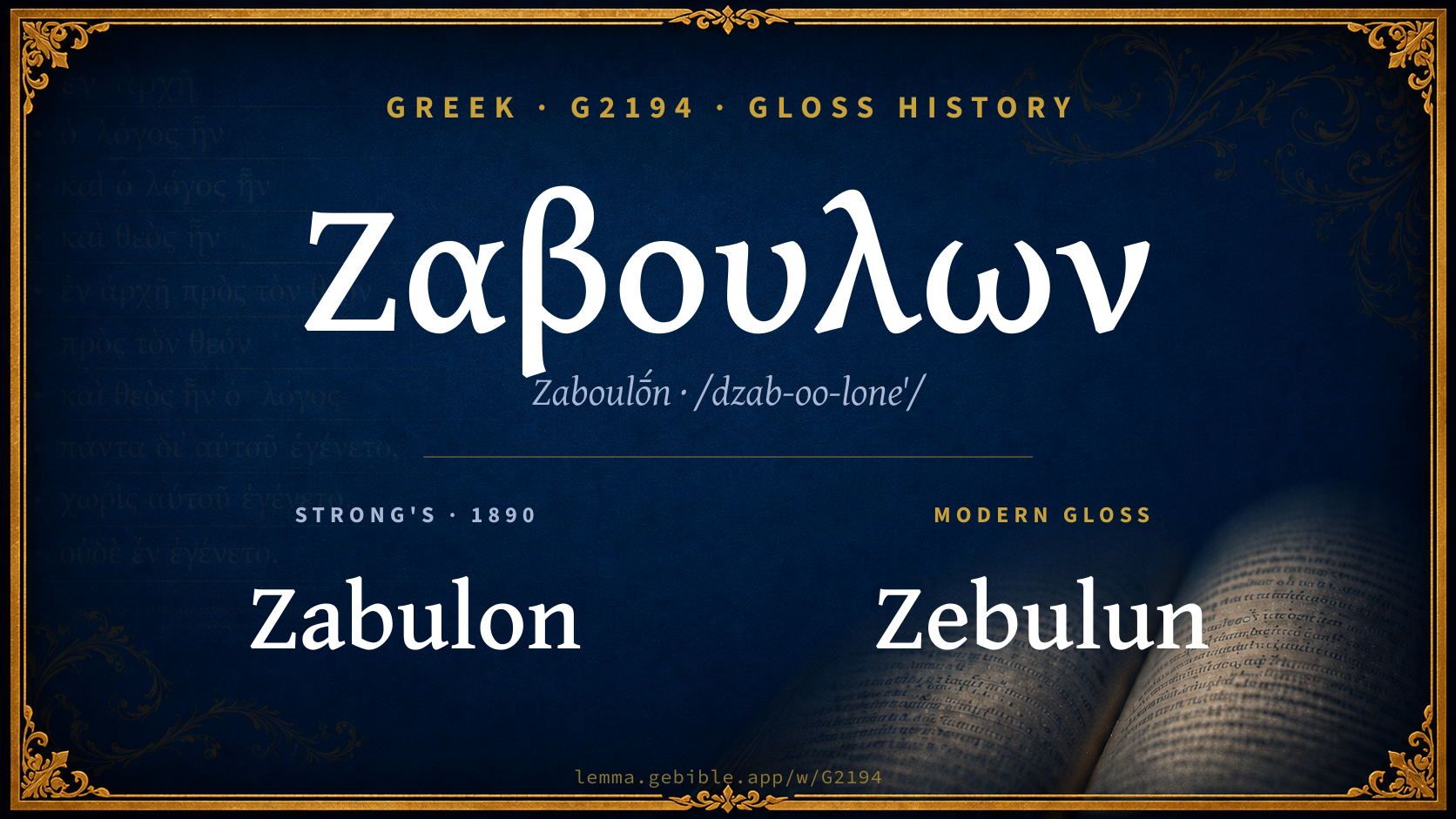
Gloss history
Strong's 1890 vs modern scholarship
About this word
Strong's G2194 catalogs a Greek word from the Greek New Testament.
These counts are not copied from any lexicon or concordance. They are computed here, from the morphology-tagged Greek New Testament. What Lemma adds →
- 3
- distinct verses
- The word appears in 3 distinct verses.
- 2 / 27
- NT books
- The word appears in 2 of 27 New Testament books.
- #2,203
- by frequency
- Top 2500 most frequent Greek words (rank 2,203 of 5,347 Greek words by occurrence).
View all 3 occurrences in the concordance →
Most concentrated in
- Matthew 2 verses 67%
- Revelation 1 verse 33%
By section of the New Testament
By traditional corpus
Conventional, traditional groupings — biblical authorship is debated, so this is a traditional corpus grouping, not an authorship claim. Some books belong to more than one corpus (Luke is in both the Gospels and the Lukan corpus, and so on), so these shares overlap and need not total 100%. Each figure is a share of the word’s 3 distinct verses.
- Gospels 2 verses · 67%
- Johannine 1 verse · 33%
- Revelation 1 verse · 33%
How translations render this word
Counts come from each version’s own published word-to-Strong’s tagging or interlinear alignment — an approximate guide to how each version renders this word, not a word-level alignment the data otherwise carries. Because each total is that version’s own tagged count, the per-version totals vary from one another and need not match the appearance or distinct-verse counts above. These counts may also differ from a printed concordance because Lemma counts each distinctly tagged rendering and does not collapse phrase taggings into a single head-word total. This is a fixed set of word-tagged versions (KJV, ASV, BSB, ULT) and does not change with the reading translation you choose elsewhere. Each version’s license is shown beside its name below (and on Sources).
- King James Version: Zabulon 3×
- American Standard Version: Zebulun 3×
- Berean Standard Bible: Zebulun 3×
- unfoldingWord Literal Text: Zebulun 3×
King James Version Public Domain
Renders G2194 across 3 tagged occurrences — most commonly:
American Standard Version Public Domain
Renders G2194 across 3 tagged occurrences — most commonly:
Berean Standard Bible Public Domain
Renders G2194 across 3 tagged occurrences — most commonly:
unfoldingWord Literal Text CC BY-SA 4.0
Renders G2194 across 3 tagged occurrences — most commonly:
Senses in Thayer's
The 3 senses Thayer's distinguishes for this word, in lexicon order (not ranked by frequency or importance). The full entry — with sub-senses — is in the Lexicon Entry tab.
- Zebulun meaning "a habitation"
- the tenth of the sons of Jacob
- the tribe of Zebulun
Word origin
Derived from זבולון (Zᵉbûwlûwn) (H2074) — Zebulun.
Of hebrew origin [ H2074 ]; Zabulon (that is Zebulon ) a region of Palestine : - Zabulon.
— Strong’s Exhaustive Concordance (1890), public domain.
Same root — word family
Other Thayer's entries built from the same root as G2194, grouped by Strong’s listed origin. These share a root / origin per the lexicon — not necessarily a shared meaning. Each links to that word’s own entry.
Derives from
Proper names from this root
People and places named from this root — a name, not an additional meaning of the word.
Compare all same-root words → 2 of the same-root words are proper names (people or places). They share a root, not necessarily a meaning.
Bible dictionary
Public-domain dictionary articles matched to this entry by name (Zebulun). A biblical name can be shared by more than one person or place, so an article may treat several.
Easton's Bible Dictionary · M. G. Easton, 1897
Dwelling, the sixth and youngest son of Jacob and Leah (Gen. 30:20). Little is known of his personal history. He had three sons (46:14).
Smith's Bible Dictionary · William Smith, 1863
(a habitation), the tenth of the sons of Jacob, according to the order in which their births are enumerated, the sixth and last of Leah. (Genesis 30:20; 35:23; 46:14; 1 Chronicles 2:1) His birth is mentioned in (Genesis 30:19,20) Of the individual Zebulun nothing is recorded. The list of Genesis46 ascribes to him three sons, founders of the chief families of the tribe (comp.) (Numbers 26:26) at the time of the migration to Egypt. The tribe is not recorded to have taken part, for evil or good, in any of the events of the wandering or the conquest. The statement of Josephus is probably in the main correct, that it reached on the one side to the Lake of Gennesareth and on the other to Carmel and the Mediterranean. On the south it was bounded by Issachar, who lay in the great plain or valley of the Kishon; on the north it had Naphtali and Asher. Thus remote from the centre of government, Zebulun remains throughout the history with one exception, in the obscurity which envelops the whole of the northern tribes. That exception, however, is a remarkable one. The conduct of the tribe during the struggle with Sisera, when they fought with desperate valor side by side with their brethren of Naphtali, was such as to draw down the special praise of Deborah, who singles them out from cell the other tribes. (Judges 5:18)
Hitchcock's Bible Names Dictionary · Roswell D. Hitchcock, 1869
Zebulon, dwelling; habitation
Classic public-domain reference works; full attribution on Sources.
Septuagint usage
The same Greek word Ζαβουλων appears 46 times in the Greek Old Testament (Septuagint), across 44 verses in 11 books.
- 46
- LXX occurrences
- Tagged occurrences of this Greek word in the Septuagint.
- 44
- verses
- Distinct Septuagint verses containing this word.
- 11 / 39
- OT books
- The word appears in 11 of the 39 Old Testament books.
Sample Septuagint occurrences
- Genesis 30:20 ζαβουλων
- Exodus 1:3 ζαβουλων
- Numbers 1:9 ζαβουλων
- Deuteronomy 27:13 ζαβουλων
- Joshua 19:10 ζαβουλων
- Judges 1:30 ζαβουλων
- 1 Chronicles 2:1 ζαβουλων
- 2 Chronicles 30:10 ζαβουλων
- Psalms 67:28 ζαβουλων
- Isaiah 8:23 ζαβουλων
- Ezekiel 48:26 ζαβουλων
Septuagint occurrences (same lexeme)
Every verse where the same Strong’s number (G2194) appears in the Greek Septuagint. Verse text shown in the World English Bible for context; the Greek form is the matched word — the English is not keyword-highlighted.
- Genesis 30:20 ζαβουλων Leah said, "God has endowed me with a good dowry. Now my husband will live with me, because I have borne him six sons." She named him Zebulun.
- Genesis 35:23 ζαβουλων The sons of Leah: Reuben (Jacob's firstborn), Simeon, Levi, Judah, Issachar, and Zebulun.
- Genesis 46:14 ζαβουλων The sons of Zebulun: Sered, Elon, and Jahleel.
- Genesis 49:13 ζαβουλων "Zebulun will dwell at the haven of the sea. He will be for a haven of ships. His border will be on Sidon.
- Exodus 1:3 ζαβουλων Issachar, Zebulun, and Benjamin,
- Numbers 1:9 ζαβουλων Of Zebulun: Eliab the son of Helon.
- Numbers 1:28 ζαβουλων Of the children of Issachar, their generations, by their families, by their fathers' houses, according to the number of the names, from twenty years old and upward, all who were able to go out to war;
- Numbers 1:29 ζαβουλων those who were numbered of them, of the tribe of Issachar, were fifty-four thousand four hundred.
- Numbers 2:7 ζαβουλων The tribe of Zebulun: and the prince of the children of Zebulun shall be Eliab the son of Helon.
- Numbers 7:24 ζαβουλων On the third day Eliab the son of Helon, prince of the children of Zebulun
- Numbers 10:16 ζαβουλων Over the host of the tribe of the children of Zebulun was Eliab the son of Helon.
- Numbers 13:10 ζαβουλων Of the tribe of Zebulun, Gaddiel the son of Sodi.
- Numbers 26:22 ζαβουλων These are the families of Judah according to those who were numbered of them, seventy-six thousand five hundred.
- Numbers 26:23 ζαβουλων The sons of Issachar after their families: [of] Tola, the family of the Tolaites; of Puvah, the family of the Punites;
- Numbers 34:25 ζαβουλων Of the tribe of the children of Zebulun a prince, Elizaphan the son of Parnach.
- Deuteronomy 27:13 ζαβουλων These shall stand on Mount Ebal for the curse: Reuben, Gad, and Asher, and Zebulun, Dan, and Naphtali.
- Deuteronomy 33:18 ζαβουλων Of Zebulun he said, Rejoice, Zebulun, in your going out; Issachar, in your tents.
- Joshua 19:10 ζαβουλων The third lot came up for the children of Zebulun according to their families; and the border of their inheritance was to Sarid;
- Joshua 19:16 ζαβουλων This is the inheritance of the children of Zebulun according to their families, these cities with their villages.
- Joshua 19:27 ζαβουλων and it turned toward the sunrise to Beth Dagon, and reached to Zebulun, and to the valley of Iphtah El northward to Beth Emek and Neiel; and it went out to Cabul on the left hand,
- Joshua 19:34 ζαβουλων and the border turned westward to Aznoth Tabor, and went out from there to Hukkok; and it reached to Zebulun on the south, and reached to Asher on the west, and to Judah at the Jordan toward the sunrise.
- Joshua 21:7 ζαβουλων The children of Merari according to their families had out of the tribe of Reuben, and out of the tribe of Gad, and out of the tribe of Zebulun, twelve cities.
- Joshua 21:34 ζαβουλων To the families of the children of Merari, the rest of the Levites, out of the tribe of Zebulun, Jokneam with its suburbs, and Kartah with its suburbs,
- Judges 1:30 ζαβουλων Zebulun didn't drive out the inhabitants of Kitron, nor the inhabitants of Nahalol; but the Canaanites lived among them, and became subject to forced labor.
- Judges 4:6 ζαβουλων She sent and called Barak the son of Abinoam out of Kedesh-naphtali, and said to him, Hasn't Yahweh, the God of Israel, commanded, [saying], Go and draw to Mount Tabor, and take with you ten thousand men of the children of Naphtali and of the children of Zebulun?
- Judges 4:10 ζαβουλων Barak called Zebulun and Naphtali together to Kedesh; and there went up ten thousand men at his feet: and Deborah went up with him.
- Judges 5:14 ζαβουλων Out of Ephraim [came down] they whose root is in Amalek; After you, Benjamin, among your peoples; Out of Machir came down governors, Out of Zebulun those who handle the marshal's staff.
- Judges 5:18 ζαβουλων Zebulun was a people that jeopardized their lives to the death, Naphtali, on the high places of the field.
- Judges 6:35 ζαβουλων He sent messengers throughout all Manasseh; and they also were gathered together after him: and he sent messengers to Asher, and to Zebulun, and to Naphtali; and they came up to meet them.
- Judges 12:12 ζαβουλων Elon the Zebulunite died, and was buried in Aijalon in the land of Zebulun.
- 1 Chronicles 2:1 ζαβουλων These are the sons of Israel: Reuben, Simeon, Levi, and Judah, Issachar, and Zebulun,
- 1 Chronicles 6:48 ζαβουλων Their brothers the Levites were appointed for all the service of the tent of the house of God.
- 1 Chronicles 6:62 ζαβουλων To the sons of Gershom, according to their families, out of the tribe of Issachar, and out of the tribe of Asher, and out of the tribe of Naphtali, and out of the tribe of Manasseh in Bashan, thirteen cities.
- 1 Chronicles 12:34 ζαβουλων Of Naphtali one thousand captains, and with them with shield and spear thirty-seven thousand.
- 1 Chronicles 12:41 ζαβουλων
- 1 Chronicles 27:19 ζαβουλων of Zebulun, Ishmaiah the son of Obadiah: of Naphtali, Jeremoth the son of Azriel:
- 2 Chronicles 30:10 ζαβουλων So the posts passed from city to city through the country of Ephraim and Manasseh, even to Zebulun: but they ridiculed them, and mocked them.
- 2 Chronicles 30:11 ζαβουλων Nevertheless certain men of Asher and Manasseh and of Zebulun humbled themselves, and came to Jerusalem.
- 2 Chronicles 30:18 ζαβουλων For a multitude of the people, even many of Ephraim and Manasseh, Issachar and Zebulun, had not cleansed themselves, yet did they eat the Passover otherwise than it is written. For Hezekiah had prayed for them, saying, The good Yahweh pardon everyone
- Psalms 67:28 ζαβουλων
- Isaiah 8:23 ζαβουλων
- Ezekiel 48:26 ζαβουλων By the border of Issachar, from the east side to the west side, Zebulun, one [portion].
- Ezekiel 48:27 ζαβουλων By the border of Zebulun, from the east side to the west side, Gad, one [portion].
- Ezekiel 48:33 ζαβουλων At the south side four thousand and five hundred [reeds] by measure, and three gates: the gate of Simeon, one; the gate of Issachar, one; the gate of Zebulun, one.
These are occurrences of the same Greek lexeme (G2194) in the Septuagint — not a translation of any one Hebrew word. The store carries no word-level Hebrew↔Greek alignment, so no Hebrew original is asserted here. Counts come from the recovered LXX Strong's tagging — high-frequency vocabulary is well covered, while rare or late forms may be untagged — so they reflect tagged occurrences and may slightly undercount.