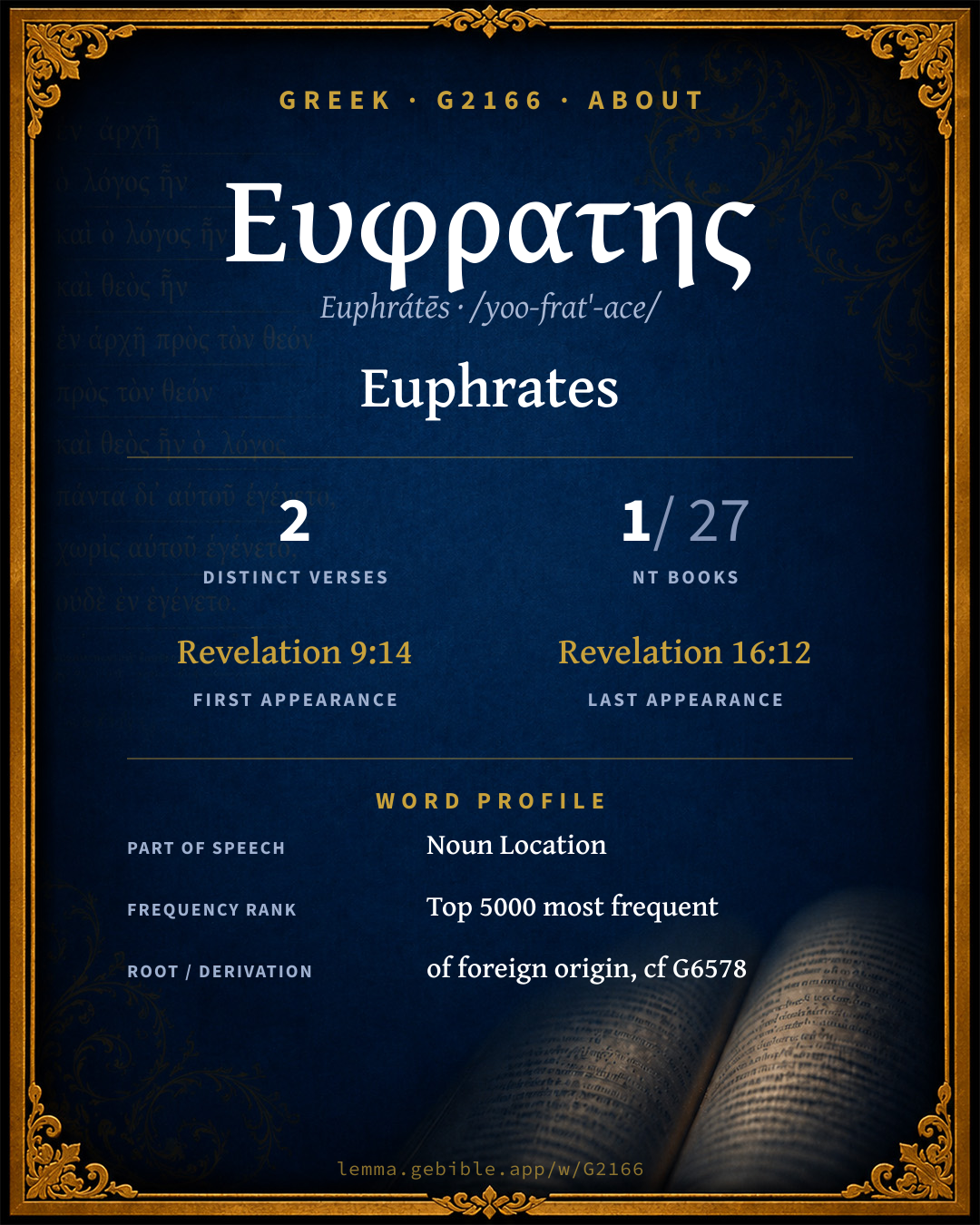
Εὐφράτης
Euphrates
Thayer's lists 2 entries for ‘Euphrates’ fuller range ↓
Full lexicon entry — Thayer's Greek Lexicon
From Thayer's Greek Lexicon
Where this word appears
See every Accusative-case word in the Greek New Testament →
Grammar key — what these labels mean
Part of speech
- Noun
- A naming word — a person, place, thing, or idea.
Case
- Accusative
- The case of the direct object and of extent.
- Dative
- The case of the indirect object, means, or location — “to / for / with / in.”
Gender
- Masculine
- Grammatically masculine.
Number
- Singular
- One.
Grammatical forms
- Noun, Accusative, Singular, Masculine 1 time (50%)
- Noun, Dative, Singular, Masculine 1 time (50%)
Parsed forms decoded from the imported morphology (Robinson–Tischendorf, public domain), counted across 2 parsed occurrences — not distinct verses.
Every verse where G2166 appears — 2 distinct verses across 1 book. Click any verse to open its interlinear word-by-word view. Verse text shown in the World English Bible for context — . Each verse’s Greek form is shown with its reference; the English is not keyword-highlighted, since the data carries no word-level English alignment. Use “Compare translations” on any verse to read it across multiple English versions. This concordance covers the Greek New Testament; Septuagint (Greek Old Testament) occurrences of this word are not indexed here.
Revelation 2 verses
- Revelation 9:14 Εὐφράτῃ n dat sg masc saying to the sixth angel who had one trumpet, "Free the four angels who are bound at the great river Euphrates!"
- Revelation 16:12 Εὐφράτην n acc sg masc The sixth poured out his bowl on the great river, the Euphrates. Its water was dried up, that the way might be made ready for the kings that come from the sunrise.
About this entry
At a glance — auto-summarized from this page’s data, not written by a person. Every figure links to its source below. This summary describes the numbers; it doesn’t interpret them.
At its core, Ευφρατης (Euphrátēs) means “Euphrates.” With only 2 verses it sits in the long tail of Greek New Testament vocabulary. The word gravitates to Revelation (100%). It first appears in Revelation 9:14. Each statement above links to its evidence; the full detail follows below.
Gloss history
Strong's 1890 vs modern scholarship
About this word
Strong's G2166 catalogs a Greek word from the Greek New Testament.
These counts are not copied from any lexicon or concordance. They are computed here, from the morphology-tagged Greek New Testament. What Lemma adds →
- 2
- distinct verses
- The word appears in 2 distinct verses.
- 1 / 27
- NT books
- The word appears in 1 of 27 New Testament books.
- #2,678
- by frequency
- Top 5000 most frequent Greek words (rank 2,678 of 5,347 Greek words by occurrence).
View all 2 occurrences in the concordance →
Most concentrated in
- Revelation 2 verses 100%
By section of the New Testament
By traditional corpus
Conventional, traditional groupings — biblical authorship is debated, so this is a traditional corpus grouping, not an authorship claim. Some books belong to more than one corpus (Luke is in both the Gospels and the Lukan corpus, and so on), so these shares overlap and need not total 100%. Each figure is a share of the word’s 2 distinct verses.
- Johannine 2 verses · 100%
- Revelation 2 verses · 100%
How translations render this word
Counts come from each version’s own published word-to-Strong’s tagging or interlinear alignment — an approximate guide to how each version renders this word, not a word-level alignment the data otherwise carries. Because each total is that version’s own tagged count, the per-version totals vary from one another and need not match the appearance or distinct-verse counts above. These counts may also differ from a printed concordance because Lemma counts each distinctly tagged rendering and does not collapse phrase taggings into a single head-word total. This is a fixed set of word-tagged versions (KJV, ASV, BSB, ULT) and does not change with the reading translation you choose elsewhere. Each version’s license is shown beside its name below (and on Sources).
- King James Version: Euphrates 2×
- American Standard Version: Euphrates 1×, River euphrates 1×
- Berean Standard Bible: Euphrates 2×
- unfoldingWord Literal Text: Euphrates 2×
King James Version Public Domain
Renders G2166 across 2 tagged occurrences — most commonly:
American Standard Version Public Domain
Renders G2166 across 2 tagged occurrences — most commonly:
Berean Standard Bible Public Domain
Renders G2166 across 2 tagged occurrences — most commonly:
unfoldingWord Literal Text CC BY-SA 4.0
Renders G2166 across 2 tagged occurrences — most commonly:
Senses in Thayer's
The 2 senses Thayer's distinguishes for this word, in lexicon order (not ranked by frequency or importance). The full entry — with sub-senses — is in the Lexicon Entry tab.
- Euphrates = "the good and abounding river"
- a large, famous river which rises in the mountains of Armenia Major, flows through Assyria, Syria, Mesopotamia and the…
Word origin
Origin: of foreign origin, cf G6578
Of foreign origin (compare [ H6578 ]); Euphrates a river of Asia : - Euphrates.
— Strong’s Exhaustive Concordance (1890), public domain.
Forms in the corpus
The 2 distinct written forms G2166 takes in the Greek New Testament, most frequent first — each parse links to that case’s occurrences in the concordance.
| Form | Parsing | Example | Uses |
|---|---|---|---|
| Εὐφράτην Euphrátēn | Noun, Accusative, Singular, Masculine | Revelation 16:12 | 1 |
| Εὐφράτῃ Euphrátē | Noun, Dative, Singular, Masculine | Revelation 9:14 | 1 |
Bible dictionary
Public-domain dictionary articles matched to this entry by name (Euphrates). A biblical name can be shared by more than one person or place, so an article may treat several.
Easton's Bible Dictionary · M. G. Easton, 1897
Hebrew, Perath; Assyrian, Purat; Persian cuneiform, Ufratush, whence Greek Euphrates, meaning "sweet water." The Assyrian name means "the stream," or "the great stream." It is generally called in the Bible simply "the river" (Ex. 23:31), or "the great river" (Deut. 1:7).
The Euphrates is first mentioned in Gen. 2:14 as one of the rivers of Paradise. It is next mentioned in connection with the covenant which God entered into with Abraham (15:18), when he promised to his descendants the land from the river of Egypt to the river Euphrates (comp. Deut. 11:24; Josh. 1:4), a covenant promise afterwards fulfilled in the extended conquests of David (2 Sam. 8:2-14; 1 Chr. 18:3; 1 Kings 4:24). It was then the boundary of the kingdom to the north-east. In the ancient history of Assyria, and Babylon, and Egypt many events are recorded in which mention is made of the "great river." Just as the Nile represented in prophecy the power of Egypt, so the Euphrates represented the Assyrian power (Isa. 8:7; Jer. 2:18).
It is by far the largest and most important of all the rivers of Western Asia. From its source in the Armenian mountains to the Persian Gulf, into which it empties itself, it has a course of about 1,700 miles. It has two sources, (1) the Frat or Kara-su (i.e., "the black river"), which rises 25 miles north-east of Erzeroum; and (2) the Muradchai (i.e., "the river of desire"), which rises near Ararat, on the northern slope of Ala-tagh. At Kebban Maden, 400 miles from the source of the former, and 270 from that of the latter, they meet and form the majestic stream, which is at length joined by the Tigris at Koornah, after which it is called Shat-el-Arab, which runs in a deep and broad stream for above 140 miles to the sea. It is estimated that the alluvium brought down by these rivers encroaches on the sea at the rate of about one mile in thirty years.
Smith's Bible Dictionary · William Smith, 1863
is probably a word of Aryan origin, signifying "the good and abounding river. " It is most frequently denoted in the Bible by the term "the river." The Euphrates is the largest, the longest and by far the most important of the rivers of western Asia. It rises from two chief sources in the Armenian mountains, and flows into the Persian Gulf. The entire course is 1780 miles, and of this distance more than two-thirds (1200 miles) is navigable for boats. The width of the river is greatest at the distance of 700 or 800 miles from its mouth--that is to say, from it junction with the Khabour to the village of Werai . It there averages 400 yards. The annual inundation of the Euphrates is caused by the melting of the snows in the Armenian highlands. It occurs in the month of May. The great hydraulic works ascribed to Nebuchadnezzar had for their chief object to control the inundation. The Euphrates is first mentioned in Scripture as one of the four rivers of Eden. (Genesis 2:14) We next hear of it in the covenant made with Abraham. (Genesis 15:18) During the reigns of David and Solomon it formed the boundary of the promised land to the northeast. (11:24; Joshua 1:4) Prophetical reference to the Euphrates is found in (Jeremiah 13:4-7; 46:2-10; 51:63; Revelation 9:14; 16:12) "The Euphrates is linked with the most important events in ancient history. On its banks stood the city of Babylon; the army of Necho was defeated on its banks by Nebuchadnezzar; Cyrus the Younger and Crassus perished after crossing it; Alexander crossed it, and Trajan and Severus descended it."--Appleton's Cyc.
Hitchcock's Bible Names Dictionary · Roswell D. Hitchcock, 1869
that makes fruitful
Classic public-domain reference works; full attribution on Sources.
Septuagint usage
The same Greek word Ευφρατης appears 20 times in the Greek Old Testament (Septuagint), across 20 verses in 9 books.
- 20
- LXX occurrences
- Tagged occurrences of this Greek word in the Septuagint.
- 20
- verses
- Distinct Septuagint verses containing this word.
- 9 / 39
- OT books
- The word appears in 9 of the 39 Old Testament books.
Sample Septuagint occurrences
- Genesis 2:14 εὐφράτης
- Exodus 23:31 εὐφράτης
- Deuteronomy 1:7 εὐφράτης
- Joshua 1:4 εὐφράτης
- 2 Samuel 8:3 εὐφράτης
- 2 Kings 23:29 εὐφράτης
- 1 Chronicles 5:9 εὐφράτης
- 2 Chronicles 35:20 εὐφράτης
- Jeremiah 13:4 εὐφράτης
Septuagint occurrences (same lexeme)
Every verse where the same Strong’s number (G2166) appears in the Greek Septuagint. Verse text shown in the World English Bible for context; the Greek form is the matched word — the English is not keyword-highlighted.
- Genesis 2:14 εὐφράτης The name of the third river is Hiddekel: this is the one which flows in front of Assyria. The fourth river is the Euphrates.
- Genesis 15:18 εὐφράτης In that day Yahweh made a covenant with Abram, saying, "To your seed have I given this land, from the river of Egypt to the great river, the river Euphrates:
- Exodus 23:31 εὐφράτης I will set your border from the Red Sea even to the sea of the Philistines, and from the wilderness to the River; for I will deliver the inhabitants of the land into your hand, and you shall drive them out before you.
- Deuteronomy 1:7 εὐφράτης turn you, and take your journey, and go to the hill-country of the Amorites, and to all [the places] near thereunto, in the Arabah, in the hill-country, and in the lowland, and in the South, and by the sea-shore, the land of the Canaanites, and Lebanon, as far as the great river, the river Euphrates.
- Deuteronomy 11:24 εὐφράτης Every place whereon the sole of your foot shall tread shall be yours: from the wilderness, and Lebanon, from the river, the river Euphrates, even to the hinder sea shall be your border.
- Joshua 1:4 εὐφράτης From the wilderness, and this Lebanon, even to the great river, the river Euphrates, all the land of the Hittites, and to the great sea toward the going down of the sun, shall be your border.
- 2 Samuel 8:3 εὐφράτης David struck also Hadadezer the son of Rehob, king of Zobah, as he went to recover his dominion at the River.
- 2 Kings 23:29 εὐφράτης In his days Pharaoh Necoh king of Egypt went up against the king of Assyria to the river Euphrates: and king Josiah went against him; and [Pharaoh Necoh] killed him at Megiddo, when he had seen him.
- 2 Kings 24:7 εὐφράτης The king of Egypt didn't come again out of his land any more; for the king of Babylon had taken, from the brook of Egypt to the river Euphrates, all that pertained to the king of Egypt.
- 1 Chronicles 5:9 εὐφράτης and eastward he lived even to the entrance of the wilderness from the river Euphrates, because their cattle were multiplied in the land of Gilead.
- 1 Chronicles 18:3 εὐφράτης David struck Hadarezer king of Zobah to Hamath, as he went to establish his dominion by the river Euphrates.
- 2 Chronicles 35:20 εὐφράτης After all this, when Josiah had prepared the temple, Neco king of Egypt went up to fight against Carchemish by the Euphrates: and Josiah went out against him.
- Jeremiah 13:4 εὐφράτης Take the belt that you have bought, which is on your loins, and arise, go to the Euphrates, and hide it there in a cleft of the rock.
- Jeremiah 13:5 εὐφράτης So I went, and hid it by the Euphrates, as Yahweh commanded me.
- Jeremiah 13:6 εὐφράτης It happened after many days, that Yahweh said to me, Arise, go to the Euphrates, and take the belt from there, which I commanded you to hide there.
- Jeremiah 13:7 εὐφράτης Then I went to the Euphrates, and dug, and took the belt from the place where I had hid it; and, behold, the belt was marred, it was profitable for nothing.
- Jeremiah 26:2 εὐφράτης Thus says Yahweh: Stand in the court of Yahweh's house, and speak to all the cities of Judah, which come to worship in Yahweh's house, all the words that I command you to speak to them; don't diminish a word.
- Jeremiah 26:6 εὐφράτης then will I make this house like Shiloh, and will make this city a curse to all the nations of the earth.
- Jeremiah 26:10 εὐφράτης When the princes of Judah heard these things, they came up from the king's house to the house of Yahweh; and they sat in the entry of the new gate of Yahweh's [house].
- Jeremiah 28:63 εὐφράτης
These are occurrences of the same Greek lexeme (G2166) in the Septuagint — not a translation of any one Hebrew word. The store carries no word-level Hebrew↔Greek alignment, so no Hebrew original is asserted here. Counts come from the recovered LXX Strong's tagging — high-frequency vocabulary is well covered, while rare or late forms may be untagged — so they reflect tagged occurrences and may slightly undercount.