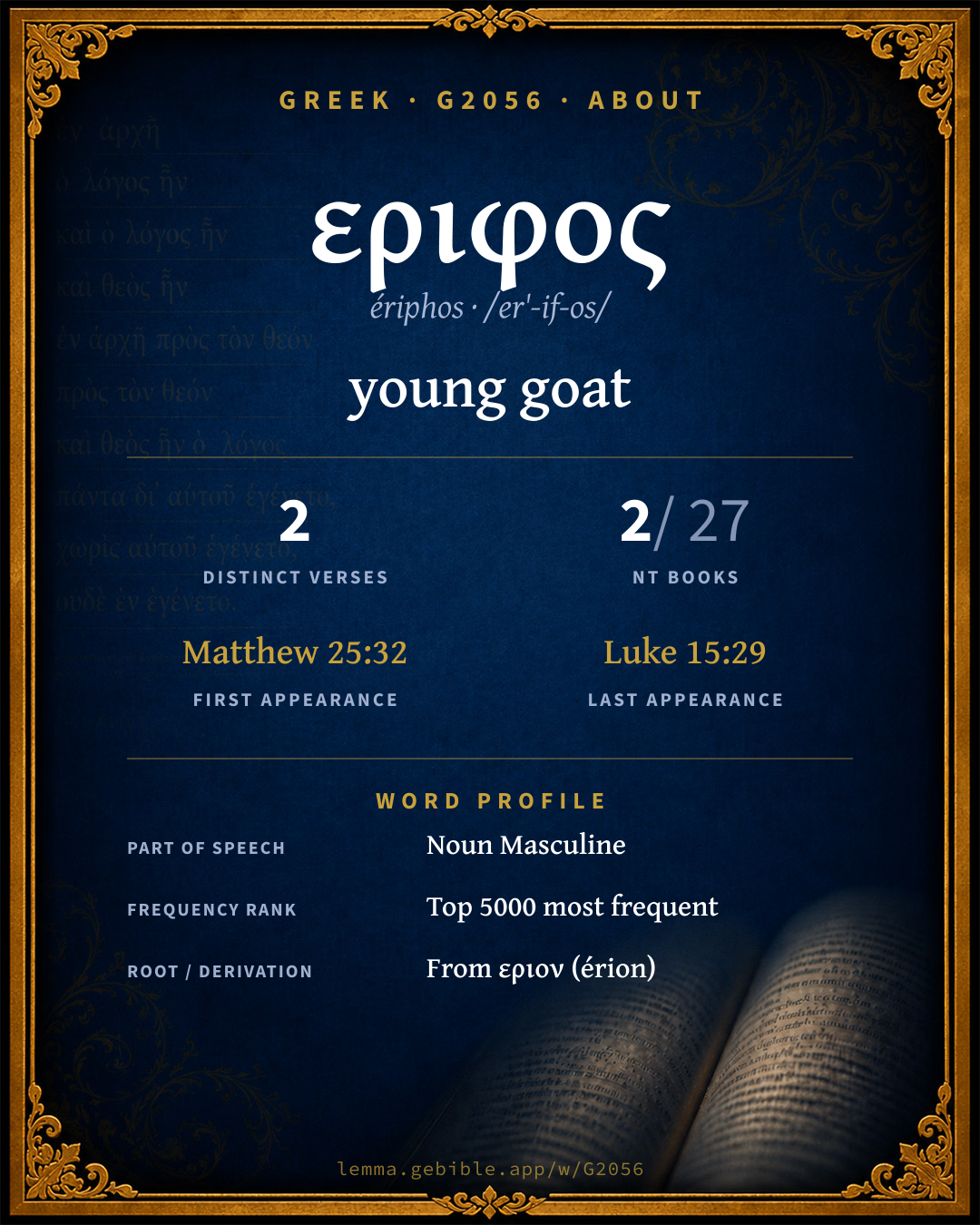
ἔριφος
young goat
Full lexicon entry — Thayer's Greek Lexicon
From Thayer's Greek Lexicon
Where this word appears
Grammar key — what these labels mean
Part of speech
- Noun
- A naming word — a person, place, thing, or idea.
Case
- Accusative
- The case of the direct object and of extent.
- Genitive
- The case of source, possession, or “of” — answers “whose / from what.”
Gender
- Masculine
- Grammatically masculine.
Number
- Singular
- One.
- Plural
- More than one.
Every verse where G2056 appears in the Book of Matthew — 1 distinct verse. Click any verse to open its interlinear word-by-word view. Verse text shown in the World English Bible for context — . Each verse’s Greek form is shown with its reference; the English is not keyword-highlighted, since the data carries no word-level English alignment. Use “Compare translations” on any verse to read it across multiple English versions. This concordance covers the Greek New Testament; Septuagint (Greek Old Testament) occurrences of this word are not indexed here.
Matthew
About this entry
At a glance — auto-summarized from this page’s data, not written by a person. Every figure links to its source below. This summary describes the numbers; it doesn’t interpret them.
εριφος — transliterated ériphos — is a Greek noun carrying the sense “young goat.” The Greek New Testament uses it only 2 verses. Its uses cluster heavily in Matthew (50% of all occurrences). Its earliest occurrence is Matthew 25:32. Sharing its root, it stands alongside εριον and εριφιον. See the sense tree, 2-verse concordance, and the renderings breakdown below.
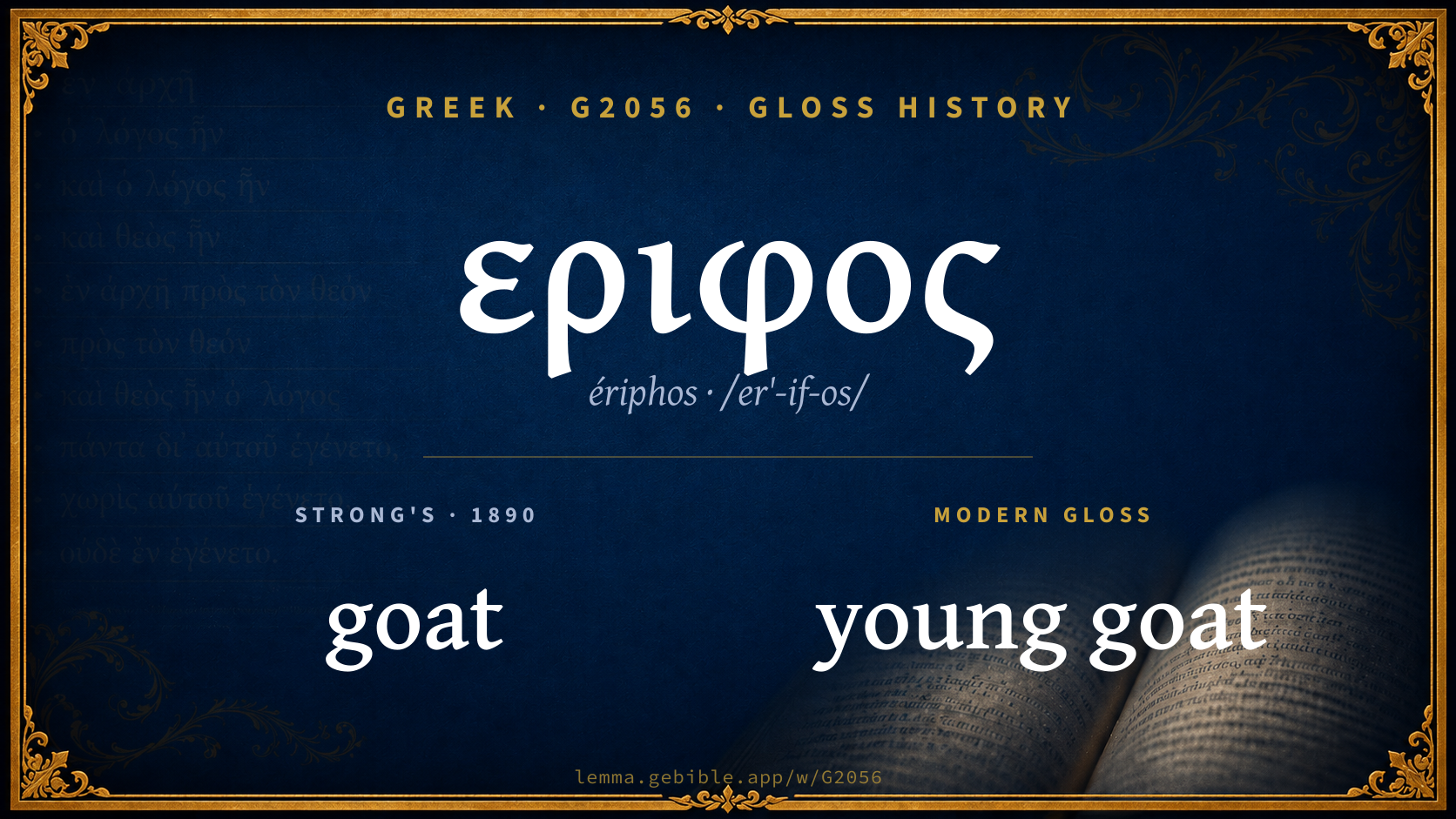
Gloss history
Strong's 1890 vs modern scholarship
About this word
Strong's G2056 catalogs a Greek word from the Greek New Testament.
These counts are not copied from any lexicon or concordance. They are computed here, from the morphology-tagged Greek New Testament. What Lemma adds →
- 2
- distinct verses
- The word appears in 2 distinct verses.
- 2 / 27
- NT books
- The word appears in 2 of 27 New Testament books.
- #2,678
- by frequency
- Top 5000 most frequent Greek words (rank 2,678 of 5,347 Greek words by occurrence).
View all 2 occurrences in the concordance →
By traditional corpus
Conventional, traditional groupings — biblical authorship is debated, so this is a traditional corpus grouping, not an authorship claim. Some books belong to more than one corpus (Luke is in both the Gospels and the Lukan corpus, and so on), so these shares overlap and need not total 100%. Each figure is a share of the word’s 2 distinct verses.
- Gospels 2 verses · 100%
- Lukan (Luke–Acts) 1 verse · 50%
How translations render this word
Counts come from each version’s own published word-to-Strong’s tagging or interlinear alignment — an approximate guide to how each version renders this word, not a word-level alignment the data otherwise carries. Because each total is that version’s own tagged count, the per-version totals vary from one another and need not match the appearance or distinct-verse counts above. These counts may also differ from a printed concordance because Lemma counts each distinctly tagged rendering and does not collapse phrase taggings into a single head-word total. This is a fixed set of word-tagged versions (KJV, ASV, BSB, ULT) and does not change with the reading translation you choose elsewhere. Each version’s license is shown beside its name below (and on Sources).
- King James Version: Goats 1×, Kid 1×
- American Standard Version: Goats 1×, Kid 1×
- Berean Standard Bible: Goats 1×, Young goat 1×
- unfoldingWord Literal Text: Goats 1×, Young goat 1×
King James Version Public Domain
Renders G2056 across 2 tagged occurrences — most commonly:
American Standard Version Public Domain
Renders G2056 across 2 tagged occurrences — most commonly:
Berean Standard Bible Public Domain
Renders G2056 across 2 tagged occurrences — most commonly:
unfoldingWord Literal Text CC BY-SA 4.0
Renders G2056 across 2 tagged occurrences — most commonly:
Senses in Thayer's
The 1 sense Thayer's distinguishes for this word, in lexicon order (not ranked by frequency or importance). The full entry — with sub-senses — is in the Lexicon Entry tab.
- a kid, a young goat
Word origin
Derived from εριον (érion) (G2053) — wool.
Perhaps from the same as G2053 (through the idea of hairiness ); a kid or (generally) goat : - goat kid.
— Strong’s Exhaustive Concordance (1890), public domain.
Forms in the corpus
The 2 distinct written forms G2056 takes in the Greek New Testament, most frequent first — each parse links to that case’s occurrences in the concordance.
| Form | Parsing | Example | Uses |
|---|---|---|---|
| ἐρίφων eríphōn | Noun, Genitive, Plural, Masculine | Matthew 25:32 | 1 |
| ἔριφον ériphon | Noun, Accusative, Singular, Masculine | Luke 15:29 | 1 |
Same root — word family
Other Thayer's entries built from the same root as G2056, grouped by Strong’s listed origin. These share a root / origin per the lexicon — not necessarily a shared meaning. Each links to that word’s own entry.
Derives from
Derived from this word
Compare all same-root words → They share a root, not necessarily a meaning.
Septuagint usage
The same Greek word εριφος appears 23 times in the Greek Old Testament (Septuagint), across 23 verses in 11 books.
- 23
- LXX occurrences
- Tagged occurrences of this Greek word in the Septuagint.
- 23
- verses
- Distinct Septuagint verses containing this word.
- 11 / 39
- OT books
- The word appears in 11 of the 39 Old Testament books.
Sample Septuagint occurrences
- Genesis 27:9 ἔριφος
- Exodus 12:5 ἔριφος
- Leviticus 1:10 ἔριφος
- Judges 6:19 ἔριφος
- 1 Samuel 16:20 ἔριφος
- 2 Chronicles 35:7 ἔριφος
- Song of Solomon 1:8 ἔριφος
- Isaiah 11:6 ἔριφος
- Jeremiah 28:40 ἔριφος
- Ezekiel 43:22 ἔριφος
- Amos 6:4 ἔριφος
Septuagint occurrences (same lexeme)
Every verse where the same Strong’s number (G2056) appears in the Greek Septuagint. Verse text shown in the World English Bible for context; the Greek form is the matched word — the English is not keyword-highlighted.
- Genesis 27:9 ἔριφος Go now to the flock, and get me from there two good kids of the goats. I will make them savory food for your father, such as he loves.
- Genesis 27:16 ἔριφος She put the skins of the kids of the goats on his hands, and on the smooth of his neck.
- Genesis 37:31 ἔριφος They took Joseph's coat, and killed a male goat, and dipped the coat in the blood.
- Genesis 38:17 ἔριφος He said, "I will send you a kid of the goats from the flock." She said, "Will you give me a pledge, until you send it?"
- Genesis 38:20 ἔριφος Judah sent the kid of the goats by the hand of his friend, the Adullamite, to receive the pledge from the woman's hand, but he didn't find her.
- Genesis 38:23 ἔριφος Judah said, "Let her keep it, lest we be shamed. Behold, I sent this kid, and you haven't found her."
- Exodus 12:5 ἔριφος Your lamb shall be without blemish, a male a year old. You shall take it from the sheep, or from the goats:
- Leviticus 1:10 ἔριφος "'If his offering is from the flock, from the sheep, or from the goats, for a burnt offering, he shall offer a male without blemish.
- Judges 6:19 ἔριφος Gideon went in, and made ready a kid, and unleavened cakes of an ephah of meal: the flesh he put in a basket, and he put the broth in a pot, and brought it out to him under the oak, and presented it.
- Judges 13:15 ἔριφος Manoah said to the angel of Yahweh, I pray you, let us detain you, that we may make ready a kid for you.
- Judges 13:19 ἔριφος So Manoah took the kid with the meal-offering, and offered it on the rock to Yahweh: and [the angel] did wondrously, and Manoah and his wife looked on.
- Judges 14:6 ἔριφος The Spirit of Yahweh came mightily on him, and he tore him as he would have torn a kid; and he had nothing in his hand: but he didn't tell his father or his mother what he had done.
- Judges 15:1 ἔριφος But it happened after a while, in the time of wheat harvest, that Samson visited his wife with a kid; and he said, I will go in to my wife into the chamber. But her father wouldn't allow him to go in.
- 1 Samuel 16:20 ἔριφος Jesse took a donkey loaded with bread, and a bottle of wine, and a kid, and sent them by David his son to Saul.
- 2 Chronicles 35:7 ἔριφος Josiah gave to the children of the people, of the flock, lambs and kids, all of them for the Passover offerings, to all who were present, to the number of thirty thousand, and three thousand bulls: these were of the king's substance.
- 2 Chronicles 35:8 ἔριφος His princes gave for a freewill-offering to the people, to the priests, and to the Levites. Hilkiah and Zechariah and Jehiel, the rulers of the house of God, gave to the priests for the Passover offerings two thousand and six hundred [small cattle], and three hundred oxen.
- Song of Solomon 1:8 ἔριφος If you don't know, most beautiful among women, Follow the tracks of the sheep. Graze your young goats beside the shepherds' tents.
- Isaiah 11:6 ἔριφος The wolf shall dwell with the lamb, and the leopard shall lie down with the kid; and the calf and the young lion and the fattened calf together; and a little child shall lead them.
- Jeremiah 28:40 ἔριφος
- Ezekiel 43:22 ἔριφος On the second day you shall offer a male goat without blemish for a sin-offering; and they shall cleanse the altar, as they did cleanse it with the bull.
- Ezekiel 43:25 ἔριφος Seven days shall you prepare every day a goat for a sin-offering: they shall also prepare a young bull, and a ram out of the flock, without blemish.
- Ezekiel 45:23 ἔριφος The seven days of the feast he shall prepare a burnt offering to Yahweh, seven bulls and seven rams without blemish daily the seven days; and a male goat daily for a sin-offering.
- Amos 6:4 ἔριφος Who lie on beds of ivory, And stretch themselves on their couches, And eat the lambs out of the flock, And the calves out of the midst of the stall;
These are occurrences of the same Greek lexeme (G2056) in the Septuagint — not a translation of any one Hebrew word. The store carries no word-level Hebrew↔Greek alignment, so no Hebrew original is asserted here. Counts come from the recovered LXX Strong's tagging — high-frequency vocabulary is well covered, while rare or late forms may be untagged — so they reflect tagged occurrences and may slightly undercount.