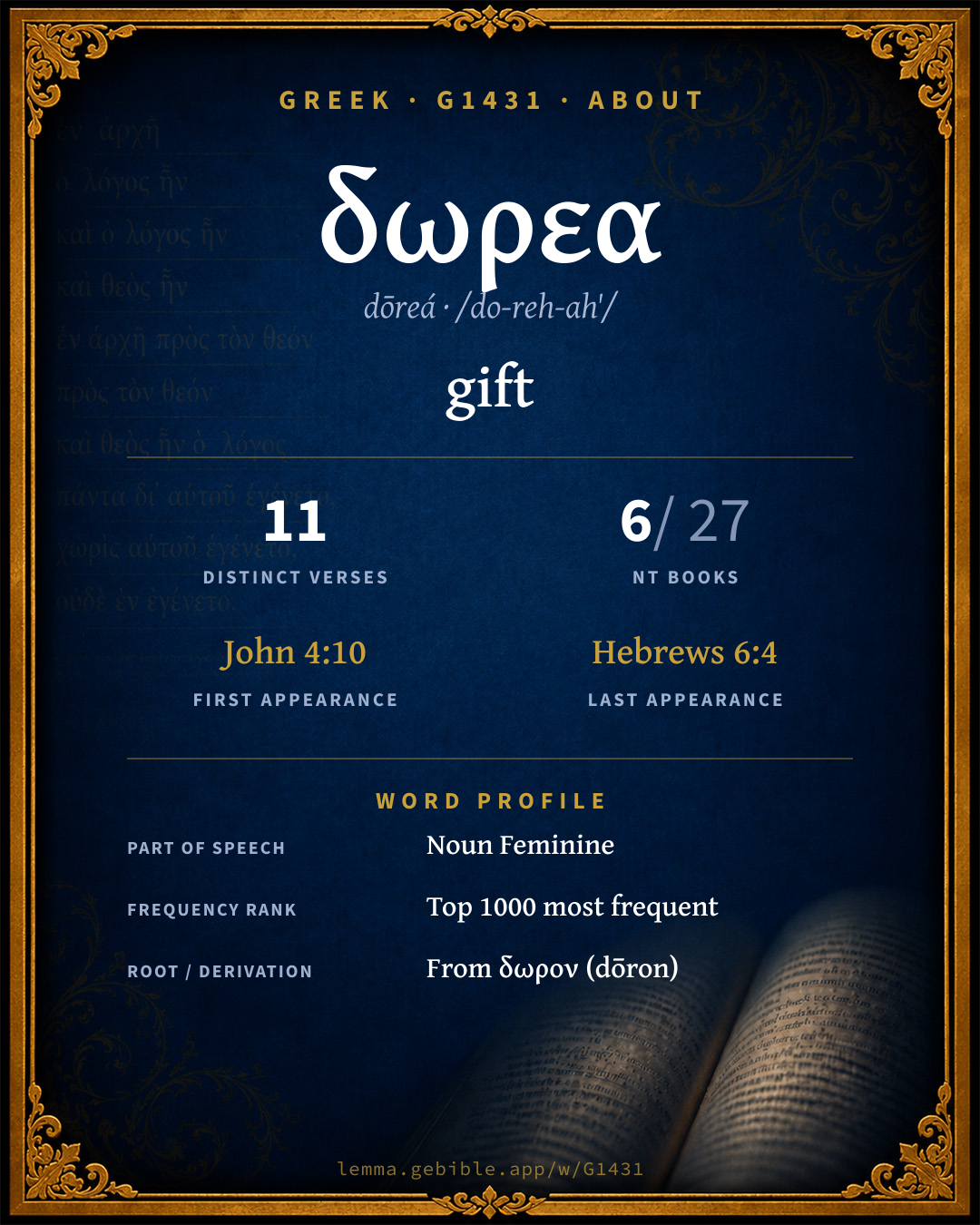
δωρεά
gift
Full lexicon entry — Thayer's Greek Lexicon
From Thayer's Greek Lexicon
Where this word appears
See every Genitive-case word in the Greek New Testament →
Grammar key — what these labels mean
Part of speech
- Noun
- A naming word — a person, place, thing, or idea.
Case
- Accusative
- The case of the direct object and of extent.
- Genitive
- The case of source, possession, or “of” — answers “whose / from what.”
- Nominative
- The case of the subject (and the predicate nominative).
- Dative
- The case of the indirect object, means, or location — “to / for / with / in.”
Gender
- Feminine
- Grammatically feminine.
Number
- Singular
- One.
1 verse where G1431 appears in the Nominative case in the Book of Romans. Filtered view — show all forms. Click any verse to open its interlinear word-by-word view. Verse text shown in the World English Bible for context — . Each verse’s Greek form is shown with its reference; the English is not keyword-highlighted, since the data carries no word-level English alignment. Use “Compare translations” on any verse to read it across multiple English versions. This concordance covers the Greek New Testament; Septuagint (Greek Old Testament) occurrences of this word are not indexed here.
Romans
About this entry
At a glance — auto-summarized from this page’s data, not written by a person. Every figure links to its source below. This summary describes the numbers; it doesn’t interpret them.
δωρεα (dōreá) is a Greek noun most often rendered “gift.” It first appears in John 4:10. With 11 verses in 6 books, it is an uncommon word in the Greek New Testament. It concentrates in Acts, which alone accounts for 36% of its uses. It clusters with δωρον, δωρεομαι and δωρεαν under a shared root. For the data behind this summary, explore the sense tree and the renderings breakdown below.
Gloss history
Strong's 1890 vs modern scholarship
About this word
Strong's G1431 catalogs a Greek word from the Greek New Testament.
These counts are not copied from any lexicon or concordance. They are computed here, from the morphology-tagged Greek New Testament. What Lemma adds →
- 11
- distinct verses
- The word appears in 11 distinct verses.
- 6 / 27
- NT books
- The word appears in 6 of 27 New Testament books.
- #978
- by frequency
- Top 1000 most frequent Greek words (rank 978 of 5,347 Greek words by occurrence).
View all 11 occurrences in the concordance →
By section of the New Testament
By traditional corpus
Conventional, traditional groupings — biblical authorship is debated, so this is a traditional corpus grouping, not an authorship claim. Some books belong to more than one corpus (Luke is in both the Gospels and the Lukan corpus, and so on), so these shares overlap and need not total 100%. Each figure is a share of the word’s 11 distinct verses.
- Pauline corpus 5 verses · 45%
- Lukan (Luke–Acts) 4 verses · 36%
- Gospels 1 verse · 9%
- Johannine 1 verse · 9%
- Hebrews 1 verse · 9%
How translations render this word
Counts come from each version’s own published word-to-Strong’s tagging or interlinear alignment — an approximate guide to how each version renders this word, not a word-level alignment the data otherwise carries. Because each total is that version’s own tagged count, the per-version totals vary from one another and need not match the appearance or distinct-verse counts above. These counts may also differ from a printed concordance because Lemma counts each distinctly tagged rendering and does not collapse phrase taggings into a single head-word total. This is a fixed set of word-tagged versions (KJV, ASV, BSB, ULT) and does not change with the reading translation you choose elsewhere. Each version’s license is shown beside its name below (and on Sources).
- King James Version: Gift 11×
- American Standard Version: Gift 11×
- Berean Standard Bible: Gift 11×
- unfoldingWord Literal Text: Gift 11×
King James Version Public Domain
Renders G1431 across 11 tagged occurrences — most commonly:
American Standard Version Public Domain
Renders G1431 across 12 tagged occurrences — most commonly:
Plus 1 rendering that appears only once — usually multi-word phrases or single function words the recovered tagging swept in, not distinct renderings.
Berean Standard Bible Public Domain
Renders G1431 across 11 tagged occurrences — most commonly:
unfoldingWord Literal Text CC BY-SA 4.0
Renders G1431 across 12 tagged occurrences — most commonly:
Plus 1 rendering that appears only once — usually multi-word phrases or single function words the recovered tagging swept in, not distinct renderings.
Senses in Thayer's
The 1 sense Thayer's distinguishes for this word, in lexicon order (not ranked by frequency or importance). The full entry — with sub-senses — is in the Lexicon Entry tab.
- a gift
Word origin
Derived from δωρον (dōron) (G1435) — offering.
From G1435 ; a gratuity : - gift.
— Strong’s Exhaustive Concordance (1890), public domain.
Forms in the corpus
The 4 distinct written forms G1431 takes in the Greek New Testament, most frequent first — each parse links to that case’s occurrences in the concordance.
| Form | Parsing | Example | Uses |
|---|---|---|---|
| δωρεὰν dōreàn | Noun, Accusative, Singular, Feminine | John 4:10 | 5 |
| δωρεᾶς dōreâs | Noun, Genitive, Singular, Feminine | Romans 5:17 | 3 |
| δωρεὰ dōreà | Noun, Nominative, Singular, Feminine | Acts 10:45 | 2 |
| δωρεᾷ dōreâ | Noun, Dative, Singular, Feminine | 2 Corinthians 9:15 | 1 |
Same root — word family
Other Thayer's entries built from the same root as G1431, grouped by Strong’s listed origin. These share a root / origin per the lexicon — not necessarily a shared meaning. Each links to that word’s own entry.
Derives from
Shares the same root
Derived from this word
Compare all same-root words → They share a root, not necessarily a meaning.
Septuagint usage
The same Greek word δωρεα appears 23 times in the Greek Old Testament (Septuagint), across 23 verses in 14 books.
- 23
- LXX occurrences
- Tagged occurrences of this Greek word in the Septuagint.
- 23
- verses
- Distinct Septuagint verses containing this word.
- 14 / 39
- OT books
- The word appears in 14 of the 39 Old Testament books.
Sample Septuagint occurrences
- Genesis 29:15 δωρεά
- Exodus 21:2 δωρεά
- Numbers 11:5 δωρεά
- 1 Samuel 19:5 δωρεά
- 2 Samuel 24:24 δωρεά
- 1 Kings 2:31 δωρεά
- 1 Chronicles 21:24 δωρεά
- Job 1:9 δωρεά
- Psalms 34:7 δωρεά
- Isaiah 52:3 δωρεά
- Jeremiah 22:13 δωρεά
- Lamentations 3:52 δωρεά
Septuagint occurrences (same lexeme)
Every verse where the same Strong’s number (G1431) appears in the Greek Septuagint. Verse text shown in the World English Bible for context; the Greek form is the matched word — the English is not keyword-highlighted.
- Genesis 29:15 δωρεά Laban said to Jacob, "Because you are my brother, should you therefore serve me for nothing? Tell me, what will your wages be?"
- Exodus 21:2 δωρεά If you buy a Hebrew servant, he shall serve six years and in the seventh he shall go out free without paying anything.
- Exodus 21:11 δωρεά If he doesn't do these three things for her, she may go free without paying any money.
- Numbers 11:5 δωρεά We remember the fish, which we ate in Egypt for nothing; the cucumbers, and the melons, and the leeks, and the onions, and the garlic:
- 1 Samuel 19:5 δωρεά for he put his life in his hand, and struck the Philistine, and Yahweh worked a great victory for all Israel: you saw it, and did rejoice; why then will you sin against innocent blood, to kill David without a cause?
- 1 Samuel 25:31 δωρεά that this shall be no grief to you, nor offense of heart to my lord, either that you have shed blood without cause, or that my lord has avenged himself. When Yahweh shall have dealt well with my lord, then remember your handmaid.
- 2 Samuel 24:24 δωρεά The king said to Araunah, No; but I will most assuredly buy it of you at a price. Neither will I offer burnt-offerings to Yahweh my God which cost me nothing. So David bought the threshing floor and the oxen for fifty shekels of silver.
- 1 Kings 2:31 δωρεά The king said to him, Do as he has said, and fall on him, and bury him; that you may take away the blood, which Joab shed without cause, from me and from my father's house.
- 1 Chronicles 21:24 δωρεά King David said to Ornan, No; but I will most assuredly buy it for the full price: for I will not take that which is your for Yahweh, nor offer a burnt-offering without cost.
- Job 1:9 δωρεά Then Satan answered Yahweh, and said, "Does Job fear God for nothing?
- Psalms 34:7 δωρεά The angel of Yahweh encamps round about those who fear him, And delivers them.
- Psalms 34:19 δωρεά Many are the afflictions of the righteous, But Yahweh delivers him out of them all.
- Psalms 68:5 δωρεά A father of the fatherless, and a defender of the widows, Is God in his holy habitation.
- Psalms 108:3 δωρεά I will give thanks to you, Yahweh, among the nations. I will sing praises to you among the peoples.
- Psalms 118:161 δωρεά
- Psalms 119:7 δωρεά I will give thanks to you with uprightness of heart, When I learn your righteous judgments.
- Isaiah 52:3 δωρεά For thus says Yahweh, You were sold for nothing; and you shall be redeemed without money.
- Isaiah 52:5 δωρεά Now therefore, what do I here, says Yahweh, seeing that my people is taken away for nothing? those who rule over them do howl, says Yahweh, and my name continually all the day is blasphemed.
- Jeremiah 22:13 δωρεά Woe to him who builds his house by unrighteousness, and his chambers by injustice; who uses his neighbor's service without wages, and doesn't give him his hire;
- Lamentations 3:52 δωρεά They have chased me sore like a bird, those who are my enemies without cause.
- Daniel 2:48 δωρεά Then the king made Daniel great, and gave him many great gifts, and made him to rule over the whole province of Babylon, and to be chief governor over all the wise men of Babylon.
- Daniel 11:39 δωρεά He shall deal with the strongest fortresses by the help of a foreign god: whoever acknowledges [him] he will increase with glory; and he shall cause them to rule over many, and shall divide the land for a price.
- Malachi 1:10 δωρεά "Oh that there were one among you who would shut the doors, that you might not kindle fire on my altar in vain! I have no pleasure in you," says Yahweh of hosts, "neither will I accept an offering at your hand.
These are occurrences of the same Greek lexeme (G1431) in the Septuagint — not a translation of any one Hebrew word. The store carries no word-level Hebrew↔Greek alignment, so no Hebrew original is asserted here. Counts come from the recovered LXX Strong's tagging — high-frequency vocabulary is well covered, while rare or late forms may be untagged — so they reflect tagged occurrences and may slightly undercount.