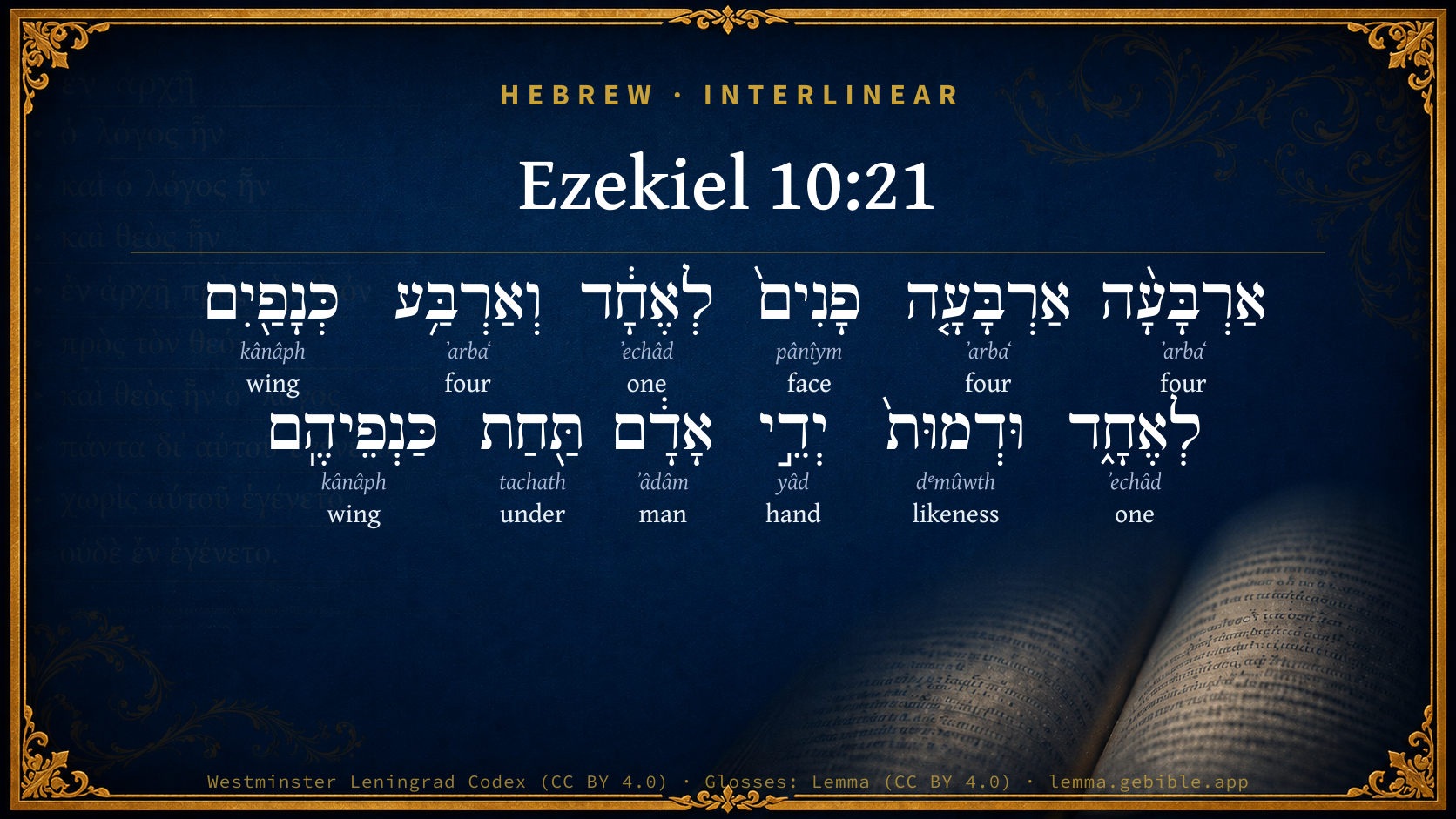
Ezekiel 10:21

Hebrew (Westminster Leningrad Codex) Ezekiel 10:21 appears in the Hebrew Old Testament. The text above is from the Westminster Leningrad Codex. Each word links to its Strong’s number, a concise gloss, and parsing drawn from the Open Scriptures Hebrew Bible morphology. Click any word for its full Brown-Driver-Briggs (BDB) entry.
Download image
Cite this verse

Ezekiel 10:21 (World English Bible). Public Domain. Lemma interlinear Bible study tool, https://lemma.gebible.app/v/ezekiel/10/21.

Show BibTeX & RIS
BibTeX
RIS
English Translation
Every one had four faces, and every one four wings; and the likeness of the hands of a man was under their wings.
World English Bible · Public Domain
Download a study sheet

One document with this verse’s original text, its word-by-word gloss line, the meaning frame, cross-references with their text, attributed commentary, and full source and license credits — printable, and it pastes into notes with its structure intact.

This verse Autodidact and up

Study sheet (.html) Plain text (.txt)

A passage Seminary Student

Up to 50 verses in one chapter. A passage sheet keeps up to 6 commentary sources and 12 cross-references per verse, in the order this page ranks them, and says so on the sheet whenever that leaves anything out. Ask for a single verse and you get the Autodidact verse sheet above.

Everything on this page stays free to read, with no account — the sheet is a download of what is already on screen, not access to it.

Want to remove ads? Support Godless Engineer
Compare translations 3

The same verse in 3 English versions, stacked beneath the original-language interlinear above. Click any original word for its lexicon entry.

Each is an independent rendering of the whole verse — the interlinear is not word-aligned to these translations.

Highlighted words mark where these versions differ — a whole-verse word diff, not a word-by-word alignment.

  • World English Bible Public Domain
    Every one had four faces, and every one four wings; and the likeness of the hands of a man was under their wings.
  • King James Version Public Domain
    Every one had four faces apiece, and every one four wings; and the likeness of the hands of a man was under their wings.
  • unfoldingWord Literal Text CC BY-SA 4.0
    They had four faces each and four wings each, and the likeness of human hands under their wings,

unfoldingWord Literal Text — © unfoldingWord, licensed CC BY-SA 4.0. Word-aligned USFM3 via Door43 (git.door43.org/unfoldingWord/en_ult).

Versions to compare (up to 4)

3 of 4 selected

Show all 18 translations

Every available English version of this verse, each an independent rendering of the whole verse.

  • World English Bible Public Domain
    Every one had four faces, and every one four wings; and the likeness of the hands of a man was under their wings.
  • Berean Standard Bible Public Domain
    Each had four faces and four wings, with what looked like human hands under their wings.
  • Majority Standard Bible Public Domain
    Each had four faces and four wings, with what looked like human hands under their wings.
  • King James Version Public Domain
    Every one had four faces apiece, and every one four wings; and the likeness of the hands of a man was under their wings.
  • American Standard Version (1901) Public Domain
    Every one had four faces, and every one four wings; and the likeness of the hands of a man was under their wings.
  • Revised Version (1885) Public Domain
    Every one had four faces apiece, and every one four wings; and the likeness of the hands of a man was under their wings.
  • Geneva Bible (1599) Public Domain
    Euery one had foure faces, and euery one foure wings, and the likenesse of mans hands was vnder their wings.
  • Douay-Rheims (1899) Public Domain
    Each one had four faces, and each one had four wings: and the likeness of a man's hand was under their wings.
  • Young's Literal Translation Public Domain
    Four faces `are' to each, and four wings to each, and the likeness of the hands of man `is' under their wings.
  • Literal Standard Version CC BY-SA 4.0
    [The] four—each had four faces, and each had four wings, and the likeness of the hands of man [is] under their wings.
  • Unlocked Literal Bible CC BY-SA 4.0
    They had four faces each and four wings each, and the likeness of human hands under their wings,
  • unfoldingWord Literal Text CC BY-SA 4.0
    They had four faces each and four wings each, and the likeness of human hands under their wings,
  • Darby Bible Public Domain
    Each one had four faces, and every one four wings; and the likeness of the hands of a man was under their wings.
  • World Messianic Bible Public Domain
    Every one had four faces, and every one four wings. The likeness of the hands of a man was under their wings.
  • Webster's Bible Public Domain
    Every one had four faces each, and every one four wings; and the likeness of the hands of a man was under their wings.
  • Free Bible Version CC BY-SA 4.0
    Each had four faces and four wings and had what looked like human hands under their wings.
  • Bible in Basic English Public Domain
    Every one had four faces and every one had four wings; and hands like a man's hands were under their wings.
  • JPS Tanakh (1917) Public Domain
    Every one had four faces apiece, and every one four wings; and the likeness of the hands of a man was under their wings.

Literal Standard Version (2020), Covenant Press — licensed CC BY-SA 4.0. Text via the HelloAO Bible API (eBible.org). Unlocked Literal Bible (unfoldingWord) — licensed CC BY-SA 4.0. Text via the HelloAO Bible API (eBible.org). unfoldingWord Literal Text — © unfoldingWord, licensed CC BY-SA 4.0. Word-aligned USFM3 via Door43 (git.door43.org/unfoldingWord/en_ult). Free Bible Version, Dr. Jonathan Gallagher — licensed CC BY-SA 4.0. Text via the HelloAO Bible API (eBible.org).

Word by word

More ways to search: Search by grammar → Find every occurrence → Compare this word →

Practice this passage: Drill this verse → Learn its vocabulary →

וּדְמוּת֙
dᵉmûwth
H1823
“and · likeness of”
Conjunction + Noun, Common, Feminine, Singular, Construct
Part of Speech
Conjunction + Noun
Type
Common
Gender
Feminine
Number
Singular
State
Construct
Full BDB Definition

Origin: from H1819

TWOT: 437a

likeness, similitude (noun feminine) - in the likeness of, like as (adverb)
  1. אַרְבָּעָ֨ה ʼarbaʻ H702 “four” Adjective, Cardinal number, Masculine, Singular, Absolute
  2. אַרְבָּעָ֤ה ʼarbaʻ H702 “four” Adjective, Cardinal number, Masculine, Singular, Absolute
  3. פָנִים֙ pânîym H6440 “face(s)” Noun, Common, Both, Plural, Absolute
  4. לְאֶחָ֔ד ʼechâd H259 “to/for · one” Preposition + Adjective, Cardinal number, Masculine, Singular, Absolute
  5. וְאַרְבַּ֥ע ʼarbaʻ H702 “and · four” Conjunction + Adjective, Cardinal number, Feminine, Singular, Absolute
  6. כְּנָפַ֖יִם kânâph H3671 “wings” Noun, Common, Feminine, Dual, Absolute
  7. לְאֶחָ֑ד ʼechâd H259 “to/for · one” Preposition + Adjective, Cardinal number, Masculine, Singular, Absolute
  8. יְדֵ֣י yâd H3027 “hands of” Noun, Common, Both, Dual, Construct
  9. אָדָ֔ם ʼâdâm H120 “man” Noun, Common, Masculine, Singular, Absolute
  10. תַּ֖חַת tachath H8478 “under” Preposition
  11. כַּנְפֵיהֶֽם kânâph H3671 “wings · their” Noun, Common, Feminine, Dual, Construct + Suffix, Personal, 3rd Person, Masculine, Plural

About this verse

These counts appear in no published source. They are computed here, from the morphology-tagged text and Lemma’s own curated glosses. What Lemma adds →

12
words
8
distinct lemmas
Prophets
section

Notable vocabulary

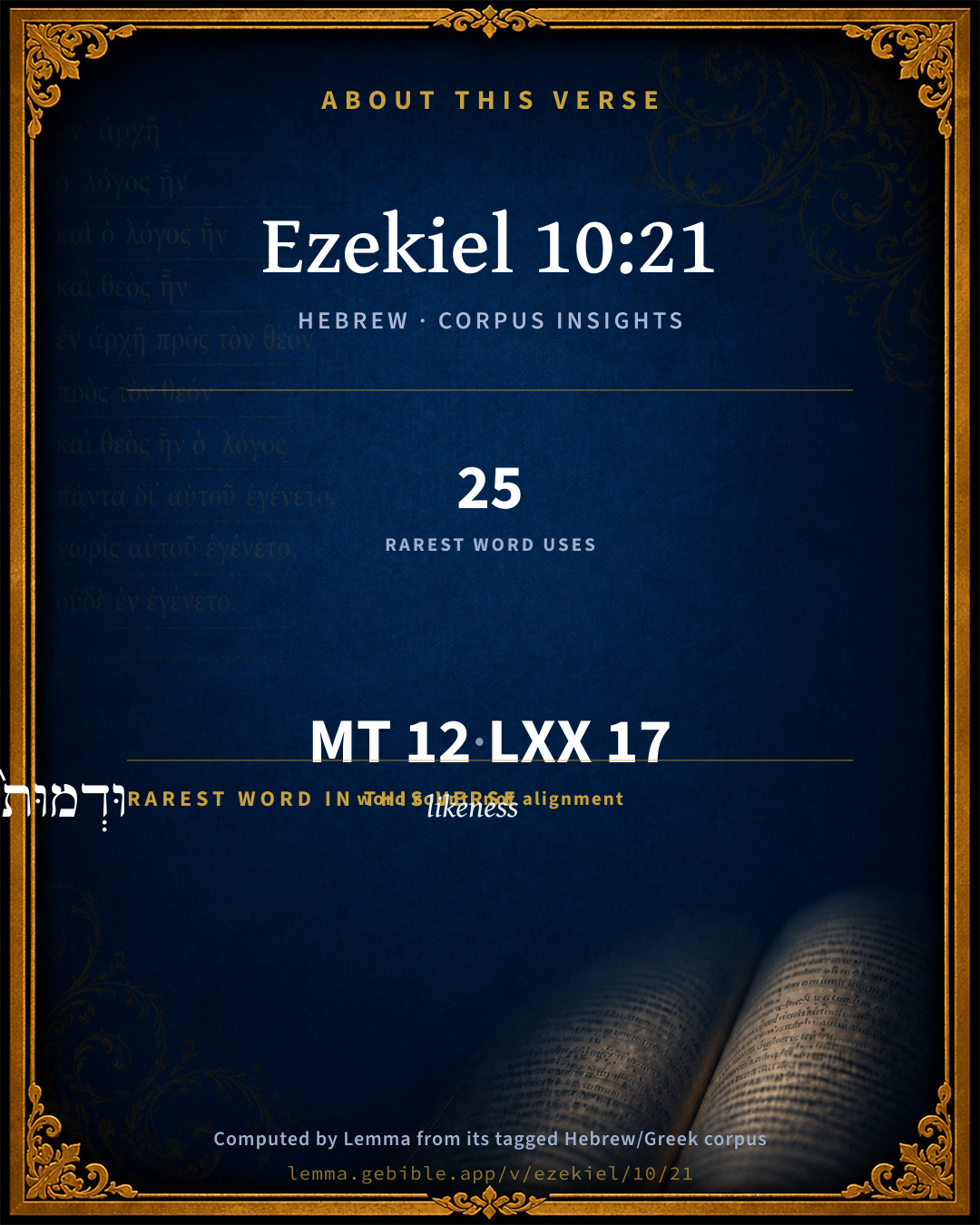
The rarest word here is וּדְמוּת֙ likeness H1823 — appearing just 25 times in the whole Hebrew Bible.

Shared distinctive vocabulary

וּדְמוּת֙ likeness H1823 occurs in 22 verses of the Hebrew Bible. Also found in:

Grammatical profile

  • 6 nouns
  • 5 adjectives
  • 1 preposition

Repetition

Words recur within this verse — often emphatic in Hebrew:

  • אַרְבָּעָ֨ה four H702 ×3
  • לְאֶחָ֔ד one H259 ×2
  • כְּנָפַ֖יִם wing H3671 ×2

Hebrew & Septuagint length

In English translation the verse runs 23 words from the Hebrew and 21 from the Septuagint (LXX English) — closely comparable.

A rough comparison of the two English renderings, which tokenize alike — not a word-level alignment.

Word counts can differ between the Hebrew and the Greek without any difference in meaning — e.g. the Hebrew direct-object marker אֵת has no separate Greek word, and Greek often adds the article ὁ.

In the original languages it is 12 Hebrew tokens and 17 Greek tokens — but the two are counted differently (Hebrew bundles its prefixes and suffixes into one token; the Greek is in lemma form), so that isn’t a like-for-like length.

Cross-references

5

Topical passages linked to Ezekiel 10:21 in the Treasury of Scripture Knowledge — connected by theme and wording, ordered by reader-vote popularity; previews shown in the World English Bible.

  • Ezekiel 1:6 Everyone had four faces, and everyone of them had four wings.
  • Ezekiel 10:14 Every one had four faces: the first face was the face of the cherub, and the second face was the face of a man, and the third face the face of a lion, and the fourth the face of an eagle.
  • Ezekiel 41:18–19 It was made with cherubim and palm trees; and a palm tree was between cherub and cherub, and every cherub had two faces;
  • Ezekiel 1:8–10 They had the hands of a man under their wings on their four sides; and they four had their faces and their wings [thus]:
  • Revelation 4:7 The first creature was like a lion, and the second creature like a calf, and the third creature had a face like a man, and the fourth was like a flying eagle.

Cross-references courtesy of OpenBible.info (CC BY 4.0).

Hebrew and Greek witnesses Masoretic Hebrew ↔ Greek Septuagint

The same verse in the two great witnesses to the Old Testament, shown verse-for-verse.

These are two independent witnesses, not word-aligned to each other, and the Septuagint is shown in lemma (dictionary) form.

Hebrew Ezekiel 10:21 Masoretic · Westminster Leningrad Codex

אַרְבָּעָ֨ה אַרְבָּעָ֤ה פָנִים֙ לְאֶחָ֔ד וְאַרְבַּ֥ע כְּנָפַ֖יִם לְאֶחָ֑ד וּדְמוּת֙ יְדֵ֣י אָדָ֔ם תַּ֖חַת כַּנְפֵיהֶֽם

Every one had four faces, and every one four wings; and the likeness of the hands of a man was under their wings.

World English Bible · Public Domain

Greek LXX Ezekiel 10:21 Septuagint · lemma form

τέσσαρες πρόσωπον ὁ εἷς καί ὀκτώ πτέρυξ ὁ εἷς καί ὁμοίωμα χείρ ἄνθρωπος ὑποκάτωθεν ὁ πτέρυξ αὐτός

Each one had four faces, and each one had eight wings; and under their wings was the likeness of men's hands.

LXX2012 (modern English Septuagint) · Public Domain

On this verse, John Gill's Exposition discusses the Septuagint’s reading. Read the note in Commentary ↓

Hebrew: Westminster Leningrad Codex (CC BY 4.0). Greek: Septuagint (public domain); English from LXX2012 (modern English Septuagint) (Public Domain). How the Septuagint differs from the Hebrew →

Targum (Aramaic paraphrase)

1

The Targum is the ancient Jewish Aramaic paraphrase of the Hebrew Scriptures — an interpretive translation, not the Hebrew text itself. Onkelos (literal) and Pseudo-Jonathan (expansive) render the Torah, and Jonathan the Prophets. Coverage is partial: where no permissively-licensed English translation exists for a verse, only the Aramaic is shown. This is verse-level text, not a word-by-word alignment to the Hebrew.

  1. Targum Jonathan Prophets (Joshua–Malachi)
    אַרְבַּע אַרְבַּע אַפִּין לְחַד וְאַרְבַּע גַפִּין לְחַד וּדְמוּת יַד אֱנָשָׁא תְּחוֹת גַפֵּיהוֹן:

    (no public-domain English translation for this verse)

    Targum Jonathan — Aramaic: “Mikraot Gedolot” (public domain). English: “Sefaria Community Translation” (CC0 1.0 (public-domain dedication)); “London "Chaldee Paraphrase," 1871” (public domain). Text via Sefaria.

Commentary

Notes on Ezekiel 10:21 from classic Christian and Jewish commentators (each source and its license shown beneath its notes). The classic Christian expositions comment on the surrounding passage and are grouped to its opening verse, so a note may address several verses; the Jewish commentaries on the Tanakh (Rashi and others) are per-verse, so they appear only where the commentator wrote on this verse.

Lemma curates 59 commentaries, every one of them public domain or Creative Commons licensed, each selected and text-cleaned for this edition rather than reprinted as found. About our sources →

Trapp's Complete Commentary

John Trapp

Eze 10:21 Every one had four faces apiece, and every one four wings; and the likeness of the hands of a man [was] under their wings.

Ver. 21. Every one had four faces apiece.] Ad taedium usque eandem rem repetit, ut nihil excusationis haberent. These careless and cross-grained Jews are told the same things thus over and over, to leave them without all excuse, if they would not be wrought upon by all.

John Trapp, A Commentary or Exposition upon All the Books of the Old and New Testament (1647–1656) — public domain. Text from a community e-Sword module.

The Biblical Illustrator

Joseph S. Exell

Eze_10:21

The likeness of the hands of a man was under their wings.

Wing and hand

In two places in Ezekiel we are told there were hands under the wings: human hands; hands like ours. If this world is ever brought to God, it will be by appreciation of the fact that supernatural and human agencies are to go together; that which soars, and that which practically works; that which ascends the heavens, and that which reaches forth to earth: the joining of the terrestrial and the celestial, the hand and the wing.

1. We see this union in the construction of the Bible. The wing of inspiration is in every chapter. What realms of the ransomed earth did Isaiah fly over! Over what battlefields for righteousness; what coronations; what dominations of gladness; what rainbows around the throne did St. John hover! But in every book of the Bible you just as certainly see the human hand that wrote it. Moses, the lawyer, showing the hand in the Ten Commandments, the foundation of all good legislation; Amos, the herdsman, showing the hand in similes drawn from fields and flocks: the fishermen Apostles, showing the hand when writing about Gospel nets; Luke, the physician, showing the hand by giving especial attention to diseases cured; Paul showing the scholarly hand by quoting from heathen poets, and making arguments about the Resurrection that stand as firmly as on the day he wrote them; and St. John shows the hand by taking his imagery from the appearance of the bright waters spread round the island of Patmos at the hour of sunset, when he speaks of the sea of glass mingled with fire; scores of hands writing the parables, the miracles, the promises, the hosannas, the raptures, the consolations, the woes of ages.

2. Behold this combination of my text in all successful Christian work. We stand or kneel offering prayer. Now, if anything has wings, it is prayer. Prayer flies not only across continents, but across centuries. If prayer had only feet, it might run here and there and do wonders. But it has wings, and they are as radiant of plume, and as swift to rise, or swoop, or dart, or circle, as the cherubims wings which swept through Ezekiels visions. But, oh, the prayer must have the hand under the wing, or it may amount to nothing. Stop singing, Fly abroad, thou mighty Gospel, unless you are willing to give something of your own means to make it fly. Have you been praying for the salvation of a young mans soul? That is right; but also extend the hand of invitation to come to a religious meeting. From the very structure of the hand we might make up our mind as to some of the things it was made for: to hold fast, to lift, to push, to pull, to help, and to rescue. And endowed with two hands, we might take the broad hint that for others as well as for ourselves we were to hold fast, to lift, to push, to pull, to help, to rescue.

3. This idea is combined in Christ. When He rose from Mount Olivet He took wing. All up and down His life you see the uplifting Divinity. But He was also very human. It was the hand under the wing that touched the woes of the world, and took hold of the sympathies of the centuries.

4. There is a kind of religion in our day that my text rebukes. There are men and women spending their time in delectation over their saved state, going about from prayer meeting to prayer meeting, and from church to church, telling how happy they are. But show them a subscription paper, or ask them to go and visit the sick, or tell them to reclaim a wanderer, or speak out for some unpopular Christian enterprise, and they have bronchitis, or stitch in the side, or sudden attack of grippe. Their religion is all wing and no hand. They can fly heavenward, but they cannot reach out earthward. There was much sense in that which the robust boatman said when three were in a boat off the coast in a sudden storm that threatened to sink the boat, and one suggested that they all kneel down in the boat to pray, and the robust man took hold of the oar and began to pull, saying: Let you, the strong, stout fellow, lay hold of the other oar, and let the weak one who banner pull give himself up to prayer. Pray by all means; but at the same time pull with all your might for the worlds rescue.

5. There is also in my subject the suggestion of rewarded work for God and righteousness. When the wing went the hand went. When the wing ascended the hand ascended; and for every useful and Christian hand there will be elevation celestial and eternal. Expect no human gratitude, for it will not come. That was a wise thing Fenelon wrote to his friend: I am very glad, my dear, good friend, that you are pleased with one of my letters which has been shown to you. You are right in saying and believing that I ask little of men in general. I try to do much for them and to expect nothing in return. I find a decided advantage in these terms. On these terms I defy them to disappoint me. But the day cometh when your work, which perhaps no one has noticed, or rewarded, or honoured, will rise to heavenly recognition. While I have been telling you that the hand was under the wing of the cherubim, I want you to realise that the wing was over the hand. Perhaps reward may not come to you at once. But I promise you victory further on and higher up; if not in this world, then in the next. Roll on that everlasting rest for all the toiling and misunderstood and suffering and weary children of God, and know right well that to join your hand, at last emancipated from the struggle, will be the soft hand, the gentle hand, the triumphant hand of Him who wipeth away all tears from all faces. That will be the Palace of the King of which the poet sang in somewhat Scotch dialect:--

Its a bonnie, bonnie warl that were livin in the noo,

And sunny is the lan we often traivel thro;

But in vain we look for something to which oor hearts can cling,

For its beauty is as naething to the Palace o the King.

We see oor friends await us ower yonder at His gate:

Then let us a be ready, for ye ken its gettin late;

Let oor lamps be brichtly burnin; lets raise our voice an sing:

Soon well meet, to part nae mair, i the Palace o the King.

(T. De Witt Talmage.)

.

The Biblical Illustrator, edited by Joseph S. Exell (c. 1880s–1900s) — public domain. Text from a community e-Sword module.

Jamieson, Fausset & Brown

Robert Jamieson, A. R. Fausset & David Brown

The repetition is in order that the people about to live without the temple might have, instead, the knowledge of the temple mysteries, thus preparing them for a future restoration of the covenant. So perverse were they that they would say, "Ezekiel fancies he saw what has no existence." He, therefore, repeats it over and over again.

Jamieson, Fausset & Brown — Commentary Critical and Explanatory on the Whole Bible (1871) — public domain (CC PDM 1.0). Text via the HelloAO Bible API.

John Calvin's Commentaries

The Prophet appears to dwell on points by no means doubtful: he has already spoken of the four heads, then why does he repeat it? Because he was dealing with a dull and perverse people: they were also slow in receiving the Prophet’s doctrine: and they added this vice worse than all the rest, namely, a constant and open endeavor to detract from the authority of all the Prophets. For this reason the Prophet says, that there were four heads and four wings to each living creature, lest the Jews should scoffingly deride it as an empty specter and delusion of the Prophet, because he thought he saw what had no existence. For this reason he inculcates more frequently what. was sufficiently clear by itself had the Jews been docile and obedient. It follows —

John Calvin's Commentaries (1540-1563) — public domain. Text from the Calvin Translation Society English edition (1840s-50s) via the Christian Classics Ethereal Library (ccel.org). Calvin's coverage is partial (roughly two-thirds of the Bible); uncommented books and verses are honest gaps, never fabricated. The 19th-century editor's footnotes and remarks are omitted so the notes are faithfully Calvin's own voice.

John Gill's Exposition

Every one had four faces apiece,.... Every one of the four living creatures, or cherubim, had four faces; which were the face of a man, of a lion, of an ox, and of an eagle, Eze 1:10;

and everyone four wings: the Septuagint version reads eight wings; and the Syriac version "six"; so many in all indeed they had; see Gill on Eze 1:23;

and the likeness of the hands of a man was under their wings; See Gill on Eze 10:8.

John Gill's Exposition of the Whole Bible (1746–1763) — public domain (CC PDM 1.0). Text via the HelloAO Bible API.

Lesson kit

Teaching starters — assembled from the data on this page, not authored interpretation. Every prompt links to the verse data it draws on. Edit before teaching.

Ezekiel, in the Prophets, opens this verse with 12 words (8 distinct Hebrew lemmas). Its most distinctive word is dᵉmûwth (“likeness”). A historical commentator’s framing appears above. Read the whole chapter for the surrounding context.

Discussion questions

  1. How does “likeness” (dᵉmûwth) shape what this verse is saying?
  2. How does Genesis 1:26, which shares the word «likeness», read alongside this verse?
  3. What does the repetition of “four” (3× in this one verse) do in this verse?
  4. The translations on this page render this verse differently — a whole-verse word diff, not a word-by-word alignment. What might account for the different wordings?
  5. Compare how Trapp's Complete Commentary and The Biblical Illustrator read this verse. Where do they agree or differ?

Things to notice

Reading settings

Reading text

Shown beneath each verse's original-language words.

Old Testament
Old Testament edition

Read the OT as the Masoretic Hebrew (MT) or the Greek Septuagint (LXX).

English shown for the Greek Septuagint (in the Hebrew ↔ Greek comparison).

Comparing translations? Open the Compare panel on any verse page to stack up to four side by side.