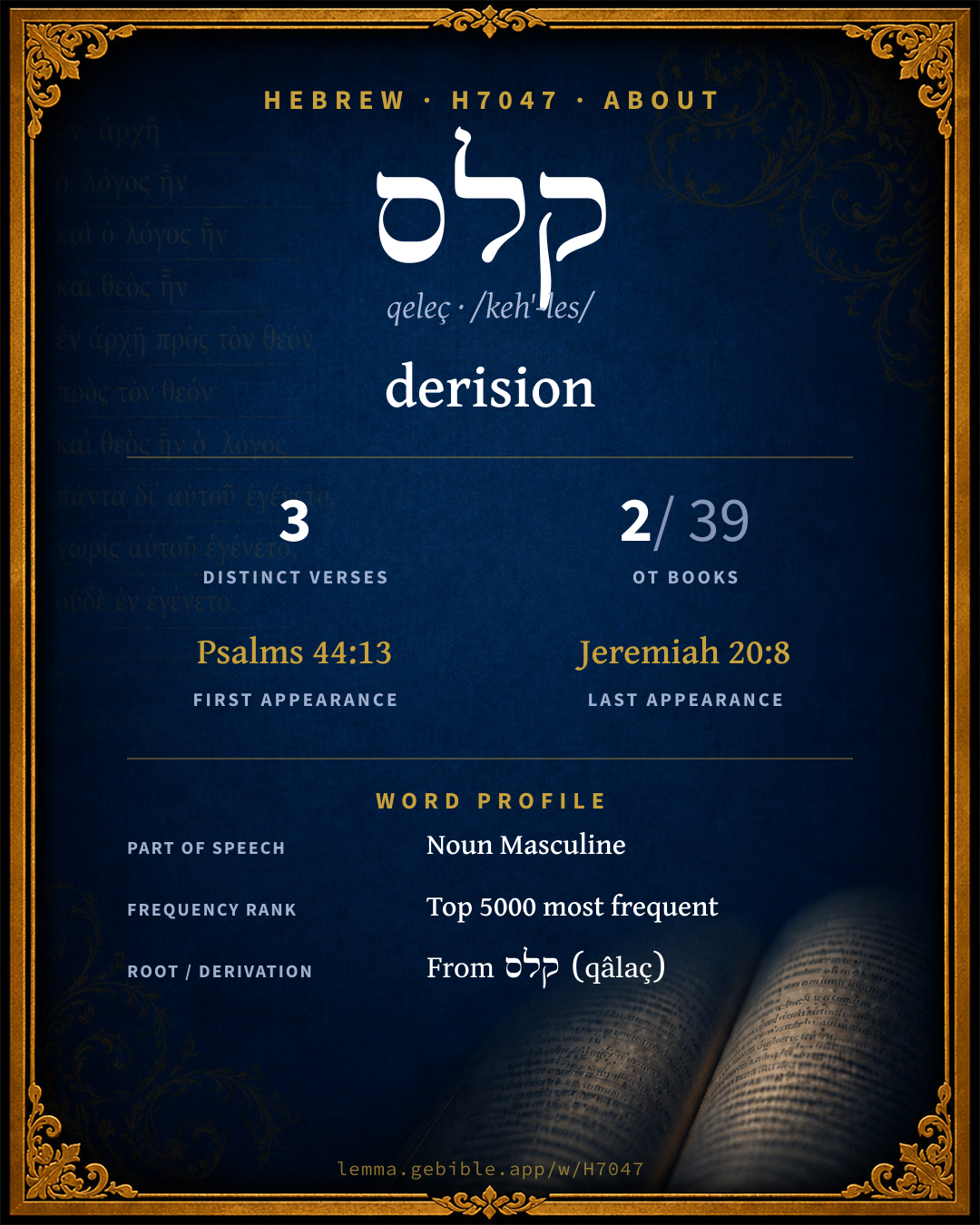
קֶ֫לֶס
derision
Full lexicon entry — Brown-Driver-Briggs (BDB)
From Brown-Driver-Briggs (BDB)
Where this word appears
Grammar key — what these labels mean
Noun type
- Common
- A common noun — a general class of person, place, or thing (“king,” “city,” “water”), not a specific name.
State
- Absolute
- The independent form of a noun, not bound to a following word.
Gender
- Masculine
- Grammatically masculine.
Number
- Singular
- One.
Every verse where H7047 appears — 3 distinct verses across 2 books. Click any verse to open its interlinear word-by-word view. Verse text shown in the World English Bible for context — . Each verse’s Hebrew form is shown with its reference; the English is not keyword-highlighted, since the data carries no word-level English alignment. Use “Compare translations” on any verse to read it across multiple English versions. This concordance covers the Hebrew Bible; Septuagint (Greek Old Testament) occurrences are not indexed here.
Psalms 2 verses
Jeremiah 1 verse
About this entry
At a glance — auto-summarized from this page’s data, not written by a person. Every figure links to its source below. This summary describes the numbers; it doesn’t interpret them.
At its core, קלס (qeleç) means “derision.” With only 3 verses it sits in the long tail of Hebrew Bible vocabulary. Its uses cluster heavily in Psalms (67% of all occurrences). Scripture first uses it in Psalms 44:13. From the same root come קלס and קלסה. Dig into 3-verse concordance and the renderings breakdown below.
Gloss history
Strong's 1890 vs modern scholarship
About this word
Strong's H7047 catalogs a Hebrew word from the Hebrew Old Testament.
These counts are not copied from any lexicon or concordance. They are computed here, from the morphology-tagged Hebrew Old Testament. What Lemma adds →
- 3
- distinct verses
- The word appears in 3 distinct verses.
- 2 / 39
- OT books
- The word appears in 2 of 39 Old Testament books.
- #4,179
- by frequency
- Top 5000 most frequent Hebrew words (rank 4,179 of 8,640 Hebrew words by occurrence).
View all 3 occurrences in the concordance →
By traditional corpus
Conventional, traditional groupings — biblical authorship is debated, so this is a traditional corpus grouping, not an authorship claim. Each share is this word’s portion of its verses in that division of the Hebrew canon. Each figure is a share of the word’s 3 distinct verses.
- Writings (Ketuvim) 2 verses · 67%
- Prophets (Nevi'im) 1 verse · 33%
How translations render this word
Counts come from each version’s own published word-to-Strong’s tagging or interlinear alignment — an approximate guide to how each version renders this word, not a word-level alignment the data otherwise carries. Because each total is that version’s own tagged count, the per-version totals vary from one another and need not match the appearance or distinct-verse counts above. These counts may also differ from a printed concordance because Lemma counts each distinctly tagged rendering and does not collapse phrase taggings into a single head-word total. This is a fixed set of word-tagged versions (KJV, ASV, BSB, ULT) and does not change with the reading translation you choose elsewhere. Each version’s license is shown beside its name below (and on Sources).
- King James Version: Derision 3×
- American Standard Version: Derision 2×
- Berean Standard Bible: Derision 3×
- unfoldingWord Literal Text: Derision 3×
King James Version Public Domain
Renders H7047 across 3 tagged occurrences — most commonly:
American Standard Version Public Domain
Renders H7047 across 3 tagged occurrences — most commonly:
Plus 1 rendering that appears only once — usually multi-word phrases or single function words the recovered tagging swept in, not distinct renderings.
Berean Standard Bible Public Domain
Renders H7047 across 3 tagged occurrences — most commonly:
unfoldingWord Literal Text CC BY-SA 4.0
Renders H7047 across 3 tagged occurrences — most commonly:
Senses in BDB
The 1 sense BDB distinguishes for this word, in lexicon order (not ranked by frequency or importance). The full entry — with sub-senses — is in the Lexicon Entry tab.
- derision, ridicule
Word origin
קֶ֫לֶס n.[m.] derision, i.e., object of it
— Brown-Driver-Briggs (Oxford 1906, public domain), digitized via Sefaria, supplemented by the OpenScriptures HebrewLexicon (CC BY 4.0). See Sources.
Derived from קלס (qâlaç) (H7046) — to mock.
Jastrow Dictionary
A second Hebrew/Aramaic lexicon for comparison, covering Aramaic and post-biblical (Talmudic, Targumic, Midrashic) usage that the biblical-Hebrew BDB does not. Matched by lemma rather than by Strong’s number, so a lemma may carry more than one Jastrow headword (shown separately below), and the entries cover usage well beyond the Bible.
קָלַס I
- , Pi. קִלֵּס (denom. of קוֹלָס) to put a helmet on; part. pass. מְקוּלָּס an animal roasted in its entirety with the entrails and legs on the head. Pes. 74ᵃ R. Ṭarfon called it גדי מ׳ a kid with a helmet on. Tosef. Bets. II, 15 איזוהי גדי מ׳ … וקרבו (not בקרבו) what is a g’di m’ḳullas? Entirely roasted, with head, legs, and entrails. Ib. עגל מ׳ a calf roasted with the head &c. Ib. Todos taught the Roman Jews to take lambs ועושין אותו מְקוּלָּסִין וכ׳ and prepare them ‘helmeted’ on Passover nights.—[Midr. Till. to Ps. XCII מקולסין, v. נִיקְלְוָוס.]
קָלַס II
- , Pi. קִלֵּס, קִי׳ (denom. of קוֹל, Pales) [to shout, make noise,]
- 1. to praise; [b. h. to decry, deride]. B. Bath. 176ᵃ אע"פ שק׳ ר"י וכ׳ although R. Yishm. praised Ben N. (commended his argument) the practice follows his (R. Yishmael’s) opinion; Y. ib. X, end, 17ᵈ על מדרשו קִילְּסוֹ he commended him for his mode of argumentation. Lev. R. s. 30 ניקח … ונְקַלֵּס להקב"ה let us take up the Lulab and Ethrog and offer praise to the Lord. Midr. Till. to Ps. CXIV (expl. סֹלּוּ, Ps. LXVIII, 5) קַלְּסוּ (not קילסו) praise him. Ib. Ps. CIV; a. v. fr. e.g. Psalms 68:5
- 2. to tramp or clap (in wailing ceremonies or on joyous occasions), v. קִילּוּס II, 2; M. Kat. 27ᵇ המְקַלֵּס לא יְקַלֵּס וכ׳ the tramper (at mourning ceremonies) must not tramp with a sandal on his foot, but with a shoe, to avoid accident.
- to be praised; to be done honor to by song, clapping &c. Y. Ḥag. I, 76ᶜ כשהיה רואה … מִתְקַלְּסִין (not סון …) whenever he saw a deceased person or a bride honored.
קְלַס
- , Pa. קַלֵּס ch. same, to call out; to praise; to tramp. Targ. Esth. VI, 9; 11 (h. text קרא). Targ. Y. II, Deut. XXXII, 43. Targ. Y. II, Ex. XXXII, 18; a. fr.—Keth. 21ᵇ משום דקַלְּסָהּ … את נמי מְקַלְּסַת לה because thy mother’s father commended it, thou commendest it likewise. Y. Kil. VIII, 31ᵇ, a. e. והוה … מְקַלֵּס ליה הזלים וכ׳ R. J. praised him by applying the verse (Is. XLVI, 6) &c. Y. Maas. Sh. I, end, 53ᵃ אמרה … וקַלְּסֵיה he said it before R. Abina, and he applauded him, opp. קנתריה; a. e.—Y. Peah I, 15d; Y. Ab. Zar. I, 42ᶜ top מקלס קומי וכ׳ did honor to bridal couples (singing, dancing &c.); (Keth. 17ᵃ מרקד). e.g. Isaiah 46:6
קֹלָס
- , v. קוֹלָס, קוּלְסָא.
A Dictionary of the Targumim, the Talmud Babli and Yerushalmi, and the Midrashic Literature (Marcus Jastrow; London, Luzac, 1903) — Public Domain. Digitized via Sefaria. Digitized via Sefaria. Full attribution on Sources.
Forms in the corpus
The 2 distinct written forms H7047 takes in the Hebrew Bible, most frequent first — each parse links to that state’s occurrences in the concordance. Hebrew forms include their vowel points and cantillation, so a single lemma takes many written forms.
| Form | Parsing | Example | Uses |
|---|---|---|---|
| וָ֝/קֶ֗לֶס | Noun, Common, Masculine, Singular, Absolute | Psalms 44:13 | 2 |
| וּ/לְ/קֶ֖לֶס | Noun, Common, Masculine, Singular, Absolute | Jeremiah 20:8 | 1 |
Same root — word family
Other BDB entries built from the same root as H7047, grouped by Strong’s listed origin. These share a root / origin per the lexicon — not necessarily a shared meaning. Each links to that word’s own entry.
Derives from
Shares the same root
Compare all same-root words → They share a root, not necessarily a meaning.
Septuagint verse parallels
This word appears in 3 verses that also exist in the Greek Old Testament (Septuagint), out of the 3 Hebrew verses it occurs in. You can read those verses in Greek by switching the Old Testament edition to the Septuagint.
Read these verses in the Septuagint
This is a verse-level parallel only — the same verses exist in both the Hebrew and Greek Old Testaments. No word-level Hebrew↔Greek correspondence is claimed: the data carries no such alignment, so no Greek word is shown as this Hebrew word’s translation. Coverage is not total — the Septuagint omits the deuterocanon and renumbers the Psalms, so some Hebrew verses have no direct Greek parallel.