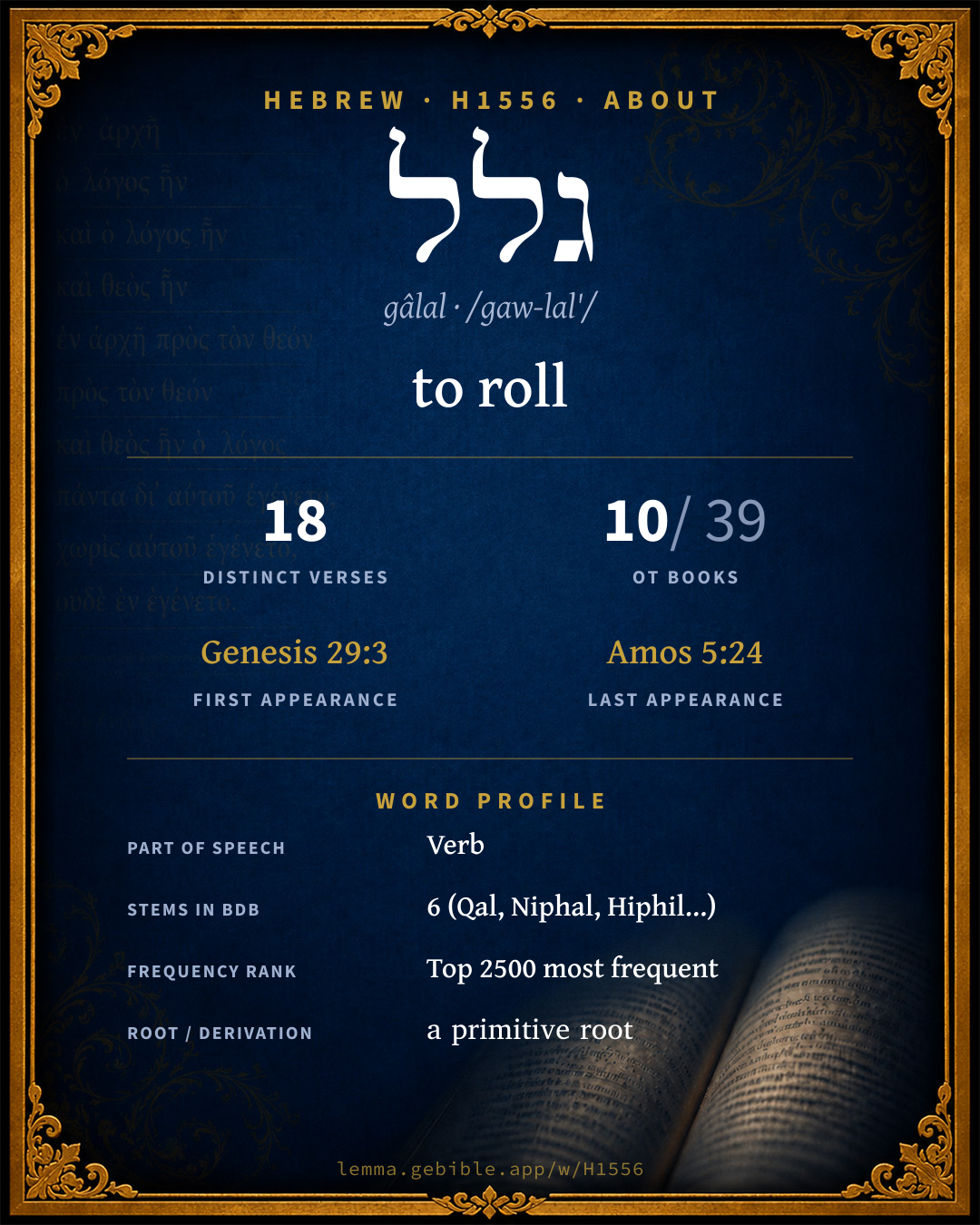
גָּלַל
to roll
also: roll away, roll down, roll together fuller range ↓
Full lexicon entry — Brown-Driver-Briggs (BDB)
From Brown-Driver-Briggs (BDB)
Where this word appears
See every Qal verb in the Hebrew Bible →
Grammar key — what these labels mean
Part of speech
- Verb
- An action or state-of-being word.
Stem
- Qal
- The basic, simple active stem — the plain form of the verb (“he wrote”).
- Niphal
- Usually the simple passive or reflexive of the Qal (“he was written”).
- Pilpel
- A reduplicated intensive stem of two-letter or hollow roots.
- Hithpolel
- The reflexive counterpart of the Polel.
- Piel
- An intensive or resultative active stem.
Form
- Imperative
- A direct command (“write!”).
- Imperfect
- An incomplete, ongoing, or future action (“he will / would write”).
- Sequential Perfect
- A perfect with prefixed waw continuing a preceding imperfect or command (waw-consecutive perfect).
- Perfect
- A completed action or state — Hebrew marks aspect (completeness) more than strict tense (“he wrote”).
- Participle Active
- A verbal adjective expressing ongoing or characteristic action (“writing / one who writes”).
- Sequential Imperfect
- An imperfect with prefixed waw — the standard past-narrative form (waw-consecutive imperfect).
- Infinitive Construct
- A bound verbal noun, frequently with prepositions (“to write / in writing”).
- Participle Passive
- A verbal adjective expressing action received (“written”).
State
- Absolute
- The independent form of a noun, not bound to a following word.
Person
- 2nd Person
- The one addressed (“you”).
- 3rd Person
- The one spoken about (“he / she / it / they”).
- 1st Person
- The speaker (“I / we”).
Gender
- Masculine
- Grammatically masculine.
- Common
- Either gender — not distinguished for this form.
- Feminine
- Grammatically feminine.
Number
- Singular
- One.
- Plural
- More than one (in Hebrew, generally three or more).
Grammatical forms 15 distinct
- Verb, Qal, Imperative, 2nd Person, Masculine, Singular 3 times (17%)
- Verb, Qal, Imperative, 2nd Person, Masculine, Plural 2 times (11%)
- Verb, Niphal, Imperfect, 3rd Person, Masculine, Singular 1 time (6%)
- Verb, Niphal, Sequential Perfect, 3rd Person, Common, Plural 1 time (6%)
- Verb, Pilpel, Sequential Perfect, 1st Person, Common, Singular 1 time (6%)
- Verb, Qal, Perfect, 3rd Person, Common, Plural 1 time (6%)
- Verb, Qal, Sequential Perfect, 3rd Person, Common, Plural 1 time (6%)
- Verb, Qal, Participle Active, Masculine, Singular, Absolute 1 time (6%)
+7 more forms (7 occurrences)
Parsed forms decoded from the imported morphology (morphhb / Westminster Leningrad Codex — WLC text public domain, morphhb tagging CC BY 4.0), counted across 18 parsed occurrences — not distinct verses.
Every verse where H1556 appears — 18 distinct verses across 10 books. Click any verse to open its interlinear word-by-word view. Verse text shown in the World English Bible for context — . Each verse’s Hebrew form is shown with its reference; the English is not keyword-highlighted, since the data carries no word-level English alignment. Use “Compare translations” on any verse to read it across multiple English versions. This concordance covers the Hebrew Bible; Septuagint (Greek Old Testament) occurrences are not indexed here.
Genesis 4 verses
- Genesis 29:3 וְ/גָלֲל֤וּ conj + Qal pf 3cp There all the flocks were gathered. They rolled the stone from the well's mouth, and watered the sheep, and put the stone again on the well's mouth in its place.
- Genesis 29:8 וְ/גָֽלֲלוּ֙ conj + Qal wpf 3cp They said, "We can't, until all the flocks are gathered together, and they roll the stone from the well's mouth. Then we water the sheep."
- Genesis 29:10 וַ/יָּ֤גֶל conj + Qal wimpf 3ms It happened, when Jacob saw Rachel the daughter of Laban, his mother's brother, and the sheep of Laban, his mother's brother, that Jacob went near, and rolled the stone from the well's mouth, and watered the flock of Laban his mother's brother.
- Genesis 43:18 לְ/הִתְגֹּלֵ֤ל prep + Hithpolel inf.cs The men were afraid, because they were brought to Joseph's house; and they said, "Because of the money that was returned in our sacks at the first time are we brought in; that he may seek occasion against us, and fall on us, and take us for bondservants, along with our donkeys."
Joshua 2 verses
- Joshua 5:9 גַּלּ֛וֹתִי Qal pf 1cs Yahweh said to Joshua, This day have I rolled away the reproach of Egypt from off you. Therefore the name of that place was called Gilgal, to this day.
- Joshua 10:18 גֹּ֛לּוּ Qal impv 2mp Joshua said, Roll great stones to the mouth of the cave, and set men by it to keep them:
1 Samuel 1 verse
2 Samuel 1 verse
Job 1 verse
Psalms 3 verses
- Psalms 22:8 גֹּ֣ל Qal impv 2ms "He trusts in Yahweh; Let him deliver him; Let him rescue him, since he delights in him."
- Psalms 37:5 גּ֣וֹל Qal impv 2ms Commit your way to Yahweh. Trust also in him, and he will do this:
- Psalms 119:22 גַּ֣ל Piel impv 2ms Take reproach and contempt away from me, For I have kept your statutes.
Proverbs 2 verses
Isaiah 2 verses
- Isaiah 9:5 מְגוֹלָלָ֣ה Poal ptcp.pass fs For all the armor of the armed man in the tumult, and the garments rolled in blood, shall be for burning, for fuel of fire.
- Isaiah 34:4 וְ/נָגֹ֥לּוּ conj + Niphal wpf 3cp All the host of the sky shall be dissolved, and the heavens shall be rolled together as a scroll; and all their host shall fade away, as the leaf fades from off the vine, and as a fading [leaf] from the fig tree.
Jeremiah 1 verse
Amos 1 verse
About this entry
At a glance — auto-summarized from this page’s data, not written by a person. Every figure links to its source below. This summary describes the numbers; it doesn’t interpret them.
The Hebrew verb גלל centers on the idea of “to roll.” Different stems carry different senses — BDB groups them under 6 stems, among them Qal and Niphal. It appears 18 verses across 10 books of the Hebrew Bible, among its uncommon vocabulary. Debuting at Genesis 29:3, it then recurs through the corpus. It shares a root with גל, גל and גלגל. Dig into 18-verse concordance and the renderings breakdown below.
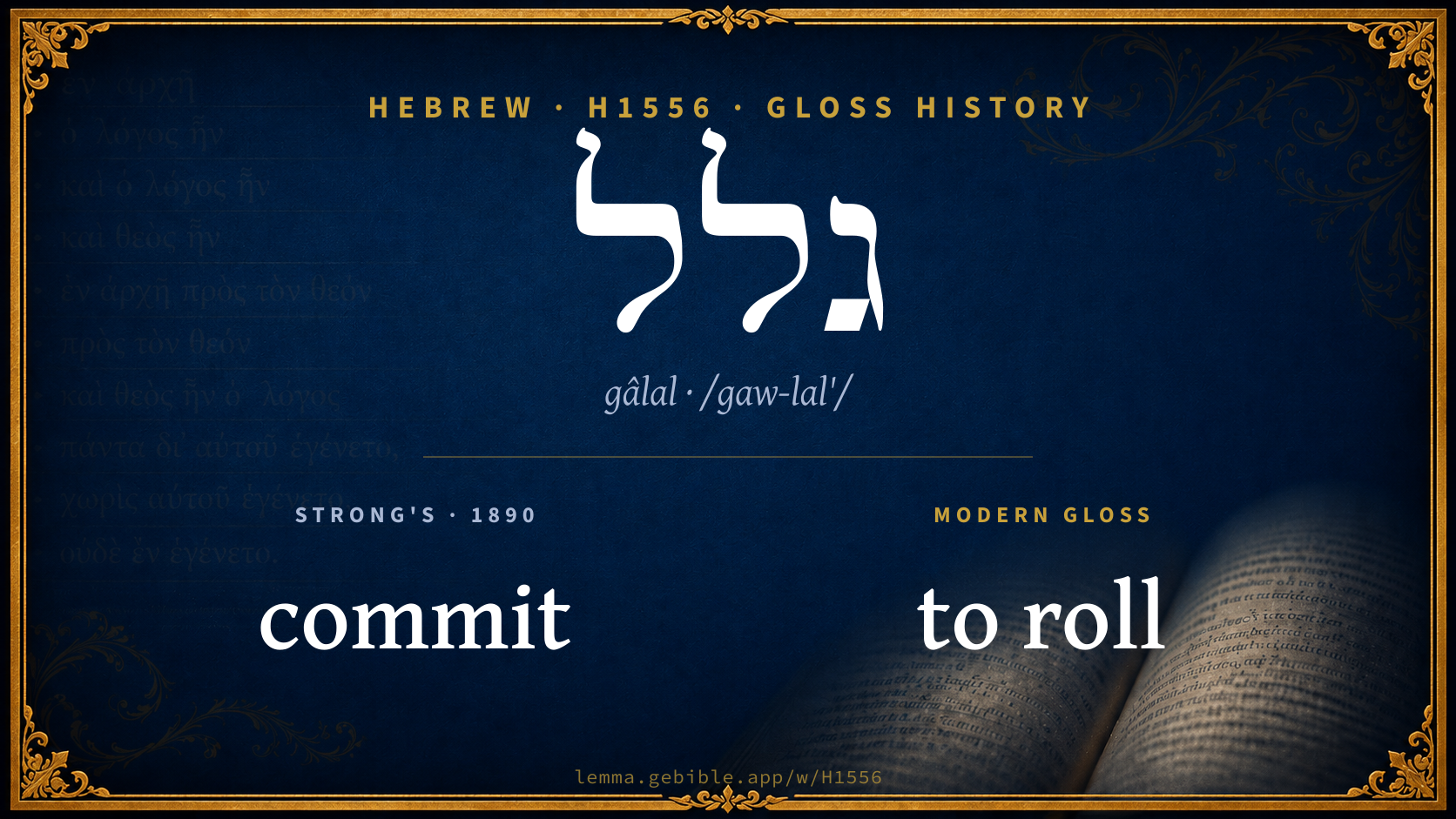
Gloss history
Strong's 1890 vs modern scholarship
About this word
Strong's H1556 catalogs a Hebrew word from the Hebrew Old Testament.
These counts are not copied from any lexicon or concordance. They are computed here, from the morphology-tagged Hebrew Old Testament. What Lemma adds →
- 18
- distinct verses
- The word appears in 18 distinct verses.
- 10 / 39
- OT books
- The word appears in 10 of 39 Old Testament books.
- #1,612
- by frequency
- Top 2500 most frequent Hebrew words (rank 1,612 of 8,640 Hebrew words by occurrence).
View all 18 occurrences in the concordance →
By section of the Old Testament
By traditional corpus
Conventional, traditional groupings — biblical authorship is debated, so this is a traditional corpus grouping, not an authorship claim. Each share is this word’s portion of its verses in that division of the Hebrew canon. Each figure is a share of the word’s 18 distinct verses.
- Prophets (Nevi'im) 8 verses · 44%
- Writings (Ketuvim) 6 verses · 33%
- Torah (Pentateuch) 4 verses · 22%
How translations render this word
Counts come from each version’s own published word-to-Strong’s tagging or interlinear alignment — an approximate guide to how each version renders this word, not a word-level alignment the data otherwise carries. Because each total is that version’s own tagged count, the per-version totals vary from one another and need not match the appearance or distinct-verse counts above. These counts may also differ from a printed concordance because Lemma counts each distinctly tagged rendering and does not collapse phrase taggings into a single head-word total. This is a fixed set of word-tagged versions (KJV, ASV, BSB, ULT) and does not change with the reading translation you choose elsewhere. Each version’s license is shown beside its name below (and on Sources).
- King James Version: Commit 2×, Roll 2×, Rolled 2×
- American Standard Version: Commit 3×, Roll 2×, Rolled 2×
- Berean Standard Bible: Commit 2×, Roll 2×, Rolled 2×
- unfoldingWord Literal Text: Roll 6×, Rolled 2×
King James Version Public Domain
Renders H1556 across 18 tagged occurrences — most commonly:
Plus 10 renderings that appear only once — usually multi-word phrases or single function words the recovered tagging swept in, not distinct renderings.
American Standard Version Public Domain
Renders H1556 across 18 tagged occurrences — most commonly:
Plus 11 renderings that appear only once — usually multi-word phrases or single function words the recovered tagging swept in, not distinct renderings.
Berean Standard Bible Public Domain
Renders H1556 across 18 tagged occurrences — most commonly:
Plus 12 renderings that appear only once — usually multi-word phrases or single function words the recovered tagging swept in, not distinct renderings.
unfoldingWord Literal Text CC BY-SA 4.0
Renders H1556 across 19 tagged occurrences — most commonly:
Plus 11 renderings that appear only once — usually multi-word phrases or single function words the recovered tagging swept in, not distinct renderings.
Senses in the full BDB
Hebrew verbs can shift meaning by stem (binyan): Qal is the basic action, Niphal is often passive or reflexive, Piel often intensifies or makes it factitive, and Hiphil is typically causative. The senses below are grouped under the stem BDB assigns to each. This entry also uses one or more reduplicated stems (the Pōlēl/Pilpēl type), which for hollow or geminate roots behave much like Piel — often intensive or iterative.
What do BDB’s symbols mean?
BDB uses these scholarly abbreviations:
| Symbol | Meaning |
|---|---|
| 𝔊 | the Septuagint (the ancient Greek translation, LXX) |
| 𝔙 | the Vulgate (the Latin translation) |
| 𝔖 | the Syriac version (the Peshitta) |
| 𝔗 | the Targum (the Aramaic translation) |
| ψ | the Psalms |
| √ | root (the underlying root or stem) |
| ‖ | parallel passage (a synonymous or contrasted parallel) |
| † | the dagger: every passage where the word occurs is cited |
The 6 senses and sub-senses the full Brown-Driver-Briggs lexicon distinguishes for this word, in lexicon order (not ranked by frequency), with BDB’s own verbatim wording and sub-sense lettering. Shown in Hebrew script with BDB’s own scholarly abbreviations. The condensed entry is in the Lexicon Entry tab. See also the Forms in the corpus table below.
Qal
- Pf. 1 s. גַּלּוֹתִי Jos 5:9, וְגָֽלֲלוּ consec. Gn 29:3, 8; Imv. גֹּל ψ 22:9 (MT De; but 𝔊 Bi Che read גַּל 3 ms. pf., so AV RVm) Pr 16:3, גּוֹל ψ 37:5, גַּל 119:22 (but read גֹּל Ew Hi Ri Gr Che), גֹּלּוּ Jos 10:18 1 S 14:33; Pt. גֹּלֵל Pr 26:27;—roll a stone Pr 26:27; roll away stone from upon (מֵעַל) the mouth of a well Gn 29:3, 8; roll stones unto (אֶל) the mouth of a cave Jos 10:18; stone unto (אֶל) Saul, at which to slay beasts 1 S 14:33; fig. reproach from upon (מֵעַל) the people Jos 5:9 (subj. י׳), cf. ψ 119:22 (sq. מֵעַל); but also גּוֹל עַל־י׳ דַּרְכֶּ֑ךָ ψ 37:5, cf. 22:9 Pr 16:3 (both sq. אֶל־). e.g. Joshua 5:9
Niphal
- Pf. וְנָגֹלּוּ consec. Is 34:4; Impf. וְיִגַּל (juss.) Am 5:24;—roll, roll up or along (intrans.). וְנָגֹלּוּ כַסֵּפֶר הַשָּׁמַיִם Is 34:4 and the heavens shall roll up like a book; יִגַּל כַּמַּיִם מִשְׁפָּט Am 5:24 let judgment roll along (flow down) as the waters. e.g. Isaiah 34:4
Pilp
- Pf. וְגִלְגַּלְתִּיךָ consec. Je 51:25 and I will roll thee down from (מִן) the rocks (subj. י׳; obj. Babylon under fig. of mt.) Pōʿal. Pt. שִׂמְלָה מְגוֹלָלָה בְדָמִים Is 9:4 garment rolled (dabbled, rolled over and over) in blood. e.g. Jeremiah 51:25
Hithpo
- Inf. לְהִתְגֹּלֵל Gn 43:18; Pt. מִתְגֹּלֵל 2 S 20:12; roll oneself over and over, וַעֲמָשָׂא מִתְג׳ בַּדָּם 2 S 20:12 now Amasa was wallowing in his blood; fig. Gn 43:18 לְהִתְג׳ עָלֵינוּ to roll himself upon us, i.e. assail us with overwhelming force (‖ וּלְהִתְנַפֵּל עָלֵינוּ). e.g. Genesis 43:18
Hithpalp
- Pf. הִתְגַּלְגָּ֑לוּ Jb 30:14 (abs.; ‖ כְּפֶרֶץ רָחָב יֶאֱתָ֑יוּ) cf. Hithpo. Gn 43:18. e.g. Job 30:14
Hiphil
- Impf. וַיָּ֫גֶל Gn 29:10;—roll away stone from upon (מֵעַל) mouth of well; as Qal (which it really is, Impf. in i, according to BaZMG 1888, 178). e.g. Genesis 29:10
Senses from the full Brown-Driver-Briggs lexicon (Brown, Driver, Briggs; Oxford 1906 — public domain), digitized via Sefaria, supplemented by the OpenScriptures HebrewLexicon (CC BY 4.0). Full attribution on Sources.
Word origin
vb. roll, roll away (NH id., & deriv.; Aramaic Pa. גַּלֵּל, Palp. גַּלְגֵּיל roll, Ithpalp. reflex., & deriv.; cf. ܓܰܠ Ethiopic, Ethpalp. (v. PS). ܓܺܓܰܠ rota, ܓܰܠܠܴܐ fluctus, etc.)—
— Brown-Driver-Briggs (Oxford 1906, public domain), digitized via Sefaria, supplemented by the OpenScriptures HebrewLexicon (CC BY 4.0). See Sources.
Origin: a primitive root
Jastrow Dictionary
A second Hebrew/Aramaic lexicon for comparison, covering Aramaic and post-biblical (Talmudic, Targumic, Midrashic) usage that the biblical-Hebrew BDB does not. Matched by lemma rather than by Strong’s number, so a lemma may carry more than one Jastrow headword (shown separately below), and the entries cover usage well beyond the Bible.
גָּלַל
- (b. h.)
- 1. to roll, unfold, fold. Meg. 32ᵃ he opens (the scroll), sees the place (to read from), גּוֹלֵל ומברך rolls it up again and says the benediction. Ib. הגּוֹלֵל ס"ת וכ׳ he who rolls the scrolls up (preparing the place to read from). B. Mets. II, 8 (29ᵇ) גוֹלְלָן he must roll the scrolls over (for the purpose of airing); a. fr.
- 2. (v. Gen. XXIX, 3) to roll off (one’s shoulders), disregard. Gen. R. s. 21 (play on גללו, Job XX, 7) על שג׳ מצוה וכ׳ because he disregarded a light command. e.g. Genesis 29:3
- to be rolled, folded. Cant. R. to V, 14 והיו נִגְלָלִין they could be folded up. Snh. 68ᵃ my two arms which are like two scrolls of the Law שנגללין rolled up (not unfolded, i.e. with me learning is buried which I was prevented from teaching).—Trnsf., with על, to be rolled on top of, to prevail. Ber. 7ᵃ יִגּוֹלּוּ רחמי על וכ׳ may my mercy prevail over my attributes (of justice &c.). Ib. יגולו רחמיך; v. גִּלְגֵּל.
- to be rolled up, folded. Taan. 21ᵇ; Men. 95ᵃ הוּגְלְלוּ הפרוכות when the curtains (of the Tabernacle) were folded up (for removing).
גְּלַל
- , to roll, unfold.—Part. pass. גְּלִיל unfolded, visible. Targ. Cant. V, 14.
- to roll off. Targ. Y. II, Gen. XXVIII, 10 (some ed. לִגְלָלָא Pe.).
- , v. גַּלְגֵּל, Ithpalp.
גָּלָל
- preced.)
- 1. rolling along with, appendage. Men. 15ᵃ; Pes. 13ᵇ לחם ג׳ תודה the bread is an appendage of the thank-offering; Men. 80ᵃ לִגְלַל תודה.—בִּגְלַל in consequence of, on account of, v. next w.
- 2. something rolled, rounded, ball, ordure, excrement, dung. B. Kam. III, 3 ההופך את הג׳ he who upturns (throws up) ordure into the street.—Pl. גְּלָלִים, גְּלָלִין. Sabb. 153ᵇ להטיל ג׳ to cast excrements (of animals). Lev. R. s. 16; Esth. R. to III, 1 מה הג׳ הללו וכ׳ as the dung is repulsive.
- 3. (with כְּלֵי) a material used for vessels, supposed to be baked ordure. Kel. X, 1. Par. V, 5. Mikv. IV, 1; Sabb. 16ᵇ. Men. 69ᵃ; 69ᵇ; a. fr. [Rashi to Sabb. l. c. expl. ג׳ = שייש, marble, to Men. l. c. = צפיעי בקר.]
גְּלָל
- 1. untrimmed stone, cobble (v. גְּוִיל). [Ezra V, 8.]—Ḥull. 63ᵃ אתא ג׳ a stone fell (from on high); Yalk. Zech. 578 גלאלא. Gitt. 47ᵃ Ar. (ed. גַּלְגַּלְתָּא). Ab. Zar. 22ᵇ, v. דַּגָּלָא. e.g. Ezra 5:8
- 2. lump.—Pl. גְּלָלֵי. Ḥull. 112ᵃ bot. תרי ג׳ דמלחא Rashi (ed. ג׳ מלחא) two lumps of salt.
- 3. ordure, v. גַּלָּא.—Pl. as supra. B. Kam. 92ᵇ (prov.) a dog in his hunger ג׳ מבלע (Ms. H. sing.) will swallow excrements (Rashi: stones).
- 4. wave, v. גַּלָּא.
- 5. consequence; בג׳ on account of, in order to. Targ. Ps. XL, 12 (Ms. ג׳ היכנא). Targ. II Chr. XXIV, 25; a. e.
A Dictionary of the Targumim, the Talmud Babli and Yerushalmi, and the Midrashic Literature (Marcus Jastrow; London, Luzac, 1903) — Public Domain. Digitized via Sefaria. Digitized via Sefaria. Full attribution on Sources.
Forms in the corpus
The 17 distinct written forms H1556 takes in the Hebrew Bible, most frequent first — each parse links to that stem’s occurrences in the concordance. Hebrew forms include their vowel points and cantillation, so a single lemma takes many written forms.
Same root — word family
Other BDB entries built from the same root as H1556, grouped by Strong’s listed origin. These share a root / origin per the lexicon — not necessarily a shared meaning. Each links to that word’s own entry.
Derived from this word
- גל gal H1530 wave
- גל gôl H1531 bowl, basin
- גלגל galgal H1534 whirlwind
- גלגלת gulgôleth H1538 skull
- גלה gullâh H1543 bowl
- גלול gillûwl H1544 idols
- גליל gâlîyl H1550 circuit
- גלל gâlâl H1557 dung
- גלל gâlâl H1558 on account of
- גלל gᵉlâl H1560 rolling
- מגלה mᵉgillâh H4039 scroll
Proper names from this root
People and places named from this root — a name, not an additional meaning of the word.
Compare all same-root words → Showing 4 of 13 — not the complete family. 1 of the same-root words is a proper name (a person or place). They share a root, not necessarily a meaning.
Septuagint verse parallels
This word appears in 16 verses that also exist in the Greek Old Testament (Septuagint), out of the 18 Hebrew verses it occurs in. You can read those verses in Greek by switching the Old Testament edition to the Septuagint.
Read these verses in the Septuagint
- Genesis 29:3
- Joshua 5:9
- 1 Samuel 14:33
- 2 Samuel 20:12
- Job 30:14
- Psalms 37:5
- Proverbs 16:3
- Isaiah 9:5
- Jeremiah 51:25
- Amos 5:24
This is a verse-level parallel only — the same verses exist in both the Hebrew and Greek Old Testaments. No word-level Hebrew↔Greek correspondence is claimed: the data carries no such alignment, so no Greek word is shown as this Hebrew word’s translation. Coverage is not total — the Septuagint omits the deuterocanon and renumbers the Psalms, so some Hebrew verses have no direct Greek parallel.