
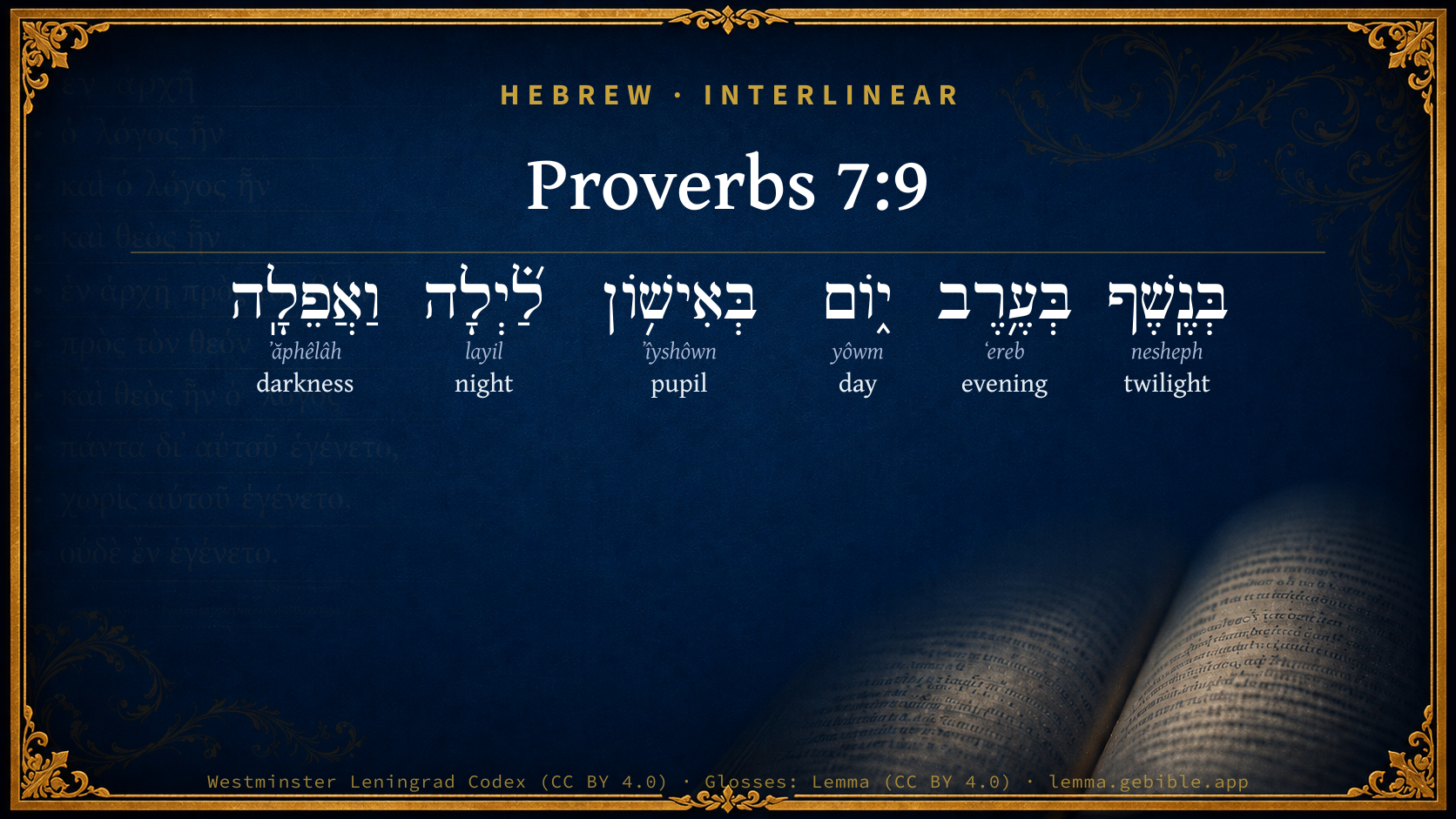
Proverbs 7:9

Hebrew (Westminster Leningrad Codex) Proverbs 7:9 appears in the Hebrew Old Testament. The text above is from the Westminster Leningrad Codex. Each word links to its Strong’s number, a concise gloss, and parsing drawn from the Open Scriptures Hebrew Bible morphology. Click any word for its full Brown-Driver-Briggs (BDB) entry.
Download image
Cite this verse

Proverbs 7:9 (World English Bible). Public Domain. Lemma interlinear Bible study tool, https://lemma.gebible.app/v/proverbs/7/9.

Show BibTeX & RIS
BibTeX
RIS
English Translation
In the twilight, in the evening of the day, In the middle of the night and in the darkness.
World English Bible · Public Domain
Download a study sheet

One document with this verse’s original text, its word-by-word gloss line, the meaning frame, cross-references with their text, attributed commentary, and full source and license credits — printable, and it pastes into notes with its structure intact.

This verse Autodidact and up

Study sheet (.html) Plain text (.txt)

A passage Seminary Student

Up to 50 verses in one chapter. A passage sheet keeps up to 6 commentary sources and 12 cross-references per verse, in the order this page ranks them, and says so on the sheet whenever that leaves anything out. Ask for a single verse and you get the Autodidact verse sheet above.

Everything on this page stays free to read, with no account — the sheet is a download of what is already on screen, not access to it.

Want to remove ads? Support Godless Engineer
Compare translations 3

The same verse in 3 English versions, stacked beneath the original-language interlinear above. Click any original word for its lexicon entry.

Each is an independent rendering of the whole verse — the interlinear is not word-aligned to these translations.

Highlighted words mark where these versions differ — a whole-verse word diff, not a word-by-word alignment.

  • World English Bible Public Domain
    In the twilight, in the evening of the day, In the middle of the night and in the darkness.
  • King James Version Public Domain
    In the twilight, in the evening, in the black and dark night:
  • unfoldingWord Literal Text CC BY-SA 4.0
    in the twilight breeze, in the evening of day, in the pupil of the night and darkness.

unfoldingWord Literal Text — © unfoldingWord, licensed CC BY-SA 4.0. Word-aligned USFM3 via Door43 (git.door43.org/unfoldingWord/en_ult).

Versions to compare (up to 4)

3 of 4 selected

Show all 18 translations

Every available English version of this verse, each an independent rendering of the whole verse.

  • World English Bible Public Domain
    In the twilight, in the evening of the day, In the middle of the night and in the darkness.
  • Berean Standard Bible Public Domain
    at twilight, as the day was fading into the dark of the night.
  • Majority Standard Bible Public Domain
    at twilight, as the day was fading into the dark of the night.
  • King James Version Public Domain
    In the twilight, in the evening, in the black and dark night:
  • American Standard Version (1901) Public Domain
    In the twilight, in the evening of the day, In the middle of the night and in the darkness.
  • Revised Version (1885) Public Domain
    In the twilight, in the evening of the day, in the blackness of night and the darkness.
  • Geneva Bible (1599) Public Domain
    In the twilight in the euening, when the night began to be blacke and darke.
  • Douay-Rheims (1899) Public Domain
    In the dark, when it grows late, in the darkness and obscurity of the night,
  • Young's Literal Translation Public Domain
    In the twilight -- in the evening of day, In the darkness of night and blackness.
  • Literal Standard Version CC BY-SA 4.0
    In the twilight—in the evening of day, || In the darkness of night and blackness.
  • Unlocked Literal Bible CC BY-SA 4.0
    It was twilight, in the evening of the day, at the time of night and darkness.
  • unfoldingWord Literal Text CC BY-SA 4.0
    in the twilight breeze, in the evening of day, in the pupil of the night and darkness.
  • Darby Bible Public Domain
    in the twilight, in the evening of the day, in the blackness of night and the darkness.
  • World Messianic Bible Public Domain
    in the twilight, in the evening of the day, in the middle of the night and in the darkness.
  • Webster's Bible Public Domain
    In the twilight, in the evening, in the black and dark night:
  • Free Bible Version CC BY-SA 4.0
    It was at dusk in the evening, as the light was fading and the dark night closed in.
  • Bible in Basic English Public Domain
    At nightfall, in the evening of the day, in the black dark of the night.
  • JPS Tanakh (1917) Public Domain
    In the twilight, in the evening of the day, in the blackness of night and the darkness.

Literal Standard Version (2020), Covenant Press — licensed CC BY-SA 4.0. Text via the HelloAO Bible API (eBible.org). Unlocked Literal Bible (unfoldingWord) — licensed CC BY-SA 4.0. Text via the HelloAO Bible API (eBible.org). unfoldingWord Literal Text — © unfoldingWord, licensed CC BY-SA 4.0. Word-aligned USFM3 via Door43 (git.door43.org/unfoldingWord/en_ult). Free Bible Version, Dr. Jonathan Gallagher — licensed CC BY-SA 4.0. Text via the HelloAO Bible API (eBible.org).

Word by word

More ways to search: Search by grammar → Find every occurrence → Compare this word →

Practice this passage: Drill this verse → Learn its vocabulary →

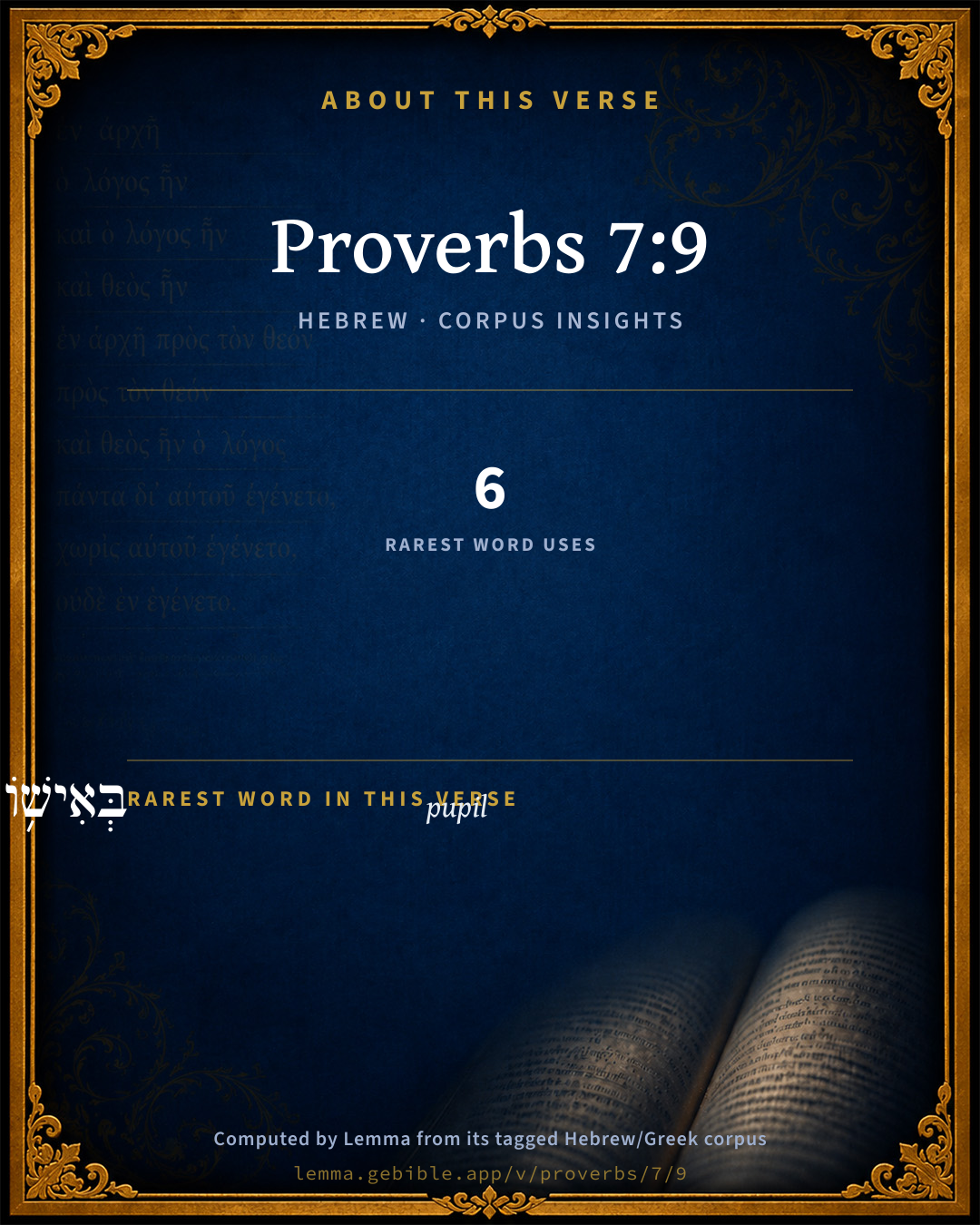
About this verse

These counts appear in no published source. They are computed here, from the morphology-tagged text and Lemma’s own curated glosses. What Lemma adds →

6
words
6
distinct lemmas
Wisdom
section

Notable vocabulary

The rarest word here is בְּאִישׁ֥וֹן pupil H380 — appearing just 6 times in the whole Hebrew Bible.

Shared distinctive vocabulary

בְּאִישׁ֥וֹן pupil H380 occurs in 5 verses of the Hebrew Bible. Also found in:

Grammatical profile

  • 6 nouns

Hebrew & Septuagint length

In English translation the verse runs 19 words from the Hebrew and 12 from the Septuagint (LXX English) — the Septuagint runs noticeably shorter here. See the side-by-side →

A rough comparison of the two English renderings, which tokenize alike — not a word-level alignment.

Word counts can differ between the Hebrew and the Greek without any difference in meaning — e.g. the Hebrew direct-object marker אֵת has no separate Greek word, and Greek often adds the article ὁ.

Cross-references

5

Topical passages linked to Proverbs 7:9 in the Treasury of Scripture Knowledge — connected by theme and wording, ordered by reader-vote popularity; previews shown in the World English Bible.

  • Job 24:13–15 "These are of those who rebel against the light; They don't know the ways of it, Nor abide in the paths of it.
  • Romans 13:12–14 The night is far gone, and the day is near. Let's therefore throw off the works of darkness, and let's put on the armor of light.
  • Genesis 39:11 It happened about this time, that he went into the house to do his work, and there were none of the men of the house inside.
  • Ephesians 5:11 Have no fellowship with the unfruitful works of darkness, but rather even reprove them.
  • Exodus 12:6 and you shall keep it until the fourteenth day of the same month; and the whole assembly of the congregation of Israel shall kill it at evening.

Cross-references courtesy of OpenBible.info (CC BY 4.0).

Hebrew and Greek witnesses Masoretic Hebrew ↔ Greek Septuagint

The same verse in the two great witnesses to the Old Testament, shown verse-for-verse.

Here the Septuagint runs noticeably shorter than the Hebrew — LXX2012 (modern English Septuagint) 12 words vs World English Bible 19. A rough length comparison of the two English translations, not a word-level alignment — read both below.

These are two independent witnesses, not word-aligned to each other, and the Septuagint is shown in lemma (dictionary) form.

Hebrew Proverbs 7:9 Masoretic · Westminster Leningrad Codex

בְּנֶֽשֶׁף בְּעֶ֥רֶב י֑וֹם בְּאִישׁ֥וֹן לַ֝֗יְלָה וַאֲפֵלָֽה

In the twilight, in the evening of the day, In the middle of the night and in the darkness.

World English Bible · Public Domain

Greek LXX Proverbs 7:9 Septuagint · lemma form

καί λαλέω ἐν σκότος ἑσπερινός ἡνίκα ἄν ἡσυχία νυκτερινός εἰμί καί γνοφώδης

when there happens to be the stillness of night and of darkness:

LXX2012 (modern English Septuagint) · Public Domain

On this verse, John Gill's Exposition discusses the Septuagint’s reading. Read the note in Commentary ↓

Hebrew: Westminster Leningrad Codex (CC BY 4.0). Greek: Septuagint (public domain); English from LXX2012 (modern English Septuagint) (Public Domain). How the Septuagint differs from the Hebrew →

Commentary

Notes on Proverbs 7:9 from classic Christian and Jewish commentators (each source and its license shown beneath its notes). The classic Christian expositions comment on the surrounding passage and are grouped to its opening verse, so a note may address several verses; the Jewish commentaries on the Tanakh (Rashi and others) are per-verse, so they appear only where the commentator wrote on this verse.

Lemma curates 59 commentaries, every one of them public domain or Creative Commons licensed, each selected and text-cleaned for this edition rather than reprinted as found. About our sources →

Trapp's Complete Commentary

John Trapp

Pro 7:9 In the twilight, in the evening, in the black and dark night:

Ver. 9. In the black and dark night.] Thinking to obscure himself; but Solomon saw him, how much more God, cui obscura patent, muta respondent, silentium confitetur, before whom night will convert itself into noon, and silence prove a speaking evidence. Foolish men think to hide themselves from God, by hiding God from themselves. See Psa 139:11-12.

John Trapp, A Commentary or Exposition upon All the Books of the Old and New Testament (1647–1656) — public domain. Text from a community e-Sword module.

Tyndale Open Study Notes

Tyndale Open Resources

7:9 Foolish actions are often associated with darkness (see 4:18-19; Eccl 2:13-14).

Tyndale Open Study Notes — © Tyndale Open Resources, licensed CC BY-SA 4.0. Text via the HelloAO Bible API.

Geneva Bible (1599)

Geneva Bible translators

He showeth that there was almost none so impudent, but they were afraid to be seen, and also their own consciences did accuse them which caused them to seek the night to cover their filthiness.

Geneva Bible (1599) marginal notes — public domain. Text via Bolls.life.

Jamieson, Fausset & Brown

Robert Jamieson, A. R. Fausset & David Brown

The time, twilight, ending in darkness.

black . . . night--literally, "pupil," or, "eye," that is, middle of night.

Jamieson, Fausset & Brown — Commentary Critical and Explanatory on the Whole Bible (1871) — public domain (CC PDM 1.0). Text via the HelloAO Bible API.

Adam Clarke's Commentary

Verse 9. In the twilight, in the evening] Some time after sun-setting; before it was quite dark.

In the black and dark night] When there were neither lamps nor moon-shine.

Adam Clarke's Commentary on the Bible (1810–1826) — public domain. Text from a community e-Sword/MySword module.

Ellicott's Commentary for English Readers

(9) In the twilight . . .—He has no excuse of sudden temptation to offer; from twilight till dark night he had trifled with danger, and now at last his “calamity comes” (Pro_6:15).

A Bible Commentary for English Readers, edited by Charles John Ellicott (1878–1897) — public domain. Text from a community e-Sword module.

The Cambridge Bible for Schools and Colleges

gen. ed. J. J. S. Perowne

9. black and dark night] Lit. in the pupil (of the eye) of the night, and the darkness. The Heb. word for pupil is the same as that rendered apple (of thine eye), Pro_7:2. It is used again poetically, as here, in Pro_20:20, in the blackest darkness, R.V. lit. in the pupil (of the eye) of darkness.

The short twilight of those latitudes is quickly followed by the blackness of night: which things are here perchance an allegory.

The Cambridge Bible for Schools and Colleges (gen. ed. J. J. S. Perowne; Cambridge University Press, 1878–1918) — public domain. Text from a community e-Sword module.

John Gill's Exposition

In the twilight, in the evening, in the black and dark night. Which is the usual time adulterers take to commit their works of darkness in, by which they think to conceal them; they being such as they themselves do not care should be seen and known, Job 24:15; their works will not bear the sun and daylight, therefore they take the twilight and when the sun is set; and choose the night, and not light nights neither, but the blackest and darkest nights, as fittest for their purpose; most likely to meet with harlots, and less liable to be seen by their neighbours; but always to be seen by the omniscient God, with whom the darkness and the light are both alike. Perhaps these several words may express the time from the young man's first setting out to his drawing nigh to the harlot's house, and his being attacked and ensnared by her; when he first set out from his own or his father's house, it was "twilight", the sun was declining; by that time he had got good part of his way the sun set, and then it was "evening"; and when he came near the harlot's house it was "black and dark night": and this may represent the gradual and progressive growth of Popery; there was first a "twilight", a decline of the purity of Gospel light and knowledge, and then the sun of the Gospel set, which brought on an "evening", and issued in the gross "darkness" of Popery, represented by the Thyatirian church state, as before observed; since that, the "morning star" of the Reformation has appeared, but this is become obscure, we are in a twilight again; it is neither day nor night with us as yet, but a dark black night is hastening on; and it is easy to observe how many, like this foolish young man, are marching on in a stately manner to the harlot's house, or are verging to Popery, whether they design it or not.

; their works will not bear the sun and daylight, therefore they take the twilight and when the sun is set; and choose the night, and not light nights neither, but the blackest and darkest nights, as fittest for their purpose; most likely to meet with harlots, and less liable to be seen by their neighbours; but always to be seen by the omniscient God, with whom the darkness and the light are both alike. Perhaps these several words may express the time from the young man's first setting out to his drawing nigh to the harlot's house, and his being attacked and ensnared by her; when he first set out from his own or his father's house, it was "twilight", the sun was declining; by that time he had got good part of his way the sun set, and then it was "evening"; and when he came near the harlot's house it was "black and dark night": and this may represent the gradual and progressive growth of Popery; there was first a "twilight", a decline of the purity of Gospel light and knowledge, and then the sun of the Gospel set, which brought on an "evening", and issued in the gross "darkness" of Popery, represented by the Thyatirian church state, as before observed; since that, the "morning star" of the Reformation has appeared, but this is become obscure, we are in a twilight again; it is neither day nor night with us as yet, but a dark black night is hastening on; and it is easy to observe how many, like this foolish young man, are marching on in a stately manner to the harlot's house, or are verging to Popery, whether they design it or not.

Proverbs 7:10

pro 7:10

pro 7:10

pro 7:10And, behold, there met him a woman,.... A married woman, and an adulteress, as the following account of her shows; as soon as ever she discerned the young man before described, who she knew, by his air, walk, and dress, was a fit person for her turn, she at once set out from her house, or the corner where she stood, and met him; she did not wait till he came up and made his suit to her, but she went out, and first attacked him; wherefore the word "behold" is prefixed as a note of admiration at the impudence of the woman, and as a note of attention to observe the consequence of this affair. This woman represents the woman on a scarlet-coloured beast, the mother of harlots, who, though she pretends to be the spouse of Christ, is an arrant whore, Rev 17:3;

with the attire of a harlot; not with her face veiled, as Tamar was, Gen 38:14; for though that might be the sign of a harlot in the daytime, yet not in the night, as this was; rather with showy gaudy garments, such as the Athenian whores wore, or short ones, as the Romans; the word signifies one fitted to her body, neat and well shaped, to recommend her: so the woman, the whore of Rome, is said to be arrayed in purple and scarlet colour, and decked with gold, and precious stones, and pearls; signifying the outward pomp and splendour of the Romish religion, designed to captivate weak and unwary minds; see Gill on Rev 17:4;

and subtle of heart; mistress of all artful and intriguing methods to seduce and ensnare (g); or, "reserved of heart" (h), cautious and wary what she said, told everything that was encouraging, but kept back what was discouraging; or she kept her own heart to herself, while she stole the hearts of others; so the Targum renders it,

"which takes away the hearts of young men;''

and to the same purpose are the versions of the Septuagint, Syriac, and Arabic: the subtlety of the popes, priests, jesuits, and other emissaries of Rome, to deceive the hearts of the simple, is well known; the coming of antichrist was after the working of Satan, with all deceivableness of unrighteousness, Th2 2:9.

(g) "Fallendique vias mille ministret amor", Tibullus ad Junonem, 6. v. 12. (h) "cauta corde", Tigurine version, Mercerus: Gejerus; "retento corde", Cocceius.

John Gill's Exposition of the Whole Bible (1746–1763) — public domain (CC PDM 1.0). Text via the HelloAO Bible API.

Matthew Poole's English Annotations

In the evening; when the day labour being ended, he was at leisure for any thing; and when such strumpets used to walk abroad for prey.

In the black and dark night; when it begun to be black and dark.

Matthew Poole's English Annotations on the Holy Bible (1683–1685) — public domain. Text from a community e-Sword/MySword module.

Whedon's Commentary on the Bible

Daniel D. Whedon

9. In the twilight… dark night — A difficult verse, on account of the seeming contrariety of terms. On the one hand, twilight, evening; on the other, the black and dark night, literally, the pupil of the eye of night — midnight. (See Pro_20:20, and note there.) The critics pass it over lightly, explaining terms, but doing little to reconcile them. Perhaps the terms may indicate progression. The scene begins in the evening, but continues into the darkness of midnight. Zockler says, “נשׁŠ, (nesheph,) rendered ‘twilight,’ strictly means the later period of evening darkness, from nine till twelve.” (See Job_7:4; Job_24:15.) The sense of the word is, however, indefinite. Another suggestion: we may understand the teacher thus: “This we may imagine to have occurred either in the twilight of the evening, or in the thick darkness of the night.” “In the twilight, in the evening, when the night began to be black and dark.” — Geneva Bible.

Daniel D. Whedon (gen. ed.), Commentary on the Old and New Testaments (1874–1909) — public domain. Text from a community e-Sword module.

The Pulpit Commentary

In the twilight, in the evening of the day. So termed to distinguish it from the morning twilight. The moralist sees the youth pacing to and fro in the early evening hours, and still watching and waiting when the darkness was deepest. (comp. Job_24:15) In the black and dark night; literally, in the pupil of the eye of night and in darkness. We have the same expression in Pro_20:20 (where see note) to denote midnight. Its appropriateness is derived from the fact that the pupil of the eye is the dark centre in the iris. Septuagint: the youth "speaking in the darkness of evening, when there is the stillness of night and gloom."

The Pulpit Commentary (1880–1919), ed. H.D.M. Spence-Jones & Joseph S. Exell — public domain. Text from a community e-Sword module.

Lesson kit

Teaching starters — assembled from the data on this page, not authored interpretation. Every prompt links to the verse data it draws on. Edit before teaching.

Proverbs, in the Wisdom, opens this verse with 6 words (6 distinct Hebrew lemmas). Its most distinctive word is ʼîyshôwn (“pupil”). The Greek Septuagint runs shorter here. A historical commentator’s framing appears above. Read the whole chapter for the surrounding context.

Discussion questions

  1. The word ʼîyshôwn carries the sense “pupil.” How does it shape the verse?
  2. How does Deuteronomy 32:10, which shares the word «pupil», read alongside this verse?
  3. The Septuagint runs shorter here than the Hebrew. What might account for the difference?
  4. The translations on this page render this verse differently — a whole-verse word diff, not a word-by-word alignment. What might account for the different wordings?
  5. Compare how Trapp's Complete Commentary and Tyndale Open Study Notes read this verse. Where do they agree or differ?

Things to notice

Reading settings

Reading text

Shown beneath each verse's original-language words.

Old Testament
Old Testament edition

Read the OT as the Masoretic Hebrew (MT) or the Greek Septuagint (LXX).

English shown for the Greek Septuagint (in the Hebrew ↔ Greek comparison).

Comparing translations? Open the Compare panel on any verse page to stack up to four side by side.