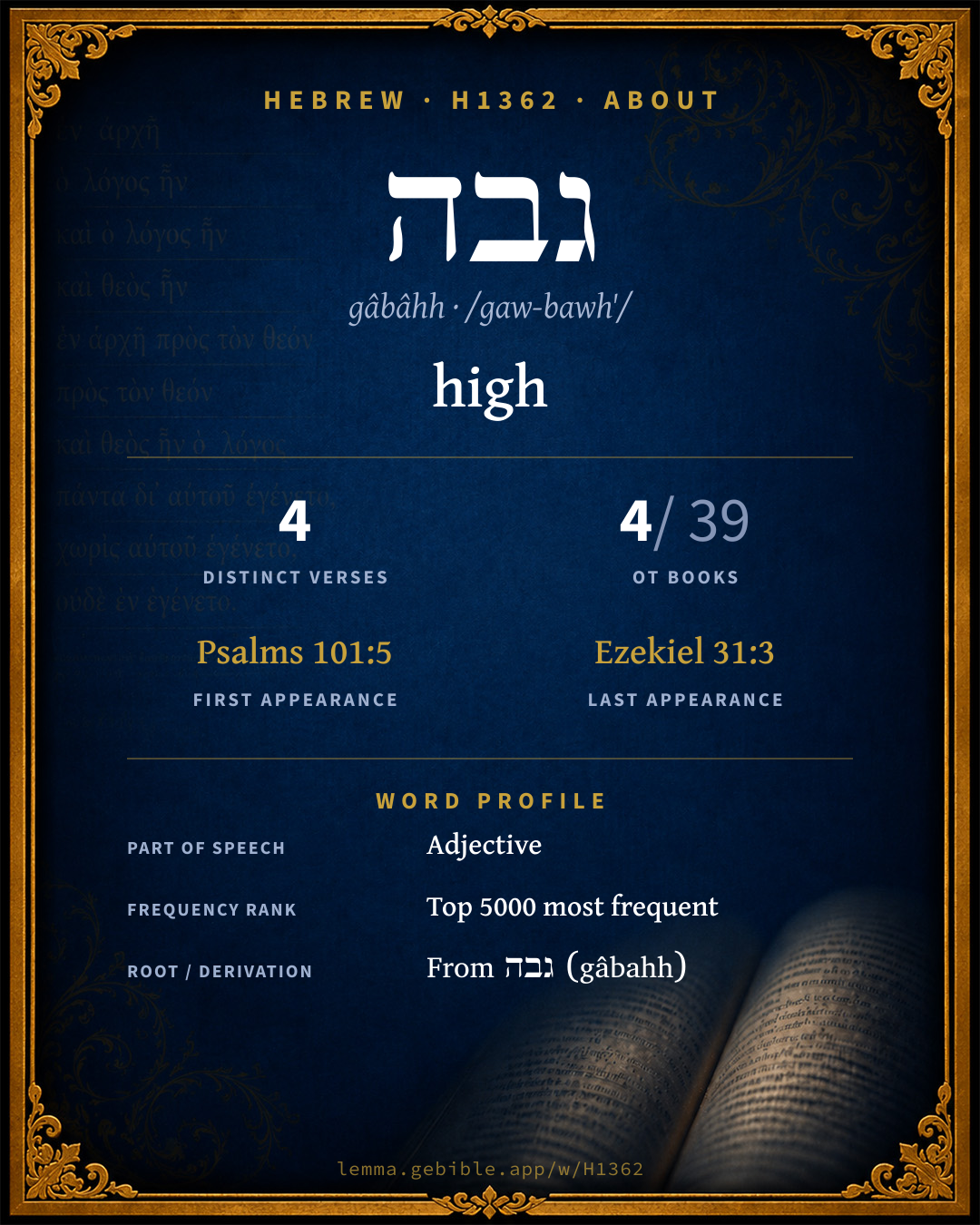
גָּבֹהַּ
high
‘high’ is one of 4 main senses fuller range ↓
Full lexicon entry — Brown-Driver-Briggs (BDB)
From Brown-Driver-Briggs (BDB)
Where this word appears
Grammar key — what these labels mean
Part of speech
- Adjective
- A word that describes or qualifies a noun.
State
- Construct
- A noun bound to a following noun in a possessive / “of” relationship (the construct chain).
Gender
- Masculine
- Grammatically masculine.
Number
- Singular
- One.
Every verse where H1362 appears — 4 distinct verses across 4 books. Click any verse to open its interlinear word-by-word view. Verse text shown in the World English Bible for context — . Each verse’s Hebrew form is shown with its reference; the English is not keyword-highlighted, since the data carries no word-level English alignment. Use “Compare translations” on any verse to read it across multiple English versions. This concordance covers the Hebrew Bible; Septuagint (Greek Old Testament) occurrences are not indexed here.
Psalms 1 verse
Proverbs 1 verse
Ecclesiastes 1 verse
Ezekiel 1 verse
About this entry
At a glance — auto-summarized from this page’s data, not written by a person. Every figure links to its source below. This summary describes the numbers; it doesn’t interpret them.
At its core, גבה (gâbâhh) means “high.” It occurs a mere 4 verses across Scripture. The word gravitates to Psalms (25%), then Proverbs and Ecclesiastes. It first appears in Psalms 101:5. Ranging over 4 senses, it is not a single-sense word. Dig into 4-verse concordance and the renderings breakdown below.
Gloss history
Strong's 1890 vs modern scholarship
About this word
Strong's H1362 catalogs a Hebrew word from the Hebrew Old Testament.
These counts are not copied from any lexicon or concordance. They are computed here, from the morphology-tagged Hebrew Old Testament. What Lemma adds →
- 4
- distinct verses
- The word appears in 4 distinct verses.
- 4 / 39
- OT books
- The word appears in 4 of 39 Old Testament books.
- #3,696
- by frequency
- Top 5000 most frequent Hebrew words (rank 3,696 of 8,640 Hebrew words by occurrence).
View all 4 occurrences in the concordance →
Most concentrated in
- Psalms 1 verse 25%
- Proverbs 1 verse 25%
- Ecclesiastes 1 verse 25%
By section of the Old Testament
By traditional corpus
Conventional, traditional groupings — biblical authorship is debated, so this is a traditional corpus grouping, not an authorship claim. Each share is this word’s portion of its verses in that division of the Hebrew canon. Each figure is a share of the word’s 4 distinct verses.
- Writings (Ketuvim) 3 verses · 75%
- Prophets (Nevi'im) 1 verse · 25%
How translations render this word
Counts come from each version’s own published word-to-Strong’s tagging or interlinear alignment — an approximate guide to how each version renders this word, not a word-level alignment the data otherwise carries. Because each total is that version’s own tagged count, the per-version totals vary from one another and need not match the appearance or distinct-verse counts above. These counts may also differ from a printed concordance because Lemma counts each distinctly tagged rendering and does not collapse phrase taggings into a single head-word total. This is a fixed set of word-tagged versions (KJV, ASV, BSB, ULT) and does not change with the reading translation you choose elsewhere. Each version’s license is shown beside its name below (and on Sources).
- King James Version: Every one that is proud 1×, Hath an high 1×, High 1×
- American Standard Version: Every one that is proud 1×, Hath a high 1×, High 1×
- unfoldingWord Literal Text: One high of 1×, One lofty of 1×, Tallest 1×
King James Version Public Domain
Renders H1362 across 4 tagged occurrences — most commonly:
American Standard Version Public Domain
Renders H1362 across 4 tagged occurrences — most commonly:
unfoldingWord Literal Text CC BY-SA 4.0
Renders H1362 across 5 tagged occurrences — most commonly:
Senses in BDB
The 4 senses BDB distinguishes for this word, in lexicon order (not ranked by frequency or importance). The full entry — with sub-senses — is in the Lexicon Entry tab.
- high, proud
- high, lofty, tall
- exalted in station
- haughty, proud
Word origin
Derived from גבה (gâbahh) (H1361) — to be high.
Jastrow Dictionary
A second Hebrew/Aramaic lexicon for comparison, covering Aramaic and post-biblical (Talmudic, Targumic, Midrashic) usage that the biblical-Hebrew BDB does not. Matched by lemma rather than by Strong’s number, so a lemma may carry more than one Jastrow headword (shown separately below), and the entries cover usage well beyond the Bible.
גַּבָּה
- f., v. גַּב
גָּבָה
- , v. גבי
גֹּבַהּ
- , v. גּוֹבַהּ, גָּבוֹהַּ.
גָּבַהּ
- v. גבב; cmp. גאה) to be high; to be elated. Meg. 15ᵃ ג׳ המן וכ׳ (Var. ג׳ לבו של המן) Haman is haughtier than Ahasver (he dared what Ah. did not venture); Yalk. Esth. 1056.—Sot. 5ᵃ ולא ג׳ הר סיני למעלה and Mount Sinai did not rise higher (grow proud).
- 1. to raise, elevate; to make elated. Taan. 23ᵃ a generation which was to be humbled הִגְבַּהְּתּוֹ בתפלתן hast thou lifted up through thy prayer, v. גָּאָה.—Erub. 55ᵃ מי שמַגְבִּיהַּ דעתו עליו כשמים Ms. M. (ed. עליה, ed. Sonc. מגב׳ עצמו כשמ׳; v. Rabb. D. S. a. l.; Yalk. Deut. 940 שמגיס דעתו) who exalts his mind in himself as high as the heavens (who considers himself very wise, ed. who considers himself on account of his knowledge of it as high &c.). Ib. 13ᵇ him who lowers himself הק"בה מַגְבִּיהוֹ the Lord will raise, וכל המגביה עצמו וכ׳ and whomsoever exalts himself, the Lord will lower; ib. 54ᵃ; Ned. 55ᵃ. Tanḥ. Ki Thissa 14 מַגְבִּיהִים פניהם lifted their faces up; a. fr.—Ḥall. III, 1 מַגְבַּהַת חלתה she lifts up (dedicates) the priest’s share; v., however, גָּבָה.
- 2. to take up a lost object in order to take possession of it. B. Mets. 8ᵃ המגביה מציאה לחבירו וכ׳ if one takes up an object in behalf of his neighbor; ib. 10ᵃ; Bets. 39ᵇ; a. fr.
- to be raised. Sot. 47ᵇ שפלים הוּגְבָּהוּ the low have been raised. Tanḥ. Ki Thissa 5; Lev. R. s. 8 בלשון זה ה׳ with the word zeh (Lev. VI, 13) has he (Aaron) been raised.—Part. מוּגְבַּהּ, f. מוּגְבַּהַת. Y. Shebu. I, 32ᵈ bot. what means שְׂאֵת (Lev. XIII, 2) מוגבהת a raised spot (Sifra Thazr., Neg. ch. I מובהקת, corr. acc.). e.g. Leviticus 6:13
- , Nithpa. נִתְגַּבֵּהַּ to be elated, boastful. Tanḥ. Ḥuck. 1 התחיל מִתְגַּבֵּהַּ והולך he beame more and more overbearing (Tanḥ. ed. Bub. ib.; Num. R. s. 18 מתגבר). Num. R. s. 6, beg. נִתְגַּבְּהוּ בעצמם they were proud of their own selves.
גְּבַהּ
- , to be high, elated. Targ. Ps. CXXXI, 1.—Sabb. 67ᵃ גְּבִיהַת מכל וכ׳ thou art higher than all other trees. Meg. 15ᵃ ג׳ מלכא וכ׳ Ms. M. (ed. גבר) the King on high is higher than the king below. Ḥull. 7ᵇ ג׳ טורא וכ׳ a mountain rose between them (separating them). [Y. Ter. X, 47ᵇ bot. גביה מן דאבהתיה, Tosaf. to Ḥull. 64ᵇ גמיר.]
- 1. to raise. Targ. II Chr. XXXIII, 14.
- 2. to take up. Succ. 44ᵇ אַגְבְּהֵיה וכ׳ he took it (the festive wreath) up once as such and a second time for the willow branches thereon. B. Mets. 2ᵇ בהדי הדדי אַגְבְּהוּהָ they took the lost object up at the same time. Ib. 8ᵃ; a. fr.
- 1. to be high; to grow proud. Targ. Job XXXV, 5. Targ. Koh. I, 12.
- 2. to rise. Targ. Job XXXIX, 27; a. e.—Ḥull. 141ᵇ sq. דלִיתְגַּבְּהוּ that the young birds may rise (when frightened).
גבי
- (√גב, v. גבב) to collect a bill, taxes &c.; to make one’s self paid, to seize. Keth. 90ᵃ, a. fr. if a later creditor (second mortgagee) שקדם וג׳ מה שג׳ ג׳ collected first, what he has collected is his own. B. Mets. 13ᵇ גּוֹבֶה מנכסים ב"ח he may make himself paid of unmortgaged property. Keth. V, 1 גּוֹבָה את הכל she is entitled to the whole amount; a. v. fr.—Lev. R. s. 11 the king sent a treasury officer לִגְבוֹת to collect (the delinquent taxes); Gen. R. s. 42 לִגְבוֹתָהּ; Tanḥ. Sh’mini 9. [Lev. R. l. c. וגבו אותו, read והכו, cmp. Gen. R. l. c.] Ex. R. s. 30 מי ג׳ הימנו הדם וכ׳ who collected from him (punished him for) the blood on his hand? לא ישראל גָּבוּ אותו וכ׳ not the Israelites collected it, but the Gibeonites did.—Gen. R. s. 85; s. 92 end מצא ב"ח מקום לגבות וכ׳ the creditor met with a chance to collect his bill, i.e. the Lord takes this occasion to visit our sins; a. fr.—Part. pass. גָּבוּי collected, seized. B. Mets. 58ᵃ על הַגָּ׳ counting on the Shekel contributions collected (though not yet delivered in the Temple treasury); Keth. 108ᵃ; Y. Shek. II, beg. 46ᶜ. Shebu. 48ᵇ, a. fr. כג׳ דמי is considered as if collected (in the possession of the creditor); a. fr.
- 1. to be collected, to be collectible. B. Mets. l. c. על העתיד לִגָּבוֹת; Y. Shek. l. c. להִיגָּבוֹת on what is yet to be collected. Peah VIII, 7 הקופה נִגְבֵּית בשנים the charity fund must be collected by two persons; B. Bath. 8ᵇ; Snh. 17ᵇ; a. fr.
- 2. to be collected from, be taxed. Pesik. R. s. 10 לא היו נִיגְּבִים וכ׳ they were not highly taxed; a. fr.
- to cause to be collected. Ḥall. III, 1 מַגְבַּהַת חלתה she orders the priest’s gift to be collected; v., however, גָּבַהּ. Gitt. 35ᵇ הַגְבּוּהָ את השאר help her to collect the balance. [Tosef. Sabb. VI (VII), 1 מגבה, v. גָּבַח.]—Part. pass. fem. מוּגְבָּה collected fund. Tanḥ. Emor 18.
A Dictionary of the Targumim, the Talmud Babli and Yerushalmi, and the Midrashic Literature (Marcus Jastrow; London, Luzac, 1903) — Public Domain. Digitized via Sefaria. Digitized via Sefaria. Full attribution on Sources.
Forms in the corpus
The 4 distinct written forms H1362 takes in the Hebrew Bible, most frequent first — each parse links to that state’s occurrences in the concordance. Hebrew forms include their vowel points and cantillation, so a single lemma takes many written forms.
| Form | Parsing | Example | Uses |
|---|---|---|---|
| גְּֽבַהּ | Adjective, Adjective, Masculine, Singular, Construct | Psalms 101:5 | 1 |
| גְּבַהּ | Adjective, Adjective, Masculine, Singular, Construct | Proverbs 16:5 | 1 |
| וּ/גְבַ֣הּ | Adjective, Adjective, Masculine, Singular, Construct | Ezekiel 31:3 | 1 |
| מִ/גְּבַהּ | Adjective, Adjective, Masculine, Singular, Construct | Ecclesiastes 7:8 | 1 |
Same root — word family
Other BDB entries built from the same root as H1362, grouped by Strong’s listed origin. These share a root / origin per the lexicon — not necessarily a shared meaning. Each links to that word’s own entry.
Derives from
Shares the same root
Proper names from this root
People and places named from this root — a name, not an additional meaning of the word.
Compare all same-root words → Showing 4 of 6 — not the complete family. 1 of the same-root words is a proper name (a person or place). They share a root, not necessarily a meaning.
Septuagint verse parallels
This word appears in 4 verses that also exist in the Greek Old Testament (Septuagint), out of the 4 Hebrew verses it occurs in. You can read those verses in Greek by switching the Old Testament edition to the Septuagint.
Read these verses in the Septuagint
This is a verse-level parallel only — the same verses exist in both the Hebrew and Greek Old Testaments. No word-level Hebrew↔Greek correspondence is claimed: the data carries no such alignment, so no Greek word is shown as this Hebrew word’s translation. Coverage is not total — the Septuagint omits the deuterocanon and renumbers the Psalms, so some Hebrew verses have no direct Greek parallel.