2 Kings 22:15

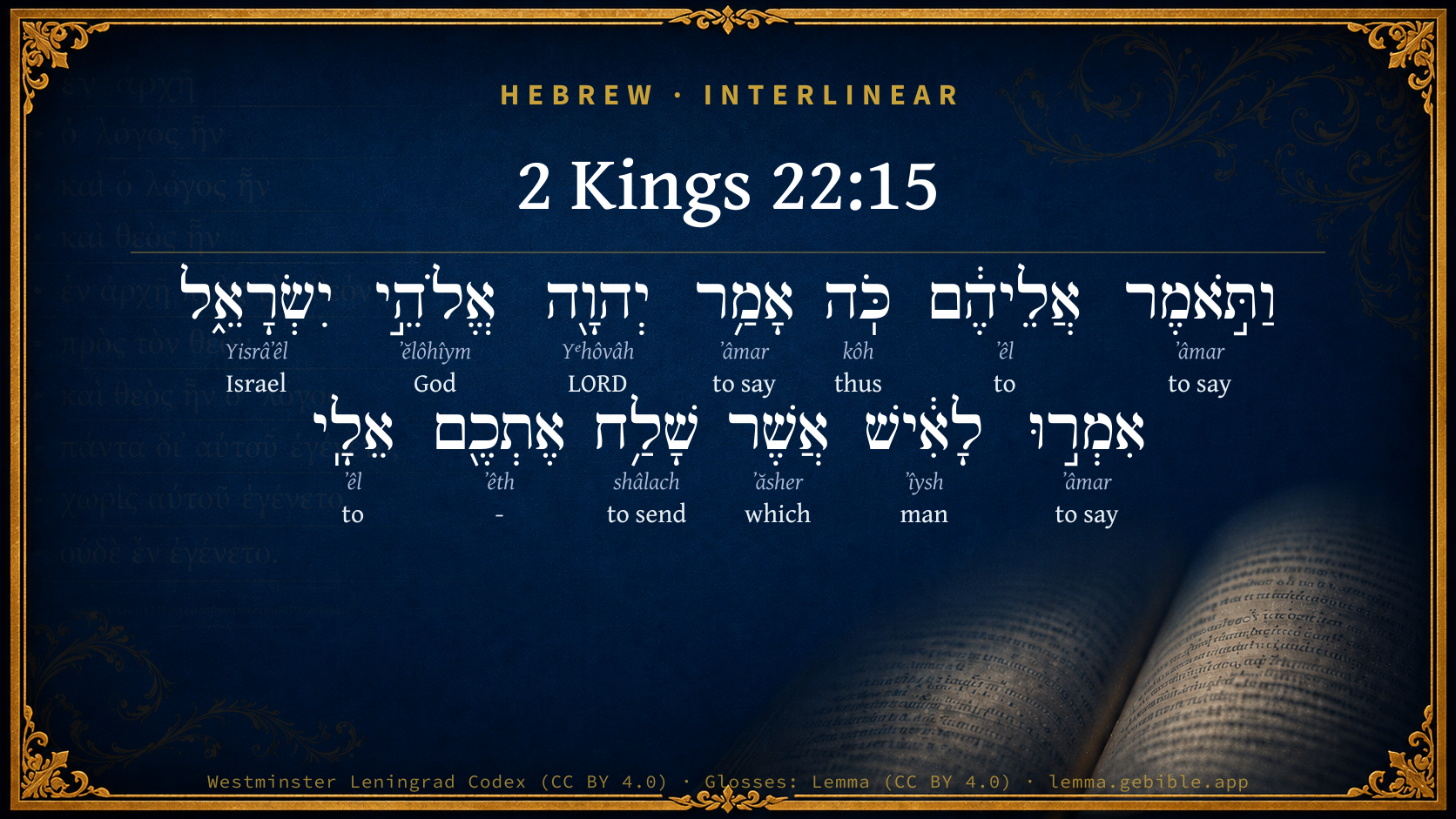
Hebrew (Westminster Leningrad Codex) 2 Kings 22:15 appears in the Hebrew Old Testament. The text above is from the Westminster Leningrad Codex. Each word links to its Strong’s number, a concise gloss, and parsing drawn from the Open Scriptures Hebrew Bible morphology. Click any word for its full Brown-Driver-Briggs (BDB) entry.
Download image
Cite this verse

2 Kings 22:15 (World English Bible). Public Domain. Lemma interlinear Bible study tool, https://lemma.gebible.app/v/2-kings/22/15.

Show BibTeX & RIS
BibTeX
RIS
English Translation
She said to them, Thus says Yahweh, the God of Israel: Tell you the man who sent you to me,
World English Bible · Public Domain
Download a study sheet

One document with this verse’s original text, its word-by-word gloss line, the meaning frame, cross-references with their text, attributed commentary, and full source and license credits — printable, and it pastes into notes with its structure intact.

This verse Autodidact and up

Study sheet (.html) Plain text (.txt)

A passage Seminary Student

Up to 50 verses in one chapter. A passage sheet keeps up to 6 commentary sources and 12 cross-references per verse, in the order this page ranks them, and says so on the sheet whenever that leaves anything out. Ask for a single verse and you get the Autodidact verse sheet above.

Everything on this page stays free to read, with no account — the sheet is a download of what is already on screen, not access to it.

Want to remove ads? Support Godless Engineer
Compare translations 3

The same verse in 3 English versions, stacked beneath the original-language interlinear above. Click any original word for its lexicon entry.

Each is an independent rendering of the whole verse — the interlinear is not word-aligned to these translations.

Highlighted words mark where these versions differ — a whole-verse word diff, not a word-by-word alignment.

  • World English Bible Public Domain
    She said to them, Thus says Yahweh, the God of Israel: Tell you the man who sent you to me,
  • King James Version Public Domain
    And she said unto them, Thus saith the LORD God of Israel, Tell the man that sent you to me,
  • unfoldingWord Literal Text CC BY-SA 4.0
    And she said to them, “Thus says Yahweh, the God of Israel, ‘Say to the man who sent you to me,

unfoldingWord Literal Text — © unfoldingWord, licensed CC BY-SA 4.0. Word-aligned USFM3 via Door43 (git.door43.org/unfoldingWord/en_ult).

Versions to compare (up to 4)

3 of 4 selected

Show all 18 translations

Every available English version of this verse, each an independent rendering of the whole verse.

  • World English Bible Public Domain
    She said to them, Thus says Yahweh, the God of Israel: Tell you the man who sent you to me,
  • Berean Standard Bible Public Domain
    And Huldah said to them, “This is what the LORD, the God of Israel, says: ‘Tell the man who sent you
  • Majority Standard Bible Public Domain
    And Huldah said to them, “This is what the LORD, the God of Israel, says: ‘Tell the man who sent you
  • King James Version Public Domain
    And she said unto them, Thus saith the LORD God of Israel, Tell the man that sent you to me,
  • American Standard Version (1901) Public Domain
    And she said unto them, Thus saith Jehovah, the God of Israel: Tell ye the man that sent you unto me,
  • Revised Version (1885) Public Domain
    And she said unto them, Thus saith the LORD, the God of Israel: Tell ye the man that sent you unto me,
  • Geneva Bible (1599) Public Domain
    And shee answered them, Thus sayth the Lord God of Israel, Tel the man that sent you to mee,
  • Douay-Rheims (1899) Public Domain
    And she said to them: Thus saith the Lord the God of Israel: Tell the man that sent you to me:
  • Young's Literal Translation Public Domain
    And she saith unto them, `Thus said Jehovah, God of Israel, Say to the man who hath sent you unto me:
  • Literal Standard Version CC BY-SA 4.0
    And she says to them, “Thus said YHWH, God of Israel: Say to the man who has sent you to me,
  • Unlocked Literal Bible CC BY-SA 4.0
    She said to them, “This is what Yahweh, the God of Israel, says: 'Tell the man who sent you to me,
  • unfoldingWord Literal Text CC BY-SA 4.0
    And she said to them, “Thus says Yahweh, the God of Israel, ‘Say to the man who sent you to me,
  • Darby Bible Public Domain
    And she said to them, Thus saith Jehovah the God of Israel: Tell the man that sent you to me,
  • World Messianic Bible Public Domain
    She said to them, “The LORD the God of Israel says, ‘Tell the man who sent you to me,
  • Webster's Bible Public Domain
    And she said to them, Thus saith the LORD God of Israel, Tell the man that sent you to me,
  • Free Bible Version CC BY-SA 4.0
    She told them, “This is what the Lord, the God of Israel, says: Tell the man who sent you to me,
  • Bible in Basic English Public Domain
    And she said to them, The Lord, the God of Israel, says, Say to the man who sent you to me,
  • JPS Tanakh (1917) Public Domain
    And she said unto them: 'Thus saith the LORD, the God of Israel: Tell ye the man that sent you unto me:

Literal Standard Version (2020), Covenant Press — licensed CC BY-SA 4.0. Text via the HelloAO Bible API (eBible.org). Unlocked Literal Bible (unfoldingWord) — licensed CC BY-SA 4.0. Text via the HelloAO Bible API (eBible.org). unfoldingWord Literal Text — © unfoldingWord, licensed CC BY-SA 4.0. Word-aligned USFM3 via Door43 (git.door43.org/unfoldingWord/en_ult). Free Bible Version, Dr. Jonathan Gallagher — licensed CC BY-SA 4.0. Text via the HelloAO Bible API (eBible.org).

Word by word

More ways to search: Search by grammar → Find every occurrence → Compare this word →

Practice this passage: Drill this verse → Learn its vocabulary →

כֹּֽה
kôh
H3541
“thus”
Adverb
Part of Speech
Adverb
Full BDB Definition

Origin: from the prefix k and H1931

TWOT: 955

thus, here, in this manner - thus, so - here, here and there - until now, until now...until then, meanwhile
  1. וַתֹּ֣אמֶר ʼâmar H559 “and · to say” Conjunction + Verb, Qal, Sequential Imperfect, 3rd Person, Feminine, Singular
  2. אֲלֵיהֶ֔ם ʼêl H413 “to · them” Preposition + Suffix, Personal, 3rd Person, Masculine, Plural
  3. אָמַ֥ר ʼâmar H559 “to say” Verb, Qal, Perfect, 3rd Person, Masculine, Singular
  4. יְהוָ֖ה Yᵉhôvâh H3068 “LORD” Noun, Proper
  5. אֱלֹהֵ֣י ʼĕlôhîym H430 “God(s) of” Noun, Common, Masculine, Plural, Construct
  6. יִשְׂרָאֵ֑ל Yisrâʼêl H3478 “Israel” Noun, Proper
  7. אִמְר֣וּ ʼâmar H559 “say” Verb, Qal, Imperative, 2nd Person, Masculine, Plural
  8. לָאִ֔ישׁ ʼîysh H376 “to/for the · man” Preposition, Determined + Noun, Common, Masculine, Singular, Absolute
  9. אֲשֶׁר ʼăsher H834 “which” Particle, Relative
  10. שָׁלַ֥ח shâlach H7971 “to send” Verb, Qal, Perfect, 3rd Person, Masculine, Singular
  11. אֶתְכֶ֖ם ʼêth H853 “- · you” Particle, Direct Object + Suffix, Personal, 2nd Person, Masculine, Plural
  12. אֵלָֽי ʼêl H413 “to · me” Preposition + Suffix, Personal, 1st Person, Common, Singular

About this verse

These counts appear in no published source. They are computed here, from the morphology-tagged text and Lemma’s own curated glosses. What Lemma adds →

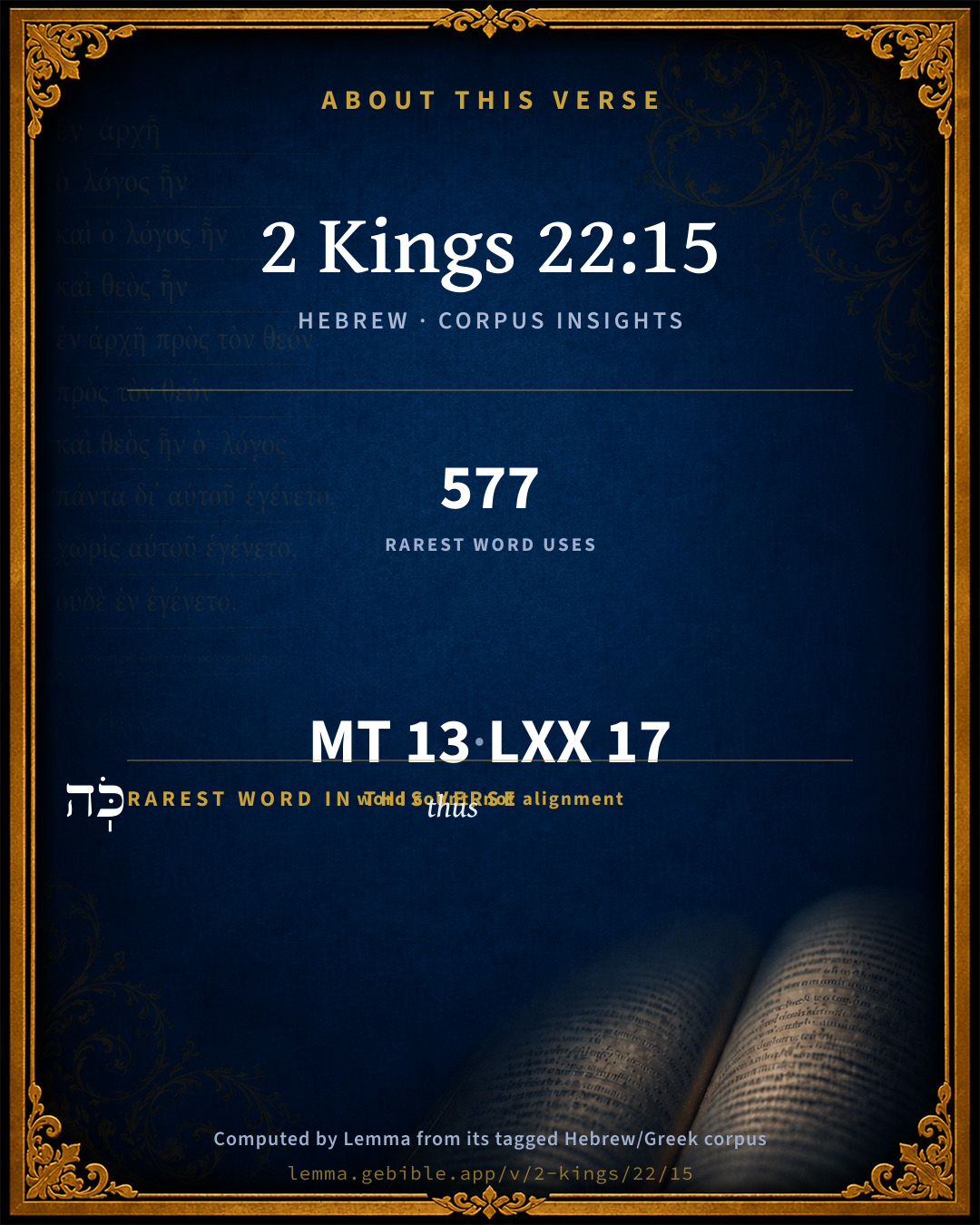
13
words
10
distinct lemmas
Historical
section

Grammatical profile

  • 4 verbs
  • 4 nouns
  • 2 prepositions
  • 1 adverb
  • 2 particles

Verb forms

  • וַתֹּ֣אמֶר Qal · Sequential Imperfect
  • אָמַ֥ר Qal · Perfect
  • אִמְר֣וּ Qal · Imperative
  • שָׁלַ֥ח Qal · Perfect

Repetition

Words recur within this verse — often emphatic in Hebrew:

  • וַתֹּ֣אמֶר to say H559 ×3
  • אֲלֵיהֶ֔ם to H413 ×2

Hebrew & Septuagint length

In English translation the verse runs 20 words from the Hebrew and 21 from the Septuagint (LXX English) — closely comparable.

A rough comparison of the two English renderings, which tokenize alike — not a word-level alignment.

Word counts can differ between the Hebrew and the Greek without any difference in meaning — e.g. the Hebrew direct-object marker אֵת has no separate Greek word, and Greek often adds the article ὁ.

In the original languages it is 13 Hebrew tokens and 17 Greek tokens — but the two are counted differently (Hebrew bundles its prefixes and suffixes into one token; the Greek is in lemma form), so that isn’t a like-for-like length.

Cross-references

3

Topical passages linked to 2 Kings 22:15 in the Treasury of Scripture Knowledge — connected by theme and wording, ordered by reader-vote popularity; previews shown in the World English Bible.

  • 2 Kings 1:6 They said to him, There came up a man to meet us, and said to us, Go, turn again to the king who sent you, and tell him, Thus says Yahweh, Is it because there is no God in Israel, that you send to inquire of Baal Zebub, the god of Ekron? therefore you shall not come down from the bed where you are gone up, but shall surely die.
  • 2 Kings 1:16 He said to him, Thus says Yahweh, Because you have sent messengers to inquire of Baal Zebub, the god of Ekron, is it because there is no God in Israel to inquire of his word? therefore you shall not come down from the bed where you are gone up, but shall surely die.
  • Jeremiah 23:28 The prophet who has a dream, let him tell a dream; and he who has my word, let him speak my word faithfully. What is the straw to the wheat? says Yahweh.

Cross-references courtesy of OpenBible.info (CC BY 4.0).

Hebrew and Greek witnesses Masoretic Hebrew ↔ Greek Septuagint

The same verse in the two great witnesses to the Old Testament, shown verse-for-verse.

These are two independent witnesses, not word-aligned to each other, and the Septuagint is shown in lemma (dictionary) form.

Hebrew 2 Kings 22:15 Masoretic · Westminster Leningrad Codex

וַתֹּ֣אמֶר אֲלֵיהֶ֔ם כֹּֽה אָמַ֥ר יְהוָ֖ה אֱלֹהֵ֣י יִשְׂרָאֵ֑ל אִמְר֣וּ לָאִ֔ישׁ אֲשֶׁר שָׁלַ֥ח אֶתְכֶ֖ם אֵלָֽי

She said to them, Thus says Yahweh, the God of Israel: Tell you the man who sent you to me,

World English Bible · Public Domain

Greek LXX 2 Kings 22:15 Septuagint · lemma form

καί εἶπον αὐτός ὅδε λέγω κύριος ὁ θεός ἰσραήλ εἶπον ὁ ἀνήρ ὁ ἀποστέλλω σύ πρός ἐγώ

And she said to them, Thus says the Lord God of Israel, Say to the man that sent you to me,

LXX2012 (modern English Septuagint) · Public Domain

Hebrew: Westminster Leningrad Codex (CC BY 4.0). Greek: Septuagint (public domain); English from LXX2012 (modern English Septuagint) (Public Domain). How the Septuagint differs from the Hebrew →

Targum (Aramaic paraphrase)

1

The Targum is the ancient Jewish Aramaic paraphrase of the Hebrew Scriptures — an interpretive translation, not the Hebrew text itself. Onkelos (literal) and Pseudo-Jonathan (expansive) render the Torah, and Jonathan the Prophets. Coverage is partial: where no permissively-licensed English translation exists for a verse, only the Aramaic is shown. This is verse-level text, not a word-by-word alignment to the Hebrew.

  1. Targum Jonathan Prophets (Joshua–Malachi)
    וַאֲמַרַת לְהוֹן כִּדְנַן אֲמַר יְיָ אֱלָהָא דְיִשְׂרָאֵל אֲמַרוּ לְגַבְרָא דִשְׁלַח יַתְכוֹן לְוָתִי:

    (no public-domain English translation for this verse)

    Targum Jonathan — Aramaic: “Mikraot Gedolot” (public domain). English: “Sefaria Community Translation” (CC0 1.0 (public-domain dedication)); “London "Chaldee Paraphrase," 1871” (public domain). Text via Sefaria.

Commentary

Notes on 2 Kings 22:15 from classic Christian and Jewish commentators (each source and its license shown beneath its notes). The classic Christian expositions comment on the surrounding passage and are grouped to its opening verse, so a note may address several verses; the Jewish commentaries on the Tanakh (Rashi and others) are per-verse, so they appear only where the commentator wrote on this verse.

Lemma curates 59 commentaries, every one of them public domain or Creative Commons licensed, each selected and text-cleaned for this edition rather than reprinted as found. About our sources →

Trapp's Complete Commentary

John Trapp

2Ki 22:15 And she said unto them, Thus saith the LORD God of Israel, Tell the man that sent you to me,

Ver. 15. Tell the man.] Kings had need to be told that they are but men. Remember that thou art but a man, said the boy to king Philip: and Agnosco me esse mortalem, I acknowledge myself a mortal, said Charles V, emperor. Huldah here speaketh from God, with whom there is no respect of persons.

John Trapp, A Commentary or Exposition upon All the Books of the Old and New Testament (1647–1656) — public domain. Text from a community e-Sword module.

Joseph Benson's Commentary

2Ki 22:15-16. Tell the man that sent you — She uses no compliments. Even kings, though gods to us, are men to God, and shall be so dealt with: for with him there is no respect of persons. Thus saith the Lord, I will bring evil upon this place, &c. — She lets him know, both what judgments God had in store for Judah and Jerusalem, and what mercy was laid up for him. Even all the words — According to all the words, of the book — All the plagues threatened in Deuteronomy 28., and in other places. The Scriptures must be fulfilled. They that will not be bound by the precept, shall be bound by the penalty. And God will be found no less terrible to the ungodly, than his word makes him to be. Take warning in time, O impenitent sinner! whosoever thou art.

Joseph Benson's Commentary on the Old and New Testaments (1811–1818) — public domain. Text from a community e-Sword module.

Keil & Delitzsch

C. F. Keil & F. Delitzsch

The reply of Huldah the prophetess. - Huldah confirmed the fear expressed by Josiah, that the wrath of the Lord was kindled against Jerusalem and its inhabitants on account of their idolatry, and proclaimed first of all (Kg2 22:16, Kg2 22:17), that the Lord would bring upon Jerusalem and its inhabitants all the punishments with which the rebellious and idolaters are threatened in the book of the law; and secondly (Kg2 22:18-20), to the king himself, that on account of his sincere repentance and humiliation in the sight of God, he would not live to see the predicted calamities, but would be gathered to his fathers in peace. The first part of her announcement applies "to the man who has sent you to me" (Kg2 22:15), the second "to the king of Judah, who has sent to inquire of the Lord" (Kg2 22:18). "The man" who had sent to her was indeed also the king; but Huldah intentionally made use of the general expression "the man," etc., to indicate that the word announced to him applied not merely to the king, but to every one who would hearken to the word, whereas the second portion of her reply had reference to the king alone. הזּה המּקום, in Kg2 22:16, Kg2 22:19, and Kg2 22:20, is Jerusalem as the capital of the kingdom. In Kg2 22:16, הסּפר כּל־דּברי is an explanatory apposition to רעה. Kg2 22:17. "With all the work of their hands," i.e., with the idols which they have made for themselves (cf. Kg1 16:7). The last clause in Kg2 22:18, "the words which thou hast heard," is not to be connected with the preceding one, "thus saith the Lord," and על or ל to be supplied; but it belongs to the following sentence, and is placed at the head absolutely: as for the words, which thou hast heart - because thy heart has become soft, i.e., in despair at the punishment with which the sinners are threatened (cf. Deu 20:3; Isa 7:4), and thou hast humbled thyself, when thou didst hear, etc.; therefore, behold, I will gather thee to thy fathers, etc. לשׁמּה להיות, "that they (the city and inhabitants) may become a desolation and curse." These words, which are often used by the prophets, but which are not found connected like this except in Jer 44:22, rest upon Lev 26 and Deut 28, and show that these passages had been read to the king out of the book of the law.

Keil & Delitzsch — Biblical Commentary on the Old Testament (1861–1891) — public domain (CC PDM 1.0). Text via the HelloAO Bible API. (Old Testament only.)

Tyndale Open Study Notes

Tyndale Open Resources

22:15-17 The Lord . . . has spoken! Like Miriam (Exod 15:20) and Deborah (Judg 4:4), Huldah had the privilege of proclaiming God’s will to the people. Huldah confirmed Josiah’s fears that God would bring disaster on Jerusalem because of the people’s unfaithfulness and many sins.

Tyndale Open Study Notes — © Tyndale Open Resources, licensed CC BY-SA 4.0. Text via the HelloAO Bible API.

Jamieson, Fausset & Brown

Robert Jamieson, A. R. Fausset & David Brown

she said unto them, Thus saith the Lord God of Israel, Tell the man that sent you to me--On being consulted, she delivered an oracular response in which judgment was blended with mercy; for it announced the impending calamities that at no distant period were to overtake the city and its inhabitants. But at the same time the king was consoled with an assurance that this season of punishment and sorrow should not be during his lifetime, on account of the faith, penitence, and pious zeal for the divine glory and worship which, in his public capacity and with his royal influence, he had displayed.

Next: 2 Kings Chapter 23

Jamieson, Fausset & Brown — Commentary Critical and Explanatory on the Whole Bible (1871) — public domain (CC PDM 1.0). Text via the HelloAO Bible API.

The Cambridge Bible for Schools and Colleges

gen. ed. J. J. S. Perowne

15. Tell [R.V. adds ye] the man that sent you to [R.V. unto] me] At first she places king and people all on one level and denounces the woes that shall surely come upon the nation for their sins, on all alike.

The Cambridge Bible for Schools and Colleges (gen. ed. J. J. S. Perowne; Cambridge University Press, 1878–1918) — public domain. Text from a community e-Sword module.

John Gill's Exposition

And she said unto them,.... The king's messengers:

thus saith the Lord God of Israel; being immediately inspired by him, she spake in his name, as prophets did:

tell the man that sent you to me; which may seem somewhat rude and unmannerly to say of a king; but when it is considered she spake not of herself, but representing the King of kings and Lord of lords, it will be seen and judged of in another light.

John Gill's Exposition of the Whole Bible (1746–1763) — public domain (CC PDM 1.0). Text via the HelloAO Bible API.

Whedon's Commentary on the Bible

Daniel D. Whedon

15. Tell the man that sent you — 2Ki_22:16-17 contain a prophecy of which every Israelite should be informed, and are communicated to the king as the representative of every man of his kingdom; 2Ki_22:18-20 are particularly for the king alone.

Daniel D. Whedon (gen. ed.), Commentary on the Old and New Testaments (1874–1909) — public domain. Text from a community e-Sword module.

The Pulpit Commentary

Vers. 15-20. The prophecy of Huldah. The word of the Lord comes to Huldah with the arrival of the messengers, or perhaps previous to it, and she is at once ready with her reply. It divides itself into two parts. In vers. 15-17 the inquiry made is answered answered affirmatively, "Yes, the fiat is gone forth; it is too late to avert the sentence; the anger of the Lord is kindled, and shall not be quenched." After this, in vers. 18-20, a special message is sent to the king, granting him an arrest of judgment, on account of his self-humiliation and abasement. "Because his heart was tender, and he had humbled himself before Jehovah, the evil should not happen in his day.

And she said unto them, Thus saith the Lord God of Israel. Huldah is the only example of a prophetess in Israel, who seems to rank on the same footing with the prophets. Miriam, (Exo_15:20) Deborah, (Jud_1:4:4) Isaiah s wife, (Isa_8:2) and Anna (Luk_2:36) are called "prophetesses," but in a secondary sense, as holy women, having a certain gift of song or prediction from God. Huldah has the full prophetic afflatus, and delivers God"s oracles, just as Isaiah and Jeremiah do. The case is a remarkable exception to the general rule that women should "keel) silence in the Churches." Tell the man that sent you to me. The contrast between this unceremonious phrase and that used in ver. 18 is best explained by Thenius, who says, "In the first part Huldah has only the subject-matter in mind, while in ver. 18, in the quieter flow of her words, she takes notice of the state of mind of the particular person who sent to make the inquiry."

The Pulpit Commentary (1880–1919), ed. H.D.M. Spence-Jones & Joseph S. Exell — public domain. Text from a community e-Sword module.

John Wesley's Explanatory Notes

The man - She uses no compliments. Tell the man that sent you - Even kings, though gods to us, are men to God, and shall be so dealt with: for with him there is no respect of persons.

John Wesley, Explanatory Notes Upon the Whole Bible (1754–1765) — public domain. Text via the GEBible commentary corpus.

Lesson kit

Teaching starters — assembled from the data on this page, not authored interpretation. Every prompt links to the verse data it draws on. Edit before teaching.

2 Kings, in the Historical, opens this verse with 13 words (10 distinct Hebrew lemmas). Its most distinctive word is kôh (“thus”). A historical commentator’s framing appears above. Read the whole chapter for the surrounding context.

Discussion questions

  1. The word kôh carries the sense “thus.” How does it shape the verse?
  2. 2 Kings 1:6 shares this passage’s theme. How do the two illuminate each other?
  3. “to say” occurs 3× in this one verse. What is the effect of the repetition?
  4. These translations render this verse differently. What is at stake in choosing one wording over another?
  5. The verb «וַתֹּ֣אמֶר» is Qal Sequential Imperfect. How does its form color the action?
  6. Reading how Trapp's Complete Commentary and Joseph Benson's Commentary read this verse, where do the two commentators agree and where do they part?

Things to notice

Reading settings

Reading text

Shown beneath each verse's original-language words.

Old Testament
Old Testament edition

Read the OT as the Masoretic Hebrew (MT) or the Greek Septuagint (LXX).

English shown for the Greek Septuagint (in the Hebrew ↔ Greek comparison).

Comparing translations? Open the Compare panel on any verse page to stack up to four side by side.