Numbers 18:13

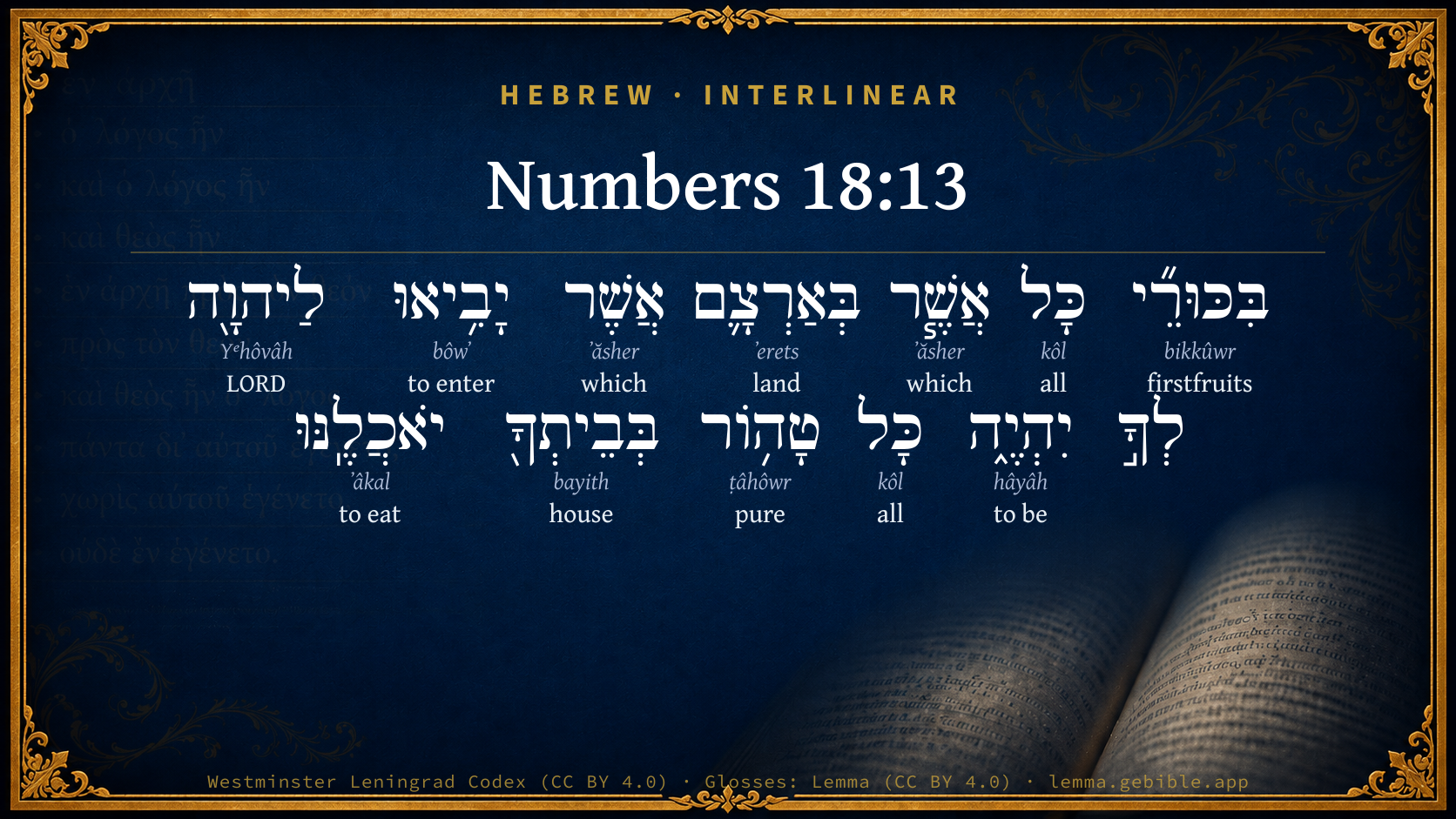
Hebrew (Westminster Leningrad Codex) Numbers 18:13 appears in the Hebrew Old Testament. The text above is from the Westminster Leningrad Codex. Each word links to its Strong’s number, a concise gloss, and parsing drawn from the Open Scriptures Hebrew Bible morphology. Click any word for its full Brown-Driver-Briggs (BDB) entry.
Download image
Cite this verse

Numbers 18:13 (World English Bible). Public Domain. Lemma interlinear Bible study tool, https://lemma.gebible.app/v/numbers/18/13.

Show BibTeX & RIS
BibTeX
RIS
English Translation
The first-ripe fruits of all that is in their land, which they bring to Yahweh, shall be yours; everyone who is clean in your house shall eat of it.
World English Bible · Public Domain
Download a study sheet

One document with this verse’s original text, its word-by-word gloss line, the meaning frame, cross-references with their text, attributed commentary, and full source and license credits — printable, and it pastes into notes with its structure intact.

This verse Autodidact and up

Study sheet (.html) Plain text (.txt)

A passage Seminary Student

Up to 50 verses in one chapter. A passage sheet keeps up to 6 commentary sources and 12 cross-references per verse, in the order this page ranks them, and says so on the sheet whenever that leaves anything out. Ask for a single verse and you get the Autodidact verse sheet above.

Everything on this page stays free to read, with no account — the sheet is a download of what is already on screen, not access to it.

Want to remove ads? Support Godless Engineer
Compare translations 3

The same verse in 3 English versions, stacked beneath the original-language interlinear above. Click any original word for its lexicon entry.

Each is an independent rendering of the whole verse — the interlinear is not word-aligned to these translations.

Highlighted words mark where these versions differ — a whole-verse word diff, not a word-by-word alignment.

  • World English Bible Public Domain
    The first-ripe fruits of all that is in their land, which they bring to Yahweh, shall be yours; everyone who is clean in your house shall eat of it.
  • King James Version Public Domain
    And whatsoever is first ripe in the land, which they shall bring unto the LORD, shall be thine; every one that is clean in thine house shall eat of it.
  • unfoldingWord Literal Text CC BY-SA 4.0
    The firstfruits of all that in their land which they bring to Yahweh shall be for you. Every clean one in your house shall eat it.

unfoldingWord Literal Text — © unfoldingWord, licensed CC BY-SA 4.0. Word-aligned USFM3 via Door43 (git.door43.org/unfoldingWord/en_ult).

Versions to compare (up to 4)

3 of 4 selected

Show all 18 translations

Every available English version of this verse, each an independent rendering of the whole verse.

  • World English Bible Public Domain
    The first-ripe fruits of all that is in their land, which they bring to Yahweh, shall be yours; everyone who is clean in your house shall eat of it.
  • Berean Standard Bible Public Domain
    The firstfruits of everything in their land that they bring to the LORD will belong to you. Every ceremonially clean person in your household may eat them.
  • Majority Standard Bible Public Domain
    The firstfruits of everything in their land that they bring to the LORD will belong to you. Every ceremonially clean person in your household may eat them.
  • King James Version Public Domain
    And whatsoever is first ripe in the land, which they shall bring unto the LORD, shall be thine; every one that is clean in thine house shall eat of it.
  • American Standard Version (1901) Public Domain
    The first-ripe fruits of all that is in their land, which they bring unto Jehovah, shall be thine; every one that is clean in thy house shall eat thereof.
  • Revised Version (1885) Public Domain
    The firstripe fruits of all that is in their land, which they bring unto the LORD, shall be thine; every one that is clean in thy house shall eat thereof.
  • Geneva Bible (1599) Public Domain
    And the first ripe of al that is in their land, which they shall bring vnto Lord, shalbe thine: all the cleane in thine house shall eate of it.
  • Douay-Rheims (1899) Public Domain
    All the firstripe of the fruits, that the ground bringeth forth, and which are brought to the Lord, shall be for thy use: he that is clean in thy house, shall eat them.
  • Young's Literal Translation Public Domain
    `The first-fruits of all that `is' in their land, which they bring in to Jehovah, are thine; every clean one in thy house doth eat it;
  • Literal Standard Version CC BY-SA 4.0
    The first-fruits of all that [is] in their land, which they bring to YHWH, are yours; every clean one in your house eats it;
  • Unlocked Literal Bible CC BY-SA 4.0
    The first ripe produce of all that is in their land, which they bring to me, will be yours. Everyone who is clean in your family may eat these things.
  • unfoldingWord Literal Text CC BY-SA 4.0
    The firstfruits of all that in their land which they bring to Yahweh shall be for you. Every clean one in your house shall eat it.
  • Darby Bible Public Domain
    The first ripe of everything that is in their land, which they shall bring to Jehovah, shall be thine; every one that is clean in thy house shall eat of it.
  • World Messianic Bible Public Domain
    The first-ripe fruits of all that is in their land, which they bring to the LORD, shall be yours. Everyone who is clean in your house shall eat of it.
  • Webster's Bible Public Domain
    And whatever is first ripe in the land, which they shall bring to the LORD, shall be thine; every one that is clean in thy house shall eat of it.
  • Free Bible Version CC BY-SA 4.0
    The firstfruits of all the crops they produce in their land that they bring to the Lord are yours. Everyone in your family who is ceremonially clean is allowed to eat them.
  • Bible in Basic English Public Domain
    The earliest produce from their land which they take to the Lord is to be yours; everyone in your house who is clean may have it for his food.
  • JPS Tanakh (1917) Public Domain
    The first-ripe fruits of all that is in their land, which they bring unto the LORD, shall be thine; every one that is clean in thy house may eat thereof.

Literal Standard Version (2020), Covenant Press — licensed CC BY-SA 4.0. Text via the HelloAO Bible API (eBible.org). Unlocked Literal Bible (unfoldingWord) — licensed CC BY-SA 4.0. Text via the HelloAO Bible API (eBible.org). unfoldingWord Literal Text — © unfoldingWord, licensed CC BY-SA 4.0. Word-aligned USFM3 via Door43 (git.door43.org/unfoldingWord/en_ult). Free Bible Version, Dr. Jonathan Gallagher — licensed CC BY-SA 4.0. Text via the HelloAO Bible API (eBible.org).

Word by word

More ways to search: Search by grammar → Find every occurrence → Compare this word →

Practice this passage: Drill this verse → Learn its vocabulary →

בִּכּוּרֵ֞י
bikkûwr
H1061
“firstfruits of”
Noun, Common, Both, Plural, Construct
Part of Speech
Noun
Type
Common
Gender
Both
Number
Plural
State
Construct
Full BDB Definition

Origin: from H1069

TWOT: 244e

first-fruits - the first of the crops and fruit that ripened, was gathered, and offered to God according to the ritual of Pentecost - the bread made of the new grain offered at Pentecost - the day of the first-fruits (Pentecost)
  1. כָּל kôl H3605 “all of” Noun, Common, Masculine, Singular, Construct
  2. אֲשֶׁ֧ר ʼăsher H834 “which” Particle, Relative
  3. בְּאַרְצָ֛ם ʼerets H776 “in/at · land · their” Preposition + Noun, Common, Both, Singular, Construct + Suffix, Personal, 3rd Person, Masculine, Plural
  4. אֲשֶׁר ʼăsher H834 “which” Particle, Relative
  5. יָבִ֥יאוּ bôwʼ H935 “to enter” Verb, Hiphil, Imperfect, 3rd Person, Masculine, Plural
  6. לַיהוָ֖ה Yᵉhôvâh H3068 “to/for · LORD” Preposition + Noun, Proper
  7. יִהְיֶ֑ה hâyâh H1961 “to be” Verb, Qal, Imperfect, 3rd Person, Masculine, Singular
  8. כָּל kôl H3605 “all of” Noun, Common, Masculine, Singular, Construct
  9. טָה֥וֹר ṭâhôwr H2889 “pure” Adjective, Adjective, Masculine, Singular, Absolute
  10. בְּבֵיתְךָ֖ bayith H1004 “in/at · house · your” Preposition + Noun, Common, Masculine, Singular, Construct + Suffix, Personal, 2nd Person, Masculine, Singular
  11. יֹאכֲלֶֽנּוּ ʼâkal H398 “to eat · him” Verb, Qal, Imperfect, 3rd Person, Masculine, Singular + Suffix, Personal, 3rd Person, Masculine, Singular

About this verse

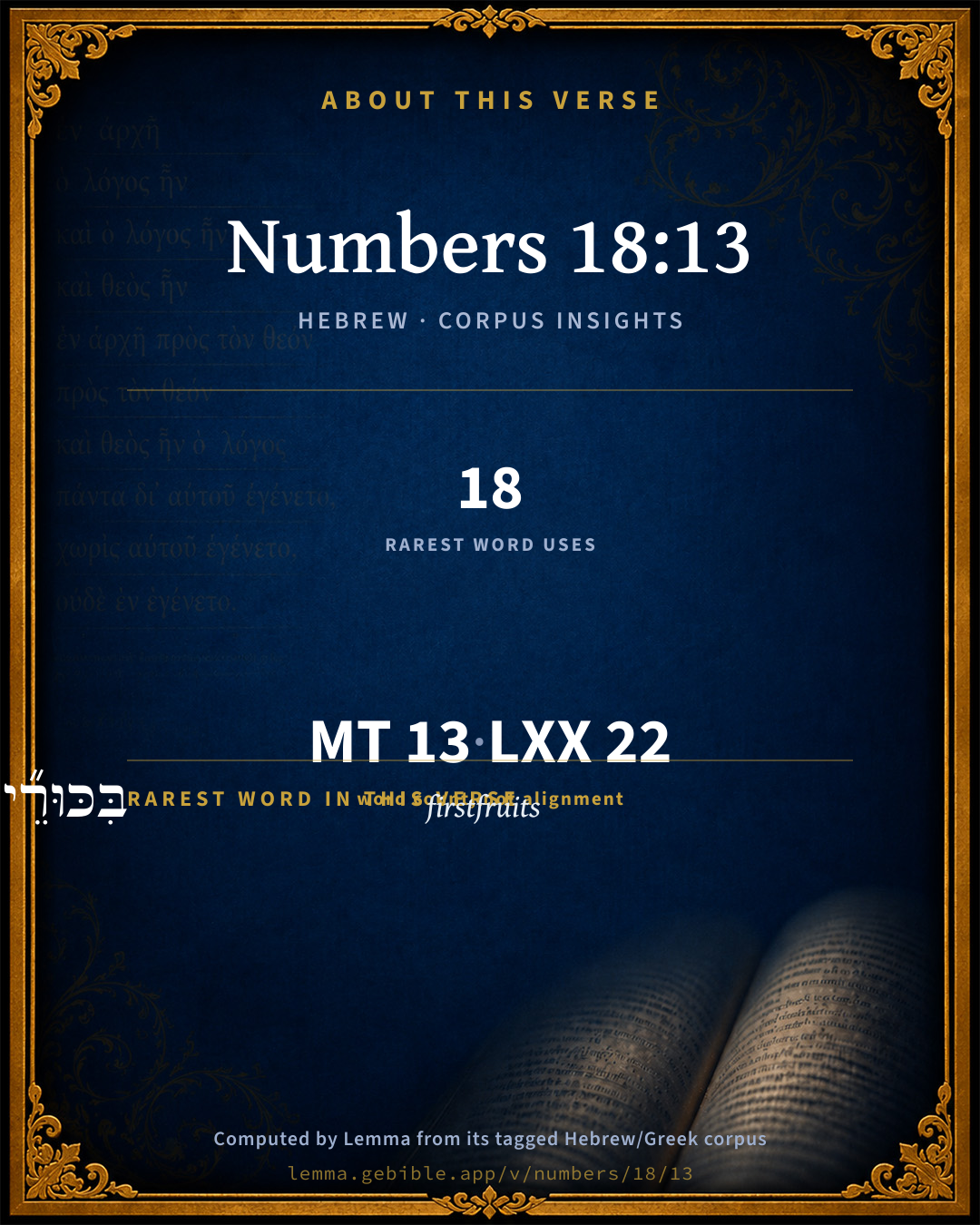
These counts appear in no published source. They are computed here, from the morphology-tagged text and Lemma’s own curated glosses. What Lemma adds →

13
words
10
distinct lemmas
Pentateuch
section

Notable vocabulary

The rarest word here is בִּכּוּרֵ֞י firstfruits H1061 — appearing just 18 times in the whole Hebrew Bible.

Shared distinctive vocabulary

בִּכּוּרֵ֞י firstfruits H1061 occurs in 16 verses of the Hebrew Bible. Also found in:

Grammatical profile

  • 3 verbs
  • 6 nouns
  • 1 adjective
  • 1 preposition
  • 2 particles

Verb forms

  • יָבִ֥יאוּ Hiphil · Imperfect
  • יִהְיֶ֑ה Qal · Imperfect
  • יֹאכֲלֶֽנּוּ Qal · Imperfect

Repetition

Words recur within this verse — often emphatic in Hebrew:

  • כָּל all H3605 ×2
  • אֲשֶׁ֧ר which H834 ×2

Hebrew & Septuagint length

In English translation the verse runs 29 words from the Hebrew and 28 from the Septuagint (LXX English) — closely comparable.

A rough comparison of the two English renderings, which tokenize alike — not a word-level alignment.

Word counts can differ between the Hebrew and the Greek without any difference in meaning — e.g. the Hebrew direct-object marker אֵת has no separate Greek word, and Greek often adds the article ὁ.

In the original languages it is 13 Hebrew tokens and 22 Greek tokens — but the two are counted differently (Hebrew bundles its prefixes and suffixes into one token; the Greek is in lemma form), so that isn’t a like-for-like length.

Cross-references

5

Topical passages linked to Numbers 18:13 in the Treasury of Scripture Knowledge — connected by theme and wording, ordered by reader-vote popularity; previews shown in the World English Bible.

  • Exodus 22:29 "You shall not delay to offer from your harvest and from the outflow of your presses. "You shall give the firstborn of your sons to me.
  • Exodus 23:19 The first of the first fruits of your ground you shall bring into the house of Yahweh your God. "You shall not boil a kid in its mother's milk.
  • Jeremiah 24:2 One basket had very good figs, like the figs that are first-ripe; and the other basket had very bad figs, which could not be eaten, they were so bad.
  • Hosea 9:10 I found Israel like grapes in the wilderness. I saw your fathers as the first ripe in the fig tree at its first season; But they came to Baal Peor, and consecrated themselves to the shameful thing, And became abominable like that which they loved.
  • Micah 7:1 Misery is mine! Indeed, I am like one who gathers the summer fruits, as gleanings of the vinyard: There is no cluster of grapes to eat. My soul desires to eat the early fig.

Cross-references courtesy of OpenBible.info (CC BY 4.0).

Hebrew and Greek witnesses Masoretic Hebrew ↔ Greek Septuagint

The same verse in the two great witnesses to the Old Testament, shown verse-for-verse.

These are two independent witnesses, not word-aligned to each other, and the Septuagint is shown in lemma (dictionary) form.

Hebrew Numbers 18:13 Masoretic · Westminster Leningrad Codex

בִּכּוּרֵ֞י כָּל אֲשֶׁ֧ר בְּאַרְצָ֛ם אֲשֶׁר יָבִ֥יאוּ לַיהוָ֖ה לְךָ֣ יִהְיֶ֑ה כָּל טָה֥וֹר בְּבֵיתְךָ֖ יֹאכֲלֶֽנּוּ

The first-ripe fruits of all that is in their land, which they bring to Yahweh, shall be yours; everyone who is clean in your house shall eat of it.

World English Bible · Public Domain

Greek LXX Numbers 18:13 Septuagint · lemma form

ὁ πρωτογένημα πᾶς ὅσος ἐν ὁ γῆ αὐτός ὅσος ἄν φέρω κύριος σύ εἰμί πᾶς καθαρός ἐν ὁ οἶκος σύ ἐσθίω αὐτός

All the first fruits that are in their land, whatever they shall offer to the Lord, shall be yours: every clean person in your house shall eat them.

LXX2012 (modern English Septuagint) · Public Domain

Hebrew: Westminster Leningrad Codex (CC BY 4.0). Greek: Septuagint (public domain); English from LXX2012 (modern English Septuagint) (Public Domain). How the Septuagint differs from the Hebrew →

Targum (Aramaic paraphrase)

2

The Targum is the ancient Jewish Aramaic paraphrase of the Hebrew Scriptures — an interpretive translation, not the Hebrew text itself. Onkelos (literal) and Pseudo-Jonathan (expansive) render the Torah, and Jonathan the Prophets. Coverage is partial: where no permissively-licensed English translation exists for a verse, only the Aramaic is shown. This is verse-level text, not a word-by-word alignment to the Hebrew.

  1. Targum Onkelos Torah (Genesis–Deuteronomy)
    בִּכּוּרֵי כָּל דִי בְאַרְעֲהוֹן דִי יַיְתוּן קֳדָם יְיָ דִילָךְ יְהֵי כָּל דִדְכֵי בְּבֵיתָךְ יֵיכְלִנֵיהּ

    (no public-domain English translation for this verse)

    Targum Onkelos — Aramaic: “Onkelos Genesis” (public domain); “Onkelos Exodus” (public domain); “Onkelos Leviticus” (public domain); “Onkelos Numbers” (public domain); “Onkelos Deuteronomy” (public domain). English: “Sefaria Community Translation” (CC0 1.0 (public-domain dedication)); “J.W. Etheridge. The Targums of Onkelos and Jonathan Ben Uzziel on the Pentateuch. London: Longmans, Green, 1862” (public domain). Text via Sefaria.

  2. Targum Pseudo-Jonathan Torah (Genesis–Deuteronomy)
    בִּכּוּרֵי דְכָל פֵּירֵי אִילָנֵי אַרְעֲהוֹן דְיִקְרְבוּן קֳדָם יְיָ דִילָךְ יְהֵי כָּל דִדְכֵי בְּבֵיתָךְ יֵיכְלוּנֵיהּ

    The firsts of all the trees of their ground which they present before the Lord shall be thine; every one who is clean in thy house may eat them.

    Targum Pseudo-Jonathan — Aramaic: “Targum Jonathan on Genesis” (public domain); “Targum Jonathan on Exodus” (public domain); “Targum Jonathan on Leviticus” (public domain); “Targum Jonathan on Numbers” (public domain); “Targum Jonathan on Deuteronomy” (public domain). English: “The Targum of Jonathan ben Uzziel, trans. J. W. Etheridge, London, 1862” (public domain). Text via Sefaria.

Commentary

Notes on Numbers 18:13 from classic Christian and Jewish commentators (each source and its license shown beneath its notes). The classic Christian expositions comment on the surrounding passage and are grouped to its opening verse, so a note may address several verses; the Jewish commentaries on the Tanakh (Rashi and others) are per-verse, so they appear only where the commentator wrote on this verse.

Lemma curates 59 commentaries, every one of them public domain or Creative Commons licensed, each selected and text-cleaned for this edition rather than reprinted as found. About our sources →

Trapp's Complete Commentary

John Trapp

Num 18:13 [And] whatsoever is first ripe in the land, which they shall bring unto the LORD, shall be thine; every one that is clean in thine house shall eat [of] it.

Ver. 13. And whatsoever is first ripe.] See what an honourable maintenance, and liberal entertainment God himself assigneth to the Levitical priesthood. And shall the ministers of the gospel be held to hard allowance? {Gal 6:6 1Co 9:7; 1Co 9:9} Ad tenuitatem beneficiorum necessario sequitur ignorantia sacerdotum. {a}

{a} Panormit.

John Trapp, A Commentary or Exposition upon All the Books of the Old and New Testament (1647–1656) — public domain. Text from a community e-Sword module.

Joseph Benson's Commentary

Num 18:13. Whatsoever is first ripe — Not only the first-fruits of the oil, and wine, and wheat, now mentioned, but all other first-fruits of all other grains, and all fruit-trees. Every one that is clean — And none else, because these fruits were first offered to God, and by consequence given to the priests; but for those which were immediately given to the priests, the clean and unclean might eat of them.

Joseph Benson's Commentary on the Old and New Testaments (1811–1818) — public domain. Text from a community e-Sword module.

The Cambridge Bible for Schools and Colleges

gen. ed. J. J. S. Perowne

13. The firstripe fruits … which they bring unto Jehovah] The latter clause shews that only a part of the firstfruits was offered; but the proportions, as in the case of the rêshîth, are not stated. For a full discussion of the subject reference may be made to Gray, Numbers, pp. 224–9.

The Cambridge Bible for Schools and Colleges (gen. ed. J. J. S. Perowne; Cambridge University Press, 1878–1918) — public domain. Text from a community e-Sword module.

John Gill's Exposition

And whatsoever is first ripe in the land,.... Of any other sort of fruit, figs, pomegranates, apples, plums, pears, &c. besides olives and vines:

which they shall bring unto the Lord, shall be thine; which they shall bring in a basket to the tabernacle, where it was, or to the temple, when built: this the priests were to have, see Deu 26:2,

everyone that is clean in thine house shall eat of it; See Gill on Num 18:11.

John Gill's Exposition of the Whole Bible (1746–1763) — public domain (CC PDM 1.0). Text via the HelloAO Bible API.

Haydock's Catholic Bible Commentary

CHAPTER XVIII.

First-ripe, (initia.) "The beginnings" (Haydock) of the fruit of trees, in the fourth year, Leviticus xix. 24. It may also comprise all the fruits of the earth. (Calmet) --- First-fruits must be distinguished from tithes, which were only the tenth part. The former were offered immediately to the Lord, but the latter to the priests, &c., for their support. Besides the first-fruits of ears of corn at the Passover, and of bread at Pentecost, and at every weekly baking, first-fruits were to be given in the 7th month of the harvest and of the vintage, according to each person’s generosity, provided he gave between the 40th and the 60th part of his revenue; and these last are commonly the first-fruits meant in Scripture. --- Lord, in sacrifice. If they were given to the priest, the unclean might partake of them. (Menochius)

George Leo Haydock (1774–1849), Haydock's Catholic Family Bible and Commentary, 1859 edition — public domain. Excludes Psalms (Douay-Rheims chapter numbering differs from Protestant) and Deuterocanonical books (Catholic canon only).

Matthew Poole's English Annotations

i.e. Not only the first-fruits of the oil, and wine, and wheat now mentioned, but all other first-fruits of all other grains, and all fruit-trees, &c.

Every one that is clean; and none else, because these were first offered to God, and by consequent given to the priests; but for those which were directly and immediately given to the priests, the clean and unclean might eat of them.

Matthew Poole's English Annotations on the Holy Bible (1683–1685) — public domain. Text from a community e-Sword/MySword module.

John Wesley's Explanatory Notes

Whatsoever is first ripe - Not only the first-fruits of the oil and wine, and wheat now mentioned, but all other first-fruits of all other grains, and all fruit trees. Clean - And none else, because these were first offered to God, and by consequence given to priests; but for those which were immediately given to the priests, the clean and unclean might eat of them.

John Wesley, Explanatory Notes Upon the Whole Bible (1754–1765) — public domain. Text via the GEBible commentary corpus.

Lesson kit

Teaching starters — assembled from the data on this page, not authored interpretation. Every prompt links to the verse data it draws on. Edit before teaching.

Numbers, in the Pentateuch, opens this verse with 13 words (10 distinct Hebrew lemmas). Its most distinctive word is bikkûwr (“firstfruits”). A historical commentator’s framing appears above. Read the whole chapter for the surrounding context.

Discussion questions

  1. The word bikkûwr carries the sense “firstfruits.” How does it shape the verse?
  2. How does Exodus 23:16, which shares the word «firstfruits», read alongside this verse?
  3. What does the repetition of “all” (2× in this one verse) do in this verse?
  4. These translations render this verse differently. What is at stake in choosing one wording over another?
  5. «יָבִ֥יאוּ» is a Hiphil Imperfect verb. How does that grammatical form shape the action described?
  6. Compare how Trapp's Complete Commentary and Joseph Benson's Commentary read this verse. Where do they agree or differ?

Things to notice

Reading settings

Reading text

Shown beneath each verse's original-language words.

Old Testament
Old Testament edition

Read the OT as the Masoretic Hebrew (MT) or the Greek Septuagint (LXX).

English shown for the Greek Septuagint (in the Hebrew ↔ Greek comparison).

Comparing translations? Open the Compare panel on any verse page to stack up to four side by side.